
While Washington applies the law to the Brazilian meat giant, Brasília absolves it with nearly four billion dollars in pen strokes. The Batista case is not a scandal. It is the most faithful allegory of the country Brazil has always quietly been.
G.K. Chesterton once observed that the poor have sometimes objected to being governed badly, whereas the rich have always objected to being governed at all. The current saga of Brazil's Batista clan and their planetary slaughterhouse furnishes the most baroque illustration imaginable of that ancient asymmetry, transformed into the perfect allegory of what Brazil has, in five centuries of stubborn effort, refused to become, namely a Republic.
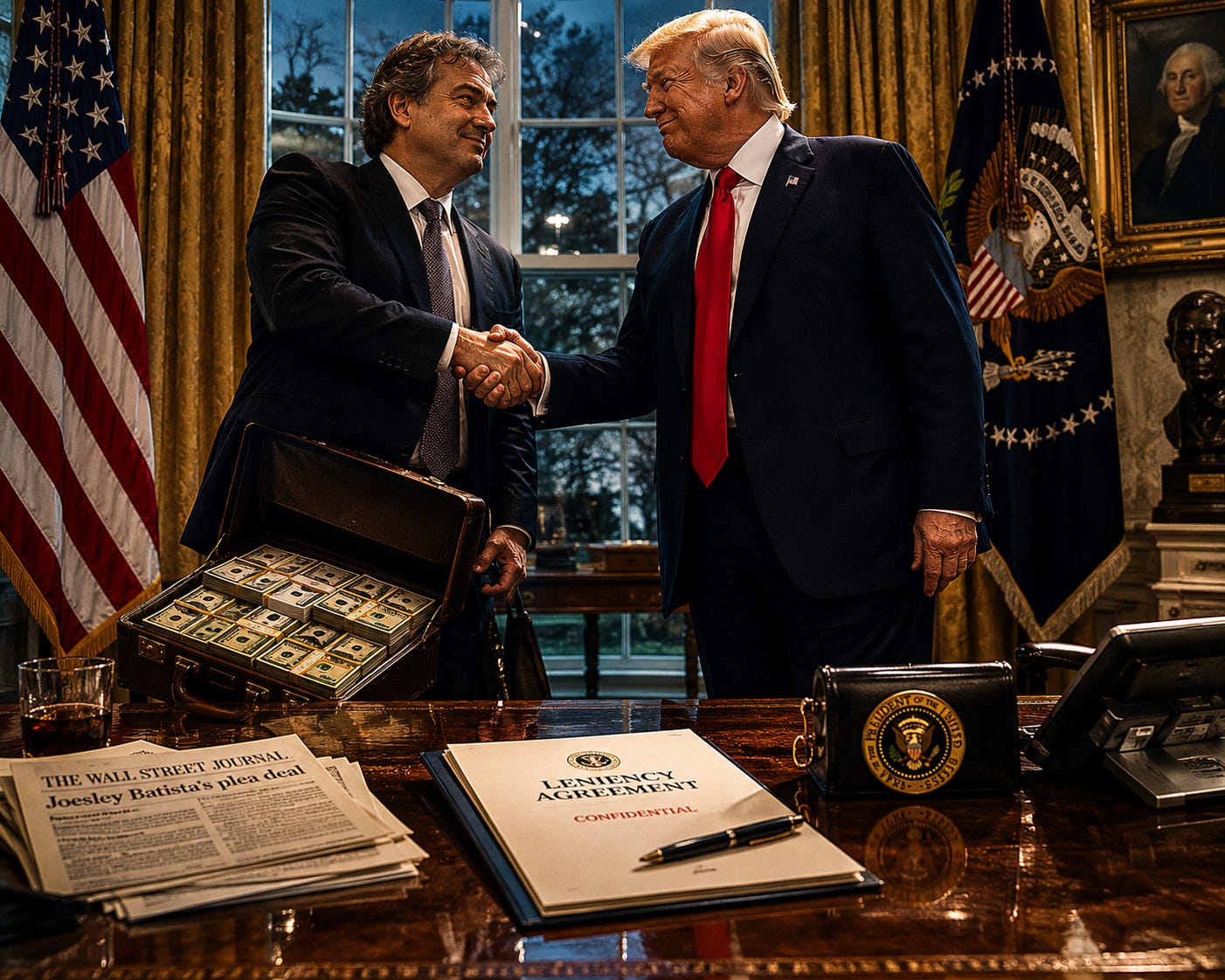
The opening scene requires no surrealism. On one side, in Brasília, the president of the Republic raises his glass with the Batista brothers while a two-billion-dollar fine against their holding company J&F dissolves quietly in the late-night pen strokes of a Supreme Court justice named Dias Toffoli. On the other side, in Washington, the same JBS, run by the same brothers in the same impeccably Italian suits, quietly writes a check for 83.5 million dollars to settle antitrust claims brought by small American ranchers. Note, dear reader, that the company is the same, the Batistas are the same, and only one thing meaningfully changes between the two hemispheres, which is the elementary notion of what Aristotle, in the Politics, would call the institutionalized common good. In the United States that notion still operates, however slowly. Among Brazilians it was long ago subleased, on favorable terms, to a single family from Goiás.
Here lies the first lesson, the one America's republican tradition inherited from its founders and the one Brazil has never wished to learn. Madison, Hamilton, and Jefferson, diligent readers of Montesquieu and intellectual grandchildren of the Stagirite, started from the Hobbesian premise that man is his own predator, and built, accordingly, a system of checks and balances whose only serious function consists of denying concentrations of power. The Sherman Act of 1890 is a direct consequence of that cosmology. Brazilians, by contrast, faithful to a tropical antropofagia of their own, imported the name Republic and exported its substance. They traded checks and balances for the embrace, the law for the arrangement, and the market for what is euphemistically called National Champions, state-backed conglomerates funded by the country's development bank, the BNDES, and shielded, when necessary, by the Supreme Court.
Understand, my friend, that JBS did not grow despite the Brazilian state, but precisely by means of it. The National Champions policy, conceived under the Workers' Party governments and irrigated with cheap public credit, declared its ambition openly, namely the manufacture of Brazilian monopolies capable of projecting soft power across the planet. What was actually produced, however, was something older and rather less exportable, broadly speaking an updated version of what the sociologist Raymundo Faoro called patrimonialism, technical shorthand for the indistinction between public and private, for the Crown handed out as dowry to the parentage, and for the king's affairs confused, without ceremony, with the affairs of the kingdom. The only modern adjustment is that the Crown now wears a tailored suit and the kingdom is listed on the stock exchange.
The cunning of this model, moreover, reveals itself at a global scale. For years, JBS exploited a quaint loophole in American food labeling to sell Brazilian beef under the Product of USA seal. The animal was born, raised, and slaughtered somewhere deep in Pará, traveled refrigerated to American soil, and was there ritually rebaptized as a domestic citizen through the merely liturgical act of repackaging. The triangulation was magnificent, namely Brazil costs in production and America prices at the supermarket, with the consumer in Iowa swallowing, in his Sunday hamburger, Amazon deforestation dressed up as economic patriotism. The USDA, it is worth recalling, finally closed that back door in March 2024. In Brasília we would never have dared close it.
The shuttle, however, does not end at the supermarket shelf. It descends much further, to the point where the legal economy and the cartel economy kiss on the mouth. What sociologists discreetly call the Mexicanization of the countryside expresses itself in the pastures of Pará as a perfect symbiosis between cattle and cocaine. The technical name for this financial operation is narco-ranching, although alchemy would be the more honest designation. The trafficker buys animals with cash, fattens the herd on stolen or grilagem-titled land, and resells the cattle to the slaughterhouse in exchange for an immaculate check of impeccable documentary origin. Beef, unlike cocaine, circulates without reservations, and JBS, ever cautious, points out that at the moment of purchase the farm was in formal compliance, a juridical formula that operates in practice as the institutionalized synonym of willful blindness.
Above this machinery, financing it, hovers the chorus of Wall Street, draped in the ecumenical cassock of ESG. Larry Fink, the high priest of BlackRock, publishes annual letters on purpose, sustainability, and climate justice, while his firm holds a position worth roughly 334 million dollars in the planet's largest meatpacker, the very firm whose name appears on the Amazon deforestation registers and on reports of indigenous land invasions. Barclays, with comparably well-tailored cynicism, has cleared around 1.7 billion dollars on JBS-related business. We are watching a phenomenon that Ortega y Gasset, were he still living, would surely classify as the new decorum of the financial mass-man, that is, hypocrisy securitized into a structured product, with the management fee included. Greenwashing, in sum, is the papal indulgence of our time, sold today in quarterly installments.

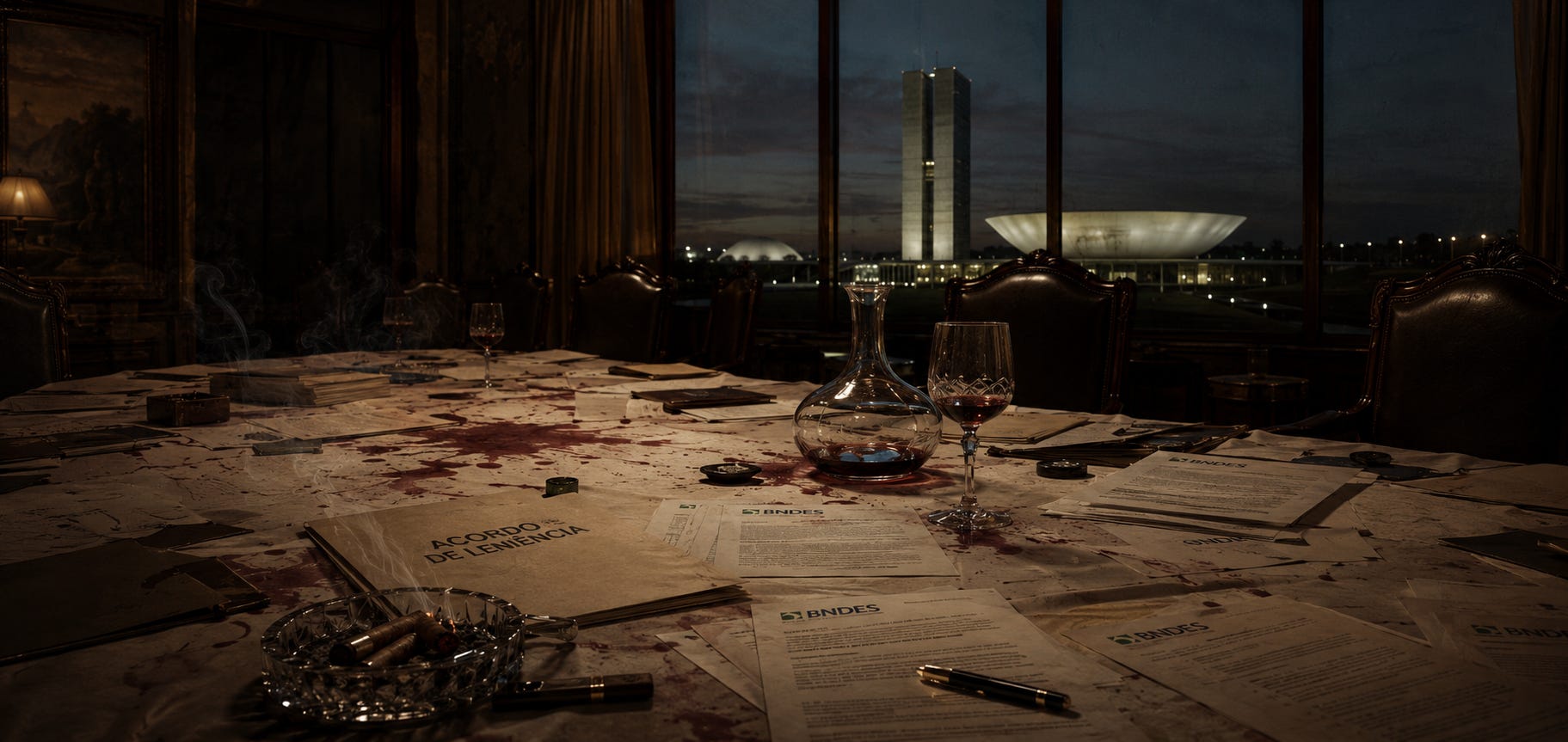
All of this, nevertheless, would remain merely picturesque if it did not flow into the terminal episode, the one in which the Brazilian system confesses, without blushing, to being exactly what it appears to be. I refer to the late-night, floridly-worded ruling by which Justice Toffoli suspended the entire 10.3 billion reais fine that J&F had agreed to pay under its leniency settlement, a ruling soon extended to the former Odebrecht (rebranded as Novonor) for another 8.5 billion reais. Nearly twenty billion reais of institutional unpaid debt, dear reader, forgiven on the pious theory that the executives had been psychologically tortured during Operation Car Wash. The confession, previously documented on video, in public acts, and in voluntary returns of physical cash, suddenly became tainted evidence. The defendant became the victim, the cooperator became the persecuted, and the investigators, in a baroque institutional gesture that Machado de Assis would have registered with his most sardonic dead narrator, were handed over as a complimentary gift to the very persons they had once investigated.
Here it is, in laboratory-grade purity, the regime under which Brazilians actually live. To the salaried citizen who files his tax return a week late, the Brazilian revenue service operates with the chill of the Hobbesian Leviathan. For the Batistas, the state operates as a devoted concierge. Brazilian law, to paraphrase the old juridical proverb, behaves like a spider's web, that is, it catches the small fly and tears itself open before the larger beetle. This regime, baptized by the ancients with the technical name of kakistocracy (the rule of the worst, a concept Aristotle sketched and Ortega refined), receives among embarrassed economists the more cordial designation of crony capitalism, although its truest name, the one no one quite dares pronounce, is feudalism with Wi-Fi.
The Brazilian, a creature of resignation that borders on piety, continues to believe he lives in a Republic. He has been trained for that belief. He follows the news as one follows a soap opera with a rotating cast, growing indignant episode by episode and forgetting chapter by chapter. The indignation lasts twenty-four hours, whereas patrimonialism lasts five centuries. There is something almost touching in this collective amnesia, something Tocqueville, surveying us today, would recognize at once as the perfect inverse of the democratic temperament he admired in America. Brazil, on this score, is modernity in its purest form, namely a country that proudly calls itself a Republic and forgets, every six months, that someone in robes just suspended four billion dollars in confessed bribery fines.
There remains the final photograph. While JBS, abroad, pays in dollars for the offense of manipulating a market, at home it receives, in reais, forgiven fines, official silences, and the toast of the Planalto Palace. Where American ranchers organize themselves into class actions to extract belated reparations, the small Brazilian rancher discovers, without particular surprise, that the land inherited from his great-grandfather is worth less than a hired gunman's bullet, while quilombola leaders such as Zé do Leite in Pará realize, with melancholy delay, that the state had closed its eyes well before they ever opened their mouths. In the United States, the rule of law operates with the majestic slowness of an institution. In Brazil, it operates as a private buffet.
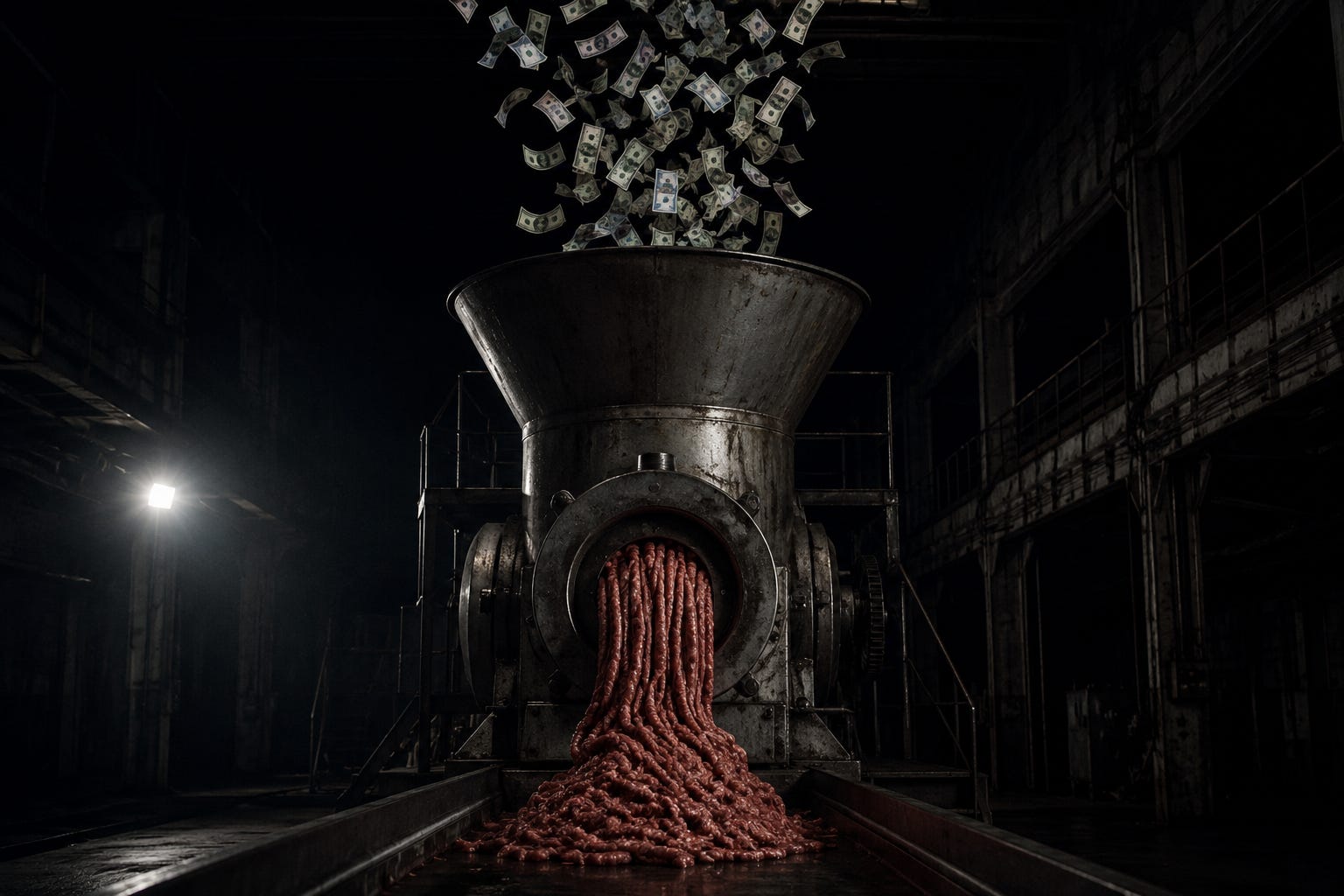
In sum, the JBS case is not a scandal, since scandal presupposes rupture from the norm, and what has been shown to the public is precisely the norm running at peak efficiency. The system, far from having failed, hit its mark perfectly within its own operating rules, rules that were never the ones taught in school under the edifying name of Republic. The meat grinder, therefore, keeps turning, fed on dollars, on reais, on rewritten confessions, and on the bottomless patience of a people who, on top of everything, are picking up the dinner check. They are also, while I think of it, paying for dessert. Were cynicism not already a civilizational trait among us, some visiting foreigner might still ask, perplexed, at what precise moment Brazil decided to trade the Republic for a steakhouse.
Comments
Nothing yet. Say the first thing.
Sign in to join the conversation.