
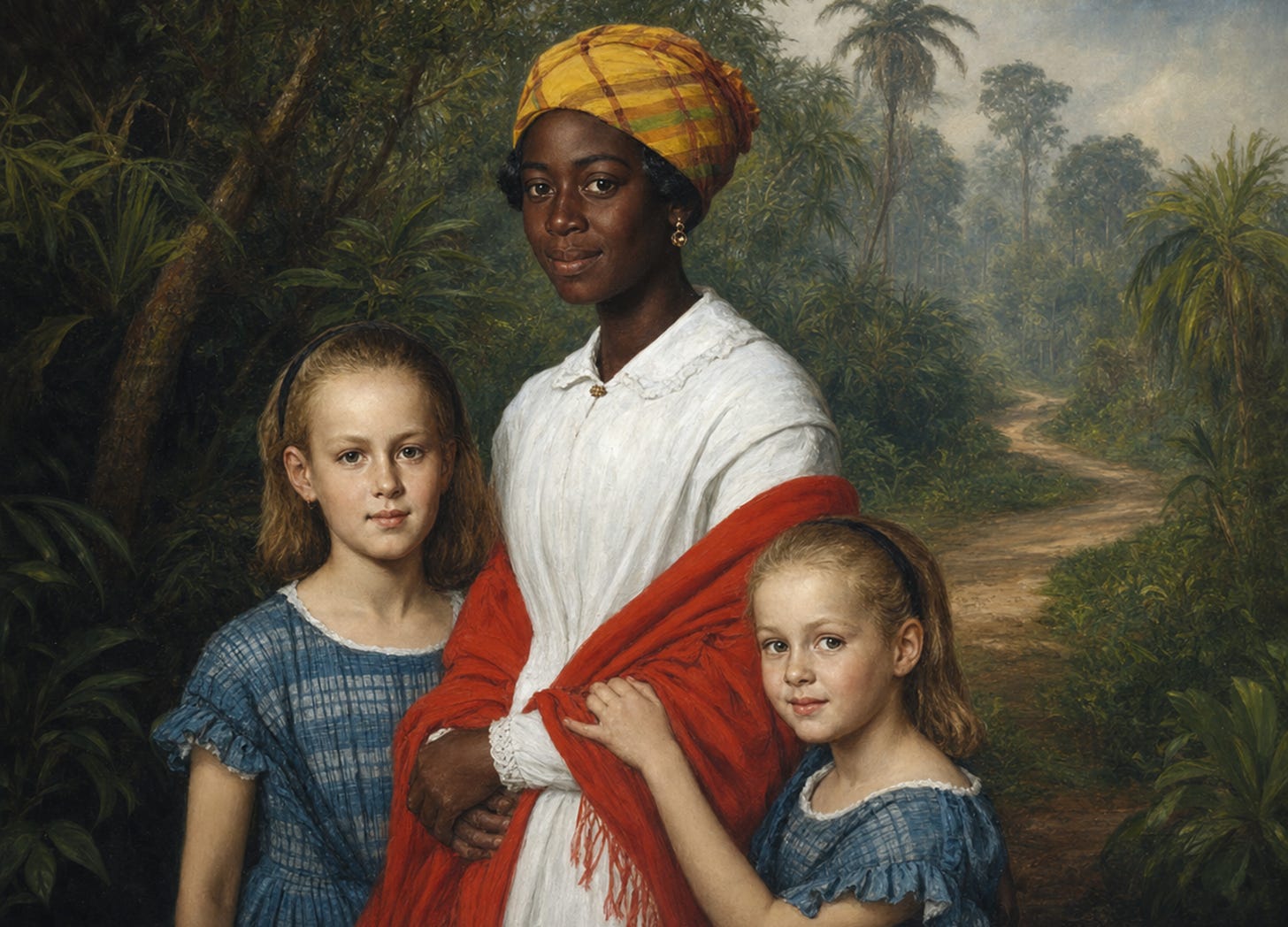
Wuh you lookin' at, gyal? De trees dem won' walk away. Come nuh, before de mosquitoes find us an' we never hear de end of it. Hol' me hand, chile. De jungle patient, but I ain't.
That’s Bajan. Barbadian Creole English. The voice of a woman who left Bridgetown sometime around 1910 with a one-way ticket on a steamship, a few belongings, and a language that had been her family’s for generations. She arrived in Colón, found work in an American household, and became something no history book quite captured; the woman who raised the children. Who walked them down jungle paths. Who fed them, scolded them, sang to them, and told them stories in the only voice she had ever known.
She didn’t know it yet, but the language she carried, the one her mother taught her, the one she used to comfort and correct and call the children in for supper — was about to plant itself in a new place and pass along to a new group.
De likkle pickney dem was listenin’. Dem always listenin’.
The children were always listening.
Before we go further, let’s settle something. Because the word creole gets misused, misunderstood, and sometimes dismissed. And it deserves better than that.
A creole begins as a pidgin, a simplified contact language that develops when people speaking different tongues need to communicate across a language barrier. Pidgins are practical. They are nobody’s first language. They exist to get the job done.
But when children grow up hearing a pidgin spoken around them and begin to speak it natively — when it becomes the language of the home, the playground, the neighborhood — something remarkable happens. The children do what children always do: they expand it. They fill in the grammar. They deepen the vocabulary. They give it rhythm and humor and the particular music of a living tongue. What was a pidgin becomes, in their mouths, a creole. And once that happens, it is no longer simplified. It is no longer a workaround. It is a language.
An’ every pickney know — home don’ sound like nowhere else.
Creoles have their own grammar, their own rhythm, their own logic. They follow rules, just not always the rules of the dominant language they resemble on the surface. Linguists continue to debate the finer points of how creoles form and how to classify them. It is, as they say, a heated field. But on one point there is broad agreement: a creole spoken natively by a community of children is a living language system with its own grammar, its own structure, its own internal logic. Not a broken version of something more correct. Not a dialect of whatever it resembles on the surface. Something that carries; in its words, its rhythms, its humor — the full weight of the lives of the people who speak it.
The Caribbean became one of the richest creole-producing regions on earth. When European colonial powers brought millions of enslaved Africans to the islands, those Africans arrived speaking hundreds of different languages: Twi, Fon, Wolof, Igbo, Kikongo, and many more. To communicate with each other, with their captors, and with the world they had been forced into, they developed first pidgins, and then, as children grew up speaking those pidgins natively; creoles. Languages that carried not just words but worldview, humor, wisdom, and identity.
In the English-speaking Caribbean, the result was a family of English-based creoles, each shaped by its island’s specific history, its particular mix of African languages, its colonial peculiarities. And each one, while recognizably related to the others, was distinctly its own.
Duh is more in de mortar dan de pestle. There is more to this story than appears on the surface.
When the United States began building the Panama Canal in 1904, they needed labor. Enormous quantities of it. The solution, as it had been for decades across the Caribbean, was the West Indies.
Workers came from across the islands. From Barbados — in the largest numbers by far. Between 1904 and 1916, over 45,000 Barbadians made the crossing to Panama, roughly one quarter of the island’s entire population. They arrived speaking Bajan, a creole with traces of Scottish and Irish English woven into its West African foundation, a fact that makes Bajan somewhat closer to standard English than most other Caribbean creoles, which is perhaps why Barbadians have sometimes described their speech with quiet pride as the King’s English.
From Jamaica came workers speaking Patois | Patwa, a creole with deeper West African grammatical roots than Bajan, richer in its verb structures, distinctive in its rhythm. Jamaicans had a long history with Panama dating back to the French construction era of the 1880s. They knew the isthmus. Many came back.
From Grenada, Trinidad, St. Lucia, Antigua, Montserrat, the Bahamas, and beyond, each island sending workers who carried their own creole variety, their own particular sound. Trinidad, which had passed between Spanish, French, and British colonial control, brought a creole layered with French, Spanish, Indian, and African elements alongside English. Grenada had its own voice. St. Lucia its own.
One canal. One narrow strip of land. But de voices dem — dem come from everywhere, mon.
This matters because what arrived in the Canal Zone was not one West Indian language. It was many. A chorus of creoles, each related, each distinct, all arriving in the same narrow strip of land at roughly the same moment in history.
This matters because what arrived in the Canal Zone was not one West Indian language. It was many. A chorus of creoles, each related, each distinct, all arriving at the same narrow strip of land at roughly the same moment in history. They settled into their communities within the Zone: Paraíso, Silver City, Rainbow City, and others and they built their lives there. They maintained their languages, passed them to their children, and kept the sounds of their islands alive.
But something else was about to happen. Something that nobody planned.
Wuh you tink, mon? Pickney don’ wait for permission to learn.
Children never do.
From the earliest years of the Canal Zone’s existence, American families employed West Indian workers in their homes. Women came as nannies, housekeepers, and nursemaids. Men came as gardeners, laborers, handymen. They crossed the boundary between the two worlds of the Canal Zone every single day, entering American homes, and in many of those homes, they did something far more significant than clean or cook or tend a garden.
They raised children.
A nanny is present from the first weeks of life. She speaks constantly — during baths, at mealtimes, on walks, during illness, at bedtime. Her language is not a lesson. It is simply the sound of her presence, of her care, of her love. And children in those earliest years of language acquisition absorb everything. They do not choose between languages. They take it all in.
How early did this happen? Earlier than most people realize.
One Zonian’s grandmother was born in Colón in 1909. Only five years after the Canal Zone was established and spoke what her family recognized as the dialect fluently. She pronounced Colón the way every Zonian came to pronounce it: Co Lawn. Not the Spanish. Not standard English. Something that began to belonged to the Zone.
Five years. De language didn’ waste no time.
By the time those first American Zonian children were old enough to play with other children, children whose own nannies had come from different islands, different creoles, different sounds. The blending had already begun. A child raised by a Barbadian housekeeper brought Bajan onto the playground. A child whose gardener was Jamaican brought Patois. They played together. They talked. They created, without knowing it, something new.
American English in their schoolrooms, speaking with their parents, the common speak in the Canal Zone and the thread through everything. But in the kitchen, in the garden, in the daily intimacy of household life, they heard Bajan. Patois. Whichever creole the woman or man who cared for them had carried from their island.
When those children came together; on playgrounds, in streets, in the yards and clubhouses of the Zone, they brought different creole voices with them. A child raised by a Barbadian housekeeper. Another whose gardener was Jamaican. Another whose nanny had come from Grenada. They played together. They talked. And somewhere in all that talking, the sounds began to find each other.
Spanish of Panama drifting in from just beyond the Zone’s borders — the chivas rattling down the road, the market vendors, the Panamanian neighbors and workers moving through daily life and you had something the world had not quite seen before.
Chuleta. Caramba. Ay yai yai.
Some of these will be old friends. Some might surprise you.
Wappin / Woppin — A greeting. An exclamation. Wuh happenin’ compressed into something faster, warmer, more Zonian. You didn’t say “hello.” You said wappin.
Mon — You know this one. From the islands, yes. But in the Zone it became something slightly different — lighter, more casual, used by people who were not Jamaican and not Barbadian but were absolutely, unmistakably Zonian.
Ras / Rass — Here’s where it gets interesting. In Bajan, ras is a profanity. Older Zonians from the 1960s and earlier knew exactly what it meant and used it accordingly. But somewhere along the way — by the 1980s, among younger Zonians — ras had softened into something closer to dude. Same word. Different generation. Different meaning. That shift is Zonialese doing what all living languages do: becoming more itself.
De chuleta! — Panama Spanish, absorbed completely. Not a borrowing. Not a foreign phrase. Just... part of how you talked.
Don vex me, mon — Don’t. Anger. Me. Three words from the islands, one word from everywhere, delivered in a tone that left no room for doubt.
Don be rasen me, I cuff you upside da face — This one has everything. Creole grammar. Zonian vocabulary. A very specific threat. Delivered, apparently, with rhythm.
Wappin? You batti floppin! — Pure Canal Zone. A rhyming greeting that made absolutely no sense and complete sense at the same time. If you know, you know.
Co Lawn — Not a phrase. A pronunciation. But possibly the most Zonian thing on this list.
Nuff talk from we side, nuh? We been runnin’ we mout long enough. De question now is simple:
Wuh YOU used to say?
Maybe it was something your housekeeper said every morning when she opened the door. Maybe it was what your gardener called you when you were getting in the way. Maybe it was the phrase your whole street used and you never once stopped to think about where it came from. It was just how you talked.
Maybe you still say it. Maybe it slips out at dinner and your kids look at you like you’ve lost your mind. De chuleta, wuh wrong wid dem.
Maybe you had a word for something that had no word in English. Maybe your phrase was different from the ones up above — because the Atlantic side didn’t always sound like the Pacific side, and Gamboa didn’t always sound like Balboa, and the 1950s didn’t always sound like the 1980s.
Dat’s de beauty of it, loco. Every Zonian carry a likkle different piece.
Razz mon, wuh ya piece?
Drop it below. A word. A phrase. A full sentence if you got one. Tell us who said it. Tell us what it meant. Tell us if you still use it or if you haven’t said it since the day you left and reading this is the first time it’s come back to you.
De door open. Come nuh, Laupe!
CZD is actively documenting the language, culture, and history of the Panama Canal Zone. This article is part of an ongoing research and preservation project. All contributions shared in the comments may be used in future CZD research and publications, with contributor credit.
archive@canalzonedocumentary.com | canalzonedocumentary.substack.com
No posts
Comments
Nothing yet. Say the first thing.
Sign in to join the conversation.