
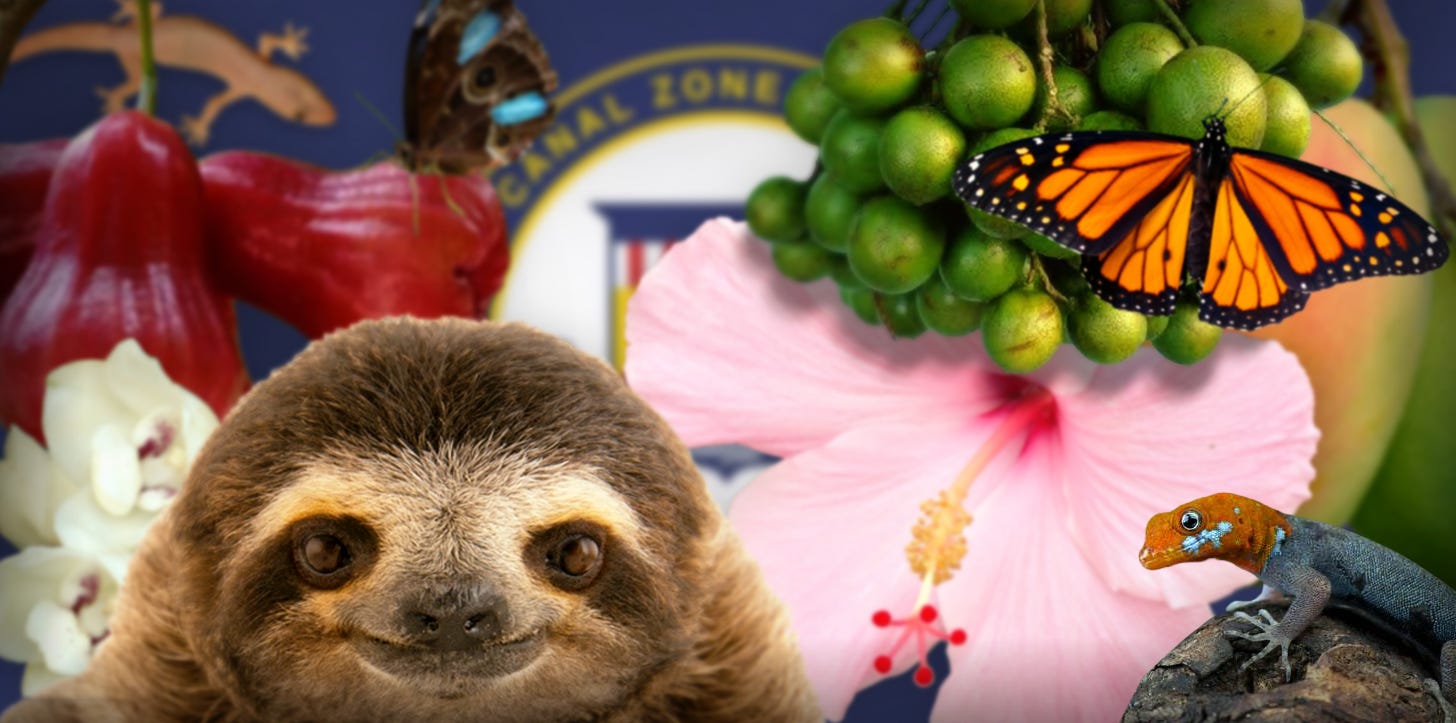
Every country has them. Panama has the Holy Ghost Orchid as its national flower—that ethereal white bloom that looks like a dove in flight. The U.S. has the bald eagle, the rose, the dogwood. Even small territories and islands list their official emblems somewhere: a distinctive bird, a native tree, the fruit that defined their landscape.
Mon — de Canal Zone ever pick sometin' for deyself, or dey just let it slide?
This Substack is reader-supported. To receive new posts and support my work, consider becoming a free or paid subscriber.
The Canal Zone had a seal (a ship passing through blue water), a flag, a motto ('“The Land Divided; The World United”), and a legal standing as a defined geographic entity. What it didn’t have—as far as known— was there an official flower, animal, fruit, tree, or a dozen other symbols?
Wuh Dis Mean to We or We Just Playin'?
Not everyone spoke a Creole in the Canal Zone. Zonians spoke English, Spanish and many heard Jamaican Patois, Bajan, Trinidad Creole woven through daily life. The West Indian communities carried their languages with them; they were as much a part of the soundscape as the howler monkeys. It's one of the things that made the CZ distinctly itself—the linguistic layering that happened nowhere else. We're not nominating a language as an official symbol today, but it belongs in this conversation. This was what it sounded like to be there.
State symbols exist for a practical reason—they’re shorthand for identity. When you pick a flower, you’re saying something about what you noticed when you lived there. You’re saying: this mattered to us. The iguanas sunning on the pool deck. The rain ditch kids used as a water slide in Cocoli. The flame trees that bloomed red-orange every April. The howler monkeys you heard more than saw.
Zonians lived close to the tropics in a way that shaped daily life. You didn’t have a choice about noticing wildlife and landscape. The jungle was in your backyard. The bugs were a climate condition. The trees weren’t decoration—they were navigation. (“Meet me under the big cuipo tree on First Street.”)
So picking symbols / emblems isn’t about creating something that didn’t exist. It’s about naming what actually we saw, lived around, and remembered.
Sum Categorie
CZ Flower The bloom that defined rainy season or marked a particular place. Ornamental. Symbolic. Something you can picture.
CZ Animal Not the mascot of one high school—the creature that lived there, that Zonians encountered or lived alongside. Iguanas in pools. Tree frogs. Howler monkeys. Sloths. What animal meant “the tropics” to you?
CZ Tree The one that was everywhere. The one kids climbed. The one that dropped something messy on the commissary roof or had pods like ears (the Corotu) or made the juice everyone drank (the Tamarind).
CZ Fruit What grew there. What you could buy at the Chinese Gardens. What street vendors sold. Not necessarily the prettiest—the one that was actually part of living there.
CZ Critter (Unofficial) For the sake of fun: the bug, amphibian, reptile, or small creature that annoyed you, fascinated you, or showed up at every Fourth of July picnic. Tree frogs, mosquitoes that DDT trucks chased away, tarantulas, whatever. This one doesn’t have to be dignified.
CZ Bird The one you heard in the jungle. The one that woke you up or made the sound of early morning. Not someone’s sports team mascot—something that actually lived in the Zone’s airspace and made itself known.
CZ Something Else Maybe something is being forgotten? Is there something that was part of our daily / seasonal life? Maybe something so common that we are not even recognizing it? Share your centavos in the comments.
De Way Dis Ting Go
Is it silly? A little. Is it also a way of saying the Canal Zone was real, it was specific, and we were paying attention? Absolutely.
Comment on this post:
The category (flower, animal, fruit, tree, bird, or critter)
What you’re suggesting
One or two sentences on why it belong specifically to CZ
That’s it. We’ll see what Zonians remember. Tell us, nuh?
Canal Zone Documentary is collecting voices, stories, and memories of the people who lived in the Canal Zone (1903–1999). If you have photographs, documents, or a story you want to preserve, subscribe to the Substack or reach out at archive@canalzonedocumentary.com.
This Substack is reader-supported. To receive new posts and support my work, consider becoming a free or paid subscriber.
Comments
Nothing yet. Say the first thing.
Sign in to join the conversation.