
When Germany invaded Poland in September of 1939, the English and French declared war on Germany, as they were bound by treaty to do. However, there were no ground operations, and nothing useful was done to help Poland defend itself by either of the two powers. A naval blockade of Germany was instituted and the Germans began sinking allied ships. A German invasion of Norway led to an unsuccessful allied intervention there, which was abandoned when Germany invaded France in May of 1940. This led observers to deride the period after the September invasion of Poland as a phony war.
Today we see opposite rhetoric used to describe a similar situation. Since the end of major combat operations by the US and Israel against the Islamic Republic, the US has maintained a naval blockade of Iranian ports. Israel is being attacked from Lebanon and staging increasingly aggressive retaliatory strikes there. Iran maintains a blockade of the Strait of Hormuz, preventing the Gulf Arab states from delivering their oil, and cutting off vital cargo to many countries. The Islamic Republic periodically attacks the United Arab Emirates, Kuwait and Qatar. In spite of this we are told that there is a ceasefire in the war between the US and Israel versus Iran.
Moreover, we have been subjected regularly to optimistic reports from the Americans, that the parties are making great progress at the negotiating table and that agreement to resolve the issues that led to the war; especially the Iranian nuclear weapons program, as well as the Iranian closure of the Strait of Hormuz; is nearly at hand. The Iranians have repeatedly denied that agreement is close and that the US must accept that it has lost the war. On Sunday, the latest Iranian response revealed that the Iranian position remains as intransigent as ever. They are demanding that the US make large concessions in return for an arrangement that would be worse than the situation that existed before the bombing campaign began.
We are learning that Israel drew closer to the United Arab Emirates during the course of the war. The Saudis are said to have attacked Iranian sponsored militias in Iraq during the hostilities. Israel’s Prime Minister said he made a secret trip to the Emirates (the UAE has denied this), and Israeli defensive systems, including Iron Dome, were deployed there to defend against Iranian missiles. Iranian attacks on the UAE and the other gulf monarchies have continued in recent days, as US warships challenged the Iranian blockade.
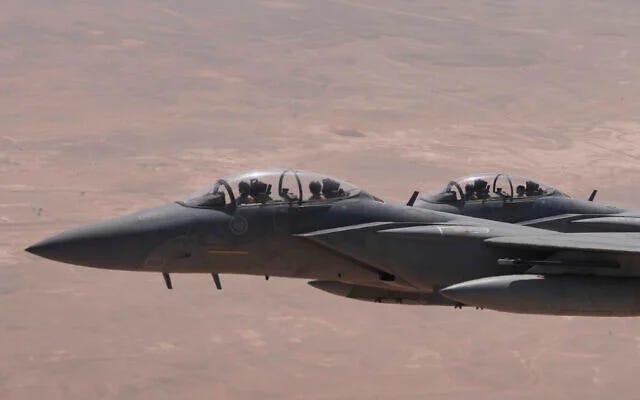
Image: Saudi F-15. Saudis reportedly struck Iranian militias in Iraq — Source: AP
Nevertheless, we are told that the ceasefire remains in effect. President Trump says that he “didn’t like” the latest Iranian response and that the ceasefire is on “life support”. Over the past few weeks, he has repeatedly failed to follow through on threats that unless Iran gives the US what it wants, they will be subject to attacks much worse than those inflicted during Operation Epic Fury, which started on February 28 and was declared over by President Trump on May 5. It seems like the reports of diplomatic progress and the official end of Epic Fury are a phony peace.
The American President has other concerns on his mind, and this week he is traveling to China for a summit whose goals are unclear, to say the least. The Iranian blockade of the Strait of Hormuz has an economic impact on the countries in Asia that depend on oil and fertilizer from the Persian Gulf, not least China. Nevertheless American entanglement in a war there may suit the Chinese, who have made it clear that an invasion of Taiwan is on their agenda. America has historically sold arms to the Taiwanese and promised to backstop de facto Taiwanese independence, but President Trump has repeatedly thrown America’s commitment to its traditional allies into question. It’s unclear whether President Trump is going to Beijing to warn them against attacking Taiwan, or to extract some kind of price from China for throwing the Taiwanese under the bus.
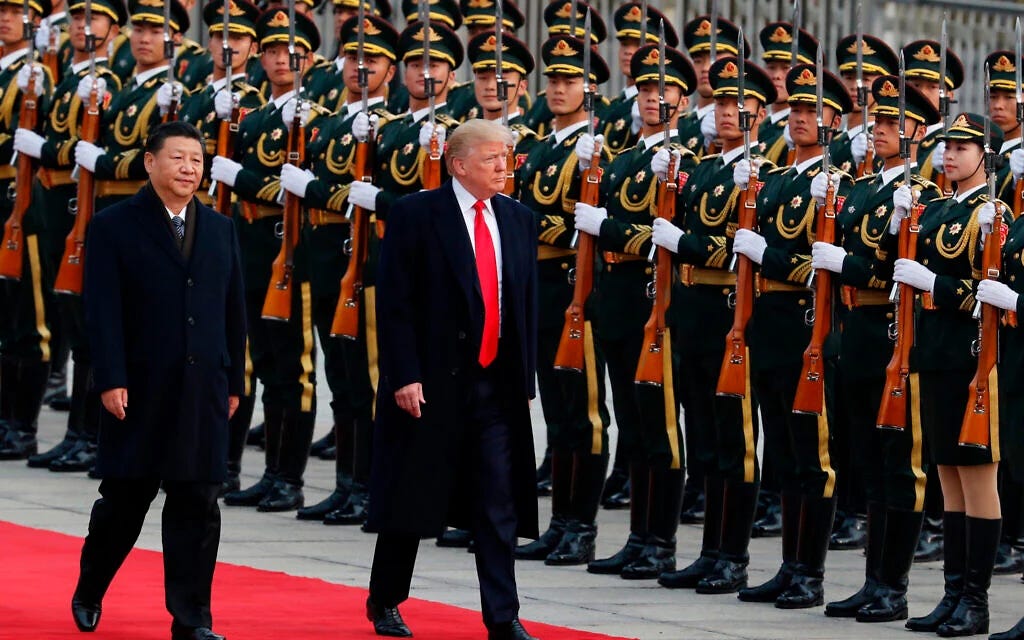
Image: Donald Trump and Chinese Dictator Xi Jin Ping -- Source AP Photo/Andy Wong
As President Trump has pointed out more than once, the biggest impact from the Iranian closure of the Strait of Hormuz is not on the US, but on Asia and, to a lesser extent, Europe. In spite of this, the rest of the world has been very slow to take action to stand up for freedom of navigation and their vital economic interests, preferring to point the finger at the Americans for supposedly causing the problem. But in finally imposing consequences on the Iranians for their decades of subversion and terror against the entire region and beyond, the Americans must have calculated that the closure of the Strait of Hormuz for a period of time was a tolerable price for finally doing something about Iranian aggression.
President Trump pointed out that other powers, such as South Korea should help to open the strait given that the Iranians have fired on their ships. The western powers do seem to be slowly organizing some sort of action to challenge the Iranian claim to ownership of the strait. However these are to be “purely defensive” operations which will take effect when there is a ceasefire. (Which the US says we already have. When the US sank Iranian boats that approached its warships it characterized these actions as “purely defensive”.)
It should be noted that Iranian claims of sovereignty over international waters in the strait of Hormuz, echo Chinese claims over the South China Sea, which likewise challenge freedom of navigation. In recent years these Chinese claims have been enforced by increasingly aggressive action against many of its neighbours.
Last week, the US announced Operation Freedom, which was meant to force the opening of the strait. It succeeded in escorting a handful of civilian ships through the Iranian blockade before abruptly abandoning it after 36 hours, in return for the latest useless round of talks. The US did subsequently send three warships through the strait, fending off attacks from small IRGC boats and bombing Iranian installations hosting the ships. Iran retaliated by conducting attacks on economic targets in the Emirates and Kuwait. It remains to be seen if the US will resume escorting ships through the strait now that the latest talks have failed. There are hundreds of ships stranded in the Persian Gulf, unwilling to risk trying to pass through the strait. As a practical matter, the Strait remains closed.
In Israel, unlike the US, the war on Iran is seen as necessary and the truce is unpopular. And there is no phony peace in Israel’s north. Hezbollah has unveiled new fiber optic drones, for which Israel doesn’t have an effective defense. Israeli soldiers have been dying in southern Lebanon and northern Israel.
In the rest of the country, the respite from nightly rocket attacks has permitted a return to a semblance of normal life. The final unraveling of the current government appears to be under way, as the Haredi parties are pulling out after losing patience with the government’s failure to deliver legislation to entrench the exemption of Haredim from the draft.
As this article is being completed, the government has withdrawn all legislation and tabled a bill to dissolve the Knesset, which means that elections are likely to be held in Israel this summer. The government and opposition have been maneuvering for months to prepare for these elections. New parties have emerged and the contest for leadership of the opposition is still unresolved.
I suspect most Israelis will be glad to have the chance to choose a new Knesset after the long war and persistent social unrest which have characterized the current one. The outgoing coalition brought extremists into government for the first time, undermining confidence in the police and the prisons. The government has challenged the role of the judiciary and the Attorney General, creating a standoff with the supreme court and a protest movement which may have an impact on the election.
I will write an article soon about the factions emerging to contest the coming vote and the prospects for a change of government. It remains to be seen if Israelis will be going to the polls during an ongoing truce or if full scale war will return before the election.
We hope you appreciate this article and over 250 others we have published over the past two and a half years. We are grateful to you for reading. If you value the work we do, please consider upgrading to a paid subscription to Canadian Zionist Forum. A paid subscription costs only $10 (Canadian) per month or $100 per year. A founding subscription is $240. (HST will be added if you are in Canada.) Subscriptions from outside Canada are tax exemptThe support of paid and founding subscribers enabled us to report to you last year from the World Zionist Congress in Jerusalem. We look forward to bringing you continuing information and thoughtful commentary, wherever the news affects Canadian Jews and our connection to the State of Israel.
Paid subscribers can also post comments. Why not become one and join the conversation?
If you would rather make a one time contribution you can buy me a coffee.

Canadian Zionist Forum sends best wishes and thanks to all our readers. We are very grateful for your interest and support. Please share this article with someone who might appreciate it.
No posts
Comments
Nothing yet. Say the first thing.
Sign in to join the conversation.