
Guest author Paul Giles is back with another thought provoking piece which couldn’t be more timely. I hope you appreciate it a much as I did. (Editor)
On January 20, 2026, in Davos, Switzerland, Mark Carney delivered a widely discussed speech about the decline of the rules-based international order:
“For decades, countries like Canada prospered under what we called the rules-based international order. We joined its institutions, we praised its principles, we benefited from its predictability. And because of that, we could pursue values-based foreign policies under its protection.
We knew the story of the international rules-based order was partially false. That the strongest would exempt themselves when convenient. That trade rules were enforced asymmetrically. And we knew that international law applied with varying rigour depending on the identity of the accused or the victim.” (Carney, 2026)
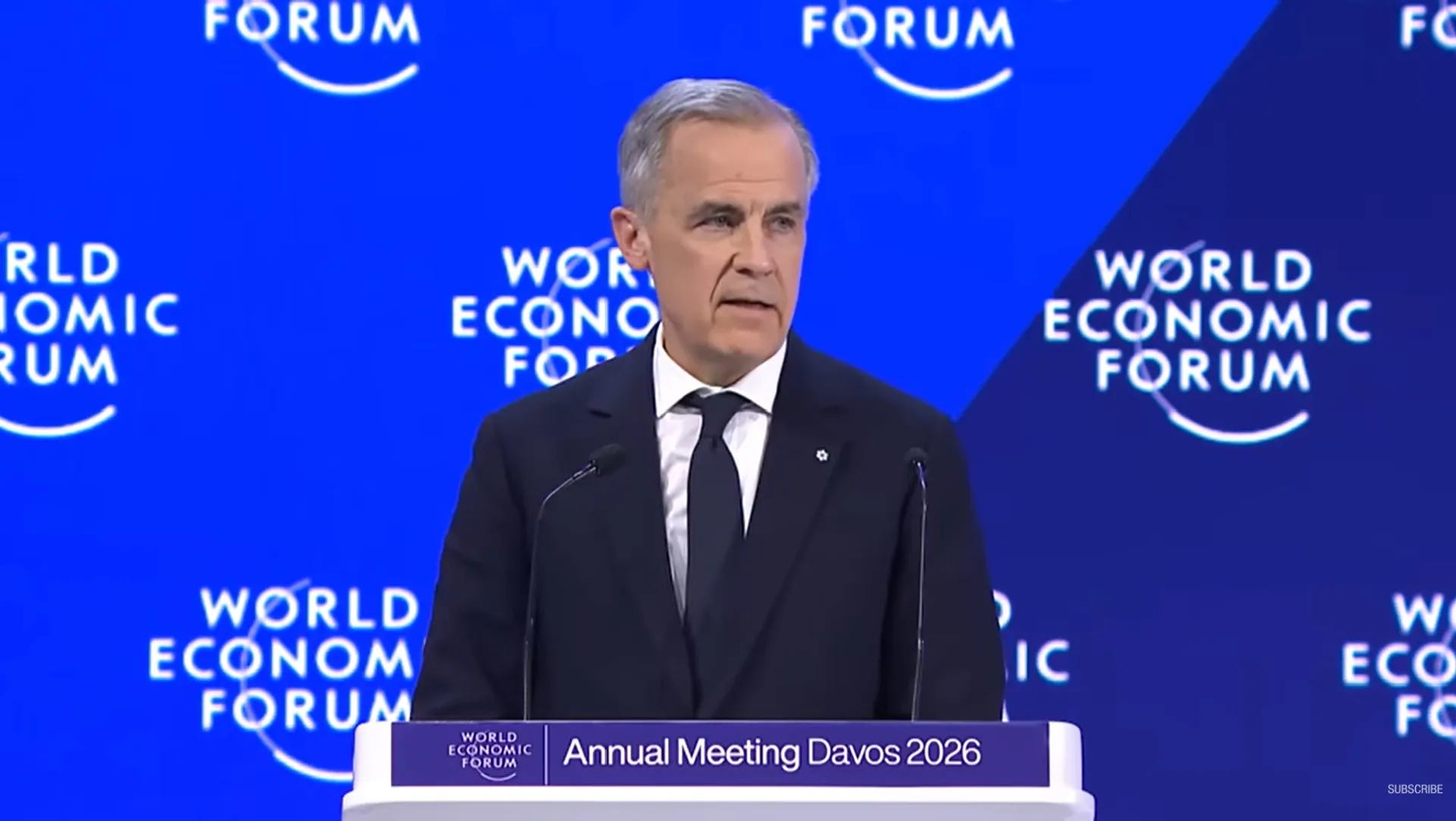
Image: Canadian Prime Minister Mark Carney speaks in Davos — Source Bigpicture.com
Israel’s experience within the so-called “rules-based order” reflects the unfairness that Carney described in Davos. Despite being aligned with Western states in both values and strategic interests, Israel has never truly been granted full membership. At the 2025 G7 Summit in Canada, German Chancellor Friedrich Merz praised Israel for doing the West’s “dirty work” in confronting Iran and its proxies. Although controversial in Germany, Merz’s remark highlighted how Israel serves the West’s strategic interests while remaining politically exposed.
This relationship between Israel and the West is analogous to the relationship between Remirro de Orco and Cesare Borgia described by Niccolò Machiavelli in The Prince. According to the Florentine, Cesare Borgia used de Orco to impose order in Romagna through the use of necessary violence. Then, when the people of Romagna began to feel uneasy with the cruelty required to bring peace and public order, Borgia had de Orco publicly executed in the town square to distance himself from the cruelty of his minister.
Since the end of World War II (1939–1945), the Jewish state and its citizens have fought a series of wars whose outcomes have had significant geopolitical consequences for the West. Historically, Israel’s victory in the 1967 Six-Day War weakened Soviet-backed Arab regimes and significantly altered the balance of power in the Middle East during the Cold War. Israel’s victory in the 1973 Yom Kippur War led to Egypt’s eventual realignment towards the West. More recently, in the years, since the October 7th terror attacks, Israel has crippled the Iranian backed Axis of Resistance by defeating Islamist groups in the Palestinian Territories, Syria, Lebanon, and Yemen. And now, in coordination with the United States, Israel is in the process of toppling the Islamic Regime in Tehran.
Despite all of these successes, Israel has been brought to the piazza[1] and excoriated by Western intergovernmental institutions. It has been condemned more than any other nation by the United Nations General Assembly, subjected to calls for boycott, divestment, and sanctions, and criticized by the leaders of key Western nations for its conduct. Although its role is critical to the maintenance of Western hegemony, Israel is consistently offered up as a sacrificial lamb whose condemnation purifies the members of the rules-based international order. In doing so, it allows them to maintain the appearance of moral authority. The condemnations are part of a façade through which Western countries demonstrate their commitment to international law and human rights. In reality, they are simply shifting moral blame onto a nation on the periphery of their world order. Perhaps Merz’s comments were controversial because they acknowledged an uncomfortable truth: That despite feigned condemnations and meaningless U.N. resolutions, the West needs Israel.
In his Davos speech, Prime Minister Carney referenced Václav Havel’s greengrocer story: “Every morning, this shopkeeper places a sign in his window: “Workers of the world, unite!” He does not believe it. No one believes it. But he places the sign anyway – to avoid trouble, to signal compliance, to get along. And because every shopkeeper on every street does the same, the system persists” (Carney, 2026). He argued that it is time to take down the shopkeeper’s sign and to break through the illusion of neutrality when it comes to international relations. It is long past time to admit that the liberal international order (LIO) is a coalition of states and institutions with a clear normative goal. The goal of institutions like the U.N, ICC, and ICJ has never been to uphold peace, the rule of law or human rights in a neutral manner. It has always been to increase the power of the liberal international world order. In some cases, this meant the subjugation and coercion of countries in the periphery, all the while keeping up the appearance of being a force for justice, right, and equity among nations.
Taking down the greengrocer’s sign means more than just lifting the veil and undoing the illusion. It means changing the way we approach international relations as members of the West. We need to stop pretending that bombs will bring democracy or anything other than destruction to the countries we go to war with. Recent events in Venezuela and now in Iran serve as a critical juncture for Western relations with the rest of the world. If we are going to engage in regime change, we must remember that the responsibility to ensure a democratic transition does not end when the bombs drop. That’s when it begins.
“Arresting” Nicolàs Maduro and permitting his deputies to run the country in his place constitutes a catastrophic strategic blunder. We had a responsibility to install María Corina Machado and the opposition party as the interim government. Instead, President Trump installed Venezuela’s Vice-President who has served as Maduro’s right hand since 2018. In doing so, Trump removed the tyrannical socialist dictator while keeping systems of oppression in place and installing an equally despotic tyrant as his replacement. By failing to support the opposition, Trump allowed the United States to become the very devil it sought to overthrow. To the citizens of the Middle East and North Africa (MENA) this is a familiar story. We cannot make the same mistake in Iran.
Finally, we need to re-evaluate our approach regarding these conflicts as diaspora Jews, Zionists, and Israelis. Instead of blasting Lynyrd Skynyrd’s “Free Bird” and joining in on the U.S.A chants in response to the war against Iran, we need to recognize the severity and seriousness of the military actions we are supporting. No incident highlights this problem more clearly than the bombing of a girls’ school by the American military. In addition to defending ourselves against the global Islamic terror threat posed by the Iranian regime we should be hoping that the Persian people, who have long been subjected to colonial Islamic rule, can finally be liberated. But we have to remember, bombs don’t liberate people, they kill people. And while this war is necessary to protect Western interests, celebrating violence is antithetical to our goals.
For the citizens of the MENA, they have lived under Islamic tyranny for decades, now they are under attack – going to sleep every night under American and Israeli bombs. For some, their family members are dead, their friends are missing, and when they look to the West, they see that we are celebrating. Continuing down this road will make us the new devil of the MENA not only to the Islamists who already consider us to be such, but also to the very people we claim to be liberating. We have to build bridges. We have to listen to people who don’t look or think like us, and we have to sympathize with their lived experiences. This is the only way to build a long-lasting coalition for peace; it’s the only way that we can bring freedom not only to the people of Iran, but to the people of Lebanon, Syria, Gaza, the Palestinian Territories in Judea and Samaria, Yemen and Israel. Because endless violence is a tyrant that affects us all.
[1] The type of Italian public square where Remirro de Orco’s body was displayed.
We hope you appreciate this article and the hundreds of others we have published over the past two and a half years. If you value the work we do please give this article a like, and please consider upgrading to a paid subscription to Canadian Zionist Forum. A paid subscription costs only $10 (Canadian) per month or $100 per year. A founding subscription is $240. (HST will be added if you are in Canada.) Subscriptions from outside Canada are tax exempt.
The support of paid and founding subscribers enabled us to report to you last year from the World Zionist Congress in Jerusalem. We look forward to bringing you continuing information and thoughtful commentary, wherever the news bears on Zionism in Canada.
Paid subscribers can also post comments. Why not become one and join the conversation?
If you would rather make a one time contribution you can buy me a coffee.

Canadian Zionist Forum sends good wishes and thanks to all our readers. We are very grateful for your interest and support. Please give us your like and share this article with someone who might appreciate it.
No posts
Comments
Nothing yet. Say the first thing.
Sign in to join the conversation.