
My grandfather was a writer. Unlike his oral communication, where he struggled with a lifelong stutter that punctuated his speech, his handwriting was fluid and came easily. For as long as I can remember, he wrote me a letter for Christmas and my birthday every year. He would talk about the farm, about the family history, about the weather and news stories, about what was happening in his community, and exciting things happening in the family. I even heard that my cousin had been drafted to the MLB through a letter from my grandpa! He made it easy to imagine his life from afar and you could hear his voice through his handwriting.
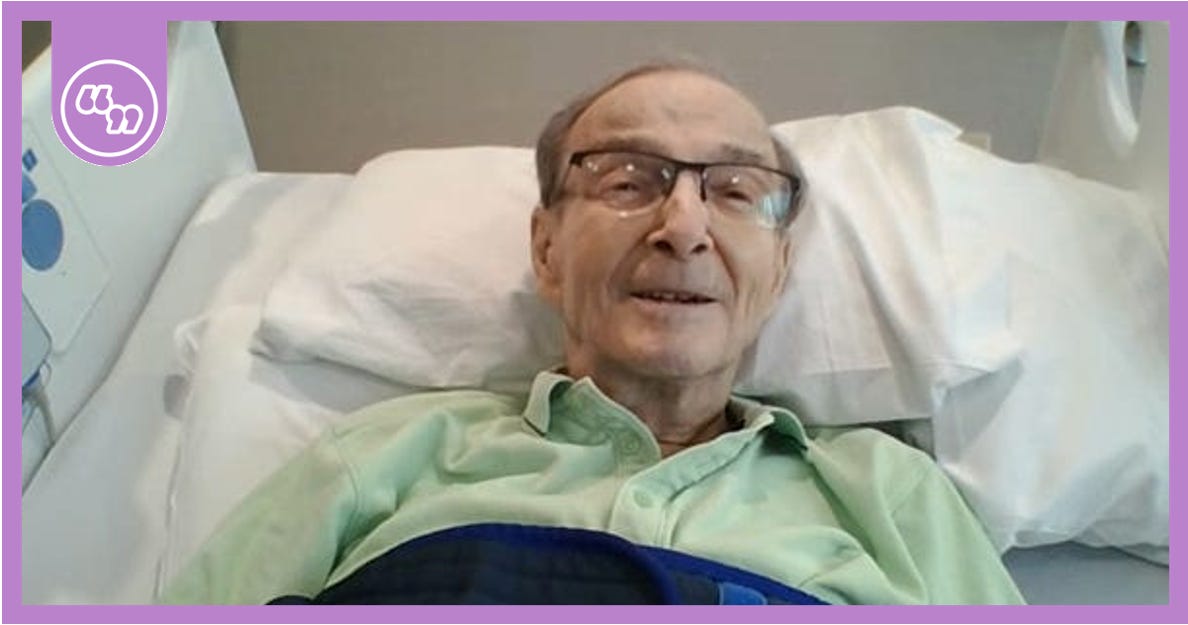
Photo by Brianne Hartman
He would date his letters, even with timestamps, often returning on multiple occasions to finish one, saying something like “my handwriting is going downhill so I’ll take a break for now.” He would then come back a few hours or days later. “I’m back, but I have to finish this one soon. I’m running out of daylight, and your birthday is approaching so we better get this in the mail.” It was half greeting and half running commentary on his life. He would photocopy the letters he had sent so that he could follow up on things from the last time and not forget what he had already told me. He was a reflective person, simple and emotive, and he was used to sharing his thoughts with us.
It was easy for me, therefore, to propose to him the idea of Dignity Therapy. This Therapy is “a carefully constructed framework of questions [that] guides participants to share their thoughts, reminiscences, advice, hopes, and dreams with those they are about to leave behind”. Dr. Harvey Chochinov developed it over the last 20 years, and I had recently completed the training with him. (For more on Dignity Therapy, visit https://dignityincare.ca/en.)
I convinced my grandpa that he was doing me a favour by letting me practice, so he agreed with even more delight. He had always shared his life in written form and, at the end of it, he warmed to the idea of doing it again through an interview with me that we could turn into a transcript. I was living far from him, so we made a Zoom date, got his permission to record, and had a beautiful conversation.
At the moment of the interview, my grandpa was in a hospice, half-reclined in a hospital bed with a colostomy bag, but during our conversation, he was clearly not thinking about this illness. He was reflecting on his life, on how he had chosen to live, to respond to what he had been given, and to pass on what he had learned.
And that’s exactly what I was able to record. He talked about being a farmer, about what it felt like to be “part of God’s world”, and the challenges that it brought. He reminisced about being a husband, a father, and a grandfather. He and my grandma met at a Valentine’s day dance in the 1950s and well into their 80s they still went dancing every Friday night. So when I asked him what it felt like when he was dancing, I was hoping to get a deep answer. I wasn’t disappointed:
I think what I like about it is the fact that I am hanging on to a real live person who is also a part of my life. The thing about dancing is that it is an occasion for us to be together. On the farm, we needed each other, and when you go to a dance, you need each other, too. Dancing is an awful lot like farming. You need that connection. Annabelle [my grandmother] is a good dancer, always was, and still is.
He was most proud of their 66-year relationship and the great-grandson whose baptismal record was written beside his own in their country parish. He talked about the importance of enjoying the present moment and marveled at the people he had in his life.
The conversation went on for about an hour and I could tell he was getting tired. I forced myself to stop the questions, and had to be satisfied with this. But he didn’t need more. He had told his story, and he finished the conversation with a joking “Arriverderci!”, the same mispronounced greeting that often ended his letters.
After the interview, I worked with him to polish the transcript into a cohesive narrative. We met over 2 short sessions to edit and refine the words he wanted included and thought about how they would be received by his loved ones. He was happy with the finished product. My uncle and my father both had the chance to hear how the interview had impacted him and I know it was an important part of his being able to let go.
My grandma decided to wait until the first anniversary of his death to publish the Dignity Therapy interview into a book for each close family member. She worked with a helpful uncle to choose photos from his life which I slotted into his narrative. We managed to get the book into the hands of each family member before or around the anniversary. The best feedback I received was from my grandma: “It sounds just like him”, she exclaimed, as the tears rolled down. And I agree. What my grandpa chose to say as his final words in his final days is a culmination of who he was. At a moment when the cancer that eventually took his life prevented him from continuing his daily life as it had been, we were able to capture his identity and put it onto paper.
Dr. Harvey Chochinov had explained during our training session: “the way [we see] people die is the way we will face our own death”. My experience with my grandfather has given me a perspective that is full of hope, of assurance that despite whatever limitations or illness threatens our bodies, who we are remains and can be communicated to those we love.
Brianne Hartman is Programs Director for Canadian Physicians for Life and completed the Dignity Therapy training with Dr. Harvey Chochinov.
Comments
Nothing yet. Say the first thing.
Sign in to join the conversation.