
I realised I put the title of Knausgaard’s The School of Night basically backwards, The Night School, in my last post, but the book is full of sinister, Satantic mirrors and mirroring so I think this makes perfect sense that would happen. I got really ill just after I finished it too, throwing up and a fever, and am spending this weekend with strep throat. Alan Hollinghurst audiobooks and old timey throat sweets that taste of liquorice and toothpaste are getting me through.
I got into Poirot novels recently and had the horrible realisation I am no longer, and will never be Cassandra from I Capture the Castle, and that I am her father, the impoverished experimental novelist who reads detective novels (‘I’ll read any detective novel, good bad or indifferent”) to distract from his despair while munching on oatcakes sprinkled with margarine and sugar. The similarities end there however, as I do not live in a rundown castle, nor am I, unfortunately, married to a dashing nudist. Pray for me to triumph in the end though as he does.
It’s almost more intimate to read what a writer you love and admire has read than to read the writer’s work itself. At the library, I found Shakespeare’s Plutarch which contains the biographies of Julius Caesar, Brutus, Marcus Antonius and Coriolanus, by Plutarch and translated by Thomas North ( 1535-1604) read by Shakespeare for research. Thomas North translated it from a famous French version rather than directly from the Greek. The edition has extracts from Shakespeare’s plays in the margins so you can see what parts he rewrote or took information from. You can get a glimpse of how his mind worked. What’s so interesting is that this edition, edited by scholar T.J.B Spencer is a penguin paperback, not an academic book, the one I have from the library is a 1967 reprint of the 1964 original. Average people int he 1960s were reading this.
I wonder what Shakespeare thought of Caesar politely eating asparagus which had accidentally been dosed in perfume oil rather than salad dressing:
Caesar supping one night in Milan with his friend Valerius Leo, was there served sperage to his board, and oil of perfume put into it instead of salad oil. He simply eat it, and found no fault, blaming his friends that were offended; and told them that it had been enough for them to have abstained to eat of that they misliked and not to shame their friend, and how that he lacked good manner that found fault with his friend.’
Here I love how you can see Shakespeare adding in a smelliness into this scene in his Julius Caesar which wasn’t there in the Thomas North/Plutarch biography:
‘Then Antonius offering it to him again, there was a second shout of joy, but yet of a few. But when Caesar refused it again the second time, then all the whole people shouted.Caesar having made this proof found that the people did not like of it, and thereupon rose out of his chair, and commanded the crown to be carried unto Jupiter in the Capitol.’ (Plutarch/North)
‘The rabblement hooted and clapped their chopped hands and threw up their sweaty nightcaps and uttered such a deal of stinking breath because Caesar refused the crown that it had almost choked Caesar’ for he swounded and fell down at it.’ (Shakespeare)
Here is Thomas North’s rendition of a famous allegorical speech by Agrippa Menenius Lanatus recollected in Plutarch
That on a time all the members of a man’s body did rebel against the belly, complaining of it that it only remained in the midst of the body, without doing anything, neither did bear any labour to the maintenance of the rest; whereas all other parts and members did labour painfully and were very careful to satisfy the appetites and desires of the body. And so the belly, all this notwithstanding, laughed at their folly and said:
‘It is true, I first receive all meats that nourish man’s body; but afterwards I send it again to the nourishment of other parts of the same.’
‘Even so,’ quoth he, ‘O you, my masters and citizens of Rome, the reason is alike between the Senate and you. For matters being well digested, and their counsels thoroughly examined, touching the benefit of the commonwealth, the Senators are cause of the common commodity that cometh unto every one of you.
And here is Shakespeare’s version in part from my wrinkly Arden:

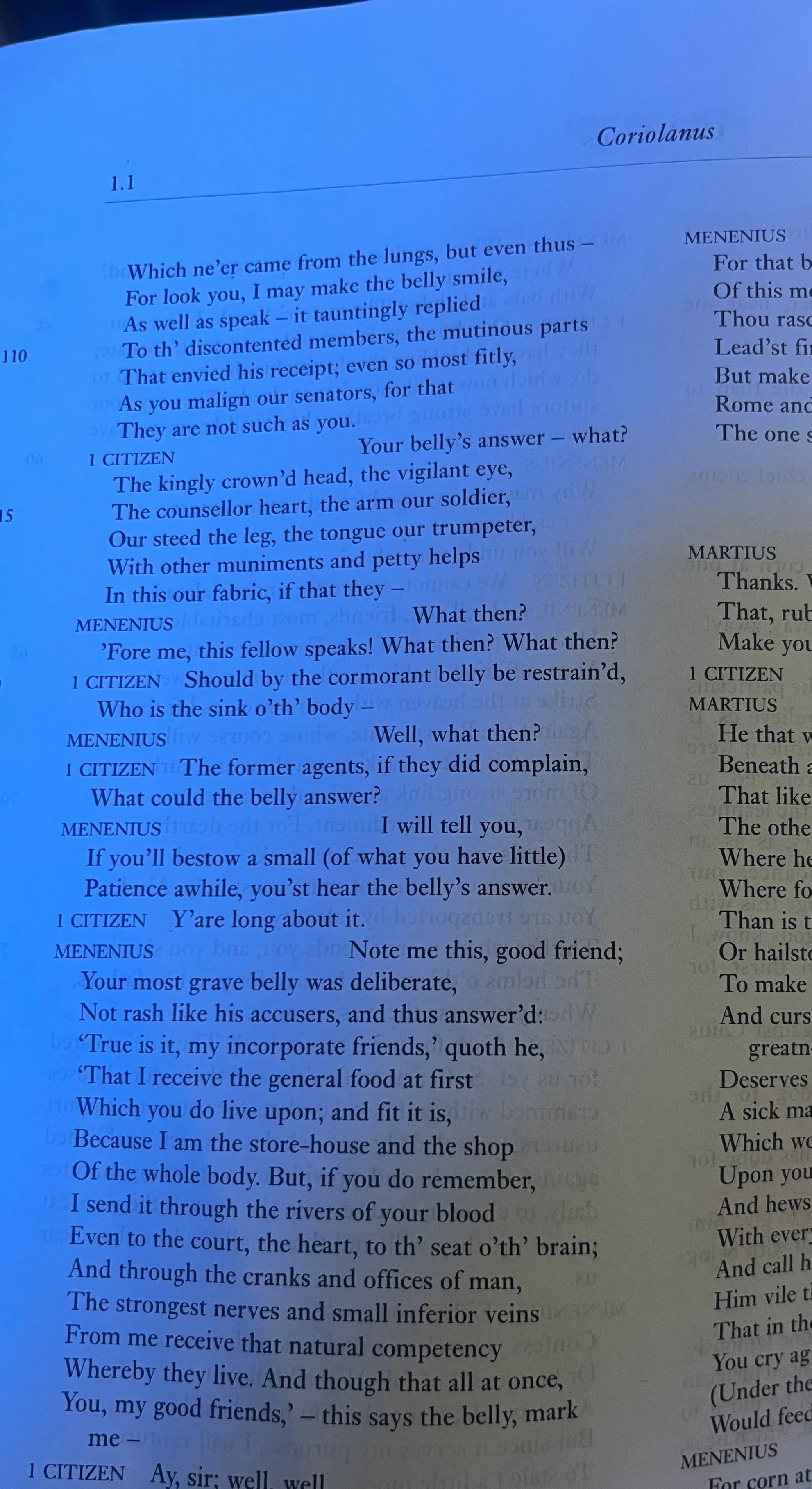
the lines I am obsessed with are ‘Still cupboarding the viand’ and ‘‘Because I am the store-house and the shop/ Of the whole body’ there is something almost Joseph Cornellish about those lines.
Another piece of classical literature Shakespeare read is the William Adlington translation of The Golden Ass by Apuleius, the most complete ancient novel we have. I get so annoyed when I am told a novel is a particular thing ( I was once told I needed to have a ‘psychological progression’) The first novels were bawdy, meandering funny, grotesque!
The Loeb edition is the Adlington translation with some revisions. ( with the original latin on a corresponding page ) I’ve read a later version, but have started to read this version. It was a big influence on A Midsummer’s Night Dream.
Flipping through the Latin side I came across the phrase ‘O Grande’ which means oh great I’ve started saying it to myself.
Though we only have an incomplete version, The Satyricon by Petronius it is a favourite favourite ancient novel and I reread it last week to much joy in J. P Sullivan’s translation. It is about a young man Encolpius who has ‘combed wavy hair,’ ‘ heavy make-up,’ soft sulkiness in his eyes, and a ‘self-conscious walk’ and his younger slave boyfriend Giton and their lover’s quarrels and escapades, including attending an infamous dinner where each dish is described in great detail ( pigs stuffed with sausages made from their own innards, dormice cooked with honey and poppyseeds, cheesecake, sow udders, dates) and meeting an annoying poet Eumolpus in an art gallery (who hasn’t?) It is filled with dildos, disguises, chickpeas, a flaccid penis compared to ‘wet leather’, dark sordid rooms and alleyways, lots of buttock spreading, drunkenness..Some favourite parts:
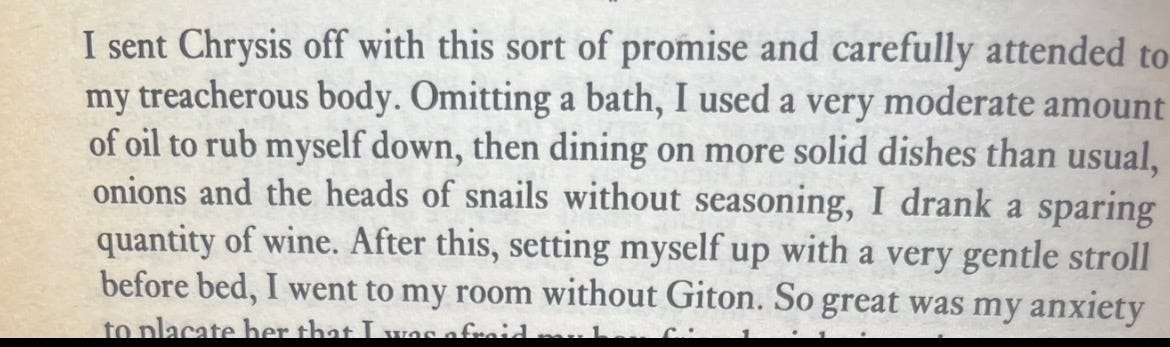

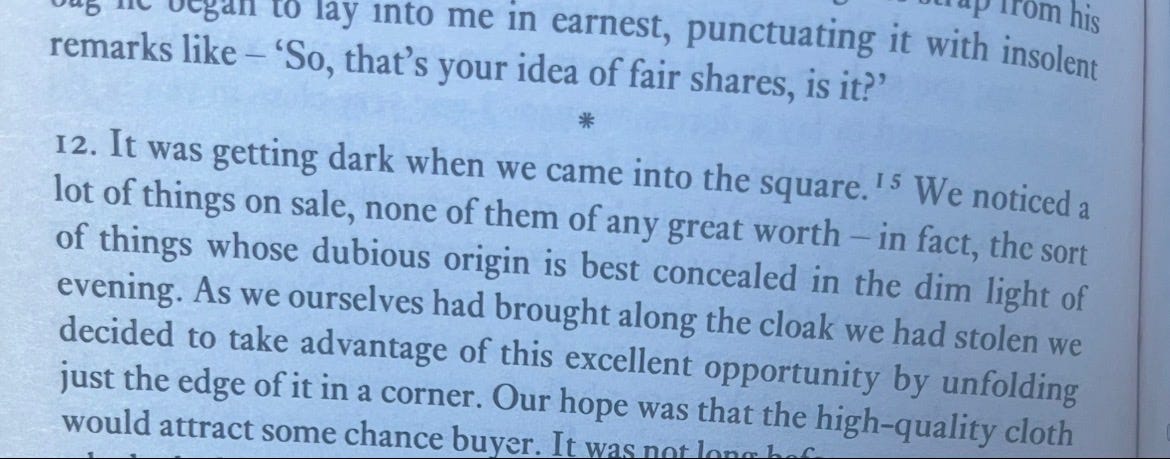
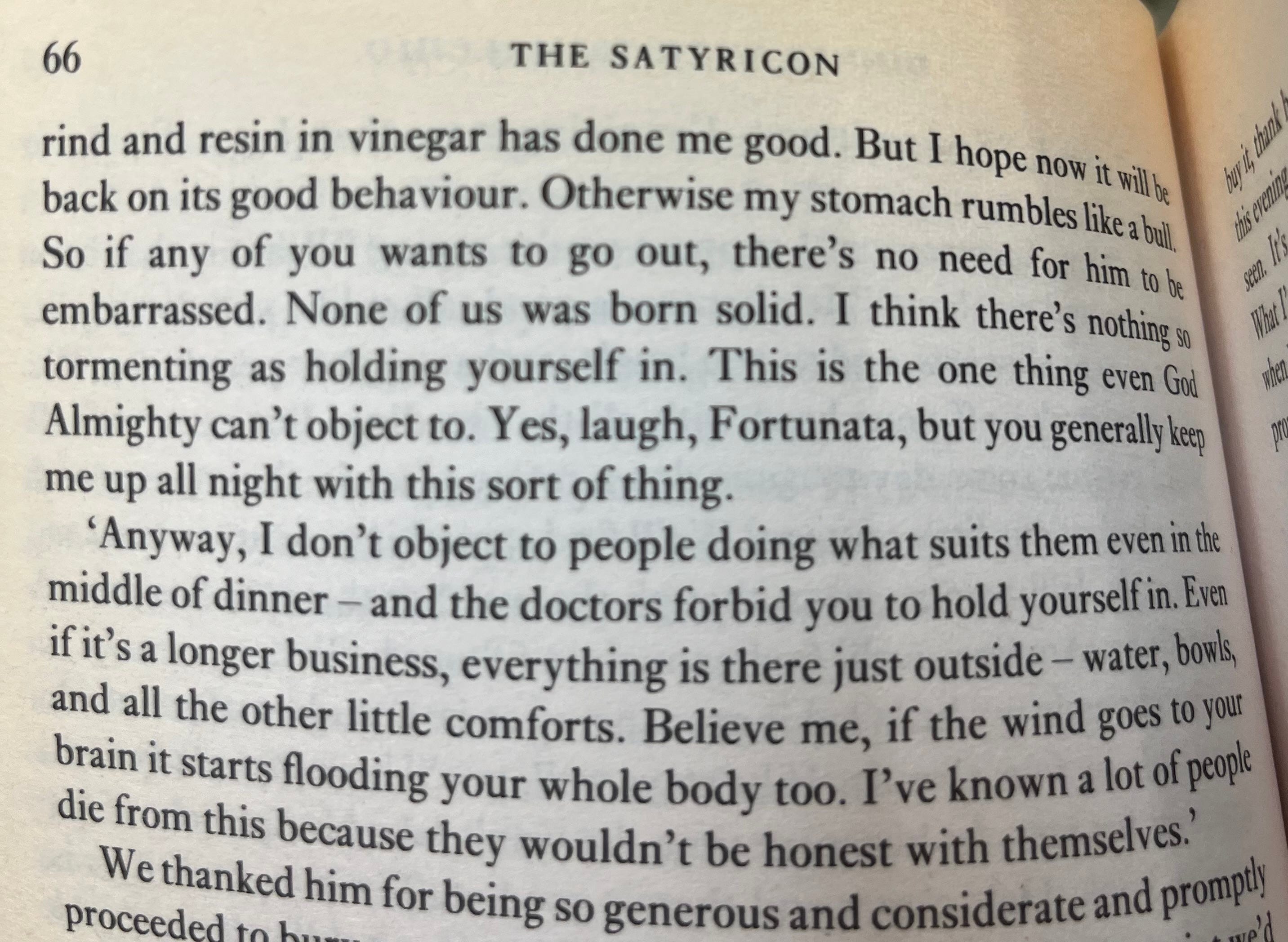
The Satyricon like Pliny the Younger’s letters brings me so close to the Romans . I used to see the Roman world as white, red and gold but now I see it as green , red, black, brown, purple. Petronius, a famous bon vivant, lived around the same time as Plutarch ( though Plutarch was Greek and never went to Rome) and was forced to commit suicide, as Romans often were, after falling out of favour with Nero, but he did it in a slow, enjoyable way, surrounded by friends and eating dinner as his wrists bled out and according to Pliny the Elder, smashed a really expensive wine dipper so Nero wouldn’t seize it after he died.
Helen DeWitt
The author Helen DeWitt has detailed on her blog why she was unable to accept a big prize which was reported in The Guardian too. Please read The Last Samurai and The English Understand Wool, they are so so good, you can also donate to her ko-fi
What I find especially upsetting is that her latest, collaborative novel has received across the board amazing reviews in the papers, but is near impossible to purchase in bookshops, and does not have a British publisher that I know of.
based off some of my own experiences I would say:
Pr people hired for accolades and big events can be astoundingly mean to the people being promoted and the recovery from that can take a long time
Accolades don’t necessarily mean you will then have the possibility to publish the work you are able to write, it can mean some will try to take advantage of the accolade energy to Stepford wife you into something more commercial.
There isn’t enough support in the book world for writer’s mental and physical health though the book world can easily destroy both
The book world is increasingly about image rather than the work itself.
I have written about this before here : many residencies and other opportunities for writers to make money etc increasingly require ‘community engagement’ as if writers were zany social workers, and if you don’t have social skills and/or write transgressive literature this discludes you while surviving on writing literature alone is near impossible. I love teaching because I can be myself but I don’t see the point of ‘social engagement’ projects when you have to hide just as much as yourself as you would working in retail or bartending.
No posts
Comments
Nothing yet. Say the first thing.
Sign in to join the conversation.