
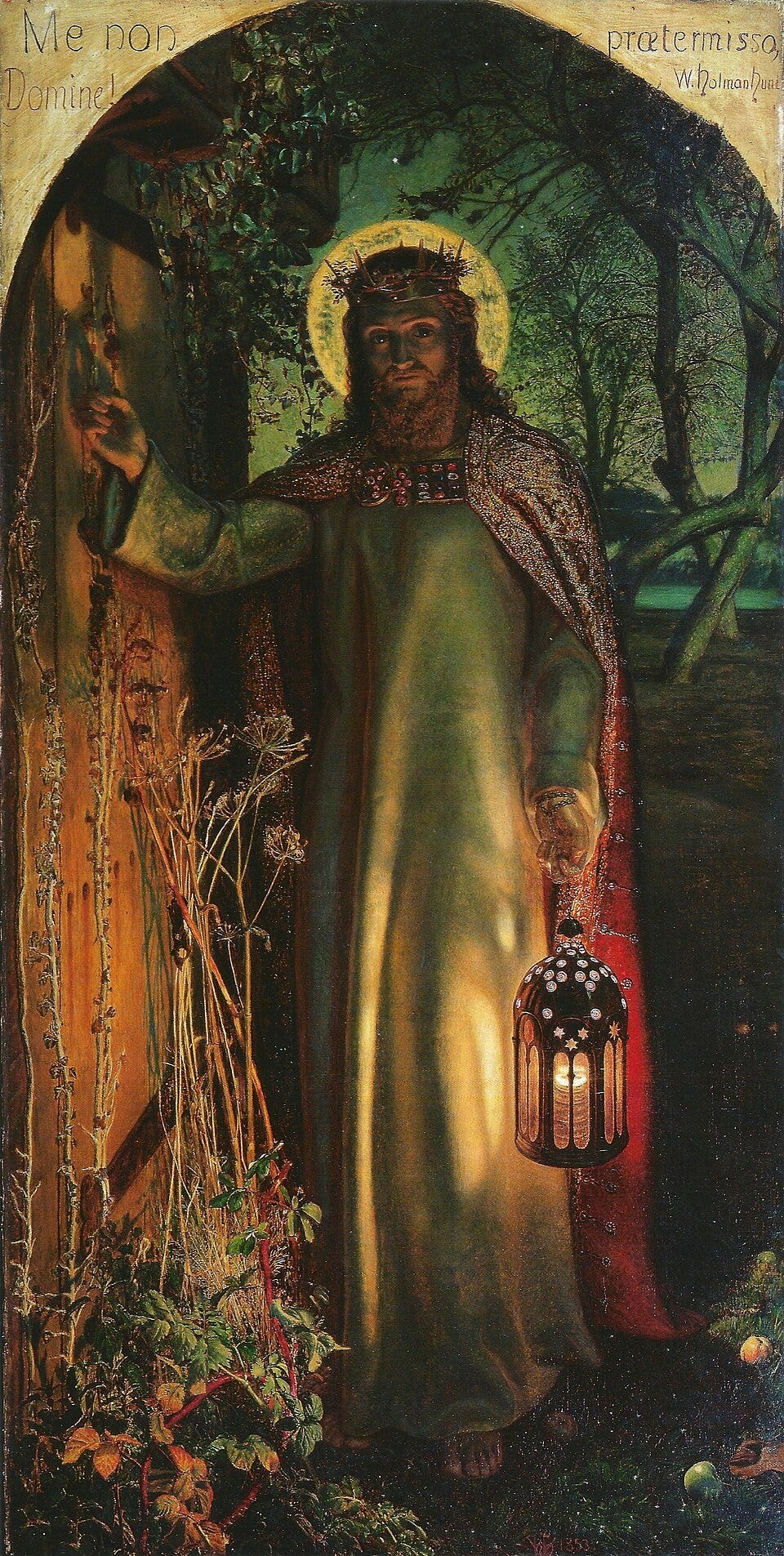
In the novels of British writer M John Harrison, I always look out for which paintings he will reference. Often, they are by the Pre-Raphaelite painter William Holman Hunt. In The Course of the Heart it is Holman Hunt’s eerie The Scapegoat and in The End of Everything, it is The Light of the World, (which I am certain appeared in previous work of his and I drove myself half mad over the week trying to find the other instance.) It also appears in Angela Carter’s The Magic Toyshop (“ There was a reproduction of “The Light of the World” in a bamboo frame over the mantlepiece”) it feels like both a nod to her work and the Pre-Raphaelites. The Pre-Raphaelites harked back to the colour and detail of medieval paintings, dismissing Raphael as a bad turn in art ( I agree, I find his work quite spongy looking, they make me think of dark rooms and rubberised old medical equipment and gynaecological examinations) The Pre-Raphaelites put religious figures in realistic, highly detailed settings which was considered by their contemporaries to be grotesque, though we consider their paintings ubiquitous and even sentimental now. Chaucer was one of Carter’s favourite authors, and The Light of the World signifies a looking back to literature before the 19th century realist novel.
The painting shows Christ in a very English landscape : cow parsley, ivy, brambles and scattered apples. The strange and holy is rendered in great detail, the bejewelled clasp of his cloak, the pattern on his lantern. Neither writers have Christian themes; rather it articulates a stylistic intent of using precision to defamiliarise, to show us just how strange Britain and the world is.
Writing about the internet can be divided into three camps I think, 1) writing like Honor Levy’s which looks at it from within and uses its temporal language 2) the traditional realist novel with phones added 3) those which try to make poetic and metaphysical sense of the technological world we live in now. Here M John Harrison is situated, along with Ben Pester, Nicola Barker and Vladimir Sorokin, and oddly, very few other writers.
The End of Everything is alternative history of England, where a form of life called the iGhetti which may be ‘a single entity made up of a huge number of components with variable functions’ took over in the 80s, beginning as a jelly found around ponds and later becoming big cloud like formations over London. Humans are’ caught up and whirled about’ by their presence but the iGhetti ‘may not even know we are here’
Society is half there and half not. People live a semblance of normal life, but any sort of social contract is gone and in one of the first chapters, Marnie, an elderly woman artist kills a child for peeing through a hole in her roof. Her neighbours tell her it was wrong (though the child’s father doesn’t seem to mind) and she kills them too.
The iGhetti form mirages everywhere, of buildings and helicopters, and have left the sea full of artefacts,’ like a stew’. Marnie’s nephew Philip is one of many who collect artefacts washed up on the beach and sell them. He finds one, the size of a baby which he thinks will be of great value.
The artefact, a biological gadget, grows from baby-sized to ‘the size of a ten-year old child, with smooth features and wisps of hair on a round, predominantly bald head’ pudding like and ‘looking as if ‘it hadn’t quite contacted the world in which it finds itself’.. Philip finds it repulsive initially, as does his aunt. After Philip temporarily loses it, group of men beat it up and cut its arm into thin slices ‘ translucent as sandwich ham’ which they eat and this strange meat makes them dozy . The arm of the gadget grows back. The artefact speaks in the same illogical pleasant way text predictive AI does. ‘Hello, nice’ ‘ ‘I love the shops’ ‘Anyone can be hurt’.. ‘and we often do unpredictable things because of it. I’m sorry for your loss.’ It starts to wear clothes, but still with its strangely smooth and uncanny face resembles processed meat. It gradually comes between the characters, confuses and controls them, smiling goofily and bringing them random gifts, becoming more energetic and strong as the humans around it become less so. ‘What are you really?’ Marnie asks ‘And what do you think of us?’
Harrison’s over specific similes work brilliantly in the way that say, Ocean Vuong’s don’t, and are one of the things I love about his prose. ‘They were both wearing silk suits without shirts, drinking soft drinks the colour of fruit in an advertisement two generations old’ ‘It resembled the office of an upscale minicab company in 1996’. Like The Sunken Land Begins to Rise Again and The Course of the Heart, it is not only a world of strange creatures and occurrences but beans on toast and charity shops, details that play the same role as the cow parsley in Holman Hunt’s painting.
Bleak Week
Filmhouse in Edinburgh and the Prince Charles Cinema in London are doing a ‘Bleak Week: Cinema of Despair.’ My slavic soul! Some Tarkovsky and Pasolini which I am planning on going to, and a horrifying Dutch film I saw years and years ago on the insistence of a cousin, and never want to see again.
Gorky
There is a great new piece in the LRB by Adam Thirwell on Gorky’s memoirs of Tolstoy and Chekov, published by Fitzcarraldo Editions and newly translated by Bryan Karetnyk. I remember loving Gorky’s My Childhood, then reading something dismissive Nabokov said about Gorky and I am very impressionable when it comes to Nabokov’s opinions on everything, but this article has made me want to go back to Gorky. Karetnyk has also translated Deceit by Yuri Felsen, which I loved, published by Prototype Books and Cynics by Anatoly Marienhof which I would like to read soon because of the quote from on the book’s advertisements ‘'A love that cannot be throttled by the rubber tube of an enema bulb is immortal.’ Is there a line of literature more directly advertised to my taste.
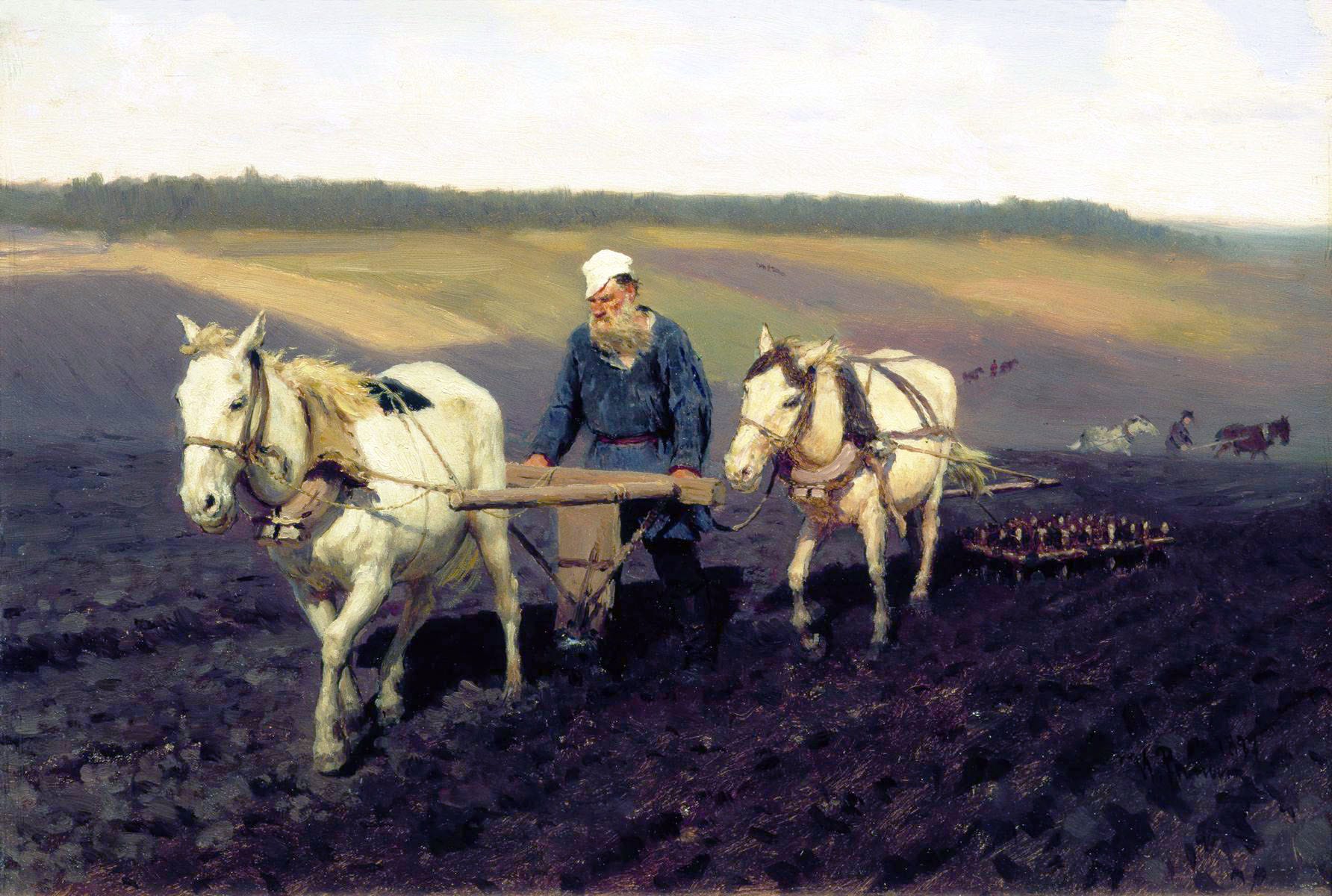
This painting of Tolstoy ploughing in the 19th century by Ilya Repin reminds name of all the contemporary British writers who pretend to be poor. ( I still love Tolstoy)
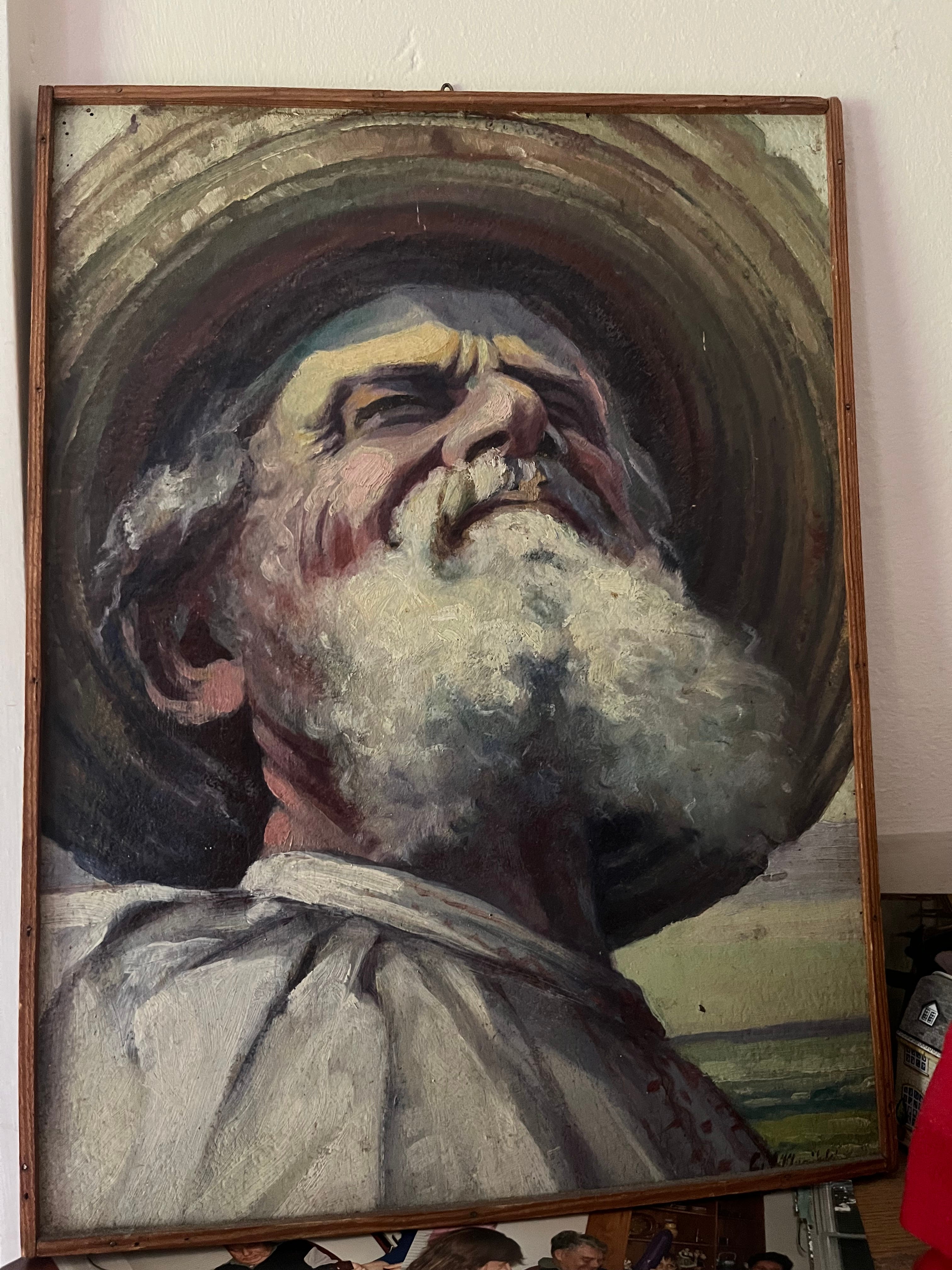
I have a painting by a great grandfather of mine, painted in Lublin which I jokingly call Tolstoy or Walt Whitman after a friend said it looked like Walt Whitman and we created a fiction of Walt Whitman wandering around the 19th century Eastern Europe.
I was fascinated by this piece in Le Monde about a ring of people ( mainly from countries which have been violently oppressed by various govs of Russia.. ) stealing rare Russian classics (Pushkin, Gogol, Lermontov ) from European libraries and most likely selling them back into Russia in an organised operation. The place of Russian culture in Europe at the moment is confusing and often hypocritical amongst debates on whether art is soft power ( whether ‘Madame Literature’ forever dead or dying, is very powerful, or not at all depends on the context it seems) and if its ethical to apply cultural boycotts of various countries onto individual artists from 100 years ago as well as contemporary ones- how much responsibility we heap on artists for when and where they were born- something out of their control, whether it has been thoughtfully considered if the country is a democracy or not1, and how much compassion we show to dissidents and exiles, those wanting to leave, (not enough compassion) or those wanting to see and experience different ways of being and connect with people around the world. In this thieving situation, literary artefacts as artefacts of power is clear, a battle between European institutions and Russia over who has the right to the legacy of Russian literature, (Pushkin, like Robert Burns, has been deeply tied to national identity) but its slightly bizarre too why European police forces are putting so much into investigating this when in other instances Russian artistic culture has been cancelled, such as an opera by a Russian composer in Poland (where some of the books were stolen) or comes with awkward PSAs as a Shostakovich concert (and even by a non Russian orchestra) I attended a few years ago in Edinburgh did .The books are worth a lot of money, but I think goes beyond that and ‘you don’t want us so we will steal our culture back’ (who is ‘our’ anyway when it comes to literature the most borderless of arts ) and is perhaps a symbolic battle of who has the right to study, interpret, analyse, to think about Gogol or Pushkin or Lermontov, and that some powers that be in Russia do not want others in these European libraries pondering, interpreting, these writers.
ie, do artists and others have a choice to boot out a government who has brought about a cultural boycott of their country by other countries.
Comments
Nothing yet. Say the first thing.
Sign in to join the conversation.