
Turner in January
Once a year at the National Gallery of Scotland they whip out their collection of Turner watercolours, this very Edinburgh tradition is called ‘Turner in January’ and they chose January, as it slowly begins to get lighter outside, the watercolours welcome us back to life and cheer us up in a way the diabolical and pricy Christmas market can’t.The Turner Exhibition is usually something locals attend more than tourists though perhaps not this year. The watercolours are delicate so they can’t be exhibited all year round, but there is also something very Scottish in the withholding and getting of a treat, the gallery like a Edinburgh host who puts the biscuit box and the wine bottle away after one helping. Every year I fixate on or notice a different painting depending on where I am in my life. This year it was a painting of Virginia Water near Windsor, with boats, swans and a Chinese pagoda, perhaps as I am meticulously trying to plan a move down south and after living near the sea for almost seven years now, I want fresh water ponds and rivers again. I grew up nowhere near the sea. I love Turner’s view of Durham cathedral, that one always haunts me . One of the people I went with beautifully explained how strange the perspective is in a wild Welsh scene. When I see the Venice ones, I remark again, to whoever is there, that I have never been to Venice but seeing anywhere clogged with tourists sets me off on being anxious about overpopulation. The paintings were in a circular room, and there was a long queue to get in (not boring, lots of Henry Raeburns to look at, sorry I like him, his brush strokes are so luscious .. Its Edwin Landseer who does my nut in) Noticed an odd phenomenon this year, people kept queuing in the room, in a semi circle and not really looking at the paintings, and I had to barge in to and fro across the room to get a look. It was like they thought there was a big grand and important painting in the centre of the room, to trump all the others, which they were really waiting for, so looked forward instead of at the artworks on the walls. There’s a dumb metaphor for life if you ever need one. On the way out of the gallery, nice to see the Titians and the El Grecos. I didn’t notice till this trip that in one El Greco painting of two men and a monkey huddled around a flame (it kind of looks like they are lighting a joint) one of the men’s teeth are exposed, I always thought these ghostly teeth were part of his moustache but no he is curling his lip in a Beavis and Butthead way and it does quite change how you look at it. El Greco also reminds me of those velvet paintings you get of Elvis and Wolves.
I need to clean my flat today its become rather vile but it feels annoying when you have books and writing you want to do and my time management is beyond terrible. I was reading recently about Muriel Spark staying at this apartment building in new york meant for artists and writers where they make your food and change your sheets so you can get on with the work.Am indulging a daydream about it, lifting a silver dish with a diamond and signet ring covered finger and eating whatever is underneath it mindlessly but it keeps getting interrupted by memories of serving drinks and appetisers to rude big fish small pondy jerks at Edinburgh cultural events. The working poor having to chug Monster energy drinks on public transport on the way to long shifts, gout from pot noodle, rise of bowel cancer. someone accusing me of lying when I got severe food poisoning from eating a herring sandwich in the basement of the wine shop where I worked. I can’t eat pork because of Robert Pickton and the fact an ex boyfriends’ friends mother used to buy pork directly from him and when I do to be polite I also think of catholics being burned at the stake in the Elizabethan era, especially during bacon. Genuinely do have to block out where meat comes from when I eat it but also the vegan shrimp facsimiles at tesco turn my stomach. I remember once years ago in a fit of OCD eating bits of lettuce in the bottom of a dirty sink because some irrational impulse told me my writing career would kick off if I did and indeed it did a few weeks later and I got a story accepted in the white review. I used to love cooking but now I hate it, which it feels almost sacrilege to say these days, like the idea of a cultured or arty or literary woman has got uncomfortably wrapped up with the idea of being a good hostess and an interesting meal is seen as on par culturally with a good novel instead of just yummy fuel for writing novels. Mind you I love eating. Snails and casseroles, jacket potatoes, red wine, really burnt toast, liquorice Guinness, crisps and apples. Don’t like being the hostess who someone has to ask ‘have YOU eaten yet?’ but a greedy guest someone has to roll home. I wouldn’t say an Italian tomato is as revelatory as reading The Magic Mountain how could you. food is transcendent when its transmuted into words like Muriel Spark’s description of offal in The Comforters but not in and of itself.
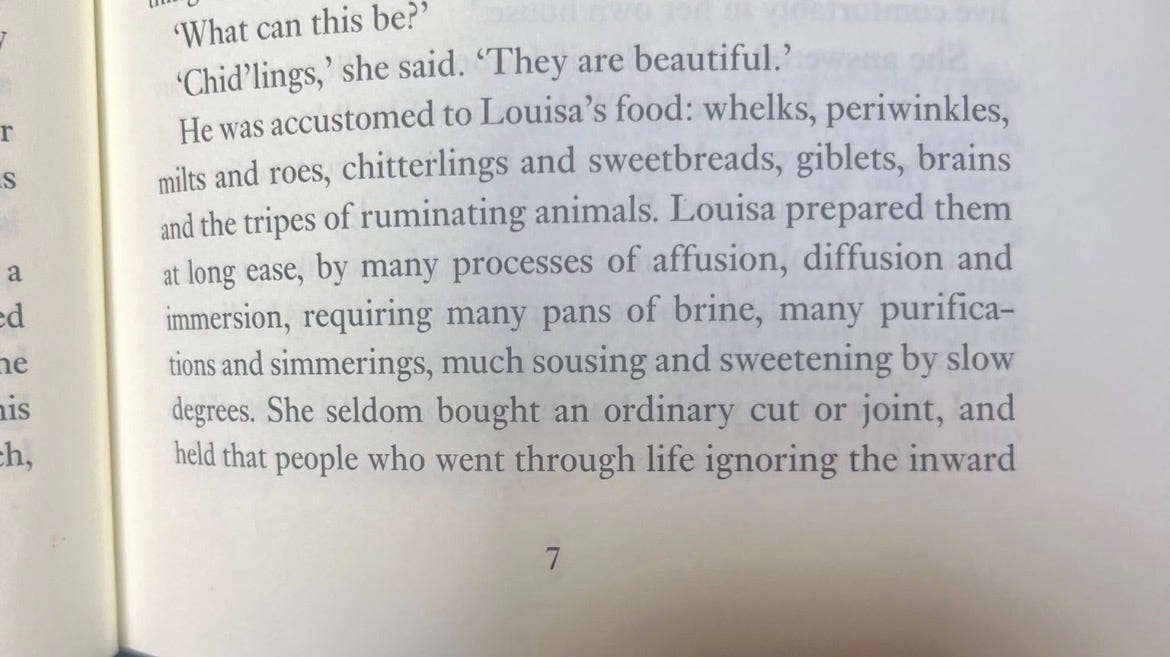
Food is essential for me to encounter in writing for me to fully enjoy a work though it annoyingly often does not have a second act not that I am hankering for it! I don’t find gross bathroom stories people go out of their way to tell me because of my last two books pleasurable or moreish, only interesting because I think humanity thinks too much of itself. I don’t like abstracted emotions and meaningless dialogue free of crunching or free of cupboards piled with edible things and toilets flushing. Contemporary writers are often at pains to make the food in their books delicious and beautiful.See CLB duck cooked in cherry sauce and nice sausage rolls. But I think the particular genius of Iris Murdoch is the knowledge you can make your characters eat anything, eggs in bran cereal for example. ( are we so put off by her these days partially due to her husband exposing in his memoir how filthy their house was) I love the bitchy disdain of A.S Byatt in her story ‘ Raw Material’ when a writing student describes at length some ooey gooey truffle pasta
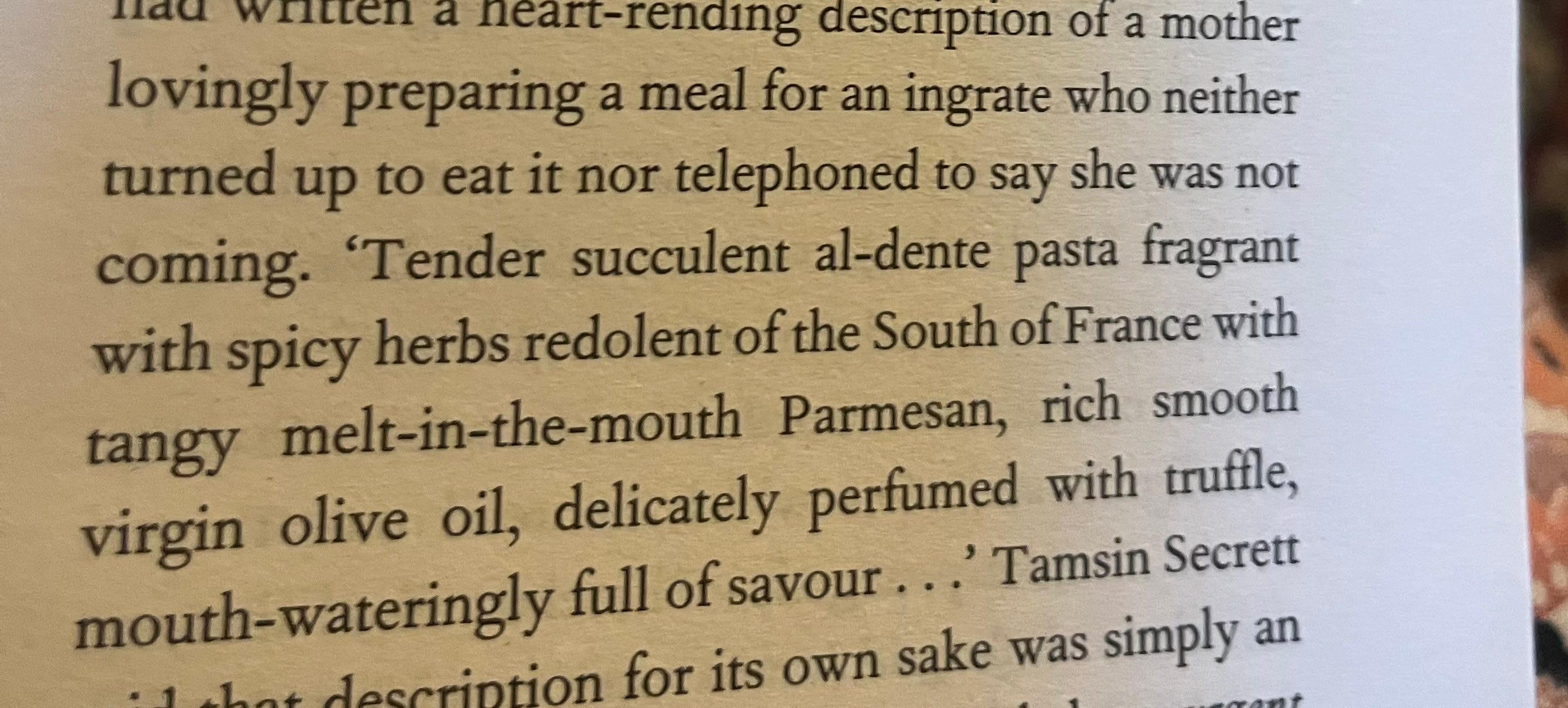
and Evelyn Waugh apologising for the French restaurant descriptions in Brideshead Revisited, saying he wrote it during rationing. The only thing of value I retain from reading harry potter is the idea that the ghosts have to eat rotting food. I can quote lunches eaten in Samuel Beckett stories but I am afraid of the Beckett estate. When Dickens characters eat cold mutton with porter, but I haven’t been to an old London chophouse! I want to go to one when in London in march . The toenail cornflakes in Fungus the bogeyman. The only thing I love in crime novels is when the exhausted protagonists have coffee and sandwich breaks. I idealise the 60s and 70s as nescafe boiled egg eras with perhaps unidentifiable mayonaissy unappetising appetisers served at boozy parties but licentious and innovative writing, the image of a woman writer in 1978 dumping a tin of beans on a plate and saying I don’t have bloody time to do anything else. In our giving food a holy status we are at pains to remove it from any association with effluence. Now and then memory of the edinburgh sewage plant tour guide, with shockingly white veneers, saying don’t look in this part if you like eating chilli! and me being alright because at an old job we had to throw out the unsold chili, right into the toilet, cutting out the middle man and the backsplash would get all over the soup pot but what could you do. Adages about food as love, care or memory blegh! Is that all we remember of Proust. Food becomes sludge within a day.
Alexandria, Neanderthals
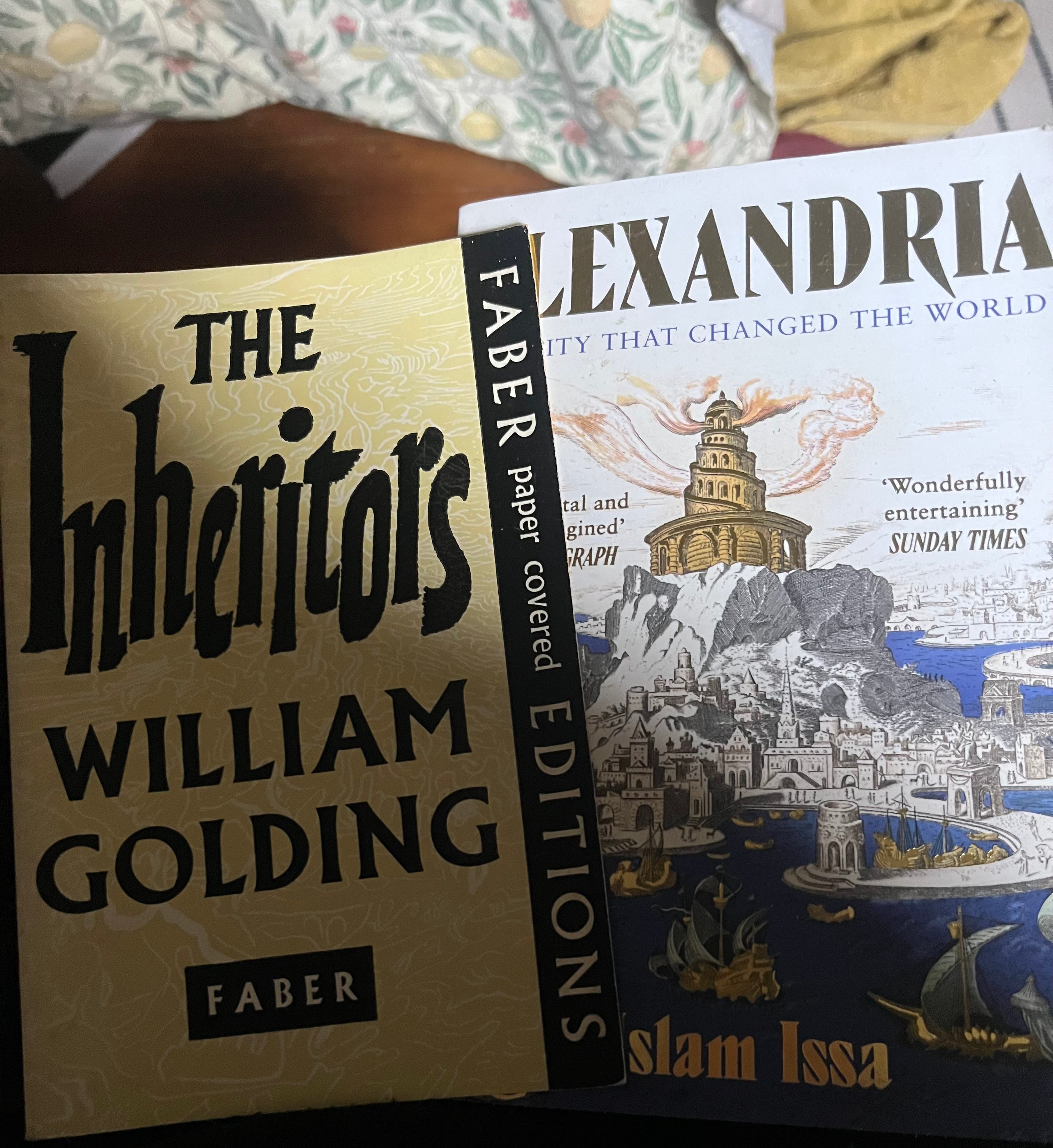
One of my life projects is to seek historical eras I find boring or off-putting in someway and learn about until I end up having a great like for them. You can change your taste through determination and familiarity. I did this with the 18th century several years ago, which I thought was dull compared to the 19th century, so I learned it till I loved it, wedgewood wigs and all. I did the same with the 17th century last year, I can’t say what exactly put me off it, John Milton’s unflattering haircut down to the shoulders and with a parted fringe maybe . Now I love the 17th century, I would go even so far to say it is my favourite period of British history. (Civil War, Thomas Browne, Purcell) Now it is time to confront my fear of Ancient Egypt, and Greek Alexandria is going to be my gateway in before I go farther back into the scary past, like past Ramesses II far into the old kingdom.I had to read a bit of Fraser’s Ptolemaic Alexandria years ago at the Toronto Reference Library when researching the history of Automata so I will go back to that book and I bought a survey history of Alexandria in that secondhand bookshop in York by the cathedral last year then will go from there. I had to stop midway through an episode of Great Canal Journeys in which Prue and Timothy go to the nile as I got too freaked out but a week ago I watched an old Father Brown episode of the ‘ancient mummy curse in Oxfordshire’ genre and enjoy it immensely. It probably has to do with that Brendan Fraser Mummy movie from 1999 and probably knowing a kind of freelance Egyptologist as a child with an endless supply of scarabs in their pocket and broken eggs in random corners of their car and also catching somewhere that the diet of the men who were forced to build the pyramids was only raw onions and beer, and the tall hats and incest of course . And there are a lot of conspiracy theories about ancient Egypt, more than any other old culture probably. Early human history freaks me out too, Homo Erectus in particular (neanderthals and denisovans don’t seem as bad I feel a bit sorry for them because we made them extinct. The suffering of orangutans and bonobos make me shudder quite a lot) and 1960s museum dioramas of them, but I listened to David Runciman’s podcast episode ‘The Rise and Fall of Homo sapiens’ the whole way through and I think I can do it. The podcast had this line in it about how our organs aren’t designed to hang upright off our spine, but dangle off it in a horizontal position, like laundry, which has only increased my faith in Pilates and crawling around on all fours. I also got ( after it was mentioned in John Carey’s memoir ) The Inheritors by William Golding a novel about early humans killing off the last Neanderthals . I think both represent a completely unfamiliar long gone humanity, and I’m just very attracted to the Romans and the Greek Hellenistic era because because they are so familiar with their jokes and sauce and novelty perfume bottles.
The History of Sound
This film is really horrible, a disgraceful squandering of two lovely It boy actors who are trying really hard with what they’ve been given. The narrative keeps inching up to conflict then avoiding it. Ok so it was adapted from a short story and is still a short story(Of the Iowa realism variety) it hasn’t been properly transformed into a film. Poetic imagery and vast skips across time ending with a hammy revelation. Daniel and Lionel are two students at a Boston conservatory who travel around America recording folk songs. Lionel is supposed to be an exceptionally talented singer but in a film you can’t get away with someone being an amazing singer or painter without showing it and its just Paul Mescal singing like any other average guy. Set in 1919 the set designs, especially when in the American South, look like a bougie Mormon wedding circa 2011, with mason jars, candles, bare weathered wood and quilts, Paul Mescal sweeping cobwebs away with a gorgeous straw broom. As the director and main actors aren’t American, it has more than a whiff of Mumford and Sons. It endorses American exceptionalism and its romantic notion of itself while ignoring its horrible and endless levels of violence and unique ugliness. I can’t stand when Europeans fawn over the bright lights of New York City and the beauty of run down roadside gas stations. Muriel Spark’s The Hothouse by the East River is the best novel about New York by a European which she wrote while in that nice, cosseted living situation.
The music isn’t a character itself, or central the way it is in O Brother where Art Thou, and even in some scenes of the main characters recording people singing, the songs are drowned out by a non-diegetic Max Richter esque soundtrack (the credits music sounded virtually the same as the Hamnet credits music). It jet sets all over the cast and crew went to Italy to film about five minutes of the film there. The heterosexual intimate scene is longer, more visible than the gay ones though it is supposed to be a gay love story.All the uncomfortable, important and intimate scenes take place off screen. If not about the music, and not about an early 20th century queer relationship , what is the film about? Thank goodness the friend I went with brought some Pringles and we munched on those during it.
Some cinemas are now showing Bela Tarr’s films due to his recent passing, Werckmeister Harmonies is my favourite, while I find Satantango unwatchable because of the cat thing. I know my limits. Nothing much happens in Werckmeister Harmonies, but it is tense and beautiful in a way History of Sound just isn’t with one of the best long shots I have ever seen. It’s about a naive and simple man in a small village entranced by a visiting exhibition of a stuffed whale and the rise of a strange fascistic leader connected to the exhibition called the prince. The soundtrack is banging too.
Annie Ernaux
I’m someone not completely taken with Annie Ernaux the way everyone else is but I read The Possession last night and this was the one for me. It is petty, gloriously undignified, really embarrassing. Annie Ernaux looking you up on the internet because you both dated the same man. ..
No posts
Comments
Nothing yet. Say the first thing.
Sign in to join the conversation.