
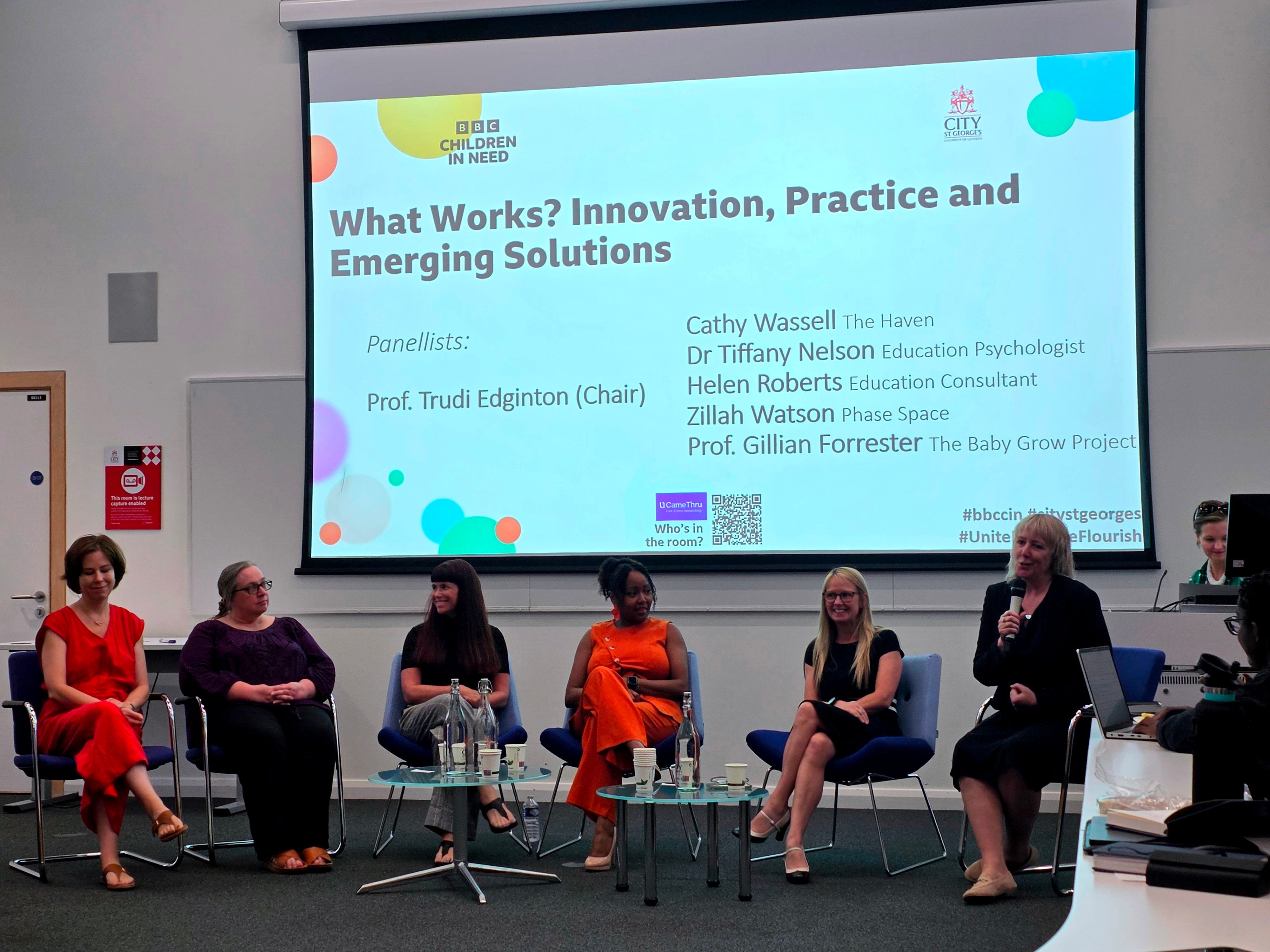
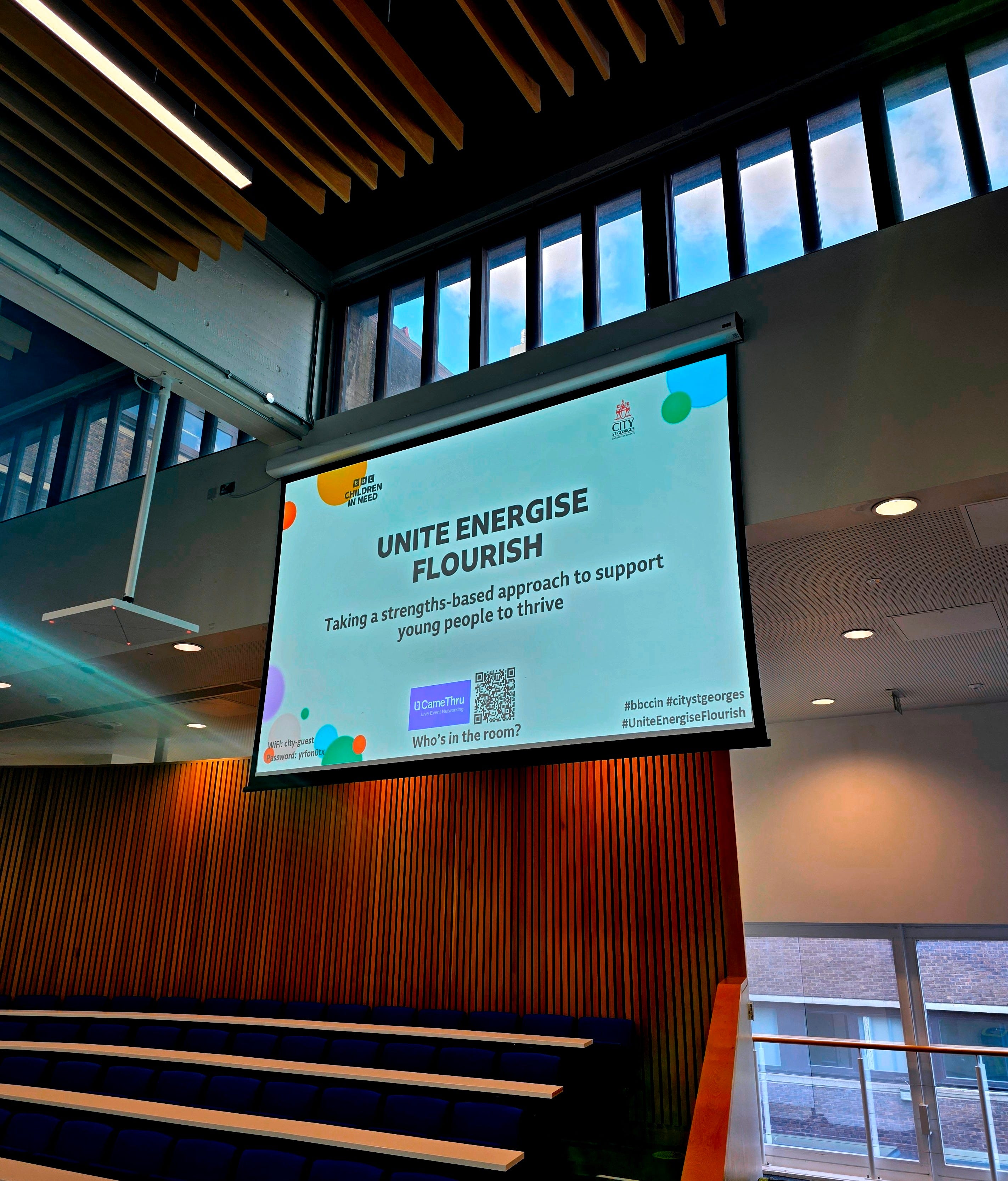
Last Wednesday I sat in a lecture theatre at City St George’s, University of London, at a conference called Unite. Energise. Flourish, run by BBC Children in Need. CameThru was the connection layer for the day, our QR code sitting on the BBC’s Children in needs own slide decks across three screens.
I’ve done a lot of events this year. London Tech Week. Guildhall. Pitch nights. This was the most informative event of the year for me, and not because of anything to do with business. It was a room full of clinicians, teachers, founders, researchers and parents talking about the systems that fail neurodivergent young people, and how to build better ones.
I’m a Black introvert who built a networking product. I didn’t expect a conference about neurodiversity to explain so much of my own story back to me. But that’s what happened.
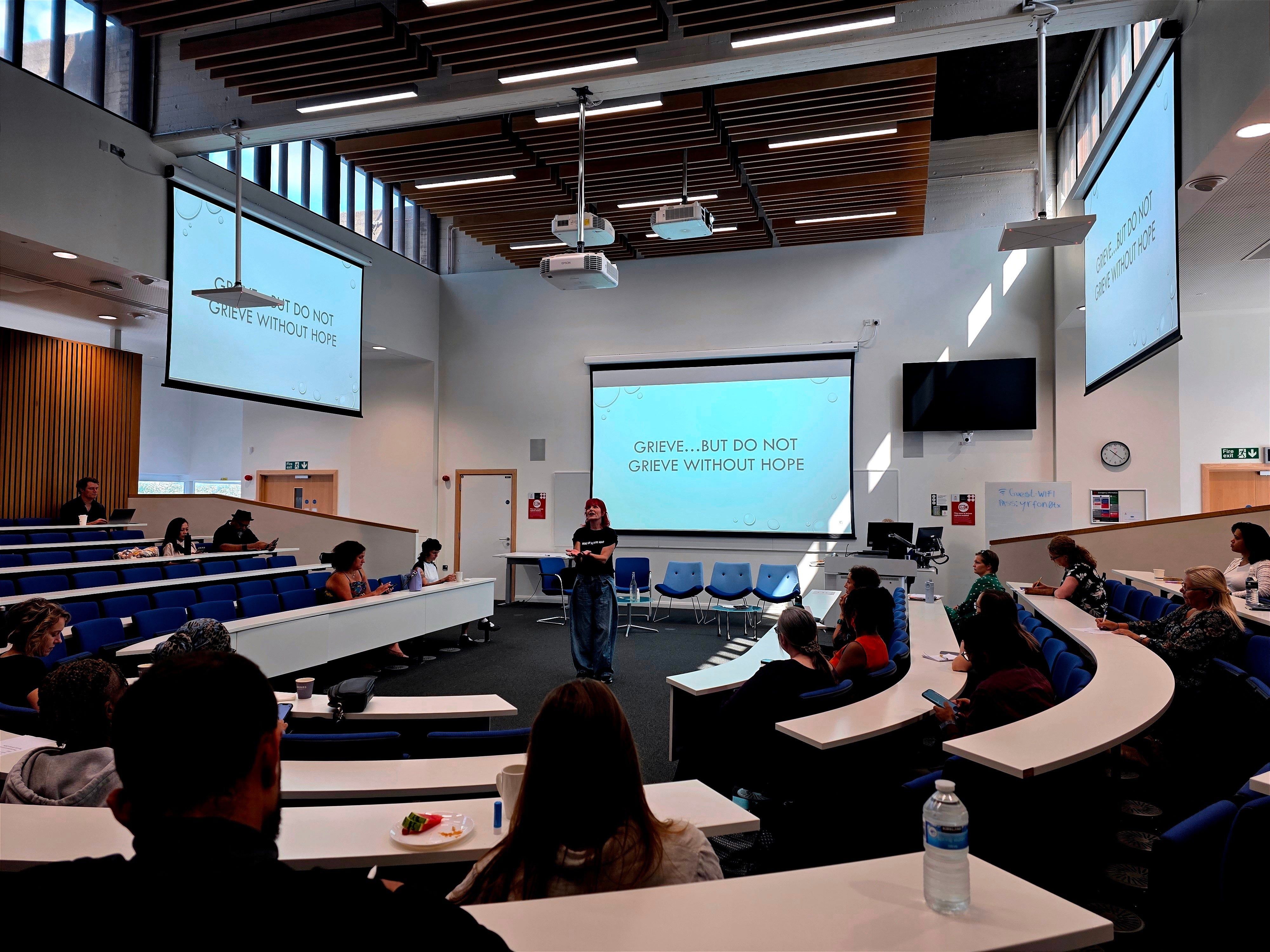
Carrie Grant opened the day. You may know her as a vocal coach and broadcaster. She’s also the mother of four neurodivergent children, one of whom was out of school entirely from 11 to 14, during which time Carrie became, in her words, their mother, therapist, teacher and entire social circle.
She started with the word apocalypse. Not the Hollywood version. The original meaning: an unveiling, a pulling back of the curtain, the revelation of hidden truth. Then she pulled the curtain back. One in three women in the UK will experience abuse. Autistic children face bullying rates reported as high as 94%. Over 175,000 children in England are missing half or more of their education. More than half a million young people are on CAMHS (Child and Adolescent Mental Health Services) waiting lists.
Her point was not to flatten the room. It was this: you cannot fast-track your way to flourishing. She told the story of a writer from the Democratic Republic of Congo who was asked what people did after genocide. His answer: we sat together in the ruins, and we asked how this happened. Not for a day. For months.
That was the day’s real agenda. Sitting together in the ruins, and asking how.
Carrie gave six practices for staying upright under the weight of it all: gather the village, connect with nature and the arts, stay curious, pursue what she calls lowerarchy instead of hierarchy, platform voices rather than claiming to give people one, and build bridges instead of burning them.
And one line that I will carry for a long time:
Have a heart that plants trees you will never sit under.
I’m of that mind completely. Sometimes you do selfless things you’ll get no thanks for. That’s not a flaw in the plan. That is the plan. It’s how any of us make a difference.
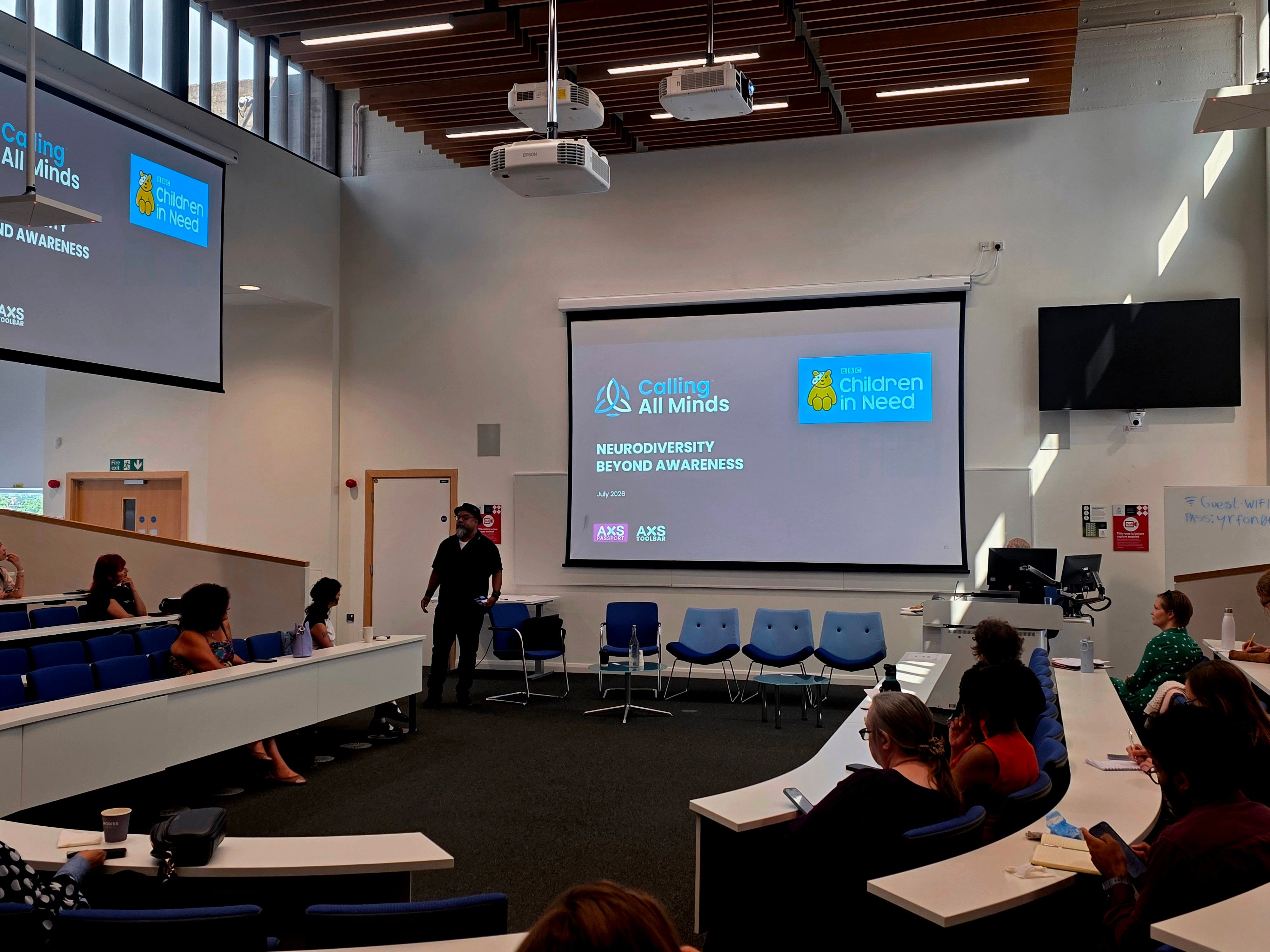
Then Atif Choudhury took the floor. CEO of Calling All Minds, co-founder of Zaytoun CIC, dyslexic and ADHD, one of thirteen children from a big council estate. He advises the NHS, the WHO and the UN on inclusive systems, and he found his voice not through a diagnosis but through solidarity work in Palestine.
His talk rearranged some furniture in my head.
The most disabling thing in the world, he said, isn’t neurodiversity. It’s poverty. The school-to-prison pipeline isn’t made up of ADHD boys or dyslexic boys. It’s made up of poor ADHD boys, disproportionately Black and brown. NHS autism waiting lists run six to nine years in places. Go private and it’s six weeks. His question to the room: do we live in a shared society, or in different economies?
He talked about how people of colour risk more when they enter a neurodiversity conversation, because we are hardwired to survive migration, colonisation and racism, and we do that by hiding. Take away the context and survival looks like deficit.
I sat with that one for a long time.
I’ve never had language for this before, but Atif handed the room a vocabulary. I’m an introvert who spent a decade in corporate rooms at Capgemini learning to perform extraversion on demand, then left and built a product whose entire purpose is to remove the most exposing part of networking: the cold approach, the reading of the room, the walk across the floor towards a stranger. I used to think of that as a clever product insight. Listening to Atif, I understood it differently. I built the thing I needed. I hide well, and I built software so that people like me don’t have to choose between hiding and being found.
It also opened my eyes to system challenges I’ve faced, and my family has faced, that I’d only ever experienced as friction. When the context is stripped away, survival looks like a deficit. That sentence explains years of things. Barriers I’d internalised as personal failings turn out to have architecture. There’s something quietly liberating about discovering that the door you kept walking into was, in fact, a door, and that other people have been walking into it too, and that some of them are now in a lecture theatre drawing diagrams of it.
His best slide was three words: reactive, proactive, anticipatory. Reactive is responding after needs are raised. Proactive is spotting barriers and fixing them. Anticipatory is designing inclusion in from the start. From reacting to problems, to designing for belonging.
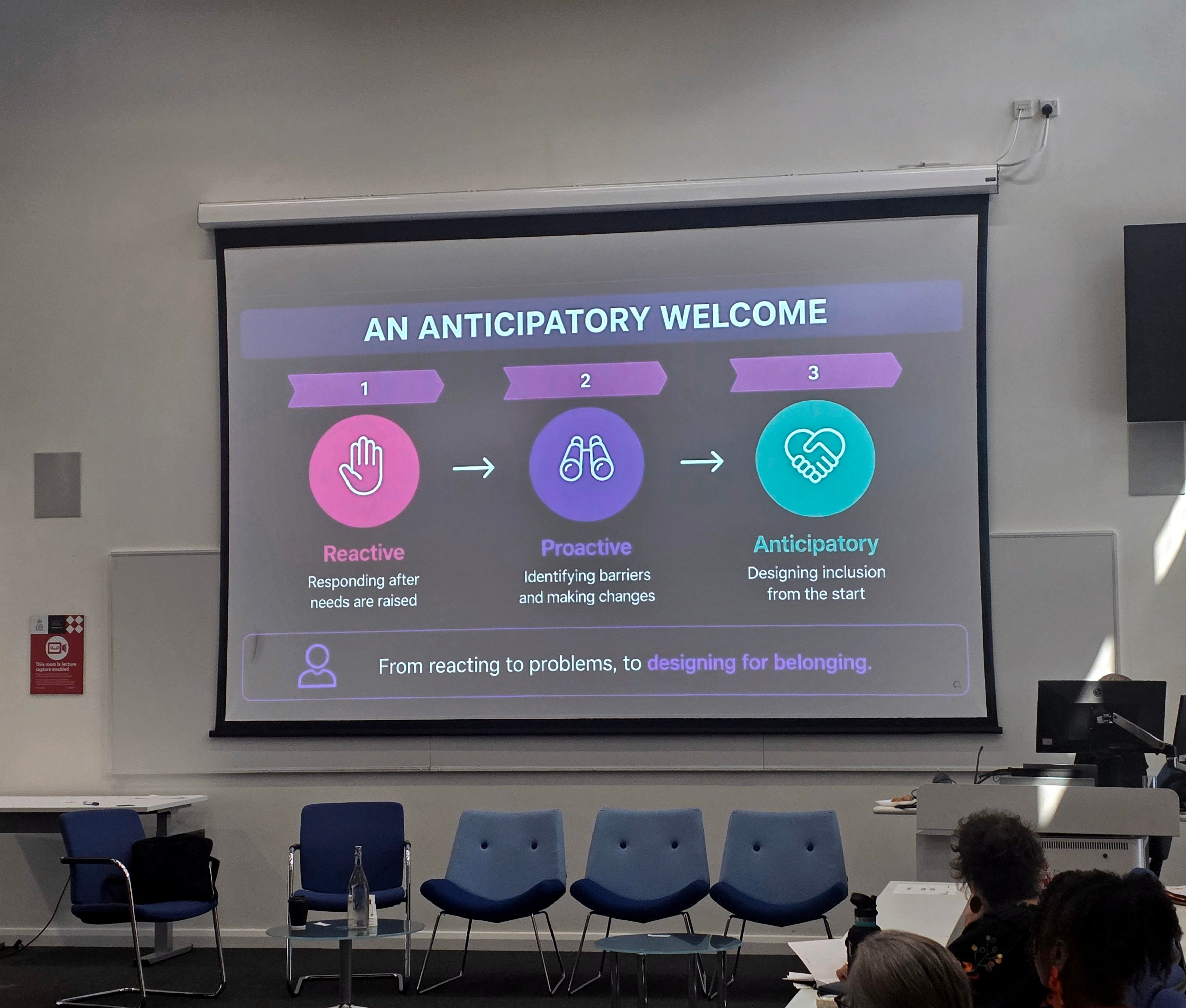
His closing line, up on the screen in purple:
“Power shapes neurodiversity. So must we. All of us.”
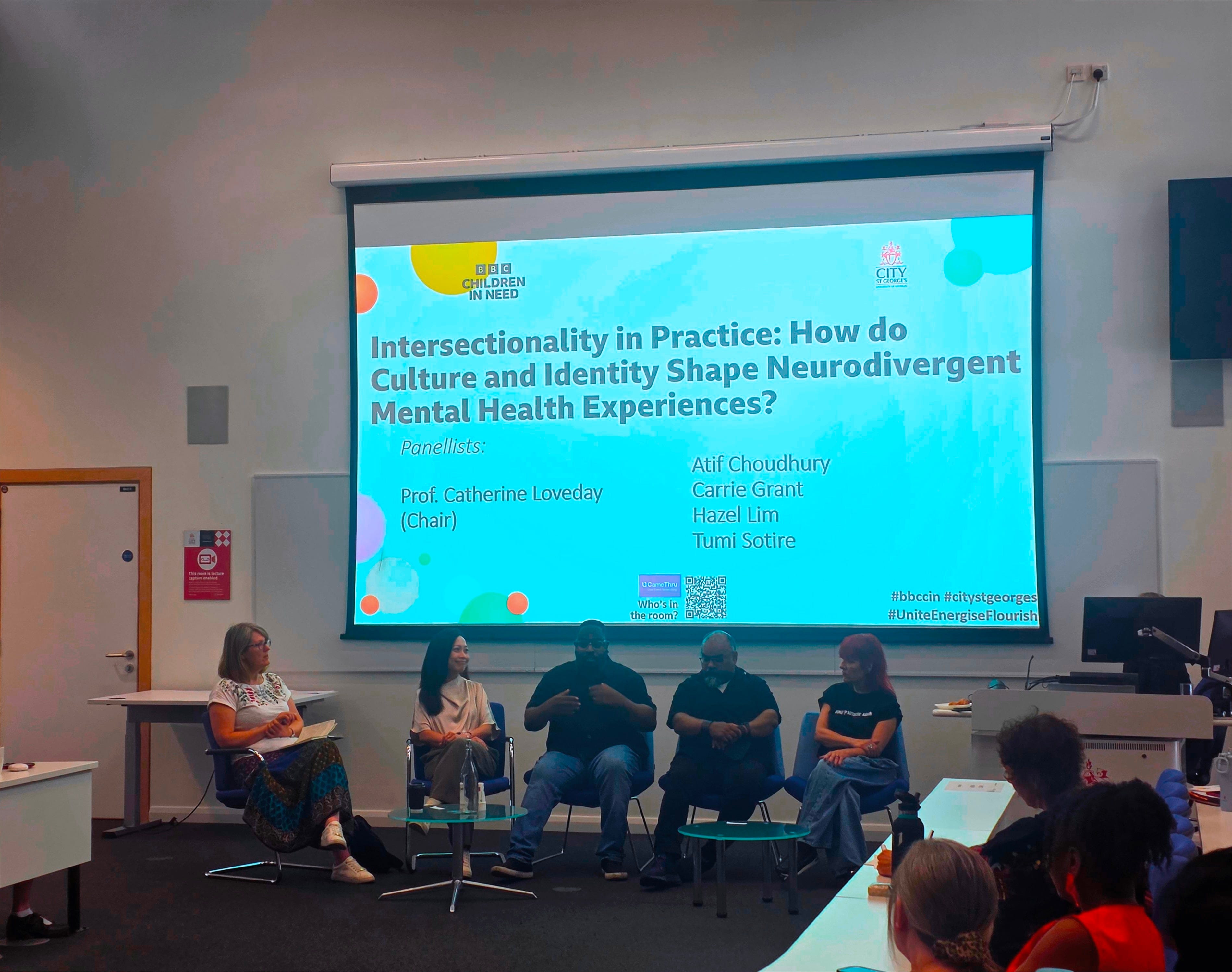
The intersectionality panel, chaired by Prof. Catherine Loveday, brought together Carrie Grant, Atif Choudhury, Hazel Lim, and Tumi Sotire. Bought some great insights.
The average reading age of adults in the UK is nine. If literacy sits at nine, where does that leave health literacy, EHCP (Education, Health and Care Plan) paperwork, tribunal processes?
And around 63% of Black and mixed-race neurodivergent children get routed onto a social, emotional and mental health pathway instead of a SEND pathway. The child becomes a behaviour problem. The family becomes the suspect. The need goes unmet, and it starts young.
Hazel Lim’s contribution spoke about the issue and stigma in Chinese communities, where the term for autism literally translates as a disease, and about being attacked in her own community groups just for raising the subject.
She’s challenging it anyway, taking charge to shape the future for her own family. In parts of Asia the stigma is brutally harsh, and watching someone stand in front of a room and name it was genuinely moving.
The panel’s wider point was that the specifics change across Chinese, Nigerian, South Asian and working-class white communities, but the pattern of shame, silence and masking is almost identical. Having those conversations out loud is how awareness gets raised, and it’s how we all move forward.
The image I took home came from the discussion about being first: it’s not enough to be first through the door. The job is to smash the door so there’s an archway others can walk through.
The afternoon was proof that the ruins aren’t the whole story.
Prof. Gillian Forrester’s Babygrow Project at the University of Sussex is tracking 100 babies from their first days of life, using AI to analyse every wriggle and kick, because motor and sensory development is the platform language and social skills are built on. Between 50 and 88% of infants later diagnosed autistic have a co-occurring motor condition. Read the movements early enough and you may have an early detection system years before current screening.
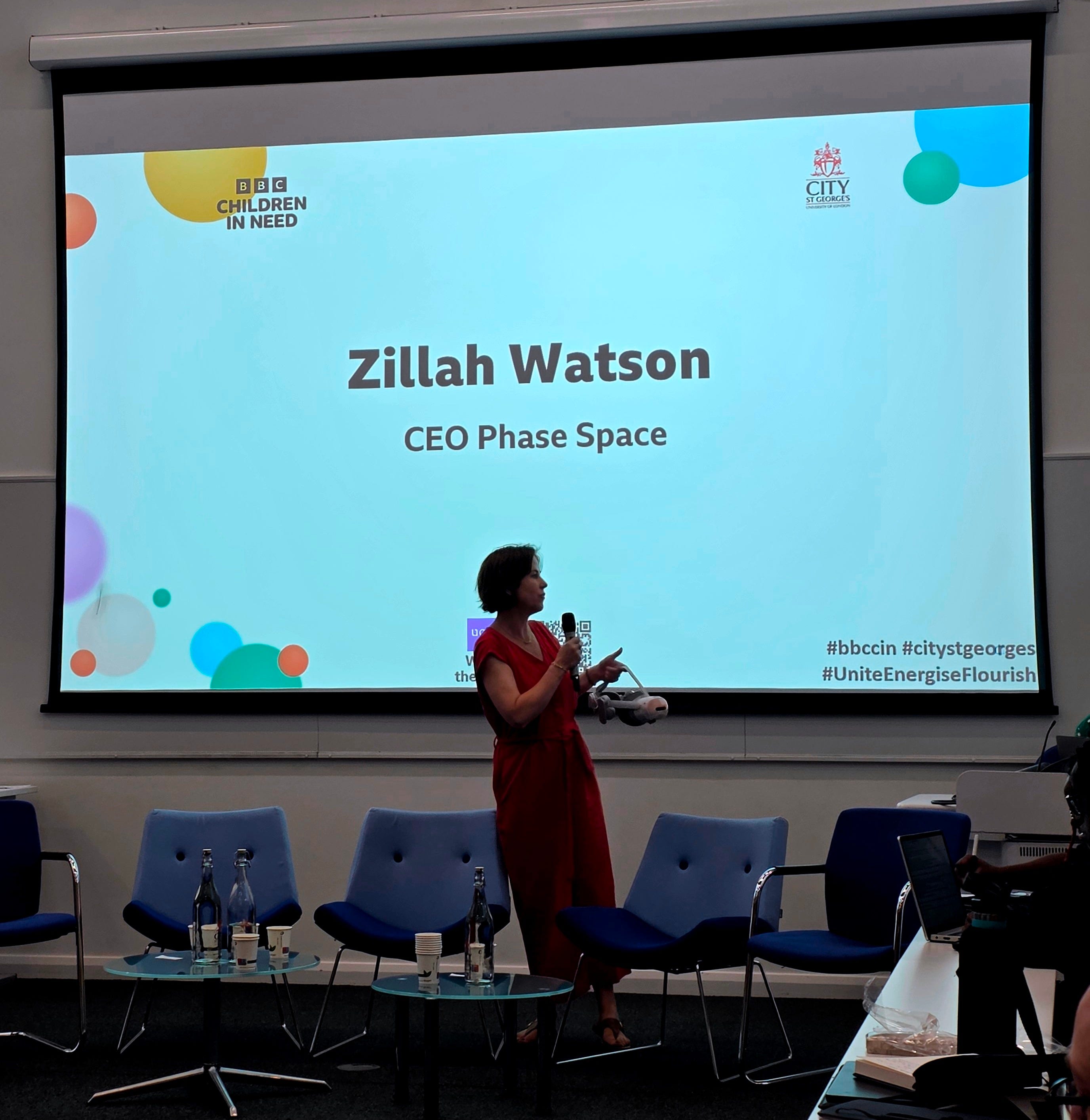
Zillah Watson’s Phase Space, former BBC head of VR, is a seven-minute virtual reality reset co-designed with students. It’s now in every one of Sutton’s 15 secondary schools, in partnership with CAMHS and backed by the South West London St George’s NHS Trust. Its superfans are often ADHD and autistic students who disengage from standard breathing exercises. One pupil’s review: it met me where I was.
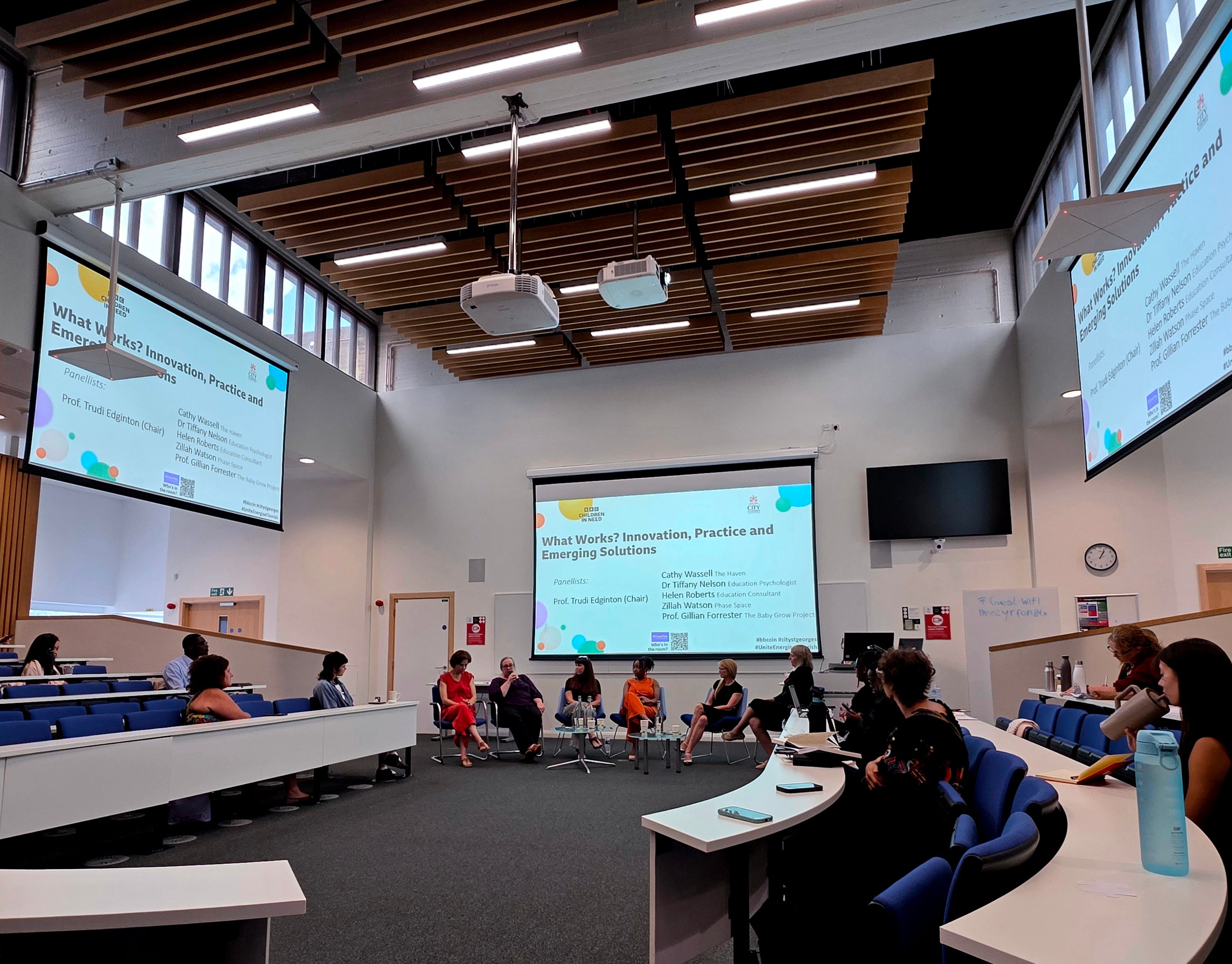
Helen Roberts, thirty years in education, told the story of a nonverbal Year 5 girl with complex needs who lost every safe space in her school during building works, until a mobile sound-absorbing pod changed her life almost overnight. Helen’s confession: in three decades as a teacher, SENCO and head, nobody ever taught her that BB93, the building regulation governing noise in schools, existed. The knowledge was there. It just never reached the room.
Dr Tiffany Nelson, educational psychologist was the most honest voice in the room about how change actually fails. She arrives in schools with a title, with influence, with what she openly called power, and she still struggles to change systems. Reports get written, provisions get recommended, and then nothing gets implemented, because without buy-in from senior leadership every good idea dies against the same three walls: no capacity, no space, no funding. She wasn’t cynical about it. She was precise about it, which is rarer and more useful.
Then she described her practice with parents, and this is where she was incredible. Parents arrive at school meetings pre-labelled. Anxious. Rude. Difficult. The labels are handed to her before the parent even enters the room, and her response to professionals is disarming: what do you think school was like for that parent when they were a child? Because the anger you’re reading is often old fear wearing a coat.
Her opening line to every parent: you don’t need to evidence anything with me. Just tell me what’s going on. And the feedback she hears most often, the one that should be printed on the wall of every SEND department in the country: you listened to me, you believed me.
She speaks from inside the experience, not above it. She assumes that if a child is neurodivergent, a parent probably is too, and she is that parent, with an autistic daughter and another with ADHD, advocating in the same meetings she chairs professionally. In the breakout she added the day’s most uncomfortable professional insight: strengths-based language, used carelessly, becomes a new way for children to be missed. Write the report too positively and the panel can’t see the need, and the support never comes. Even our kindest language can hide a child.
And her ask for the future was the one that tied the whole day together: intersectionality at every level, not as a panel topic but in policy. The new schools white paper consultation, she noted, mentioned race about twice; she couldn’t recall intersectionality appearing at all. Great innovations mean nothing if the same communities never get access to them, and who decides access is always a power question.
Cathy Wassell opened The Haven, an online school for neurodivergent girls and non-binary young people, within a year of it existing only in her head. Learners who had been out of school for five years engaged within a week. Her daughter, who she once feared wouldn’t survive the night, just finished her first year at university with a First. Flourishing is possible. Her words, and her proof.
And Charlie Winton of OK Positive gave a live demo of NeuroConnect, built in collaboration with Dr Trudi Edginton and City St George’s. An AI helper, drawing only on validated expert content, that lets a young person describe what they’re feeling without needing to know words like ADHD, with safeguarding escalation built in and support for parents stuck on SEND waiting lists. The detail that matters: it grew directly out of what was said at last year’s conference. A room produced a product. I had a great conversation with Charlie afterwards about his reflections on the morning and gave me some top tips regarding fundraising should I want to explore that in the future.
Tricia Young, Director of Impact and Influence at BBC Children in Need, closed the day with her own family’s story and an honest reckoning: navigating the system well is a privilege, and support shouldn’t depend on it. Her final note was about this word: UBUNTU. I am because we are.
Sitting at the back with the CameThru dashboard open, that line landed differently. A live attendee graph is ubuntu rendered as software. Nobody appears on it alone. You only exist on the graph through connection.
CameThru is a screen based, opt in visibility layer. If you want to be findable, and you don’t want to lose access to the people in the room once the room empties, you join.
Before, during or after the event. This event used that to full effect.
The link went out one day before. Thirty-nine people joined the graph, from the 09:08 early birds to someone joining from their sofa at 22:26 that night. There were 189 profile views and 44 social link clicks. And here’s the number I keep coming back to: 101 of those profile views happened after the event ended. More than half of the room’s networking happened once everyone had gone home.
The speakers opted in and joined their own audience. Two panellists joined after the events completed.
And one attendee quietly showed me exactly why I built this. Their status read, roughly: happy to chat, just low on energy to initiate today. At a neurodiversity conference, on a platform designed so that nobody has to perform the cold approach, they made themselves findable without spending energy she didn’t have. They ended the day among the most-viewed people in the room. The room came to support
That is the anticipatory welcome from Atif’s slide, running in production.
There was one detail I have to credit to Felicity Bennett. She didn’t just put the QR on a holding slide before the doors opened. She built “Who’s in the room?” into the corner of every content slide, right through the day, so the invitation to connect sat quietly under every talk. I’ve never seen CameThru used that way, and watching people choose to scan mid-session, off the BBC’s own deck, was one of my favourite moments of the day. Every time I run an event I learn a new use case for the thing I built. This one’s staying: I’m turning it into a badge, for pitch deck presentations “Who’s in the room?” 👀
The community that uses CameThru is the community that builds CameThru. Felicity showed me a use I hadn’t imagined, and now it becomes a feature everyone gets. That’s the whole point.
I write this post as England have just beaten Mexico and progressed to the quarter finals. I stayed up for the game, and honestly, it might be the best England performance I’ve ever seen. Ten men down. Backs against the wall. The system feeling stacked against them And still, they found a way.
The resilience, determination and fight they showed has left me inspired this Monday morning.
What a win. Back to the post…
The day was supposed to end at 16:30. It didn’t, because England were playing that evening, and a few of us stayed back to watch: Trudi, Felicity, Mahdi, Tumi and me, front row seats at a BBC partner venue, which felt only fitting. Watching everyone’s emotions as we got through was the perfect end to the day. Some things you cannot plan, and the way it worked out felt like it was meant to be.
It's coming home… 🤞🏾
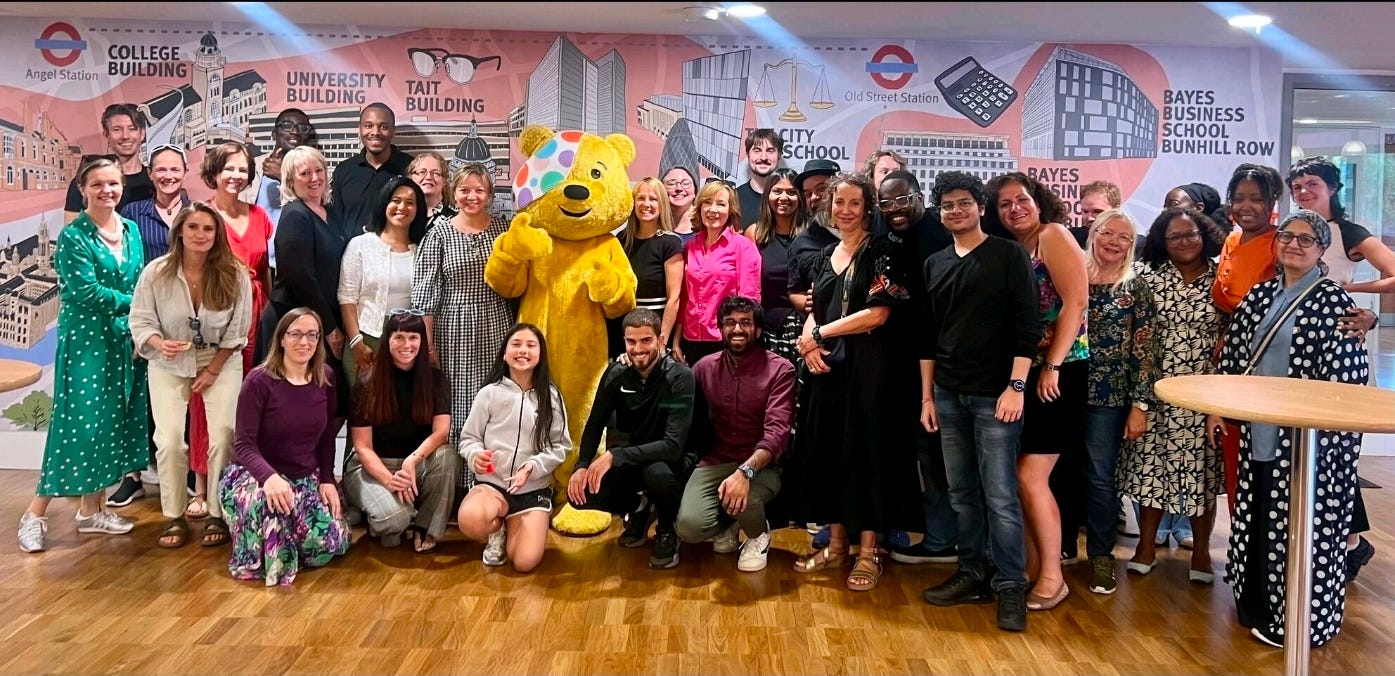
Also for the record: the catering was less lunch, more banquet. BBC Children in Need delivered big time. And yes, I met Pudsey. Yes, there is a group selfie.
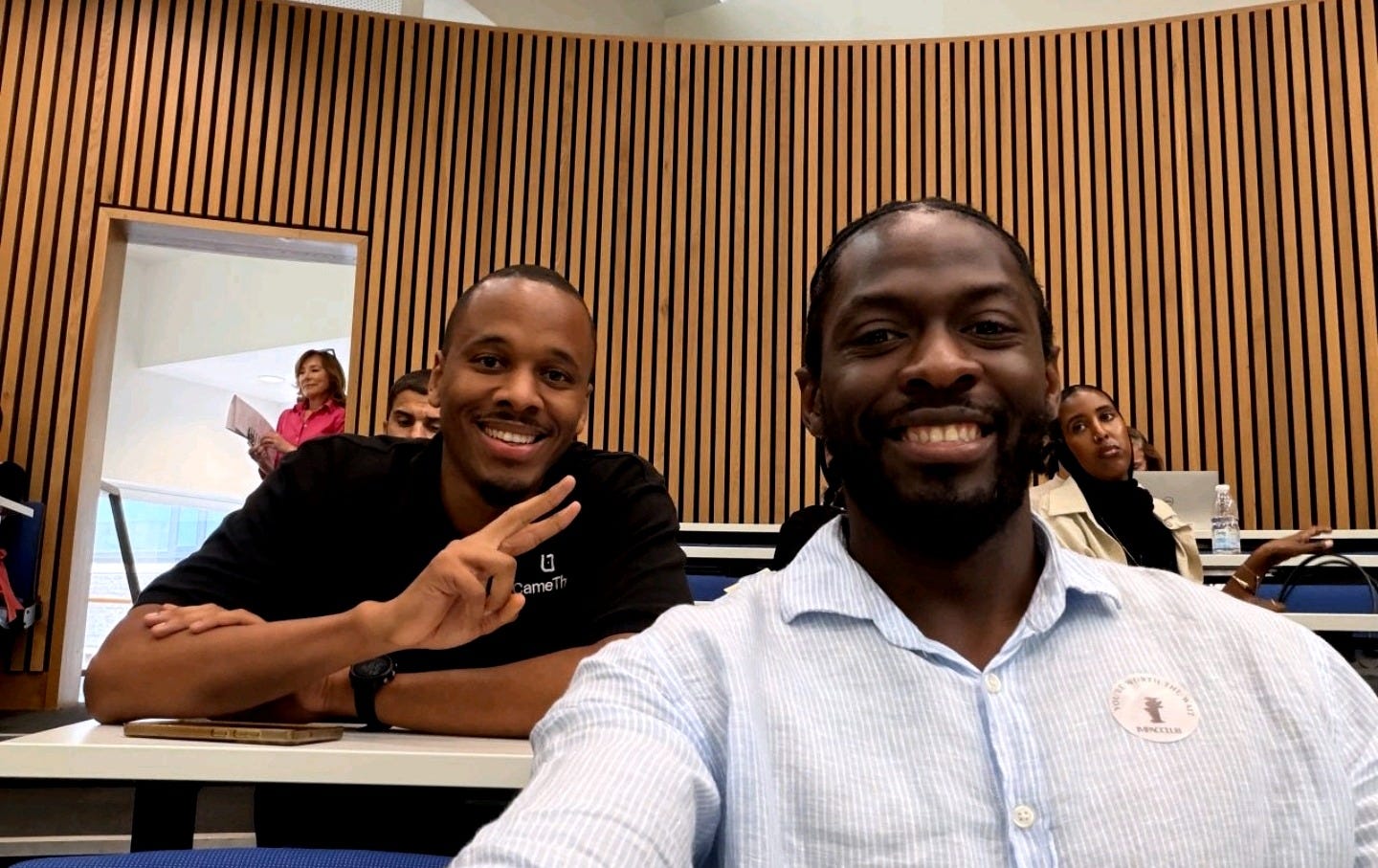
Go to events outside your industry. Go to the ones that have nothing to sell you. This one taught me more about my own product, my own family and my own story than any pitch night this year. It just felt right, and I’ve learned to trust that feeling.
Thank you to Felicity Bennett and BBC Children in Need, Dr Trudi Edginton and City St George’s, every speaker, and everyone who came and said hello to an introvert with a QR code.
Plant trees you’ll never sit under.
See you at the next one.
CameThru is the live connection layer for events: opt-in, browser-based, no downloads. If you run events, own venues or build communities, you are exactly who I built this for. Reply to this email or find me on the graph.
Comments
Nothing yet. Say the first thing.
Sign in to join the conversation.