
We planned it months in advance. Yesterday afternoon, I was scheduled to preach online for a warm and close-knit local community. I checked the lectionary and spent last week gathering my thoughts, looking up Greek words (because I am a nerd and because words are magic), and wrestling my bullet points into prose.
And then we all woke up yesterday morning to news of a horrific bombing, of yet another war. In my homily I’d been focused on our ongoing domestic crisis, the demonization and terrorization of our immigrant and refugee sisters and brothers. I have a feeling that every preacher who is committed to showing up at the ambo with the gospel in one hand and the newspaper in the other, as Karl Barth so famously called us to do, is perhaps having trouble keeping up.
Thanks for reading Attention and Astonishment! Subscribe for free to receive new posts and support my work.
During a busy Saturday with the kids, I didn’t have time to rework the entire homily. But this community brought the newspaper in the hand that I didn’t have free, and it was so good to be with people who were grieving and praying for peace, the unarmed and disarming peace that Pope Leo called for in his very first address.
The time that I had with this beautiful community, listening to their longing and heart-wrenching responses to this new act of horrific violence, was a moment of transfiguration in my life. I am grateful for it.
I’m sharing my homily below not because I have all (any??) of the answers, but because I firmly believe that we need to cling to the ways in which God is present to us, most often through one another, as we face down terrifying and cascading violence over which we have no control.
Come, let us wrap our arms around each other.
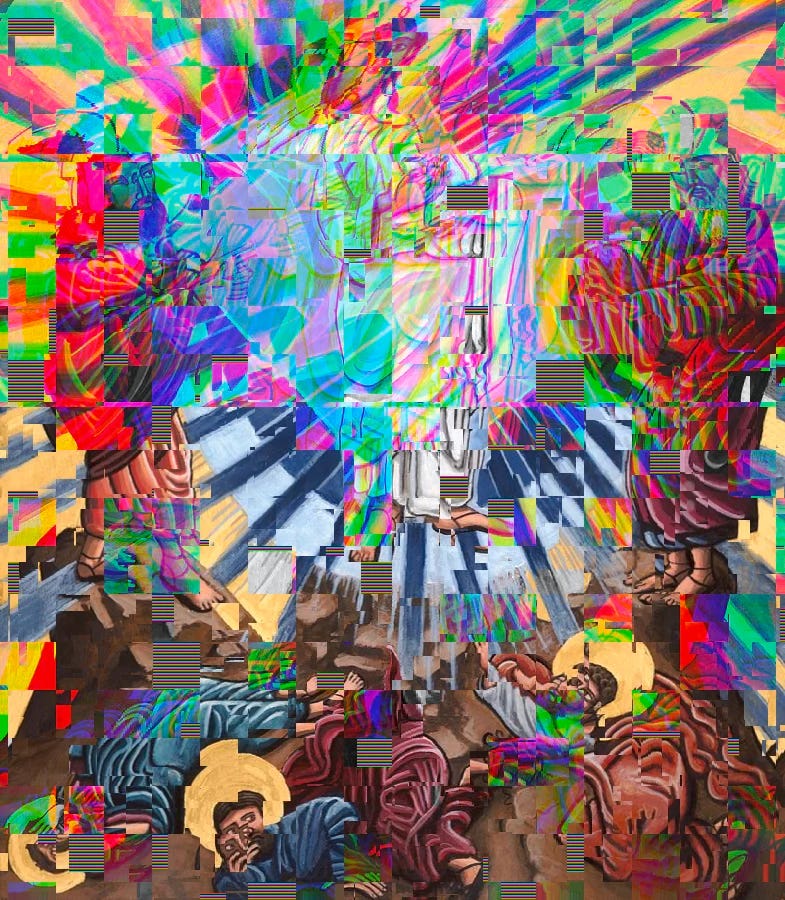
Years ago, a friend of mine who isn’t Catholic respectfully asked me a question. “I don’t understand,” he said. “If Catholics believe that Jesus is really present in the Eucharist, how can people just sit in their pews and go about life as usual? How are people not lying prostrate, their faces pressed to the floor?”
It was a good question. I’m not sure I had a good answer for him that day, but as I’ve thought about it over the years, I’ve come to understand how rooted his question was in Scriptural tradition—and how grateful I am that Jesus offers us another path.
My friend was probably thinking of the Scriptural instances of theophany—when God appears to us here on earth. And the two figures who are talking with with Jesus in the blinding light of the Transfiguration, Moses and Elijah, were no strangers to it.
Moses encountered God many times—first in a burning bush, then atop Mount Sinai amidst thunder and fire, and finally, from the safety of a cleft in a rock, Moses was able to see the back of God passing by—because no one could see the face of God and live. Elijah also met God on a mountaintop, amidst wind, an earthquake, and fire.
These moments are cosmic, and, well, frightening. In fact, the Israelites were so afraid after seeing the thunder and lightning on Mount Sinai that they pleaded with Moses to be their intermediary. “Don’t let God speak to us directly,” they said, “or we will die.”
Peter, James, and John are following in the footsteps of a long tradition in today’s reading when they fall prostrate and are terrified after the Transfiguration.
And this is why I think it’s actually what happens after the Transfiguration that might be more important than the holy moment of theophany. Because what happens there on Mount Tabor is nothing short of revolutionary: it is an entirely new way to encounter the living God.
Moses and Elijah met God in overpowering physical events, and their fear seemed perfectly justified. God was a powerful, otherworldly force. But when the disciples have the same understandable response to the Transfiguration, the aftermath is entirely different.
They receive from Jesus a human touch. A human assurance that there is no need to be afraid. Except that those human interventions are also divine.
The Greek word that is used to describe Jesus touching the disciples, haptomai, is the same word used when Jesus touches those he heals: the ten lepers, the woman with twelve years of bleeding, Peter’s mother-in-law, raised from the dead. The word arise, which Jesus speaks to the disciples, egeiro, is the same word Jesus speaks to the man on the mat lowered through the roof by his friends. It is the same word, in fact, used to describe Jesus’s own resurrection.
It’s these deeply intimate, personal experiences of a God within reach into which we are all being invited as listeners of today’s Scripture, as children of God. And it’s an invitation made by a God who is deeply human and also makes space for our own humanity.
I think what I would tell my friend today, after decades of pondering his question, is that I don’t think human beings are capable of sustained transcendence—and that we are known and loved by a God who understands that and embraces us anyway, who perhaps even delights in the human limitations of our spiritual sensitivity.
And, of course, on Mount Tabor as in our own lives, the mountaintop moment cannot last forever—the light fades, Moses and Elijah disappear, and there’s no time to build the tents Peter proposes. The Transfiguration passes all too quickly. But the disciples are not left alone—they are in the company of Jesus, their friend and their God.
It’s Lent, but I can still make out that beautiful refrain from Advent: Emmanuel. God with us.
The disciples could see, however briefly, the thread that runs from Moses through Elijah and on to Jesus: the prophets, in the company of the Messiah whose appearance they heralded. Even though Peter, James, and John didn’t fully understand it yet, all the pieces were there: manna in the desert, leading all the way up to the Eucharist, our daily bread. We don’t get many experiences of epiphany like that in our lives—maybe only a few—and they are precious.
But those moments are fleeting, and I think today’s gospel is telling us that that’s okay. We should hold to those flashes of transcendence when we can, but their absence does not mean we have wandered away from God’s presence. Not every moment can be mystic ecstasy, overwhelming theophany (to my great chagrin). But God is still just as present to us in every aspect of our human experience, whether we trace this presence to the incarnation or all the way back to creation, when God breathed into the lungs of the first humans.
That foundational theology tells us that we don’t have to have a mountaintop experience to know that God is with us, gently, tenderly, telling us not to be afraid. This visionary, deeply meaningful encounter with God, is always within our grasp, right here in our daily lives.
There’s one other thing that I think this human touch of God calls us toward—seeing the face of Christ in the people we encounter, and loving them as intimately as God loves us. I know I don’t have to tell you that this is a terrible moment in our country’s history, marked by unspeakable cruelty and violence toward our neighbors. Now is the time for us to wrap our arms around them, to offer them our assistance, our support, our presence. Now is the time to put flesh on love, and if we are not able to say, “Be not afraid” to our terrorized neighbors, let us at least say, “I am here with you.”
The Transfiguration allows us, at last, to see the face of God and live. Not only to live, but to feel the arms of a tender, compassionate God wrapping around us. And it invites us to be those same loving arms to each other.
Opening my arms with you,
Cameron
Thanks for reading Attention and Astonishment! Subscribe for free to receive new posts and support my work.
Comments
Nothing yet. Say the first thing.
Sign in to join the conversation.