
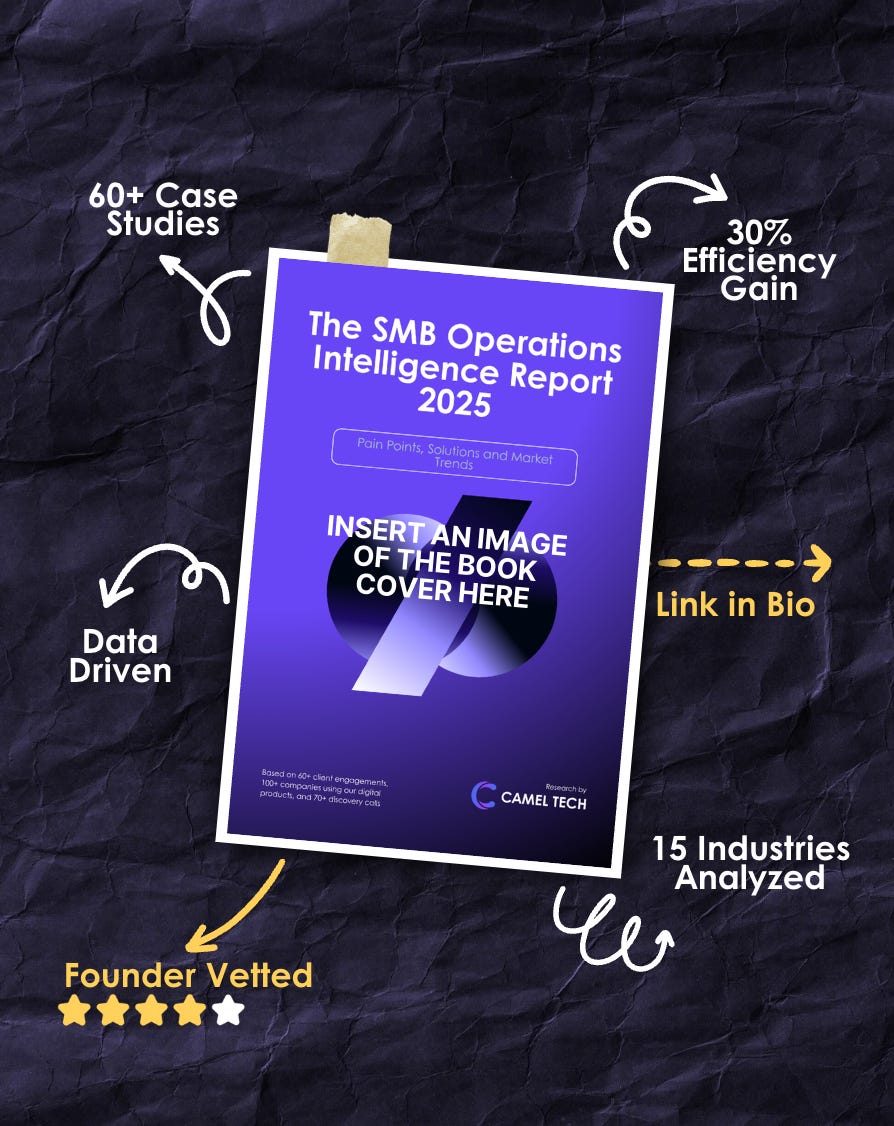
Last year, we worked with 60+ clients and talked to over 70 founders across 15 industries.
That’s 1,200+ pages of conversations. Discovery calls. Implementation projects. Post-mortems.
Instead of letting all that insight sit in our folders, we analyzed everything and put together the 2025 SMB Operations Intelligence Report.
This isn’t theory. It’s not advice from people who’ve never run a business. It’s patterns from real conversations with founders scaling from $1M to $10M.
Here’s a preview of what we found.
We expected to find unique challenges in each industry. We were wrong.
The same 6 problems kept showing up - whether we were talking to a construction company, a healthcare business, or a marketing agency.
1. Nothing is documented (95%)
Processes live in founder heads. Training happens differently every time. When key people leave, knowledge walks out the door with them.
2. Tools don’t talk to each other (90%)
Data lives in 7 different places. CRM says one thing. Project management says another. Finance is in a spreadsheet somewhere. Nobody has the full picture.
3. No founder dashboard (85%)
Founders wake up every morning with no way to see how the business is actually doing. They log into 4-5 tools, ping team members on Slack, and piece things together manually. By the time they get clarity, the information is already stale.
4. No real accountability (85%)
KPIs either don’t exist or aren’t tracked consistently. Due dates get set but not enforced. Employees don’t know what success looks like in their role.
5. Founder dependency (80%)
Business stops when the founder steps away. Every decision flows through one person. Vacations? Forget it.
We asked 50+ founders: “Can you take a 2-week vacation without checking email?”
0% said yes. Most laughed at the question.
6. Software waste (75%)
Companies use 10-20% of their software features. They pay for 3-5 subscriptions they barely touch. Average waste: $500-2,000 per month.
We tracked tool preferences across 50+ clients. Here’s how it broke down:
Project Management:
ClickUp: 45% - teams that need templates, time tracking, email integration
Notion: 30% - teams that want flexibility and better documentation
Monday.com: 25% - highly preferred by construction and trade companies
CRM:
Go High Level: 40% - agencies love the all-in-one approach
HubSpot: 30% - enterprise clients with existing investment
ClickUp CRM: 20% - teams wanting one platform for everything
Custom Notion CRM: 10% - small teams with simple sales processes
Automation:
Zapier: 40% - simple integrations
Make.com: 35% - complex multi-step workflows
n8n: 15% - self-hosted, privacy-focused teams
60% of founders we spoke to either use, have tried, or want to implement EOS.
But almost none have it working the way it should.
The problem? Tools like Ninety.io only track weekly scorecards. Founders want daily visibility. They want EOS inside the tools they already use - not another login, not another subscription.
One client told us: “Our CEO downloaded the template before a plane flight. By the end of the flight, he had the whole Vision Traction Organizer filled in. We’re almost through our first month running on EOS now.”
The difference? EOS built into their existing workspace - not bolted on as a separate tool.
That’s why more than 100+ companies are using our EOS product built on Notion
This is the section founders keep asking us about.
Everyone’s posting about AI transforming their business. But when we asked founders privately? Very different story.
What’s actually happening:
Most businesses have no AI strategy at the company level. Individual employees use ChatGPT or Claude for personal productivity - writing emails, summarizing docs, brainstorming. But at the business level? Almost nobody knows where AI fits.
The problem we keep seeing:
Companies try to bolt AI onto broken operations. They feed chaos in and get chaos back - just faster.
If data is scattered across 10 tools, AI can’t help. It has no single source of truth. If processes aren’t documented, AI can’t automate them. It doesn’t know what to automate.
What’s actually working:
Meeting transcription (Fathom, Otter, Fireflies) - this is becoming standard
AI email drafting - 30% of clients use it, saving 30-45 minutes daily
Internal knowledge bots - but only if the knowledge base is organized first
What’s not working:
AI agents handling customer inquiries - sounds great in demos, falls apart with complexity
Predictive anything - requires clean historical data that most SMBs don’t have
Automated decision-making - fails for anything nuanced
The stat that matters:
Boston Consulting Group found that only 5% of companies are “future-built” for AI. Those companies grow 1.7x faster and achieve 3.6x higher returns.
But here’s what the headlines miss - those companies didn’t start with AI. They built the operational foundation first.
This part doesn’t get talked about enough.
Most founders we spoke with work 60-70+ hours per week. But those hours aren’t spent on strategy. They’re spent:
Answering questions their team should already know
Fixing mistakes because processes aren’t clear
Searching through emails for information that should be in a system
One founder told us: “I can spend an hour searching for an email. Someone sent me a survey report or a decision or something, and I just can’t find it.”
Another said: “I’m so in the weeds of managing the day-to-day that I just feel like we need a reset.”
What changes after systemization:
15+ hours saved per week
Lead response time drops from 72 hours to 2 hours
Vacations actually happen without the business falling apart
Team handles routine decisions independently
This newsletter covers the highlights. The full report goes deeper:
Industry-specific insights for construction, healthcare, agencies, e-commerce, and more
Real quotes from founder conversations
The complete breakdown of what’s working with AI vs. what’s just hype
Tool comparison data across 50+ clients
No posts
Comments
Nothing yet. Say the first thing.
Sign in to join the conversation.