
I’m grateful I had a childhood before the internet lived wherever we go.
Even when we had dial-up, information was slower. Inspiration was slower. You couldn’t summon endless imagery in seconds. You had to wait for the magazine to arrive. You had to notice a color in nature. You had to remember something you saw on vacation and try to recreate the feeling of it.
Time felt slower then.
And I don’t think that’s a coincidence.
I’m equally grateful to live now — in an era where information is immediate, where creativity is accessible, where ideas are everywhere. It has changed everything: business, marketing, connection, and opportunity.
But it has also changed how taste is formed.
I find myself wondering:
When we love something today — where did that preference begin?
Did it emerge slowly, through lived experience?
Or was it reinforced through repetition until it felt like ours?
Algorithms are designed to learn our behavior and respond to it. We pin an image. We linger on a post. We save a reel. And suddenly, that aesthetic multiplies across our feeds.
This isn’t inherently negative. It’s efficient.
But it is narrowing.
The more we engage with something, the more it is shown to us. And the more it is shown to us, the more familiar it becomes. Familiarity breeds comfort and comfort can easily be mistaken for preference.
And so the question becomes:
Is this our personal taste — or simply what we’ve been shown most often?
In my adolescent years — the late ’90s and early 2000s — my mom and I would repaint our living room simply because we felt like it. We rearranged furniture as a pastime. We hunted for antiques because we loved old history and the stories objects carried.
Inspiration came from magazines, yes — but also from nature. From travel. From memory. From curiosity.
There was friction in the process. Effort. Imagination.
Now, I can type a color palette into AI and generate infinite variations in seconds.
The efficiency is remarkable.
But on the other side of the coin, something is lost when inspiration becomes infinite.
We like it. We pin it. We save it.
And suddenly it’s all we see.
This happens to me on Pinterest constantly. The moment I pin something, my feed begins echoing it back to me in slightly altered forms.
Which makes me wonder:
What am I not seeing?
What possibilities fall outside the pattern I’ve created?
Repeated exposure can create what feels like preference — even when it isn’t rooted in us.
When enough people adopt the same detail — scalloped cabinetry, a particular shade of plaster, a certain silhouette — it begins to feel safe. Belonging often disguises itself as taste.
But true discernment requires distance.
It requires asking:
Would I still love this if I stopped seeing it everywhere?
Developed taste is not downloaded. It is cultivated.
It forms slowly — through experience, memory, travel, architecture, art, conversation. It refines over time. It edits itself. It becomes quieter and more certain.
Consumed taste, on the other hand, arrives quickly. It feels urgent. It asks to be purchased now.
One is layered.
The other is reactive.
When it comes to interiors, this distinction matters.
Just because something is circulating widely does not mean it belongs in your home. Good design takes time - it’s not a checklist of what’s current. It’s observation, and more importantly, it’s restraint.
It’s noticing what you consistently return to — across years, not weeks.
A friend said to me recently, “Quality over quantity will always win.” And I think that applies not only to materials, but to ideas.
Before replacing something, chasing a new look or deciding your space needs an update - take a pause and live with it longer.
Ask yourself if it reflects who you are — or who the feed has shown you.
Because the goal isn’t to eliminate influence. That’s impossible.
The goal is to refine it.
To ensure what enters your home has been chosen — not simply absorbed.
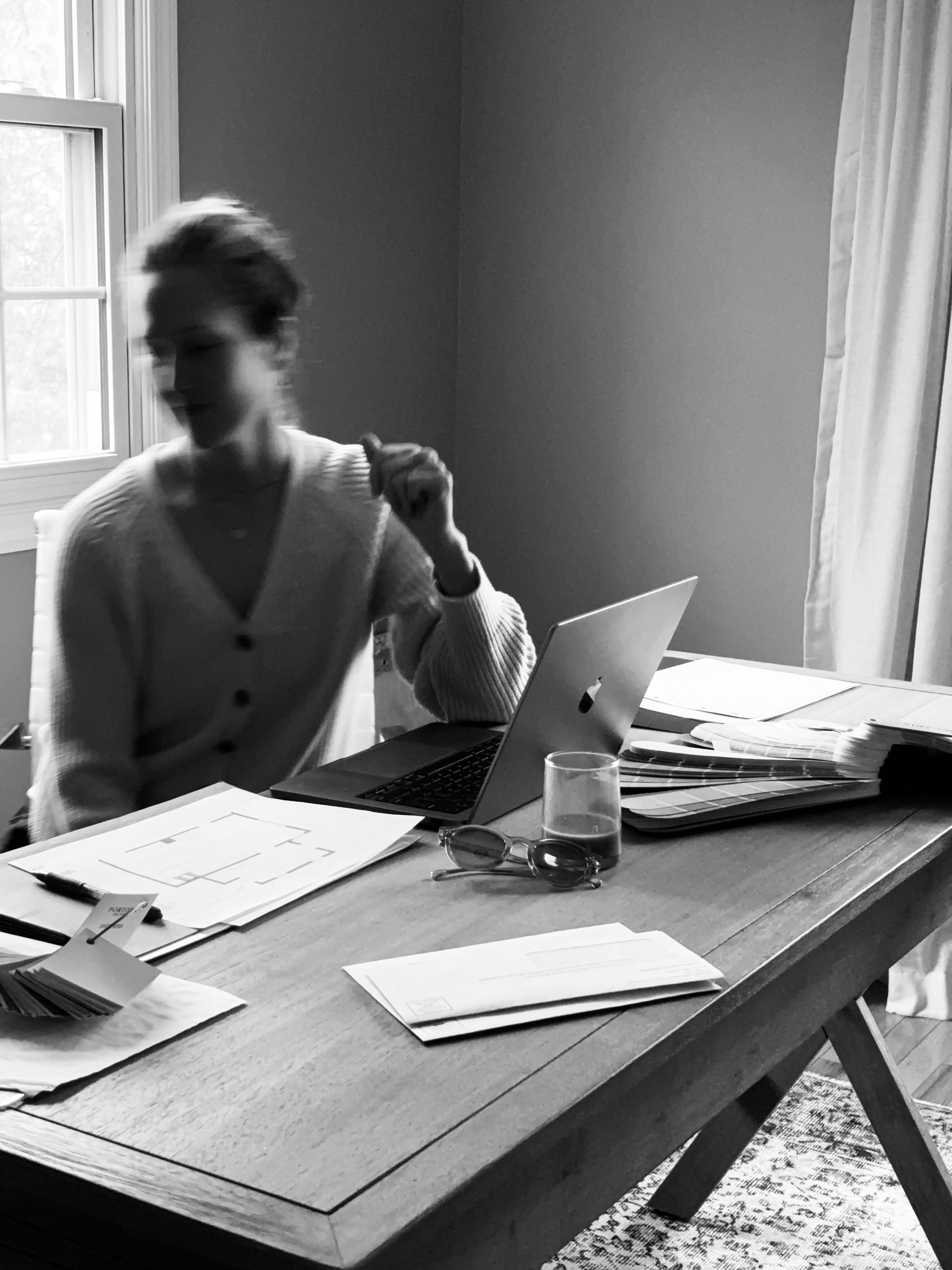
When I work with clients, this is often the quiet work beneath the visible design.
We slow the process way down. I eventually delete their access to shared Pinterest boards so that they stop looking and focus on what they truly enjoy.
We look at what they’ve loved for years — not what they saved last month.
We trace patterns in their choices.
We edit gently.
We remove what feels performative and keep what feels anchored.
Sometimes that means resisting something beautiful because it doesn’t belong in their story.
Discernment is not about having fewer options.
It’s about having clearer ones.
And clarity takes time.
If your social feeds disappeared, what aesthetic would still feel like you?
What would you miss — and what would you forget entirely?
I’d love to know what remains when the repetition fades.
We’re heading to Cape Cod this week for our first long distance project. I can’t wait to share more on this beautiful renovation.
We just completed a concept design presentation for a foursquare house renovation. We’re very excited to show our clients next week how together we can transform their home while honoring the history.
I’ve been listening to Aspire by Emma Grede and she has some powerful interviews! I really loved Issa Rae’s interview and her authenticity and candor.
I love the power of story telling through video production, so I’ve been working behind the scenes developing short videos about the design journey from start to finish. This is my way of sharing the impactful process that our clients embark on when building or renovating. Stay tuned!
Until next time,
Katie
Thanks for reading days in design! This post is public so feel free to share it.
Comments
Nothing yet. Say the first thing.
Sign in to join the conversation.