
It seems that conversations about technology and innovation in filmmaking have collapsed into just two topics: generative AI and the creator economy.
That's the whole discourse, day in, day out. So we thought we would tie these two to something more valuable that isn't in the discussion at all— curiosity, and patience. The outputs that can't be taken from us.
So we want to move toward the two things that let you catch an idea while it's still very early and has a time horizon long enough to sit with it.
The kinds of ideas that arrive before the world is ready to use them. Before its time.
Subscribe for free to receive new posts and support our work.
And stay tuned for some big announcements!
Patience as Capital
Speaking as the aphorism-forward version of ourselves, any technologist will tell you the truism: the conditions are rarely right when the idea first arrives — so we almost miss it. We call it patience-as-capital.
While the industry argues about AI replacing writers and creators disrupting studios, whether you can greenlight yourself and land on vertical platform, we almost missed that Kodak is manufacturing new film stocks. Season 3 of Television’s Euphoria was shot entirely on Kodak, exposing over one million feet of the brand-new VERITA 200D stock in 35mm and 65mm — the first TV production to ever shoot significant volumes of large-format 65mm. The stock launched in April as a new product collab co-developed with Sam Levinson and Marcell Rév.
ARRI built a camera specifically for Nolan to shoot The Odyssey on 15-perf 70mm IMAX — a format that hadn’t been used in decades along with one of the most inventive pieces of filmmaking engineering in years. SIRUI made anamorphic glass affordable for the first time in the history of the medium. Blackmagic put professional color science in a $2,000 camera body making it accessible for every storyteller, while a first-time creator filmmaker pre-visualized an entire film set in Blender — a free software, then handed the files to construction crews creating jobs that built 30,000 square feet of practical sets across four IRL sound stages just 3.5 years later. So big the crew needed maps.
And the technology doesn’t just sit at Nolan's budget. We’re missing Panavision running its New Filmmaker Program for over 25 years — providing film or digital camera packages to aspiring filmmakers at little to no cost, for shorts, thesis films, low-budget independents, PSAs, and non-profits, available year-round with no application deadline. The Pandora Short Film Grant pairs a $15,000 Panavision camera package with an optional $1,000 Kodak film grant with stock and processing, covered. These programs are managed by (Pandora, Rooftop, and Film Independent) and we’re missing it because we are occupied.
These are not marginal developments. Twenty productions at Cannes 2026 shot on Kodak. Seven of them competed for the Palme d’Or, (James Gray, Kore-eda, László Nemes, Ira Sachs, Sorogoyen among them), twelve on 35mm and eight on 16mm — including three debut features.They are the reason Obsession looks the way it looks, Backrooms feels the way it feels, and The Odyssey is the largest photochemical image ever projected. They were also acquired, record breakers for the highest grossing and debut films.
And Kodak’s Head of Motion Picture, Vanessa Bendetti, made the on-brand pitch that “shooting on film differentiates” as filmmakers of all sorts look for opportunities to expand the creative storytelling vision with innovations that were once to early.
Which translates to when a filmmaker shoots full IMAX 70mm, they aren’t just decorating; he/she is building something worth exactly what that thing is worth. Read this look as an asset valuation.
A Sixteen Year-Olds Vision that Waited Forty Years
There's a line technologists also live by: being too early is indistinguishable from being wrong. You can't tell them apart from the inside, only later, once the world catches up and decides retroactively.
Christopher Nolan took on one of the most enduring stories ever told, and by all accounts, made it even bigger when he shot the 3000 year old story entirely with IMAX 70mm film cameras. Every frame filled the entirety of IMAX 1.43:1 screens with a new Keighley camera, and cinematography by Hoyte van Hoytema.
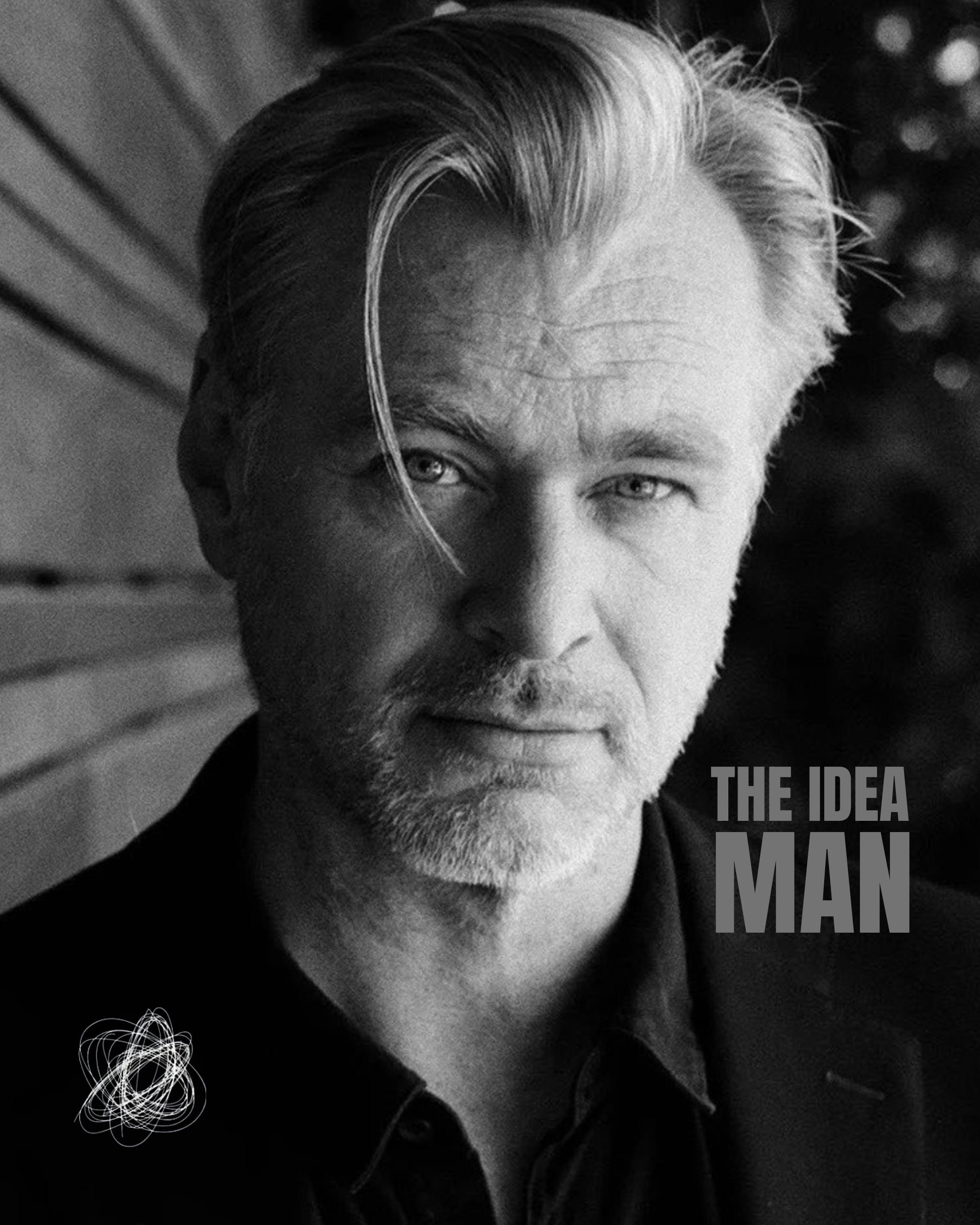
Nolan, who turns 56 on July 30th, has said he wanted to shoot a film entirely on IMAX since he was 16 but it was never possible as the noise that these incredibly large beasts generate drown out usable dialogue.
In his words he was never allowed to “go full IMAX.”
Two things made it possible forty years later. First, a new generation of IMAX film cameras designed to run more quietly — still too loud, but a start — and, second, IMAX engineers who built a special soundproof, lead-lined housing for the camera. Matt Damon described it as the size of a coffin, weighing over 300 pounds fully assembled — so heavy that dollies had to be reinforced with steel plating to carry it, and it took six people to move. They aptly named it the "Blimp." The innovation made the cameras so big, however, that when two were placed side by side for two-shot dialogue scenes, the actors couldn't see each other. To get around this — as Anne Hathaway so eloquently explains — the IMAX techs mounted mirrors on the sides of the cameras so the actors could see each other and keep a natural flow. "Ingenious stuff."
The New Look of IP Funding
Most first and second-time filmmakers pitch the story. A sheltered young woman finds herself inside… think XYZ. That’s a logline. It’s not a comp.
You're also not walking in to ask for money. You're walking in able to say what the thing is worth. A real “comp” or “comparable” is a three-part succession chain that tells them what it is. The look tells them who will buy it. The market tells them what return to expect. All three have to point at the same thing:
the story,
the look,
the market.
Without all three you lose the investor, the producer, and the collaborator before the second meeting. Every choice in the film package — the stock, the glass, the camera, the ratio — is a decision about what the finished thing is worth. Not how it looks. A filmmaker who knows these exist, and quasi understands what each one signals, walking into a funding conversation holding more than a story. We say this a lot, and we mean it.
YouTube is where you test. The room is where you price. Barker and Parsons didn't treat the $800 YouTube film as the endpoint but treated it as the proving ground and then they walked into the room and valued it for what it was worth.
And bring your DP if you must who knows what it means, but this doesn’t mean that you escape the conversation. You’re holding an asset or slate that must be described in the terms the money already thinks in. That knowledge is another differentiator. It's the difference between pitching and transacting.
The Whole Conversation: Inside the Callo Comp
Now that you've got the through-line, here's what it sounds like to walk into the world holding the film package inside the Callo comp, with an asset conversation instead of a story. Using our Callo Comp framework, our actual Callo read, product, and mechanics, the judgment stack, the fork artifacts as the thing people have to come to Callo for here is how one communicates.
“Mauser World“ The World Comp
"This TV series titled “Blah, Blah, Blah Mauser" is the world comp to the Marty Supreme world — not the $70M film, but the world it opened. A 13-year-old protagonist in that same underground ping-pong universe obsessed, slightly feral, against all odds Marty, and the girls in Marty Mauser’s life before he became the hustler. The origin story Marty Supreme never told, for the audience that watched it and wanted to stay there longer.
Shot in the same visual grammar of Josh Safdie with 35mm Kodak Vision3 500T. Using ARRICAM LT, vintage Panavision anamorphic glass, long lenses — 65mm to 100mm — compressing faces into the frame the way Safdie and Khondji did in Marty Supreme. Period grain. Tight. No room to breathe. The world looks the same because the toolkit is the same for the younger protagonist. Six to eight episodes at $1-3M per episode. The subculture is proven commercial with Marty Supreme box office hitting $179M worldwide.
Note:
The conversations happening in rooms. Why this comp holds up is because the look matches the claim. This example’s market Disney+ prestige for the generation that grew up on YouTube and now subscribes. Not Disney Channel — but the lane of coming-of-age, culturally specific, creator-native point of view.
That’s the investment thesis pattern with a film package that proves it isn’t wishful thinking.
Why the Callo World Model Works
Two craft notes: We kept Marty Supreme as the universe anchor but we drew the distinction between comping to the $70M film versus comping to the world it proved — that’s the Callo move that makes this hold under investor diligence. A sophisticated financier or Disney+ executive immediately understands this project is not claiming Marty Supreme returns, you’re claiming the subculture has a proven audience appetite and a series that lives one narrative layer beneath the film, for a younger demographic the film didn’t serve.
And “the girls in Marty’s life at 13” would be the smartest creative decision in the concept — it takes existing IP adjacency without requiring rights, flips the gender perspective in a subculture story (which is both creatively interesting and commercially legible to a Disney+ acquisitions executive making diversity-of-voice programming decisions. It also sets up a natural series arc: the show ends where Marty Supreme begins.
“Blah, Blah, Blah Mauser“ signals the IP connection clearly with a completely original title to keep all rights clean and positions the show as its own asset rather than derivative. For a creator-filmmaker protecting ownership the standalone title is usually the stronger long-term asset position.
The investor can see the claim and the evidence all pointing the same direction.
conveys the downside floor,
the upside ceiling,
the audience,
which buyers will show up
What’s a Film Package
When DPs and filmmakers say “film package,” they mean the complete technical-aesthetic decision stack: camera body + lens set + film stock (or digital format) + aspect ratio + color science approach. Together these create what the industry calls the look — but it’s more than aesthetics. It’s a series of irreversible creative commitments made in pre-production and packaging that determine what the finished film can and cannot be. Each choice locks in a specific visual vocabulary:
The camera is your footprint — how much light you need, how fast you move, how invisible you can be. An Arriflex SR3 on 16mm disappears into a room. An Alexa 35 announces itself. That difference shows up in the footage.
The lenses matter more than the camera. Same Alexa 35, two completely different films: Moviecam primes (Josephine, Bedford Park) — slightly imperfect, warm, handmade. Zeiss Master Primes — clinical, corporate. Same sensor. Completely different asset.
The stock is the emotional frequency. Kodak Vision3 250D reads golden and soft in daylight. 500T reads cooler, grainier, more dangerous at night. Buyers and programmers feel this before they can name it. It’s how they sort your film before the story registers.
The aspect ratio is your first sentence. 1.66:1 (Sing Sing) makes the human face the landscape. 2.39:1 anamorphic signals classical cinema and festival prestige. 1.33:1 (The Favourite) closes the walls in. You’re telling the audience what matters before the actor speaks.
The asset valuation point: these four decisions are made before you shoot, determines which market your film enters, which comps an investor can use, and which buyers will take the meeting.
Film Package Examples
Acquired and in or heading to theaters:
Ha-Chan, Shake Your Booty! — Josef Kubota Wladyka’s modern-day fable — took the same Alexa 35 and fell in love with Cooke S2/S3 glass, and the Cookes led them to 1.66:1. Loss and grief told with a storybook feel: the lens choice and the aspect ratio are the tone. Sony Pictures Classics acquired it a week after its Cannes premiere.
Bedford Park — Stephanie Ahn’s film — ran the same body through Moviecam primes for something warmer, more handmade. The Look: Camera: ARRI Alexa 35, Moviecam primes (DP: David McFarland). Sony Pictures Classics acquired worldwide rights on January 30, 2026; theatrical release set for September 22, 2026.
The Invite — Olivia Wilde, starring Seth Rogen, Penélope Cruz, Edward Norton — The Look: We wanted fast, versatile, modern lenses that would fare well in low light, but still resolve slightly softer skin tones and give us a little 1970’s magic. Dan Sasaki at Panavision built this set of prime lenses for the film. The lenses have an interesting coolness and green hue which complements the palette of our film and gave us skin tones that feel beautiful yet real. We shot on Kodak 5219 film stock, Format: 35mm Film Camera: Panavision XL2 Lenses: Panavision GW Primes and a Panavision 11:1 Zoom
Josephine — dir. Beth de Araújo — The Look: We required a camera system that could meet the full range of demands on “Josephine.” The film relied heavily on handheld work, often in confined, real-world locations, which necessitated a compact, highly adaptable camera without compromising image quality or reliability. The Alexa 35 was the natural choice for its ability to be built quickly for varying configurations, combined with exceptional latitude. Dir: Beth de Araújo, DP: Greta Zozula Category: US Competition, Format: Digital 4K super 35 pros res, Camera: ALEXA 35, Lenses: Zeiss Super Speeds and Master Primes.
See the complete list here. Thank you to our friends at IndieWire
Thanks for reading Move by Callo! Subscribe, for free to receive new posts and support our work. Comment to let us know what you thought of our POV. If you like what you’ve read, please share. Go to wearecallo.com to subscribe to our platform.
Comments
Nothing yet. Say the first thing.
Sign in to join the conversation.