
Battery Horror Stories
I get requests all the time to replace laptop batteries. Usually, it is a fairly simple process. I get the serial number and the brand of laptop and search for the correct battery. Once it comes in the mail, I install the battery, and my customer is happily back to mobile computing.
Every so often I run across a battery that is damaged, and the simple battery swap gets a little scary. Here is a picture from a recent battery swap.
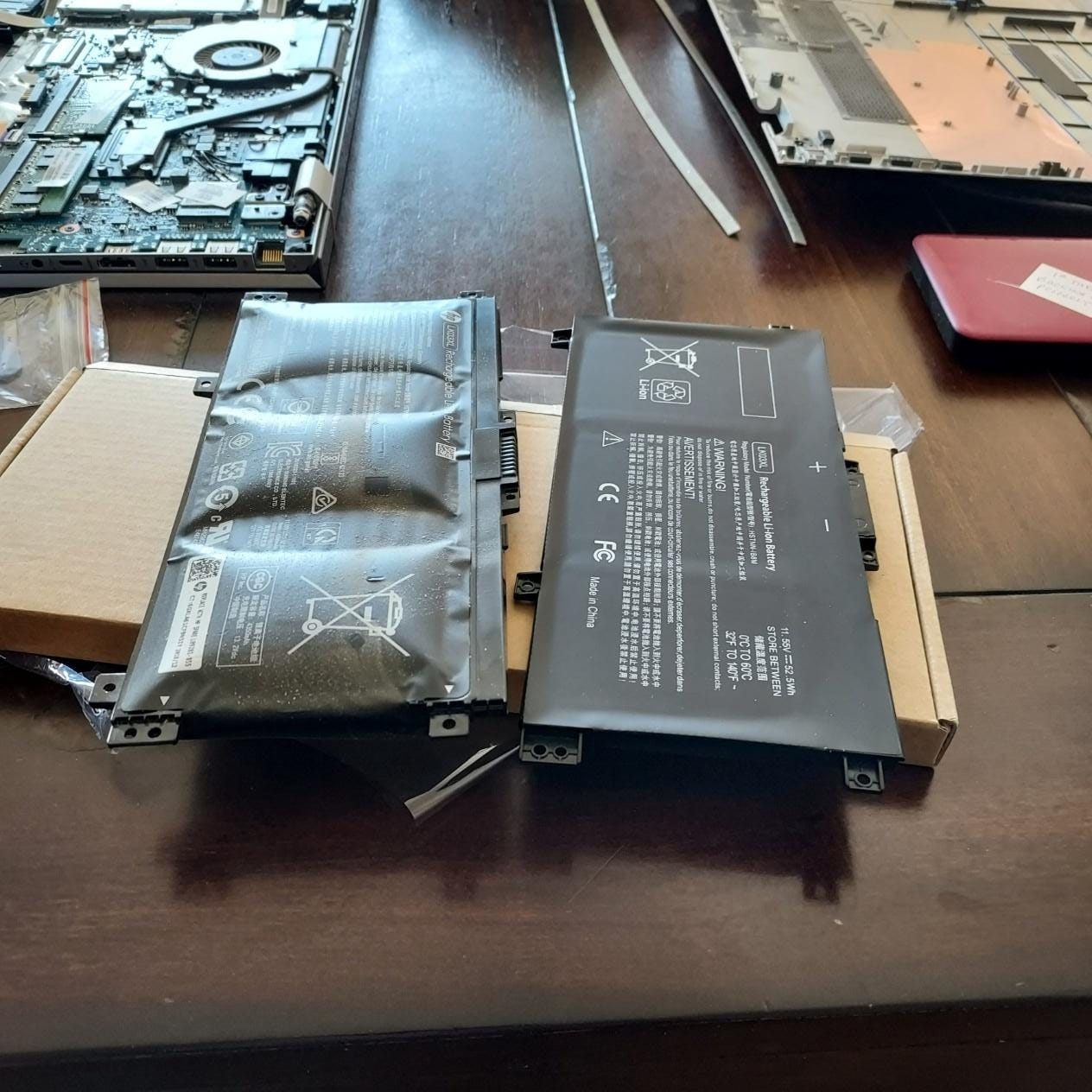
The battery on the left is the one I just pulled out of a laptop. The one on the right is the new one I am about to install. I knew it was a problem before I opened up the laptop. I could see that the keyboard was bulging, the laptop did not close flat, and while removing the screws the back was actually popping open.
Why does this battery look like this? It is a phenomenon called THERMAL RUNAWAY. If left unchanged, this battery could actually explode and cause a chemical fire. This is why they are restricted on airplanes and are always identified when being shipped.
What causes thermal runaway? There are a lot of things that can cause it, physical damage, exposure to high temperatures, manufacturing defects, aging, electrolyte leakage and poor ventilation, but the most likely cause is overcharging.
Many people treat their laptops like they are desktops. They leave them plugged in all the time. This can cause thermal runaway in extreme cases but even if it doesn’t swell and threatens to burst open your laptop, it will degrade the battery and cause it to not hold a charge.
The best thing you can do to keep your battery working properly and not expanding inside your laptop is to use the battery. Unplug the cord when the battery is fully charged and don’t plug it in until it is at or below 10%. It is alright to let it completely drain the battery occasionally. While charging the battery monitor it and unplug it as soon as it is full.
Here is a video that explains proper battery use and care.

Helper Sites and Services for Government Services
Last month, I received an email from a customer because she had just realized that she gave all of her personal information to a website that she thought was a government site but turned out not to be. She was concerned about identity theft and thought she might have just given scammers a free look at all of her personal information.
The site she went to was govplus.com. I did a little research about this site by checking out Trustpilot.com. According to TrustPilot:
“Trustpilot is an online review community that connects businesses and consumers through genuine feedback from customers about their buying and service experiences.
Since we started Trustpilot in 2007, our purpose has always been to help people. As a free and open review platform, we work to build trust between consumers and businesses.
We want to help businesses collect reviews to engage with their customers, fix problems, and achieve success by improving their services. We also want to help consumers learn about businesses so that they can make informed decisions when buying products and services. These things are only possible with customer feedback.”
Trust pilot had many reviews for the govplus site and none of the reviews mentioned being scammed or having their information stolen. Thankfully, my customer didn’t find a fake site. It was what I call a helper site. This type of site isn’t connected to the government, but they claim to make your process easier to get the government services you need. They usually charge a fee for this help. Based on consumer reviews, Govplus is very helpful and makes the passport process very easy.
There are many companies that do this sort of thing. Every year when my LLC is up for renewal, I get a letter in the mail that tells me it is about to expire, and they offer to help me with the process. In this case, I can easily go to the Colorado website and quickly file the necessary paperwork myself and pay just $10 to renew my LLC registration. The letter that I get wants $100 for this process. I always just throw these letters away. It isn’t really a scam, but it is a big waste of money, and it won’t save you any time.
It isn’t just government services that are targeted in this type of help. I also receive notifications from some official sounding domain seller when I have a domain that is up for renewal. In this case, they are trying to get me to switch my domain from GoDaddy to their company, but they make it sound like they are just being helpful. The cost for hosting my domains with this other company is usually many times the cost I currently pay to GoDaddy. It is important to be aware of this type of potential scam.
How can you protect yourself?
When on the internet, make sure you look at the actual website URL when searching. The most important part is what is between the “WWW” and the “.com, or .gov”. All federal government sites will have the “.GOV”, most state and local government sites will too, although some might have the .ORG”
If you receive a letter about renewing something, whether it is for a government service or anything else, read all of the fine print. If a company doesn’t divulge everything in their letter it is mail fraud and can cause severe penalties. They usually list in very small print that this is not required, and you can file this for yourself by going to the state website. This is what the LLC renewal always says, but the print stating this is very small, and all the rest is very large and “demanding.”
However you are contacted, you can always go to the official website for whatever agency you need to work with and ask them about the letter or other site. Many times, they will have a FAQ section, which stands for Frequently Asked Questions.
If you really are not sure, you can reach out to me. I would much rather give a little advice than try to clean up after a scam.
I hope this explanation helps in your future dealings with government and other services. There is nothing wrong with using these helper services, but it is best to be informed so you don’t accidentally give out all of your personal information.
The above article is a reprint from my monthly subscription newsletter Email ScamBusters Monthly Report, every month I highlight a couple of scams and show how to spot them to keep yourself from getting scammed. The people that initiate these scams are usually outside of the USA and they are able to quickly disappear after the scam to avoid getting caught. Education about scams is the only way to prevent getting scammed. If you or someone you know needs this type of education, you can get this monthly report in your inbox every month. I charge $30 per year for the Email ScamBusters Monthly Report, partly to cover costs and also, I have found people are more likely to read it if they pay for it. To subscribe just follow this link.


It is time to have "the talk" with your aging parents.
The talk about how to avoid becoming a victim of scams. Email Scam Busters is your monthly resource to let you and your parents in on the latest scams they should look out fo
Subscribe to Email Scam Busters
Thanks for reading Call Duane! Subscribe for free to receive new posts and support my work.
Comments
Nothing yet. Say the first thing.
Sign in to join the conversation.