

The closing bells just rang across the major exchanges. While the retail crowd is staring at superficial numbers on their screens, celebrating speculative tech headlines, the structural shifts beneath the market floorboards are accelerating. If you spent your day insulated from the real macroeconomic wires, the perimeter has fundamentally moved.
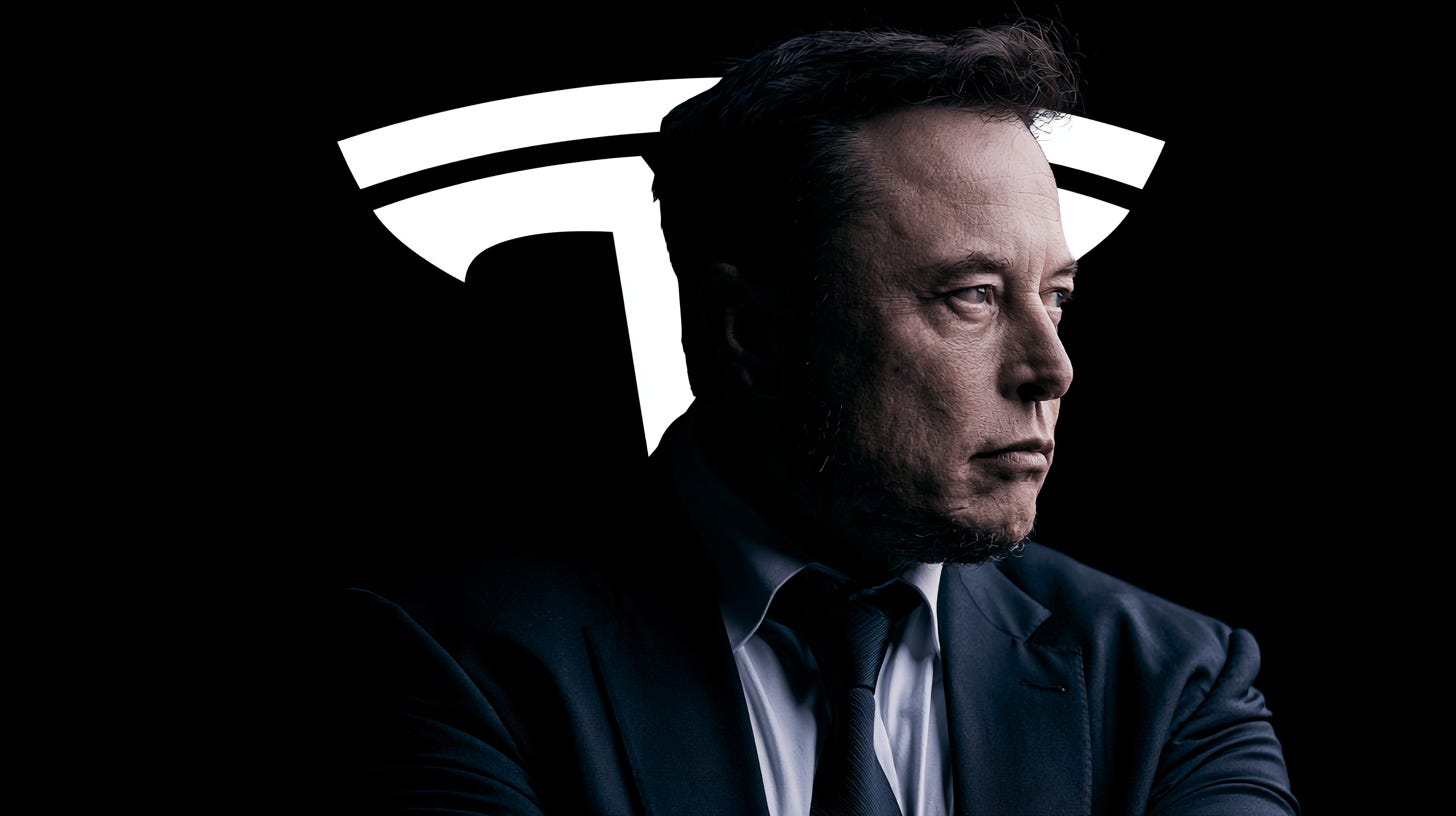
“Record vehicle deliveries!” is the headline Wall Street wants you to buy today. Here is the -$1.1 billion cash burn hiding in the fine print that they hope you never audit.
While financial media hypes top-line volume, Tesla’s automotive gross margins collapsed to 16.3%, and non-operating accounting gains masked a core operating margin of a razor-thin 1.4%. The company didn’t just miss earnings expectations by 35%—it burned over a billion dollars in free cash flow in a single quarter to fund a $25 billion AI gamble while vehicle selling prices keep dropping.
Here is why your 401(k) is sitting directly in the blast zone:
At current trading levels near $374 a share, only ~$70 represents the actual, measurable business operating today. The remaining $304 per share is pure, un-hedged speculation sitting inside the target-date and growth funds anchoring your IRA.
If you hold broad-market indices, you are quietly funding the capital drag of a decaying industrial core. I’ve stripped away the non-operating noise and deconstructed the balance sheet to give you the exact numbers before the next market correction does it for you.
Read the Full Macro Audit: Dissecting Tesla’s Q2 Cash Burn
The $87.6 Billion Emergency Supplemental: Fiscal Deficits and Duration Risk
The $111 Billion Freeze: Antitrust Fragmentation and the Mechanics of M&A Arbitrage
See the signal that flashed before Nvidia's surge — now on this stock (Ad)
Structural Fuel Inflation: How $5.10 Diesel Compresses Fund Earnings
New Patent Reveals Elon Musk’s Next Breakthrough: M.A.G.I. (Ad)
Structural Asymmetry: How Millisecond News Feeds Cost Passive Portfolios
The $1.5 Trillion Year-to-Year Lease: Inside the USMCA Sunset Deadlock
(ad)
Most financial gurus tell you what to do.
Robert Kiyosaki tells you what HE'S doing.
Four days ago, he posted this to 443,000 people:
"During this last 'retracement' or 'crash' I bought more gold and silver."
Not "you should buy." Not "consider buying." Not "this might be a good time."
"I bought more."
That's the difference between talkers and doers.
Silver crashed from $118 to $56. Gold crashed from $5,405 to $4,006.
While everyone else panicked, Robert bought.
"Gold and silver are going to the moon!!!!"
He's putting his money where his mouth is.
Now he's revealing ONE stock — a streaming company that could deliver 3X-5X silver's gains — so you can do the same.
See What Robert's Buying Into →
Talk is cheap.
Action builds wealth.
— Robert Kiyosaki
(ad)
⛽ National Average Diesel - $5.14 / gallon
Elevated fuel inputs sustain severe upward pressure on freight surcharges, directly compressing corporate operating margins.
🚗 National Average Gas - $4.00 / gallon
Sustained at the $4.00 threshold, acting as a direct drag on monthly consumer disposable income and discretionary spending.
📈 10-Year Treasury Yield - 4.60 – 4.68%
The benchmark valuation anchor for domestic retirement bonds. Elevated yields elevate corporate borrowing costs and depress bond paper values.
💸 TSLA Free Cash Flow - -$1.10B
Q2 free cash burn driven by $5.8B in CapEx, highlighting the growing capital intensity of mega-cap tech-industrial pivots.
Canadian federal officials have abruptly canceled a long-planned joint ceremonial event with U.S. representatives marking cross-border infrastructure milestones. Ottawa cited escalating bilateral trade disputes—specifically the White House’s recent invocation of Section 338 of the Tariff Act of 1930 to impose 50% tariffs on Canadian industrial inputs, alongside the ongoing USMCA annual review impasse—as the explicit rationale for the cancellation.
Art’s Take: Symbolic cancellations at the diplomatic level mark a transition from rhetoric to administrative freeze. When cross-border administrative relationships deteriorate, the operational friction quickly leaks into physical supply lines.
Logistics operators should anticipate increased border inspection rigor, extended dwell times at major crossings, and heightened compliance overhead for cross-border freight lanes. For North American industrial equities, this escalating friction represents an un-hedged operational tax that will erode cross-border supply chain efficiency through the remainder of the fiscal year.
A bitter internal dispute has surfaced among Democratic national and state committee leadership following the authorization of a $500,000 targeted disbursement in Arizona. Party strategists and regional organizers are exchanging public criticism over capital misallocation, with dissenters arguing the funds were diverted from critical down-ballot races to support an inefficient top-line media campaign.
Art’s Take: Ignore the partisan political fallout and evaluate the capital efficiency metrics. When campaign organizations engage in public disputes over a $500,000 line item, it signals growing financial strain and liquidity anxiety within major political fundraising apparatuses ahead of the upcoming election cycles.
As marginal returns on traditional media ad spending collapse, political committees are facing diminishing returns on capital deployment. For financial markets, internal party fragmentation increases legislative unpredictability, elevating policy volatility risk for swing-state industrial, energy, and real estate assets.
Keep your eyes on the data rows, not the political theater.
No posts
Comments
Nothing yet. Say the first thing.
Sign in to join the conversation.