Before Ashcroft v. Iqbal, and its companion predecessor Bell Atlantic Corp. v. Twombly, a pleading only had to provide proper notice and set forth claims that were legally sufficient. But Twombly and Iqbal added a new factual-sufficiency standard to the pleading test: The nonconclusory allegations must set forth a claim to relief that is factually plausible in light of judicial experience and…
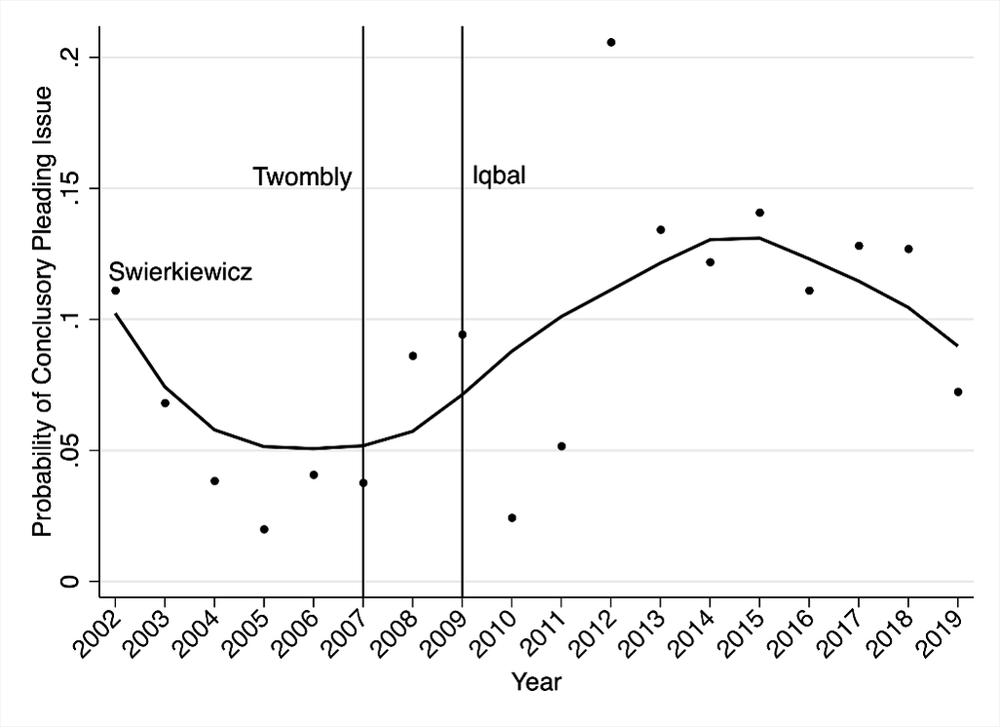
This Article presents the first systematic empirical study of “conclusory pleading” as a form of plausibility analysis in the U.S. courts of appeals following Ashcroft v. Iqbal, which critics argued would harm plaintiffs by creating excessive demand for information before discovery, and by increasing judicial subjectivity and ideology in decision-making in Rule 12(b)(6) decisions, particularly in…
In this brief Essay, I want to focus on one aspect of the Iqbal decision that I have taught for many years and which, in my view, is useful for thinking about the policy implications of the heightened pleading regime that Iqbal and its predecessor, Bell Atlantic Corp. v. Twombly, introduced: the goal of deterring nuisance suits. Both Iqbal and Twombly famously changed the standard of fact pleading…
In 2007 and 2009, the Supreme Court upended the long-understood notice pleading framework, replacing it with the plausibility standard introduced in Bell Atlantic Corp. v. Twombly and Ashcroft v. Iqbal. I proceed from the assumptions that the pre-Twombly/Iqbal pleading standard was, roughly speaking, the one announced in Conley v. Gibson, and that courts now generally apply the framework set…
Ashcroft v. Iqbal is a doctrinally instructive case. Iqbal teaches that the test for sufficient pleadings turns on the concept of plausibility.[1] It clarifies that the previous, more permissive understanding of a sufficient pleading under Conley v. Gibson is no more.[2]Iqbal also reflects the Supreme Court’s skepticism regarding district court judges’ ability to manage complex discovery disputes…
Gold has intrinsic and cultural value, as well as technological utility, which underpin its steadfast demand on the global market. However, supplying gold comes at a substantial cost. Up to 20 percent of the world’s gold comes from artisanal and small-scale gold mining (ASGM), which is conducted by individuals and small enterprises with limited capital. Modern-day ASGM practices contribute to…
Currently, there exists a “Grand Canyon” of judicial disagreement between the Fourth and Fifth Circuits on whether reverse search warrants (1) are searches under the Fourth Amendment and (2) are constitutional. This issue, on which state supreme courts are also divided, is now before the U.S. Supreme Court and awaiting decision as a question of Fourth Amendment jurisprudence. This Note proposes a…
A recent spate of major mass tort bankruptcies has renewed interest in Chapter 11 as a tool for resolving mass torts. Mass tort bankruptcy proponents argue that even highly solvent defendants should be able to take advantage of bankruptcy because it is a better procedural system for resolving mass tort controversies than multidistrict litigation (MDL). Bankruptcy has tools for delivering closure…
A genetic genealogy search for a match to a crime scene profile identifies eight relatives, one of whom is almost certain to be the perpetrator. A geofence warrant returns an anonymized list of four cell phones present at a series of bank robberies. A facial-recognition software analysis of a surveillance video generates fifteen persons of interest. By now, these scenarios are commonplace. Equally…
For nearly a century, American laws have required mines, oil and gas companies, and other potentially hazardous industries to restore land affected by their activities to a safe condition when they are done with it. These laws represent a grand bargain—they allow operators to make profitable but damaging use of land today in exchange for the promise of expensive remediation tomorrow. However, this…