
Bear with me as we take a trip back to November 2, 2004. George Bush is about to take a second term as President, Spider-Man 2 has just raised the bar for superhero movies, Lost is new and actually good, Gmail and Facebook are only a few months old, and Relient K drops their fourth album, Mmhmm.1
Now we skip ahead almost 10 years to when I start listening to Relient K, because I am the reverse hipster who only gets into things long after they’ve stopped being cool.
The third hit single on this album was “High of 75,” famously catchy for anyone who passed through a youth group or listened to the right radio stations for the next few years. Anyone afflicted would no doubt hear “Lately the weather has been so bipolar” and mentally (or verbally) finish “And consequently so have I!”
So, why do I bring up this song, about twice as old as my sixth grade students, in 2026?
As it happens, the weather in the Florida panhandle lately has in fact been pretty bipolar, shifting between cold and warm-ish, dry and wet, still and breezy, and with it things like air quality and allergy ailments have been all over the place. This latter point is especially prominent in my daily experience. How I (or my wife) will wake up feeling every day is almost a coin flip. One day I have all the energy I need, and the next it takes 20 minutes to get all the way up while I still need a good load of caffeine, creatine, and cetirizine to feel fully alive.
This phenomenon seems to have produced a lease agreement that authorizes “High of 75” to live rent-free in my head. Out of curiosity I found myself looking up the song’s origins, and while I could not find any interview texts or other official information, the small number of disussions online seemed to agree that the point of the song was to use the vicissitudes of weather as a metaphor for constant changes of emotional state or else about a major change in life (perhaps even referring to conversion) from gloom to gladness.
I do not think I agree with this interpretation.
My own experience with weather and its affects, combined with the actual lyrics of the song and my general vibe-compatibility with Matt Thiessen’s mind during this period of his career, suggests the more obvious interpretation is that it’s reflecting on the direct effects of weather upon mood. As it actually states:
We were talking together
I said, “What’s up with this weather?”
Don’t know whether or not
How sad I just got
Was on my own volition
Or if I’m just missing
The sun
The same note comes in the aforementioned bit, “lately the weather has been so bipolar / And consequently so have I,” and the later case “and we might break up / If I don’t wake up to the sun.” These invoke weather as an explanation for moods, indeed as among their efficient causes. While it’s not impossible to take all this as various metaphors for other things, I think Hooker’s maxim about Scripture works just as well for the basic matter of this song: “where a literal construction will stand, the farthest from the letter is commonly the worst.”
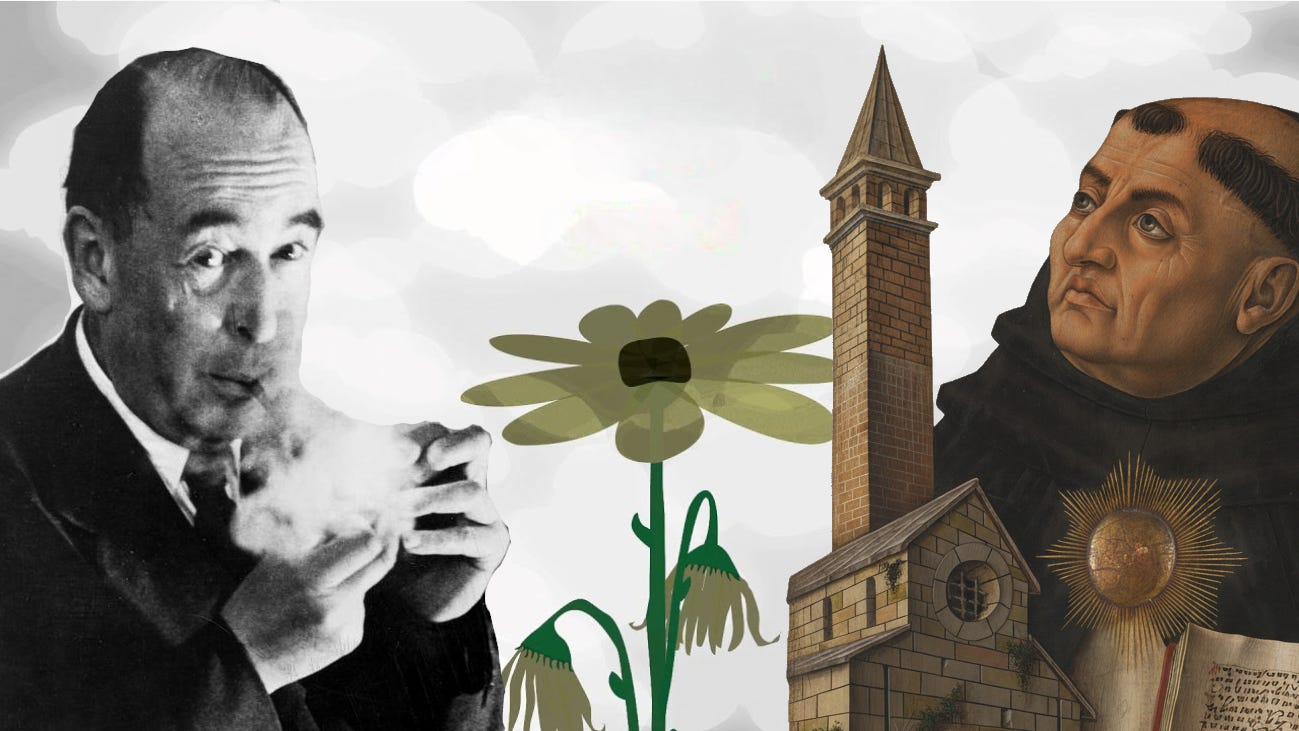
This brings Thiessen into conversation with C. S. Lewis and Thomas Aquinas, both of whom have impressed upon me deeply the raw physicality of our emotional lives. For example, Lewis when discussing faith makes this point:
Unless you teach your moods ‘where they get off,’ you can never be either a sound Christian or even a sound atheist, but just a creature dithering to and fro, with its beliefs really dependent on the weather and the state of its digestion.
Here Lewis’ main point is the need to understand faith as a kind of rational conviction that persists even when moods changes, but along the way he notes how moods work: they are largely dependent factors such as weather and digestion. Those pesky allergies are as likely to drag on the soul as on the body. Lewis speaks similarly through the mouth of Screwtape:
Humans are amphibians—half spirit and half animal… As spirits they belong to the eternal world, but as animals they inhabit time. This means that while their spirit can be directed to an eternal object, their bodies, passions, and imaginations are in continual change, for to be in time means to change. Their nearest approach to constancy, therefore, is undulation—the repeated return to a level from which they repeatedly fall back, a series of troughs and peaks. If you had watched your patient carefully you would have seen this undulation in every department of his life—his interest in his work, his affection for his friends, his physical appetites, all go up and down. As long as he lives on earth periods of emotional and bodily richness and liveliness will alternate with periods of numbness and poverty.
Here again Lewis operates on an implicit understanding of our emotional lives as bound up intimately with our animal natures, our temporal and bodily existence. We go through emotional cycles alongside and for many of the same reasons that we go through cycles of wanting or not wanting seasonings, sleep, or sex.2
I mentioned Thomas Aquinas as well on this, for from him I saw a more detailed account of what passions are, and the definitions indeed require a state of the body. For example, in ST.I.Q20.A1.Rep2,3 Thomas says:
In the passions of the sentient appetite there is, as it were, something material to consider, viz., the bodily change, and also, as it were, something formal, i.e., something on the part of the appetite. For instance, as De Anima I says, in the case of anger the material element is the heating of the blood around the heart or something of that sort, whereas the formal element is the desire for vindication.
Regardless of what we make of any technical details in Thomas’ medieval physiology, his point remains. Anger is formed as a desire for revenge or vindication, but that desire of your will all by its lonesome self doesn’t quite rise to the level of anger. It only becomes anger when that desire starts gearing your body up into a matching state, perhaps with pulse quickening, heart beating faster, face reddening, muscles tensing, breathing getting harder, etc. Thus, a formula for feelings:
Feeling = Desire + corresponding bodily disposition
Often, of course, when we feel things, the desire shows itself first, and then our bodies snap into shape to match it. This is not the only order, though. Sometimes our bodies are already disposed toward the matching feeling. For example, sadness tends to express itself as a slowing down, low energy, pressure within the tear ducts, tension at the throat. But when the weather turns and pollen fills the air, our allergies are likely to produce those same effects. When that happens, we are in a sense halfway to sadness already: we just need the right foiled desire to activate the full feeling. I have sometimes described this to myself as “a sadness in search of a sorrow.”
The same applies as much to other feelings, of course. Starting the day feeling excellent in body often sets you up to feel great about life. Famously, smiling for any reason can still improve your mood. When your skin is irritated, others will often report you yourself are irritable. And our culture has not coined the term “hangry” in vain.
So why bother drawing attention to this fairly basic and almost unremarkable fact of life? Chiefly, my interest is perspective. We may know perfectly well that people get hangry and that feeling bad flows into feeling sad. Yet when we are actually feeling things, we tend to forget that’s how this works. Far too easily we get sucked into the feeling and begin viewing it as some objective commentary on reality. “Today is just awful, the worst day ever,” said the man who slept for only three hours, never stopping to consider that maybe the day isn’t the main problem, and he might not see it in the same light if he took a nap. For this reason, in the midst of the Summa Theologiae, Thomas writes an affirmative answer to the question, “Do sleeping and bathing lessen sadness?”,4 explaining as follows:
As was explained above (q. 37, a. 4), in its species sadness is opposed to the body’s vital motion. And so the things that restore corporeal nature to the normal state of its vital motion are opposed to sadness and lessen it. Moreover, by the fact remedies of the sort in question bring the nature back to its normal condition, they are a cause of pleasure; for, as was explained above (q. 31, a. 3), this is something that gives pleasure. Hence, since every instance of pleasure lessens sadness, sadness is lessened by corporeal remedies of this sort.
Therefore the Angelic Doctor says you should take a bath when you’re sad.
More seriously, I simply want us to remember to take the body into account. Our amphibious selves need to remain aware of the fickle and fleshy nature of our feelings lest we blow them out of proportion. Sometimes we need to attend to bodily remedies when the feelings get in the way.
That said, as Thomas reminded us above, the bodily state is only half the matter. Our feelings also come from desires that give form to the body’s transitions. To turn our attentions to the right realities can also help keep our emotions in a healthy balance, at least to an extent. And whatever may naturally grab our attention, there is a fullness of joy to be found if we focus on the goodness of God, the love of Christ, and the fellowship of the Holy Spirit. Precisely at this point I think Thiessen does invoke a metaphor:
But now I’m
Sunny with a high of 75
Since You took my heavy heart
And made it light
And its funny how you find you enjoy your life
When you’re happy to be alive
To set out minds on the things that are above, where Christ is, is the other half of the perspective we need about feelings. No matter what the weather does to us, God in His kindness can and not infrequently will grant to us that splendid summer day pleasure when we count our blessings and remember by what (and by Whose) great mercy is it that we are even alive.
This makes me feel a bit old, ngl.
A phenomenon I expect the fairer sex understands better than my own.
That is, Summa Theologiae, Prima Pars, Question 20, Article 1, Reply to the Second Objection.
Summa Theologiae, Prima Secundae Partis, Question 38, Article 5.
Comments
Nothing yet. Say the first thing.
Sign in to join the conversation.