
If you make four quarters for a dollar long enough, those selling general & administrative expenses catch up to you, or your stakeholders (bond holders, lease holders, employees, private equity, shareholders, and other unsecured creditors).
In its last year of operation, WeWork lost US$1.6bln on US$1.8bln in revenues. WeWork founder Adam Neumann was but a mirage at this juncture of course, forced out of the company in the fall of 2019 with the most golden exit parachute one can envision, US$1.7bln, inclusive of a $185 million consulting fee!. Neumann had already cashed out for US$700 million pre-IPO (the S-1 for which was pulled). WeWork’s brief life as a public company came into being via the much inferior SPAC route. Of the 306 SPAC’s brought to market in the last 2 years, 3 (three, not a typo) are above their issue price!
The We Company’s guiding mission was “Elevating the World’s Consciousness”. A full 65% of the tech company’s expenses were rent. It looked, in retrospect, a lot like a plain old share-space (coworking), real estate company. WeWork was carrying rocks straight up hill as the lead real estate lessee in New York, London, San Francisco, Chicago and other major centres right into the teeth of the C-19 pandemic and resultant battle to get worker bees back to the office when the pandemic became endemic. Most long term corporate tenants are looking to shed between 1/4 and 1/3 of their commercial space presently, as their long term leases come up for renewal. WeWork’s short term tenants were typically on rolling 30 day terms.
In a way, WeWork is the modern day office space-share Lehman Brothers. Lehman was heavily reliant, coming into the fall of 2008, on wholesale funding via the short term, and sometimes fickle, commercial paper (CP) market, funding both operations and a levered asset portfolio of considerably longer tenor. Lehman’s head, Dick Fuld passed the hat around his Wall Street “peers”, but found dust, and a bit of spittle. No rescue was forthcoming from the public purse either, and Lehman famously filed for Ch. 11 bankruptcy in September 2008 with assets of $700bln. The bankruptcy work-out took a full 14 years.
WeWork poses no systemic risk. With $2.9bln of direct debt and $13bln in long-term leases, this tap-out will haunt Masayoshi Son (Softbank’s founder) lead “investor” with $16lbn committed (mostly equity, which is a zero), more than any other creditor by wide measure.
WeWork is a stark lesson in worshipping at the feet of charismatic founders and allowing corporate governance to run amuck.
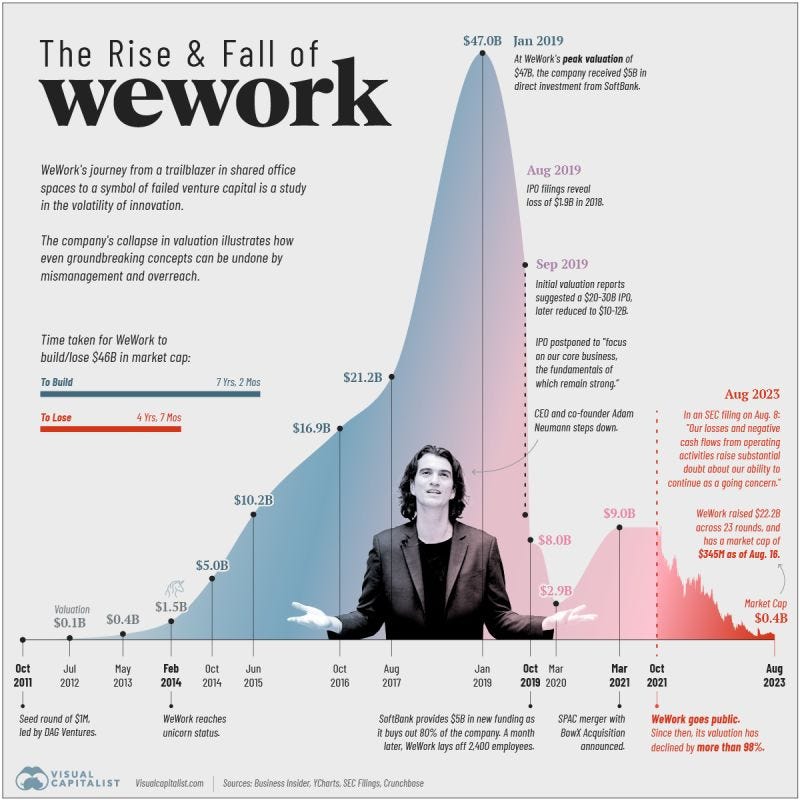
”Jesus take the wheel”. Messianic Adam Neumann. Credit: Visual Capitalist.
We should all aspire to have the charisma of Adam Neumann. At 44, even after the WeWork toxic dust has settled, his net worth has been reported at US$2.2bln.
Governance red flags:
Executive compensation; As noted, Adam sold $700mm of his We stock pre-IPO, an IPO that was eventually cancelled/postponed to “focus on our core business the fundamentals of which remain strong”. Alarm bells should have been raised, at least at Masayoshi’s SoftBank HQ.
When Mr. Newmann was ousted, soon after, from the WeWork board, he negotiated an enormous “parting gift” compensation package for himself, worth $1,700,000,000. The 10% equity stake he retained when he left backed a $410,000,000 non-recourse (to Adam Neumann) loan from SoftBank. The Wall St Journal reported the stock backing the loan was worth $500 million at the time of Adam’s departure in 2019, now worth $4 million. A liability of this size, hedged with a high beta asset needs to be managed dynamically over time (demerit SoftBank).
Hat tip to the real Prof G, Professor Scott Galloway; Adam Neumann licensed the use of “We” to wework for US$5.8 million. You really can not make this stuff up.
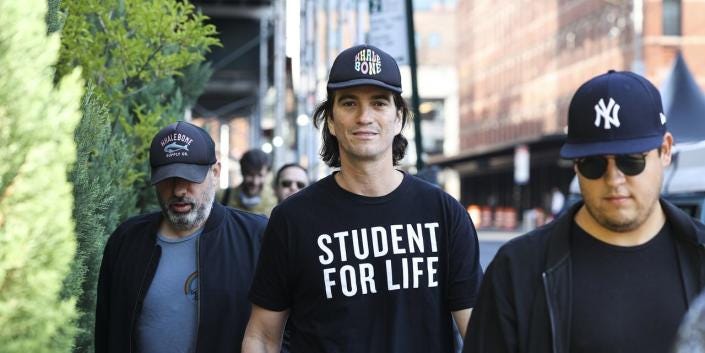
“How you doin?” 1.93m Adam Neumann casts a long shadow on the USA tech commercial real estate ecosystem.
Board composition/ HR “gaps”; All male for a the first decade of its existence, until a woman was added. Adam’s wife Rebekah, co-founder, is profiled well in the Apple+ docuseries WeCrashed as the self-appointed Chief Branding Officer of WeWork (later amended to Chief Brand and Impact Officer). Rebekah’s brother-in-law was Head of Wellness. He must have been lacklustre at his job, WeWork was sued for many HR transgressions by former employees, the State of New York and other authorities.
Dual share structure; From inception Adam’s shares were “super” voting shares, a full 20x class A “normal” shares. This was eventually stepped down to 10x and finally 3x on his departure from WeWork. This structure is common (I see you Zuck), but it can be a bad shareholder structure, in concert with mis-management, and a flawed business model. Despite having bailed out WeWork with a $5bln infusion (for 80% of the company) Masayoshi Son’s SoftBank would likely have been challenged to oust Newmann sporting 20x shares.
SoftBank’s big score was Alibaba, on which they netted $72 billion in profit over 25 years. Masa-san saw WeWork as SoftBank and the Vision Fund’s next Alibaba. Masa could not have been more wrong.
Note: The $100bln Vision Fund is funded 60% by SoftBank and 40% by Saudi Arabia (aka ATM for the world). Saudi “opts out” of select investments.
Masa-son will get full control of WeWork 2.0 for certain, but should he? $16bln invested grants him this right to decide (his debt exposure will most likely be converted to new equity). SoftBank’s exposure was further increased during the final death throws when landlords drew down on a portion of $1.7bln in Letters of Credit that SoftBank co-signed with WeWork in 2019. High finance is hard. The WEWORK 7.875% May 1, 2025 bonds are wrapped around $0.10, indicating a paltry recovery rate for unsecured shareholders (seems high to me at 9cents/$). Coincidentally, Lehman’s CDS auction post Ch. 11 in 2008 was $0.09.
Adam, Rebekah and their six children are settling into their new (post-2019) $44 million Miami Florida estate and reportedly doing OK. Venture Capital Firm Andreesen Horowitz has thrown $350 million behind Adam Neumann’s latest real estate venture which focusses on retail. Something tells me this will rhyme with, but not be called “time-share”. The beat goes on.
Adam’s other venture, Flowcarbon. plans to transform the trading of carbon credits (carbon credit crypto). Too bad that AI did not flow in the tag-line.
Perhaps too much focus on ESG ratings life-to-date have been on the E-Environmental with most ESG ratings companies equally weighting the E, S & G components.
Do your own due diligence. The truth is out there, but you need to know where to look.
Caleb Gibbons, CFA
No posts
Comments
Nothing yet. Say the first thing.
Sign in to join the conversation.