
Scott Bessent (64), the USA’s 79th Secretary of the Treasury since 2025 may wish he retired and took up sports of leisure after the week he just had!
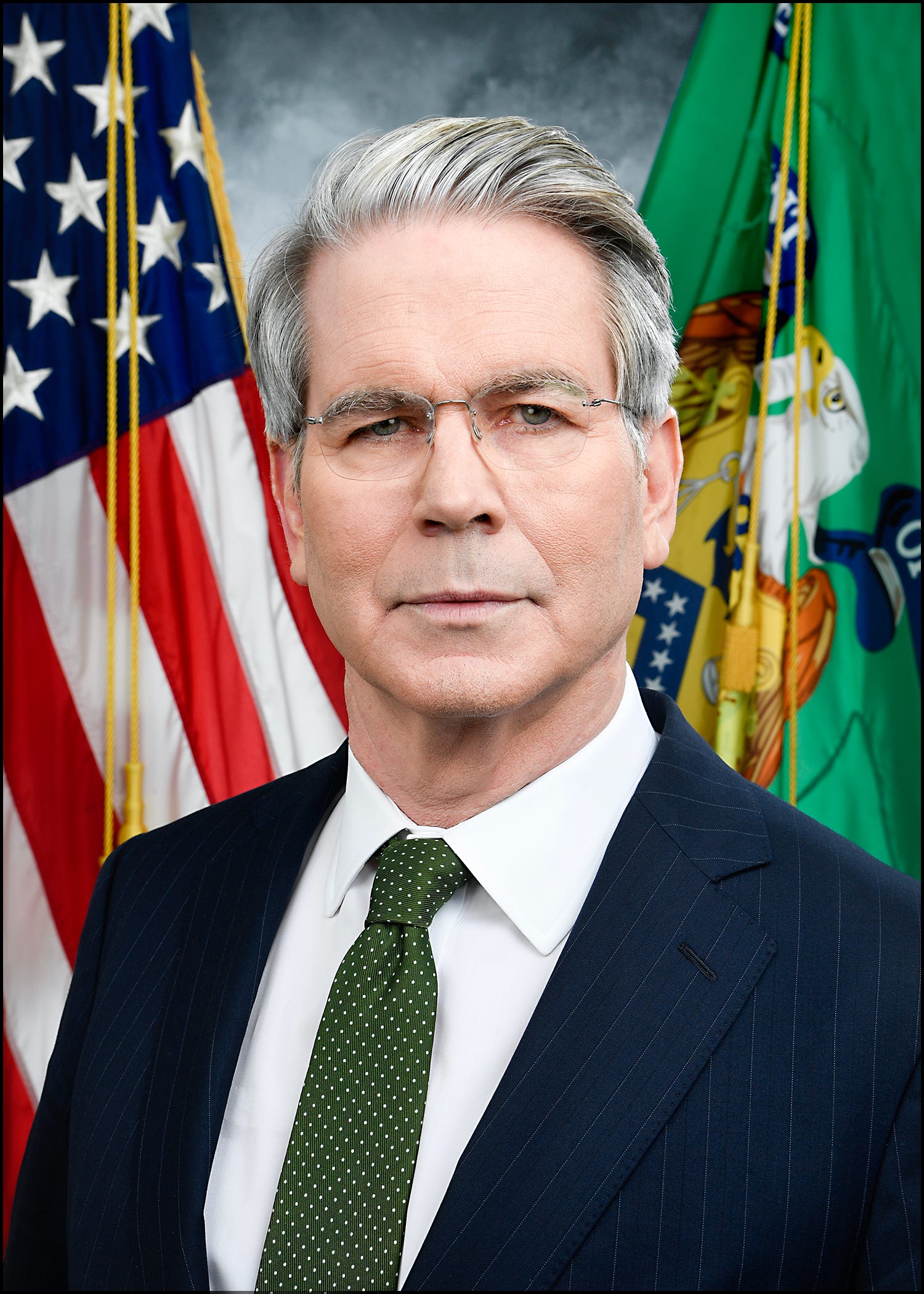
Pic: Official US Treasury picture. 2025 Scott Bessent.
The unruly (yields rocketing higher) US Treasury market, especially the “land of the big 01’ (present value of 1 bp), long bond (30 year), > 5.20%, has been cause not just for consternation, but action by the Treasury.
In addition to declaring “Operation Economic Fury” on Iran via all means know to man (likening the impact to D-Day no less, in a slightly embarrassing presser) Bessent intervened in the US Treasury market last week in an effort to drive bonds yields down in the long end of the curve, at what has been deemed a very peculiar time and in a highly peculiar fashion. The “Bessent put” is having an influence in keeping long term treasury yields in check/subdued, a play of the “Fed put” adage that implies there is limited downside for public equities as the Fed is ever present with cupped hands in the form of rate cuts, QE and whatever other extraordinary measures (e.g. $700bln Troubled Asset Relief Program, aka TARP) to recoup (eventually) ATH price levels.
Stanley Druckmiller, Bessent’s former governor (boss) 1991-2000 and 2011-2015, when he was CIO (Chief Investment Officer) at George Soros’s Quantum Fund blasted Scott’s ham-fisted effort via the Wall St. Journal this week noting that “defense against fundamentals always lose”. He added, “You can not buy your way out of a solvency conversation with liquidity tools.” Surely a fireside chat would have sufficed here? Someone is off the Christmas card list for certain. Druck, as he is affectionately known, is famous for taking on the UK government in 1992 via shorting the bejesus out of the UK Pound Sterling is an outsized wager that the UK government did not have enough in their coffers (foreign exchange reserves) to adequately defend their currency. The trade made was a monster in terms of sizing $10bln (in 1992 $) and netted US$1bln in profit for Quantum and solidified Soros and Druckmiller (Bessent was 29 year old at the time) as trading gods, if one believes in such things.
In my early financial derivative days I dealt with Bessent’s global macro trade execution team on a lumpy (1/2 yard, C$500 million notional) fx options trade where at the last minute Quantum’s purchased option (read no cpty credit risk) was cheapened by “selling the tails” on the payout, resulting in credit exposure, at a given fx cross. I was able to keep the trade by confirming it as a corridor trade versus two outright options, avoiding breaking the trade (and keeping my head!).
In the Treasury Secretary role Bessent has shown sharper elbows than Trump’s pencil, going so far as to threaten bodily harm to detractors (e.g. Bill Pulte, then housing finance director for one, and less believably Elon Musk of DOGE fame). Termed “the political pugilist” by the New York Times, I doubt Scott has ever had a hockey jersey pulled over his head, or enjoyed a “Shawinigan Handshake” (happy belated 92nd birthday to PM Chretien).
cartoon credit: Bruce MacKinnon
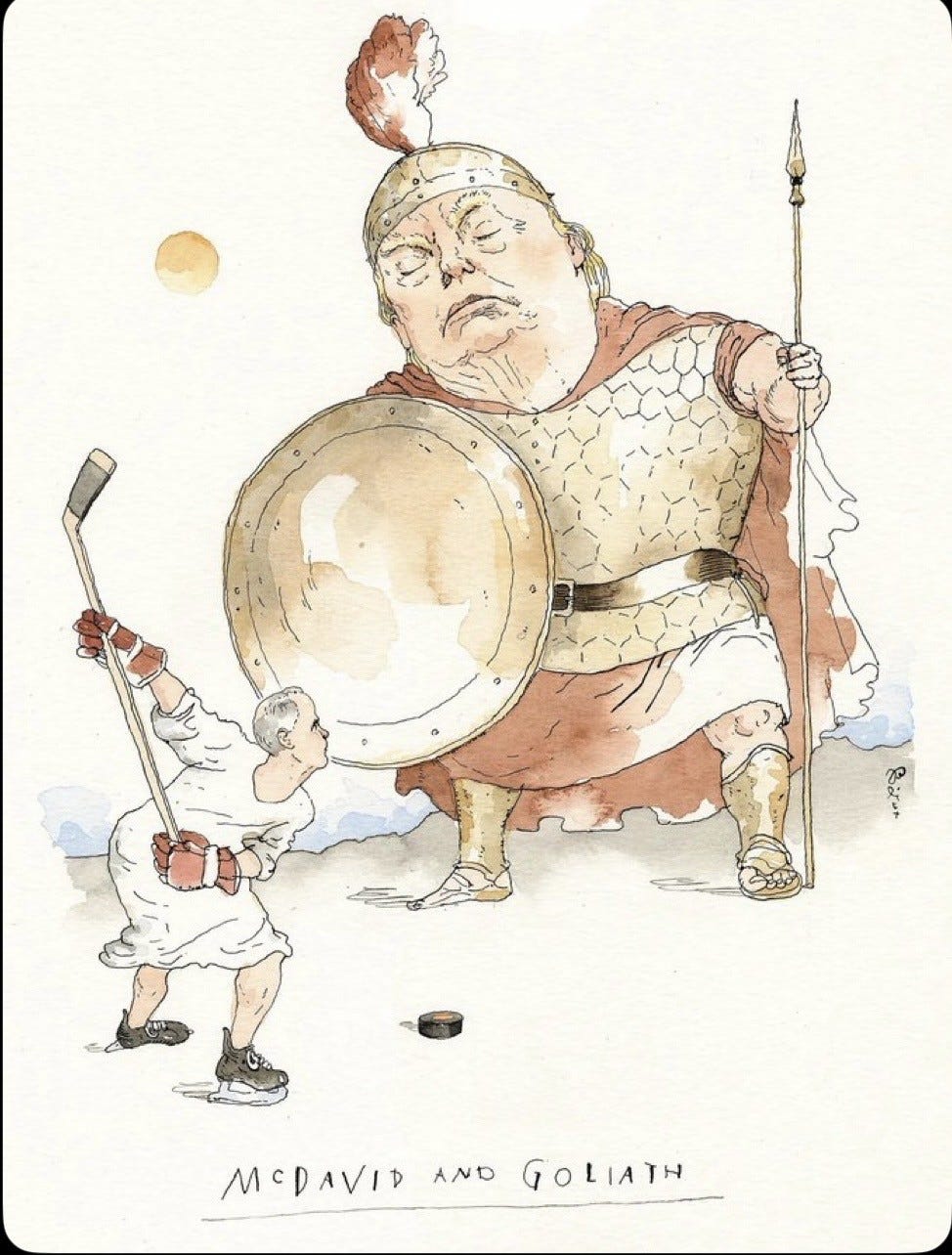
Photo credit: The New Yorker
Bond market typical management tools:
QE (Quantitative Easing). Typically done by the Federal Reserve. QE expands the Fed balance sheet and has monetary easing as its’ goal (esp when Fed Funds are at their lower bound). Long term yields lower.
Kevin Warsh is the newly minted Fed Chair, having replaced Powell as Trump’s hand picked candidate (note: The Fed Chair is meant to be apolitical/neutral). As an aside, Druck used to be Warsh’s boss as well (2011-2026). Warsh is likely mirror talking in prep for his first J-Hole (aka Jackson Hole Economic Policy Symposium) which kicks off tomorrow in Wyoming and all eyes are on the seemingly mute new Fed Governor. It will not be all Smores and single malts, to be certain.
Japan is the undisputed king of QE as they “kitchen-sinked” it a decade + ago. All assets classes are fair game and the BoJ currently owns approximately 40% of the Japanese equity market (via EFT’s). Japan’s pension plan, GFIP, is one of the world’s largest in terms of aggregate size at well over US$1 trillion, but the horrendous aging demographics of Japan would see the plan zeroed after only 5 years if younger workers were to stop contributing. As an aside, the US Social Security Trust, largely a “pay-as-you-go” system (e.g. funded largely via payroll deductions which roughly equate to interest of the $40 trillion in accumulated debt). A budget surplus has not been seen in the United States since the year of ourLord 2000, under Democrat nor Republican!
Liz Truss vs. lettuce was quite a recent spectacle also in the United Kingdom. A mini-budget that both capped utility prices for the masses and cut income taxes at the top end has bond vigilantes throwing their toys out of the pram! The skyrocketing Gilt market yields were threatening the blow up (bankrupt, literally) the private pension market in the UK (LDI, liability driven investment Kool-aid drinkers all). The Bank of England (BoE) briskly launches a targeted QE program of up to GBP1tln to buy the long end. Day saved, yields down, pensions all good, Truss out, lettuce for the win!
Treasury buybacks: U.S Treasury action whereby Treasury repurchases outstanding UST’s using cash (rare) or other financing (typically T-bills which make up almost 30% of debt issuance presently). No direct expansion of the Fed balance sheet. Done in the name of liquidity / debt management. Expansionary/inflationary to the extend terms rates are brought down (on a persistent basis). Lower long term rates targeted (note: achieved another matter).
US Midterm election are less than 3 months away with Republicans (Trumpians) under immense pressure to lower the cost of living for the average American. Under the guise of increasing long-dated treasury liquidity (Druck argues the liquidity was fine, but the price/yield was deemed wrong) Treasury executed treasury purchases in the open market that brought the observable yield on those secondary US treasury securities down. Like a fart in an elevator, the effect soon dissipated and yields returned to the levels seen 24-hours prior. The “long bond” 30 year (on-the-run) yields 5.19% at the time of print). Druck would advise Bessent to focus on reducing the deficits (legacy $40tln and $1.8tln ytd 2026 running). The Federal Reserve (Warsh et al) set monetary policy in the short end of the curve via the “Fed Funds” rate, currently 3.50-3.75%, with a September FOMC (Federal Open Market Committee) meeting soon upon us. Longer term rates are much more difficult to “coral” or control (see YCC, yield curve control below). Thus far at least, Trump is a Bessent fanboy, noting ,” He has a good touch, a very good natural touch for the bonds and interest” (whatever that means) adding more confusingly in the same interview, “We have many types of interventions, that’s one, the ultimate intervention is our military. If we have to use that we will.” (bond execution, execution style …).
Operation Twist: Traditionally the purvey of the Federal Reserve; Treasury Department can approximate via debt management. Buy long-duration + sell/issue short-duration. Balance sheet largely unchanged in classic twist. Flattens curve, lower term rates, typically lower long end and slightly higher short end. In 2011 Twist was monetary policy conducted by the Fed with this 2026 version debt management policy effected by Treasury.
YCC (Yield Curve Control): Federal Reserve. Buy UST in whatever amount necessary to defend a stated yield. In stubborn, potentially unlimited balance sheet expansion. Explicit cap targeting specific yield. Rates down / capped.
Japan has the best exhibit of YCC in the modern age whereby they targeted a 10bp (0.10%) yield on 10 year government bonds for multiple years, before abandoning it. Since, the 10 year JGB yield has risen and currently stands at 2.90% (29X the former “capped” yield of 10bp).
Who owns your debt is a factor in all of these programs. Japan’s massive debt of well over 2X GDP is 93% held in Japan. The US is beholding to foreign buyers (e.g the indirect bid in ongoing auctions) as over 30% of their debt is held by foreigners. IF the Fed’s balance sheet were ever brought down through quantitative tightening (QT) the foreign % would rise (it has historically been >50% for periods of time).
When deemed credible YCC can require less purchases as wary investors are not keen to short bonds against an effectively unlimited central bank bid (JGB shorting in particular called the “widow maker” trade.
On a continuum, normal market operations, Treasury Buybacks, Twist, QE and YCC is one way to look at the government’s policy influence over long end rates (beyond fiscal policy, prudence). .
Who is zooming who, in this instance?
Bessent’s most recent actions have been characterized as both a Treasury Buyback and a Twist Operation. Buying long dated bonds and shifting issuance toward bills is De facto Treasury Twist operation. The strict definition/moniker made even more difficult to nail down given Bessent’s follow on comments that future purchases in the UST long end (liquidity passes can be for up to $4bln per versus $2bln prior) may be funded by the Treasury General Account (TGA) which currently stands at approx. $1 trillion (elevated in terms of size, sub $500bln would be “typical”).
Throughout their storied history there have been conflicts between the Federal Reserve and Treasury. In 1951 the matter was laid to rest with the Treasury Federal Reserve Accord which was signed Mar 4, 1951. Post this accord, the Fed was no longer required to maintain Treasury bond prices/yields for the purpose of financing the government. The accord set out the mandate for both with the Federal Reserve in charge of money + reserves + monetary policy + open market operations and Treasury charged with debt issuance + maturity structure + fiscal financing. This accord signaled the foundation of modern Fed independence.
We will all be fire-hosing the news flow from Jackson Hole over the next 2 days for clues, beyond what we now know in this murky but important land of bonds!
Cheers, JCG
No posts
Comments
Nothing yet. Say the first thing.
Sign in to join the conversation.