
Trump’s 2nd POTUS term has officially been a dud thus far. As signaled by Moody’s recent USA ratings downgrade, finally joining S&P and Fitch in the “AA” category, enough is enough. This should serve as a stern warning about America’s fiscal health. With the US sovereign rating no longer AAA, a number of credits, including the large US banks were dealt a concurrent downgrade (too big to fail backstop less credible).
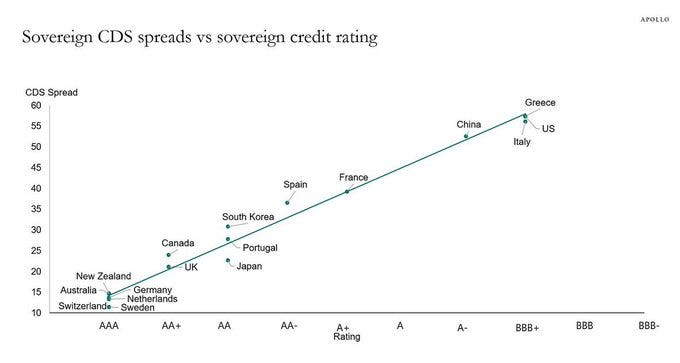
CDS (credit default swaps) on USA debt popped +14bp to 55 basis points from 41 prior to the downgrade. To put this is some context, if a counterparty wanted to insure against a default by the US Treasury they could buy CDS cover for 55bp. The yield on the 10 year UST is currently 4.43%. If credit protection was purchased for 0.55% (per annum) the “investors” effective yield drops to 3.88%. At AA1, the actual risk of a USA default is low, but the volume of CDS can spike as hedge funds and family offices play the arbitrage of buying off-the-run (secondary market) low coupon US treasuries (e.g. UST 1.375% 8/15/2050 for $47.00 price) pay 0.55% CDS premium on $100 million notional, on the small chance (e.g. technical default on debt ceiling impasse) that there is a default where they can deliver the $40 bond (acceptable under a Borrowed Money definition) and get paid $100 by their CDS counterparty (e.g. pay $47,550,000 for the cash UST and CDS premium to receive $100 million in the event of a default, delivering the UST to their counterparty for a par payout).
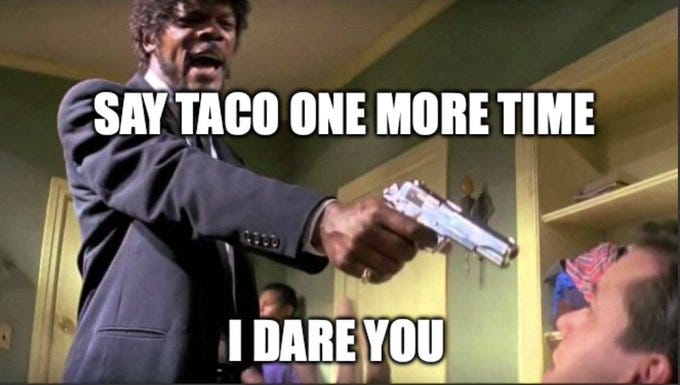
The best moniker for the Wall Street Monopoly game so far in 2025 is TACO “Trump Always Chickens Out”. Trump hates it, hence it will likely stick.
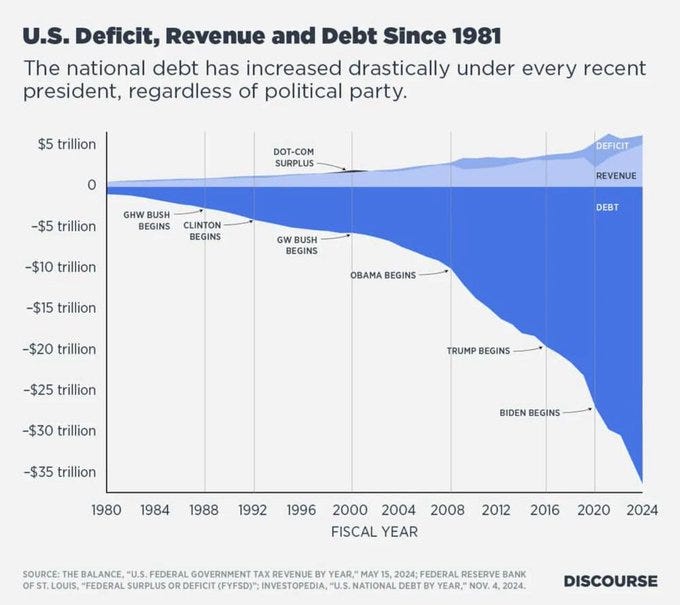
No administration, Democrat nor Republican has run a surplus since the “mini” surplus in 2000, 25 years ago! The US budget deficit over the last 5 years averaged 9% of GDP. Over the last 12 months it hit 7% of GDP. Q1 2025 has swung to -0.2 from +3%.

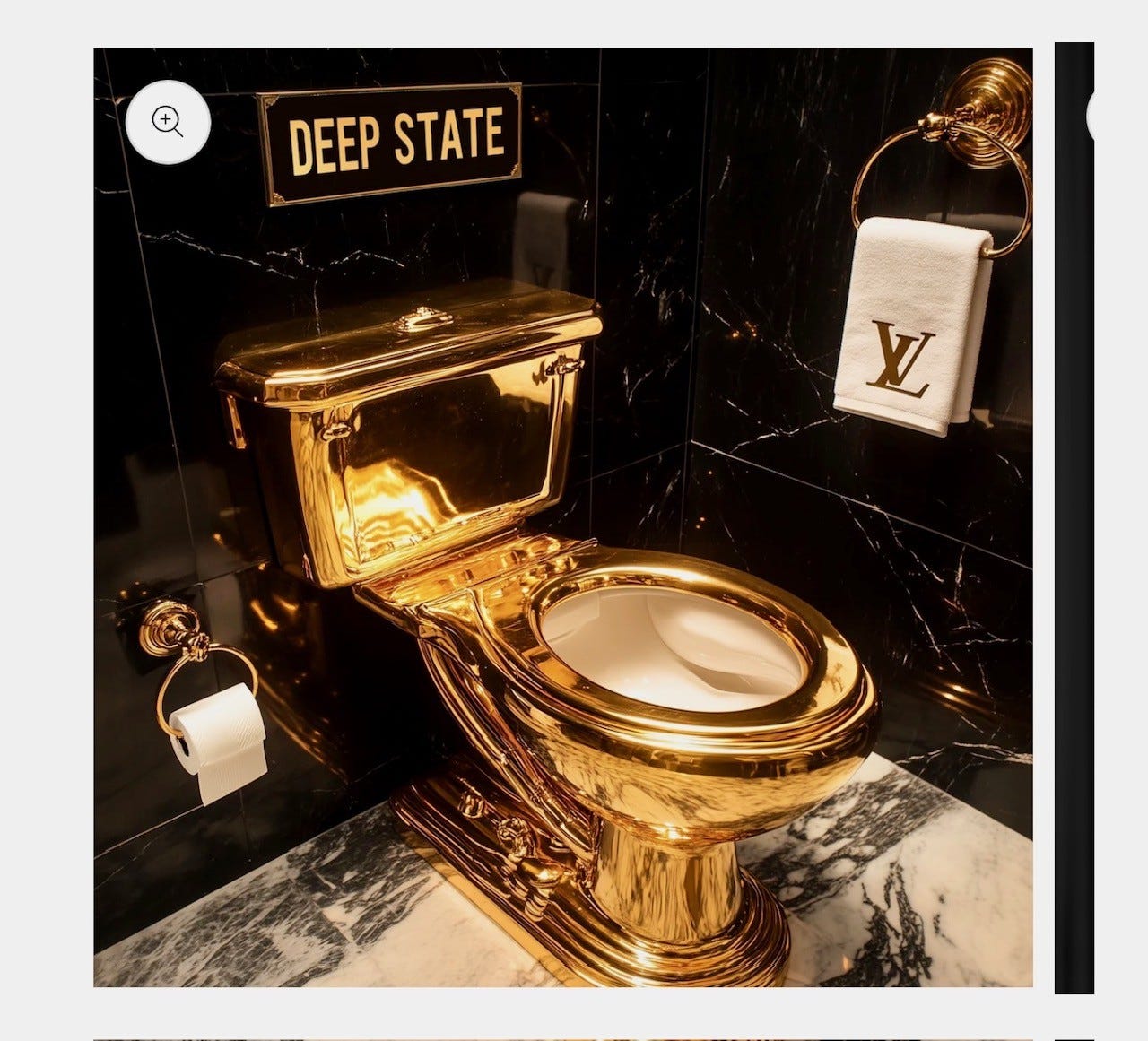
The Golden Age of Grift appears to be catching up to the current administration. The “One Big Beautiful Bill” scraped through the house with a yes this month, but will likely be rejected by the senate. Golden Visa’s for $5 million a piece. The Golden Dome protection racket (Canada) and of course the gold-adorned oval office. Matching TRUMP and MELANIA meme coins. Trump Media & Technology Group Corp. , ticker DJT 0.00%↑ market cap $4.7bln (well off highs north of $10bln). Digital corruption in DC on a scale that would likely make prohibition rum-runners blush. The currently tabled “Genius Act” (Guiding and Establishing National Innovation in U.S. Stablecoins) appears to be counter genius if anything.
The market reaction to Trump’s BBB (not to be confused with their credit rating, Mexico is rated BBB), cutting taxes for the wealthy and cutting benefits (e.g. Medicaid work requirement), hence increasing income disparity further, was swift. $3.5tln cost over 10 year ($40tln here we come with +1tln per 100-day deficit pace). Some market pundits called it Trump’s Liz Truss moment. Then UK PM Truss announced the intent to cap utility bills for all Britons concurrent with a mini-budget cutting income taxes for even the wealthiest (e.g. 45%) on September 22, 2022. The UK bond market was battered for days, long dated gilts +50bp per day (higher yields) had the UK pension industry on death watch as the LDI (liability driven investment) mantra sold to them had them gagging on the heavy allocation in the long end of the gilt curve inflicted immense paper losses (British Telecom’s pension fund alone > GBP12bln). Truss reversed course, cancelled the tax cuts and ramped a quantitative easing program of $1tln buying long end gilts exclusively. It worked, yields fell in the path of the QE steamroller. Politically Liz was no more and the lettuce did in fact outlast here tenure as PM (49 days at 10 Downing Street).
Bond vigilantes are not required to upset such a loaded apple cart. The indirect bid, from foreign buyers at set treasury auctions, can dictate the success of an auction. They do not need to sell any of their existing UST holdings to cause a spike in bond yield, they just need to buy less of an increasing supply. The global bond market dictates all, at almost 3x the size of the global equity markets, $300tln bond market vs. $110tln equity market.
Note: In the inflationary early 1980s, economist Ed Yardeni coined the term “bond vigilantes.” He described investors who sold bonds to protest against irresponsible fiscal and monetary policy, putting pressure on governments to act.
USA, UK, & Japan bonds market have been mullered. Real yields (nominal yields less inflation) are spiking while global growth expectations are tanking. This is not a healthy. The bond market is known as the adult in the room vs the frenzied equity market. Bonds are typically rational and price in the cocktail of inflation expectations, fiscal policy, geopolitics and global growth expectations.
USA
The spike in bond yields in the USA has banks facing almost $500bln in unrealized losses, up by 33% from the prior quarter. We all know the Silicon Valley Bank story, held to maturity (banking book) can not act as a shield in all circumstances. The big banks (JP Morgan $4tln of $22tln) effectively have no depositor protection limit. SIFI’s all (systemically important financial institutions), but the small banks and regionals are on a banana peel from a capital underpinning perspective.
Japan
Officials in Japan seem to open their mouths to change feet. The Prime Minister Shigeru Ishiba recently stated that their financial situation was “worse than Greece’s”, highlighting the severity of their fiscal challenges. The Agriculture Minister Taku Eto resigned following public outrage over his comments that he “never had to buy rice” because he received it as gifts from supporters. Inflation, driven by rice prices (+98.4% year over year in April) posted their biggest jump since 1971. Energy prices rose +9.3% after the March 2025 phase out of Japanese government subsidies. GPIF (Japan’s government pension plan) is one of the largest in the world at US$1.3tln. Demographics (population dropped 45th year in a row in 2024) dictate that if current worked stopped contributing GPIF would be out of funds in 5 years. 40 year government bonds(JGB’s) have spiked in yield to historic highs (highest since inception) at 3.675%. The most recent 40 year JGB auction was poor, sold at a yield of 3.135% with a bid-to-cover ratio of 2.21, the lowest since July 2024, signaling tepid demand (fiscal concerns, shifting global interest rate dynamics). Fiscal concern is warranted as Japan’s debt is 263% of GDP, the highest among developed nations. Japan Ministry of Finance is reportedly seeking to reduce the amount of 40 year debt issuance to address the weak demand and rising yields. To add insult to injury India officially surpassed Japan to become the 4th largest economy in the world, hitting the $4.2 trillion GDP milestone (IMF).
The spike in bond yields have the insurers on watch. Four Japanese insurers; Nippon Life, Dai-Ichi Life, Sumitomo Life and Meiji dominate the insurance landscape. Their losses (unrealized) on the spike in JGB yields is over 8 trillion JPY (US$563bln with USD/JPY at 144.20 at the time of print.
Canada
Tariff paralysis would be a good summary. Trump’s “whack-a-mole” tariff labyrinth is certainly hard to navigate. This week a Federal court struck down most of Trump’s tariffs, demanding they cease within 10 days and that monies collected to date be returned. Trump’s legal team is appealing of course. This news does not help the auto sector where $350bln in vehicles and parts stay in limbo, as they were implemented under Section 232 of the Trade Expansion Act of 1962, not the International Emergency Economic Powers Act (IEEPA) authority that the court rules against. If Trump’s appeal fails expect more “cowbell”, higher tariffs under Section 232. The venerable WSJ this morning reports that the White House (Gold?) is considering a stopgap effort to impose tariffs under Section 122 of the Trade Act of 1974 (it has never been used before hence no case law exists). TACO appears to have his back up.
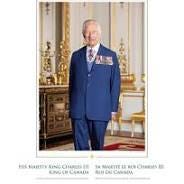
Silver bullets nor crosses have kept Trump from dialing up his 51st state rhetoric. The latest jest related to “free” Golden Dome cover OR $61bln if Canada choses to remain independent. Newly minted Canadian PM Mark Carney sent a pigeon to London to request that the King of Canada, King Charles III deliver Canada’s speech from the throne in person for only the 4th time ever (last delivered my mumsy, Queen Elizabeth II in 1977!). The King’s presence and delivery of the throne speech served as a powerful symbol of Canada’s autonomy and its enduring constitutional monarchy.
Canada would be well served to send a pigeon to China as well. China’s retaliatory tariffs affects over $2.6bln of Canadian goods including a 100% tariff of canola oil, 25% on seafood and pork (68% of China’s protein). Canada matched the USA’s 100% EV tariff (4x prior tariff level) on China and put a 25% tariff on Chinese steel and aluminum. If DJT (Donald J. Trump) is the ticker symbol for the USA then BYD (Build Your Dreams) China’s biggest EV producer is China’s. With over 300,000 Ontario jobs dependent on the automotive sector these are tough calls to make clearly, but blindly falling in line with USA tariffs on China is equally as dangerous (e.g. mouse/elephant).
Moody’s still rates Canada Aaa (His Majesty in right of Canada). The USA is now Aa1 with the latest downgrade. Canadian government bonds trade well below US Treasuries at all points in the curve (lower bond yields). The differential in 10 years is -1.2% (10 yr UST 4.42% vs. 10 yr Canada 3.22). The differential is wider in 30 years at -1.42% (USA 4.93% vs CAN 3.51%). Canada’s debt (federal and provincial combined) is 76% of GDP. Federal alone at C$1.24tln is 42%. The provinces carry heavy debt loads largely due to their responsibility for healthcare. Canada’s spends C$81.8bln in interest on its debt, a full 2x their military spend (C$40.4bln or 1.3% of GDP). Canada admits it has been a freeloader with respect to military spending and with 22/32 NATO member at or above their 2% GDP commitment we clearly need to ramp this effort quickly. Canada has now committed to hitting their spending target of 2% by 2027, six years ahead of schedule (end 2032 prior commitment).
With this envious trading environment Canada might want to capitalize on the market conditions to file a bond shelf for C$60bln in 50 year “Victory Bonds”, last used to finance military operations in WWI and WWII. These bonds would carry an interest rate of 5% and would be dual tax-exempt (federal and provincial). At the end of the retail order period, there would be sales to corporates (up to a 2% of assets de minimis cap) with the program capped once demand was satiated. A successful 2025 Victory Bond program could well get Canada to our 2% of GDP target by late 2025. Taxation bruised Canadians would “do their part” at 9% TEB (Taxable equivalent basis), assuming a 45% marginal tax rate for most individuals (5%/.55)=9.1%.
#JCG

No posts
Comments
Nothing yet. Say the first thing.
Sign in to join the conversation.