
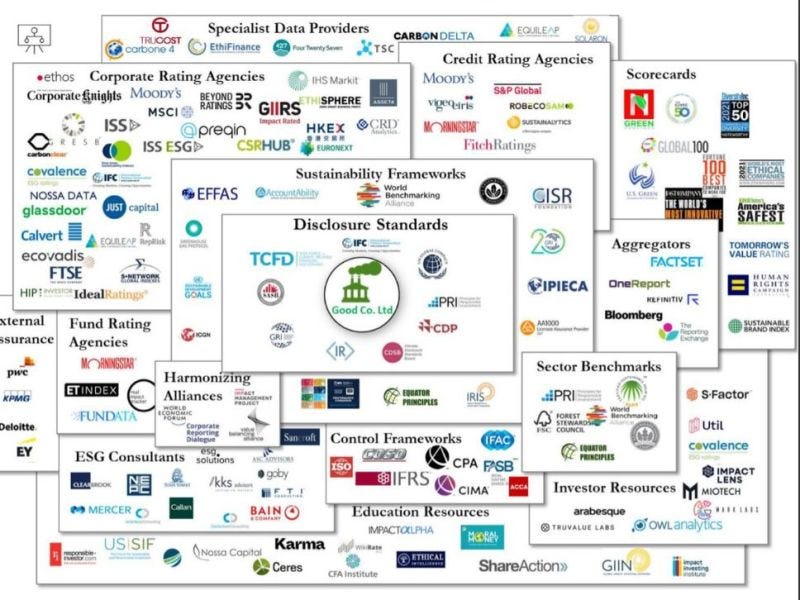
We live in the Anthropocene (human-made) era. We are certain of the impact of humans on the planet since the dawn of the industrial revolution; the carbon we have emitted into the atmosphere has resulted in global warming. Unchecked, this could have catastrophic results.
One metric that is on the rise is ESG fear. Companies are increasingly at a standstill with respect to both ESG reporting requirements (false, misleading, insufficient?) as well as proposed ESG risk mitigation measures .
ESG ratings are all over the map, due to differences in data sources and rating methodology. Most providers weigh each factor equally.
The “E” gets much of the limelight presently, given the global focus on climate change, sovereign net-zero commitments and energy transition risk.
Climate and finance is some ways are like oil & water. Fear does not exist in science per se, but in finance it certainly does. We measure fear via the statistical anomalies it generates on asset returns which we call distribution tails. If humans did not imitate each other with respect to their emotions, the markets would only experience a 50% drawdown every 5,000 years. During the Global Financial Crisis we measured 7-sigma events, the equivalent of one side of a glass of water boiling and the other freezing concurrently. We see 30-40% “left-tail” (loss) sell-offs each decade.
The deemed virtuous ESG bandwagon now encircles the globe as many times as high-speed cable did in the dot-com craze of the late 90’s. ESG “assets” were pegged at $18 trillion coming into 2023. The global greenwashing police, enforcing a stricter definition has brought that to $8 trillion.
The financial ESG circus is very much a side-show to the task at hand for most privately-held small and medium sized companies:
1.) What are my key ESG risks?
2.) Am I aligned with best practices?
3.) What mitigation measures do we propose for the short and medium term.
Hiring:
In the current ESG ecosystem, hiring is a challenge. You are largely hiring people that do not exist yet. Consultants are in high demand, and for good reason. Rent versus buy until a viable game plan becomes evident. Support your existing management team through education (detailed below).
The majority of executives with the title Chief Sustainability Officer (CSO) are women, some surveys suggest as many as 85%.
Sweden’s Climate Minister Romina Pourmokhtari is 27 years old. Canada’s Minister of Environment and Climate Steven Guilbeault was a member of Greenpeace and has a criminal record for scaling the CN tower in protest (his younger years). Canada has never met one of their net-zero goals life to date. Despite our vast forests, Canada’s land mass does not act as a carbon sink, due in recent years to large-scale forest fires in western Canada. It is estimated that upwards of 40% of global carbon emissions are absorbed by natural carbon sinks (water/land).
Corporate Social Responsibility (CSR) common examples:
Reducing carbon footprints.
Improving labor policies.
Diversity, equity and inclusion.
Charitable global giving.
Community volunteering.
Corporate policies that benefit the environment.
Socially and environmentally conscious investments.
Education:
The baseline level of knowledge in this ESG integration is thought to be low. With respect to public companies, 70% of board members felt their board was ineffective at integrating sustainability into governance and strategy building.
The Asian Development Bank (ADB-I) has a very brief (1 hour all-in) course that my finance students have found to be a good introduction to the sustainable finance. Course link directly below:
Governing Sustainable Finance - course
Continuing education and a kick-off weekend “boot camp” is also a good idea to get your team up to speed on the varied standards and frameworks jostling for global dominance.
The EU’s Corporate Sustainability Reporting Directive (CSRD) was recently adopted (11/2022). The Task Force on Climate Related Financial Disclosures (TCFD) appears to have staying power/ dominance over SASB (Sustainability Accounting Standards Board). Lesser known is the Science Based Targets Initiative (SBTi) which includes CDP (Carbon Disclosure Project) Worldwide, a non-profit working on global disclosures, as a partner. The SEC is expected to put the final touches on their disclosure proposal (material risk due to climate change, as well as greenhouse gas emissions in their production and supply chains) for publicly listed companies in March 2023. The rumour mill has been active in anticipating that scope 3 emissions will be excluded from their climate disclosure requirements.
Sustainability bonds (sustainable/social/green, combined) are expected to exceed $1.5 trillion in calendar 2023. Use of proceeds is the primary metric used currently to qualify a given security, but we are seeing some structures where coupon spreads flex based on performance versus stated net-zero targets. Data will clearly be the currency of credibility, especially when ones’ fiat bond coupon is tethered to it.
Many ESG risks are 2-tailed risk that your management team effectively deal with in the normal course of business (foreign exchange, rates, commodities, credit).
Some ESG risks are 1-tailed. ESG legal risk is rising. Some of this risk is theoretically hedged via existing insurance policies such as Directors and Officers (D&O) liability insurance. Expect some outsized inflation with respect to D&O premiums going forward.
ESG Action - DOTEKI International can help:
Scoping/Feasibility - Identifying strategy and action plan
Project Proposal / Proof of Concept
Contract
Execution
Book a complementary consultation to explore how Doteki’s pragmatic approach can get your company’s ESG fear gauge back to normal.
enquiries@dotekiinternational.com
David Jackson, Founder, Doteki International Ltd. Consultants; Richard Farrington, Tim Fallowfield, Jon Boylan & Caleb Gibbons.
Comments
Nothing yet. Say the first thing.
Sign in to join the conversation.