
Jalon painted pleasant things, and had done so for twenty-seven years.
Pleasant harbours. Pleasant fields. He had painted three hundred and twelve commissioned dogs, all of them more dignified than their owners.
People said his work was beautiful. Jalon knew they meant harmless.
His paintings matched curtains. They softened waiting rooms. He had become, by middle age, the sort of painter people remembered only after seeing his signature.
“Oh,” they would say. “That’s one of yours.”
One of yours. As if he made umbrellas. As if his life’s work had been weatherproofing.
He lived alone above a bakery that began its work at three in the morning and made sleep smell like yeast. His studio occupied the back room, where the light came in through high windows and dust settled over everything.
Every day, he painted. Every day, nothing happened.
Then, on a Thursday in November, the last kind thing anyone ever said to him arrived in a message he could not answer.
Jalon did not paint that night.
He sat in his studio until the bakery began its work below him, listening to dough slapped against wooden tables and men laughing as if morning were a thing one could simply agree to.
At seven, he stood, washed his face, and went to the gallery.
The show was in six days.
He had promised eleven paintings. Ten were finished. The eleventh stood blank on the largest canvas he owned, a thing he had bought years ago during a rare attack of ambition and never dared use.
It was taller than he was. Wider than his outstretched arms. A white field with no patience for excuses.
“What will it be?” Elena had asked when she came to see the work the week before.
Elena ran the gallery with black dresses, red glasses, and the steady disappointment of someone who had once believed artists were dangerous.
“A landscape,” Jalon had said.
“Of course,” she replied.
He had pretended not to hear the sigh.
Now the canvas waited in the centre of the room, enormous and blank, while ten polite paintings leaned against the wall behind it like witnesses ashamed of what they were about to see.
Jalon mixed blue first. He always began with blue. Blue was dependable. Blue became sea, sky, glass, distance, melancholy in rooms where melancholy needed to be decorative.
He loaded the brush, lifted his hand, and stopped. The blue was wrong. Too pretty. He dropped the brush into the turpentine jar and reached for black.
The black that was thick and oily and almost purple at the edges. It came from the tube reluctantly, like something dragged from underground.
He laid it across the canvas in a single stroke. It did not look like anything.
Good.
He added red. Then grey. Then white, but not enough to save it.
For the first hour, he tried to paint what he felt. This was his mistake. His feelings wanted out. They wanted to be heard.
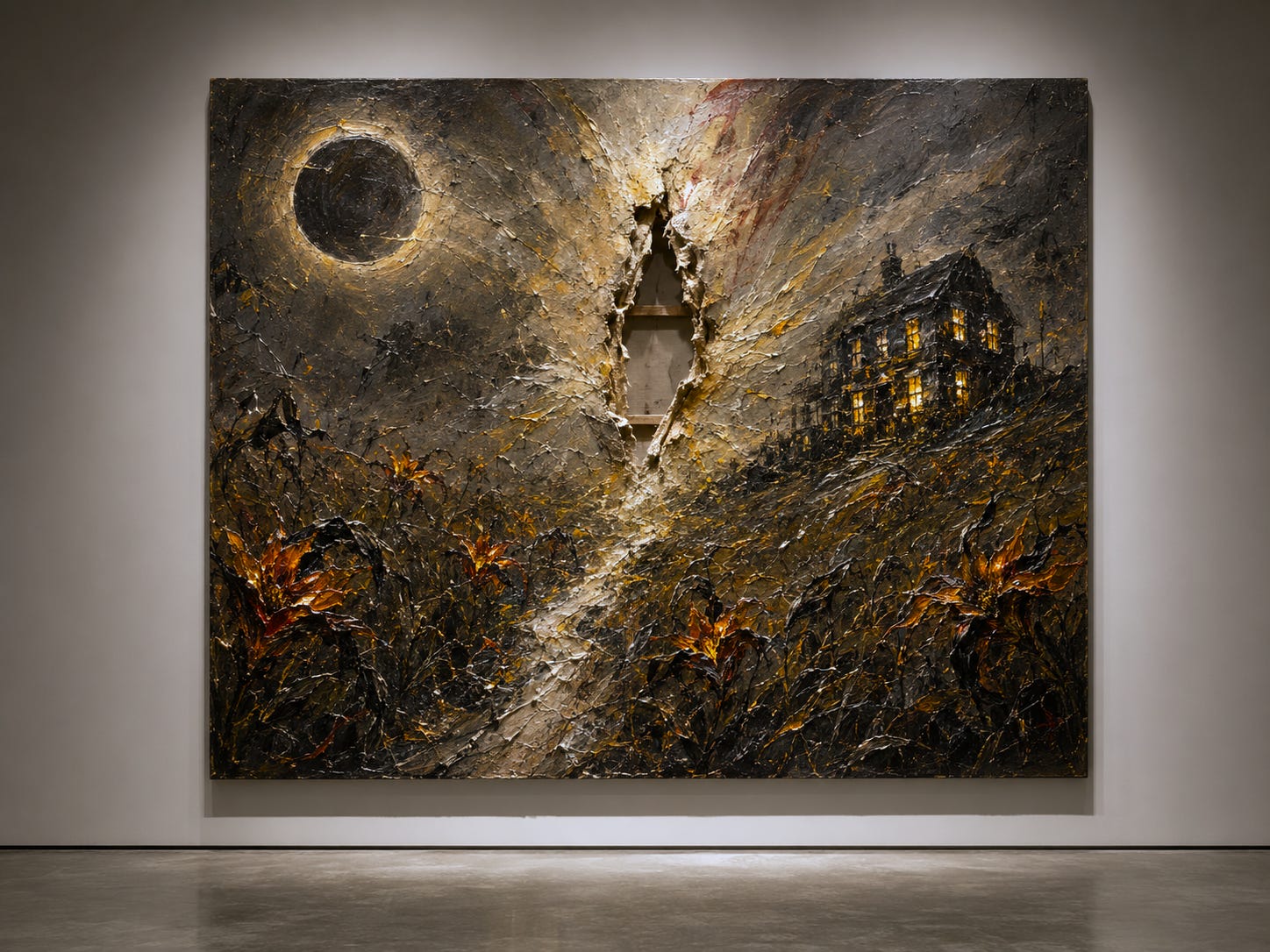
By midnight, the canvas had become a dark field crossed by a narrow band of gold. He hated the gold immediately. It was too beautiful. Too hopeful. He took the palette knife and scraped it down the centre until the paint gathered in ridges like torn skin.
The sound satisfied him. He scraped again. Again. The gold broke apart. Beneath it, the black was still wet.
He laughed once, a short, ugly sound that startled him. Then he painted faster.
A cabin appeared, although he had not intended one. Small, crooked, set in the upper corner as if abandoned there by a careless god. Every window burned with yellow light, but there was no door.
Jalon stepped back. His chest tightened. He painted over it. Then painted it again larger.
No door.
He reached for blue, then changed his mind and took green, dragging it along the bottom of the canvas in violent strokes until it became a field of flowers bent beneath an unseen wind. He gave them orange throats and black edges. Lilies, perhaps. Or flames pretending to be lilies. They leaned away from the house as though refusing to look.
Above them, he painted a sun. Then, he painted a moon crossing it. The light dimmed. The room seemed to dim with it. Jalon put down the brush and pressed both palms against the canvas. The paint was cold.
He stood there breathing, hands sunk into the wet surface, and felt something inside him trying to climb out through his ribs.
“No,” he said. He did not know to whom.
He picked up the largest brush he owned, a wide house-painter’s brush he used only for priming, and loaded it with white. He attacked the sky. Not painted. Attacked. The bristles bent and split. Paint flew against the floorboards, the table, his shirt, his face. He drove the white through the eclipse, through the field, through the house, trying to make light do what light was supposed to do.
It refused. The white became smoke. The smoke became a road. The road became a wound running from the bottom of the canvas to the place where the sun and moon overlapped.
His arm ached. His fingers cramped. Still he painted.
At some point, the brush snapped. Jalon stared at the broken handle in his hand. Then he used it anyway. The wood gouged through the paint and caught in the canvas. There was a small tearing sound.
He froze.
The rip was no longer than his thumb. A simple wound. A flaw that would ruin the piece. He should have stopped. Instead, he put both hands on either side of the tear and pulled. Jalon staggered back, breathing hard.
Behind the torn place was the studio wall, stained with old paint, cracked plaster, dust, and the shadow of the wooden stretcher frame. The wound had actual depth now, unlike the illusion of depth he had spent his life manufacturing. A space where the painting had failed to remain whole.
He went very still. Then he began again. He widened the tear. He tore until the centre of the canvas opened like a mouth. Around the wound, he painted light.
He mixed yellow with grey, white with umber, red with the dirt from the heel of his hand. He smeared it in arcs around the torn place until it looked less like light shining out and more like light being dragged unwillingly from inside.
His knuckles split against the stretcher frame. Blood appeared on the heel of his thumb.
He looked at it. Then pressed it into the painting. By morning, the studio was destroyed. Three brushes lay ruined on the floor. One had bristles embedded in the paint. The palette knife was bent. Tubes had been crushed flat. There was paint on the ceiling, on the radiator, in his hair, beneath his nails.
The ten pleasant paintings leaned against the wall, untouched and suddenly obscene.
The eleventh stood in the centre of the room.
It was not beautiful. Jalon sat on the floor and stared at it until the bakery began again below him.
At noon, Elena arrived. She knocked once, then let herself in, as she always did.
“I came to see the landscape,” she said. Jalon did not answer. She stepped into the studio, saw the floor, the broken brushes, the state of his shirt, and finally the canvas.
For a long time, she said nothing. Jalon waited for her to be angry. Instead, she removed her red glasses.
“Oh,” she said.
“It is damaged,” Jalon said.
“Yes.”
“I tore it.”
“Yes.”
“I do not know if it is finished.”
Elena put her glasses back on.
“No,” she said. “I don’t suppose it is.”
He turned to her.
“Then you won’t hang it.”
She looked at him as though he had said something stupid enough to be charming.
“Jalon,” she said, “I am going to hang it where people can’t escape it.”
The opening was on Friday.
Rain came down all evening, tapping at the gallery windows with thin, impatient fingers. People arrived in dark coats, shaking water from umbrellas, laughing too loudly as they entered the warmth. They came expecting Jalon, which meant they came expecting calm seas, soft fields, tasteful melancholy, perhaps a dog if one were lucky.
The first room gave them exactly that.
Ten paintings. Harbours. Fields. A woman in blue. A bowl of pears arranged like obedient little moons.
People nodded. People smiled. People said, “Lovely.”
Jalon stood near the back with one bandaged hand in his pocket and the other curled around a paper cup of wine he had not touched.
Elena had placed the eleventh painting alone in the second room. No title card. No price. Just the canvas, lit from above, torn open at the centre like something wounded and still standing.
The first people entered laughing. The laughter stopped. This pleased Jalon more than applause would have.
More people came in behind them, then slowed, then stopped as well. The room filled badly, unevenly, as if no one knew where to stand. Some stayed near the doorway. Others moved closer and then backed away. A critic Jalon recognized from a newspaper folded his arms and frowned with professional hunger.
“What is it called?” he asked.
Jalon looked at the painting.
The cabin without a door. The field bent under impossible weather. The sun and moon occupying the same sky. The centre torn open, refusing the lie of wholeness.
“I don’t know,” he said.
The critic frowned harder, as though this too might be technique.
A woman in a green coat stepped forward. She was not someone Jalon knew. She came close enough that Elena almost lifted a hand to stop her. The woman stared into the torn place. Her mouth trembled. Then she covered it with one hand.
Jalon looked away. He had spent his entire life wanting to move people. Now that someone had moved, he felt almost ashamed.
The room held its silence. Even the rain seemed softer against the glass. Jalon waited for the silence to break, for someone to rescue everyone with a clever remark, for the world to return to its usual arrangement.
It did not.
The painting stood there, wounded and enormous, saying everything he no longer had the strength to say. And for the first time in his life, Jalon did not explain himself.
Comments
Nothing yet. Say the first thing.
Sign in to join the conversation.