
The first thing Rodin removed was the book.
It lay open beside the lovers in his earliest sketches, its pages abandoned at the moment reading became dangerous. The story was Dante’s: Francesca da Rimini and Paolo Malatesta, drawn together while reading of Lancelot and Guinevere. One fictional kiss gave them permission for a real one. Francesca’s husband discovered them, murdered them, and consigned their names to history.
Rodin placed the lovers among the condemned souls of The Gates of Hell. They belonged there according to Dante.
According to their bodies, they did not.
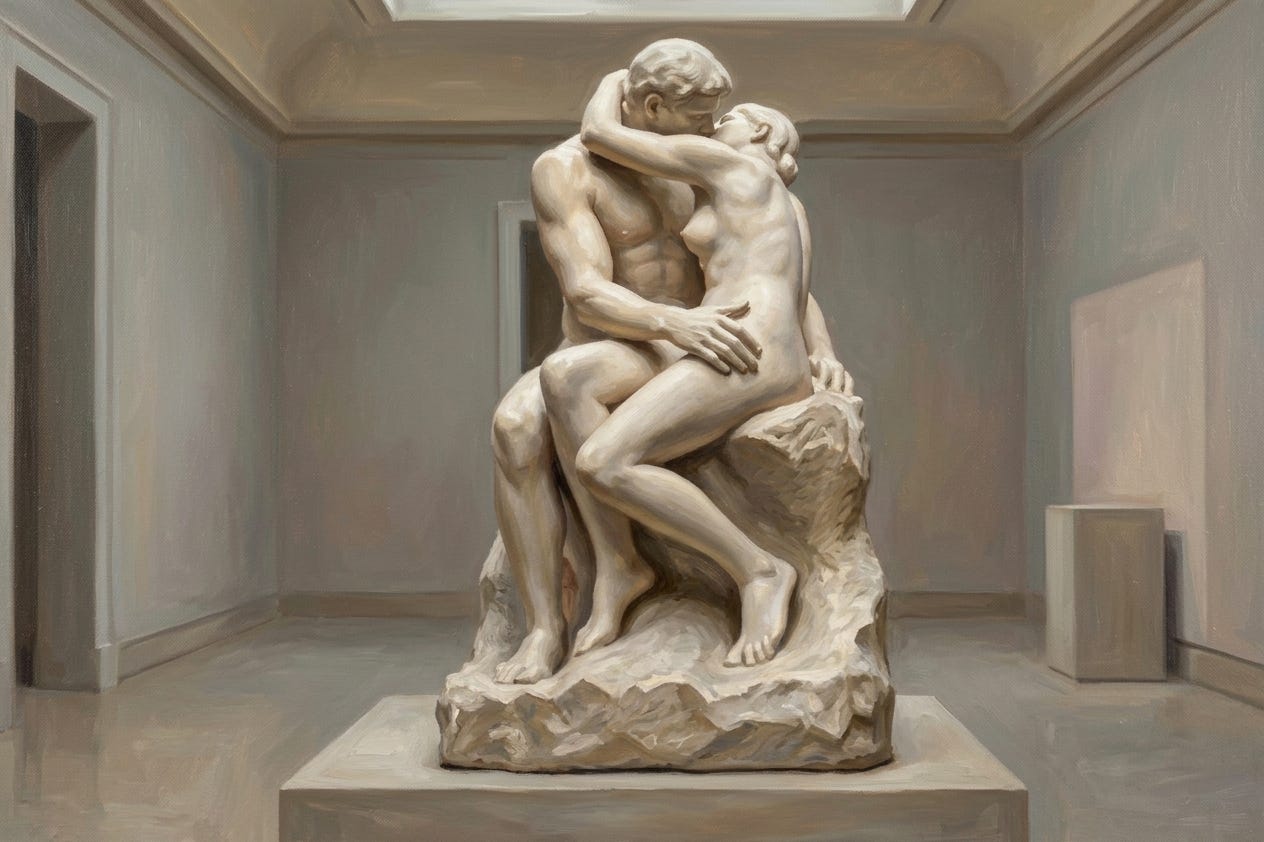
There was no torment in the woman’s arm around the man’s neck. No shame in the hand resting upon her thigh. They sat upon their unfinished stone as though everything beyond their bodies had fallen away. Hell could wait. Judgement could wait. Even the sculptor could wait.
Rodin studied them one evening after his assistants had gone.
“You are too happy,” he told them.
The couple offered no apology.
He tried roughening the clay around their shoulders. He deepened the shadows beneath their limbs. Still, the figures refused to suffer properly. Their kiss possessed the quiet certainty of something long imagined and finally allowed.
So Rodin removed them from Hell.
By 1886 they had vanished from The Gates. The following year, they stood alone before the public. Without the book, the murder, or any other clue to their identities, Paolo and Francesca became anyone. The audience supplied a simpler name.
The Kiss.
The French government commissioned a monumental marble version in 1888. The stone waited years beneath chisels, rasps, dust, and the hands of Rodin’s studio craftsmen. Slowly, two bodies emerged from a single white mass.
People insisted upon knowing who they were.
Maybe they really were Paolo and Francesca, captured before consequence entered the room.
Or they were Rodin and Camille Claudel, their complicated devotion made innocent in stone.
Others thought they were strangers he had once seen in a doorway, kissing with such urgency that he carried the shape of them home.
To some, they were a long-distance couple who had finally crossed the miles to commemorate their passion, knowing the world would separate them again by morning.
Or maybe it wasn’t that.
Rodin understood that explanation could shrink a work of art. A named couple belonged to one story. An unnamed couple belonged to everyone who had ever waited too long to touch someone.
He left parts of the marble unfinished. Beneath the lovers, the stone remained coarse and stubborn, still bearing the memory of the quarry. Their bodies rose from it smooth and warm, as though passion itself had persuaded the rock to become flesh.
Yet their lips never quite met.
A breath remained between them.
That fraction of distance was the whole sculpture: anticipation suspended before possession, the last instant in which everything remained possible. Paolo had not yet been murdered. Francesca had not yet been condemned. No doorway, nor strangers. No ocean divided anyone. No morning had arrived to make promises practical.
For one impossible moment, the lovers existed beyond consequence.
Years later, visitors would walk slowly around them. Some saw adultery. Some saw surrender. Some saw themselves and felt embarrassed by the recognition. A few noticed the abandoned book carved near the woman’s hand, still waiting for someone to finish the story.
But the story had already escaped its pages.
It had become a hand against a thigh, an arm around a neck, and two mouths holding the smallest distance in the world between them.
Perhaps Rodin knew exactly who they were.
Perhaps the lovers told him and made him swear never to reveal it.
Or just maybe he understood that every great kiss contains two stories: the one the world is permitted to hear, and the one known only to the people inside it.
Comments
Nothing yet. Say the first thing.
Sign in to join the conversation.