
With house prices up low-single digits over the last year through mid-year, an interesting question is: How much will the Fannie & Freddie conforming loan limits (CLL) change for 2027? And how much will the FHA insured loan limits change?
First, there are different loan limits for various geographical areas. There are also different loan limits depending on the number of units (from 1 to 4 units). For example, currently the CLL is $832,750 for one-unit properties in most areas. For high-cost areas like Los Angeles County, the CLL is $1,249,125 for one-unit properties (50% higher than the baseline CLL).
The CLL for each county is available at 2026 Conforming Loan Limits (excel file).
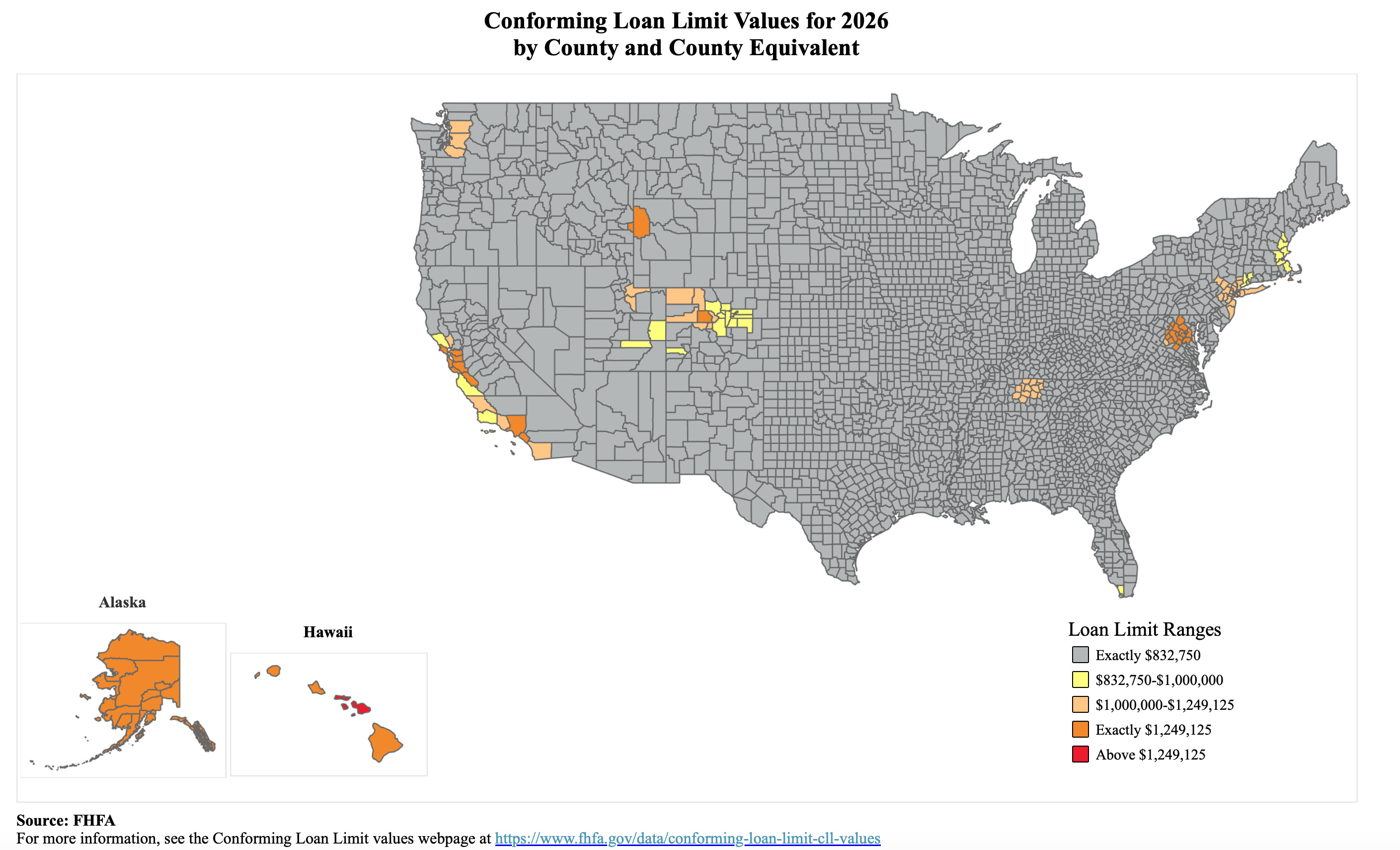
The limit is updated annually, and is adjusted using the FHFA’s quarterly national, seasonally adjusted, expanded-data index: seasonally adjusted, expanded-data FHFA HPI. The adjustment is based on the House Price Index value in Q3 divided by Q3 in the prior year. The FHFA index is a repeat sales index, similar to Case-Shiller.
Note: This calculation has changed with the Housing and Economic Recovery Act of 2008 (HERA). Also, in 2015, the FHFA decided to use the seasonally adjusted expanded data index.
Currently we only have data for Q1 2025 for the quarterly index (up 1.7% from Q1 2025), and the monthly House Price Index was up 2.2% YoY through May 2026.
Note that during periods when house prices decline, the CLL is not reduced. The CLL was at $417,000 from 2006 through 2016 and only increased slightly in 2017 as the house price index caught back up to the previous high reached during the housing bubble. This graph shows the CLL since 1979. The CLL was unchanged from 2006 through 2016.
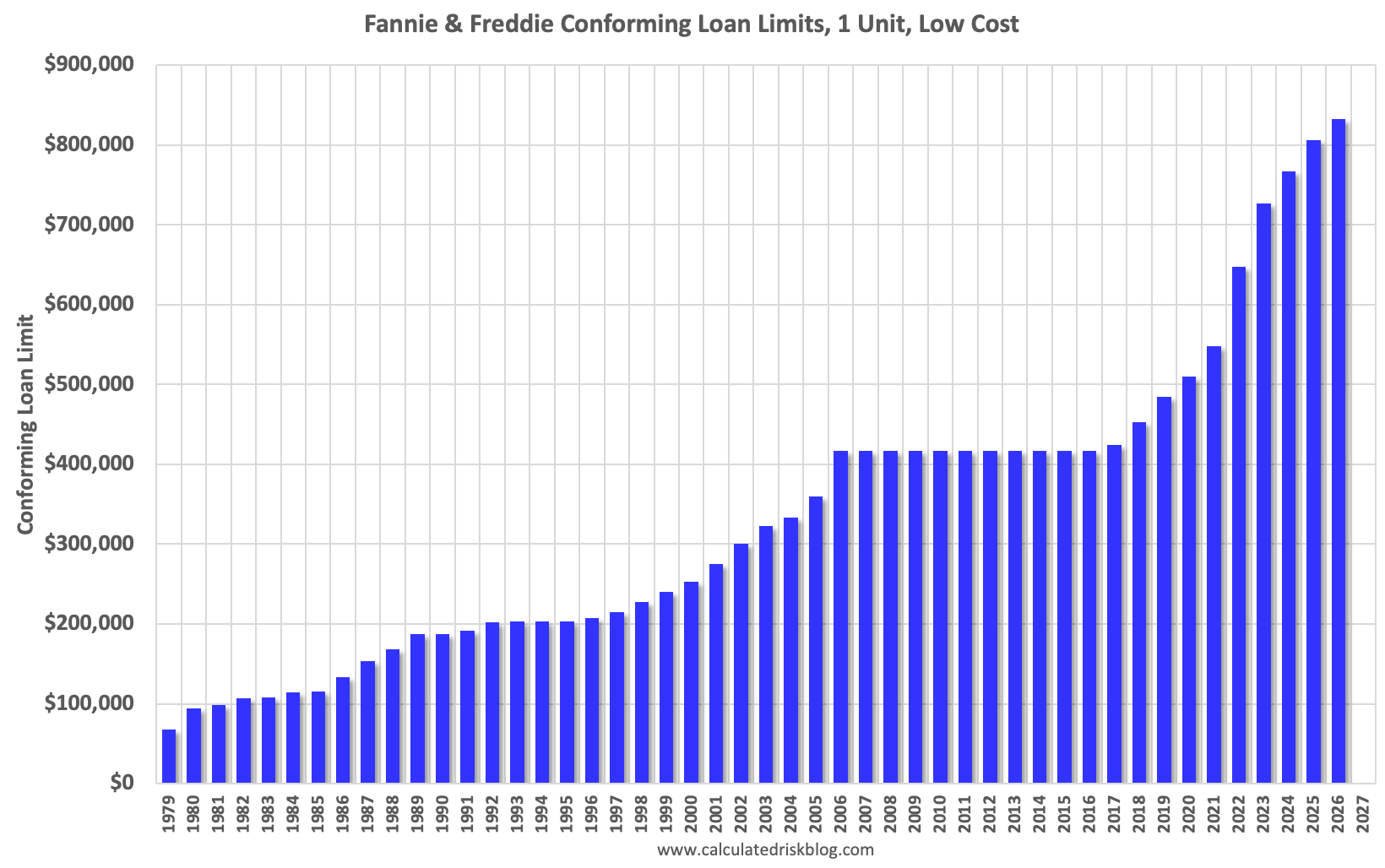
We need the house price data through September 2026 to calculate the conforming loan limit for 2027. This quarterly data will be released in late November.
Based on the current year-over-year house price change (through May), the CLL would be close to $850,000 in 2027. For high-cost areas like Los Angeles, the limit could increase to around $1.275 million.
What about FHA insured loans? From the FHA for 2026:
Low-Cost Area
The FHA national low-cost area mortgage limits, which are set at 65 percent of the national conforming limit of $832,750 for a one-unit Property, are, by property unit number, as follows:
• One-unit: $541,287
• Two-unit: $693,050
• Three-unit: $837,700
• Four-unit: $1,041,125
High-Cost Area
The FHA national high-cost area mortgage limits, which are set at 150 percent of the national conforming limit of $832,750 for a one-unit Property, are, by property unit number, as follows:
• One-unit: $1,249,125
• Two-unit: $1,599,375
• Three-unit: $1,933,200
• Four-unit: $2,402,625
These will also increase slightly in 2027.
The limit varies by geographical area (based on average house prices), and there are special limits for Alaska, Hawaii, Guam and the Virgin Islands.
Note that the 2008 HERA changed this relationship. For low costs areas, prior to HERA, the FHA insured limit (low cost) was 48% of the CLL.
Once again, we need the expanded index house price data for Q3.
Note: In some years, private lenders announced an increase in the CLL in October prior to the official release in late November. Since house prices increased sharply in 2021 and 2022, these lenders estimated the likely increase in the CLL - minus a comfortable buffer - and started accepting larger loans. These lenders qualified buyers as if they were selling the loans to Fannie and Freddie, except for the loan limit. Then these lenders held any loans made with the "unofficial limit” in their own portfolio until the following January. With a much smaller increase in house prices this year, it is unlikely we will see lenders announce unofficial increases this year.
Thank you for reading CalculatedRisk Newsletter. This post is public so feel free to share it.
Comments
Nothing yet. Say the first thing.
Sign in to join the conversation.