
I have not yet seen the new film adaptation of Homer’s Odyssey, but I have fond memories of sitting on my front porch listening to my youngest daughter translating the poem from the original Greek text. Because Homer reputably lived sometime between 1200 and 750 B.C.E. his masterworks, The Odyssey and The Iliad are precedential in the literal sense of the word, but are they precedential in the legal sense?1
After a quick search, I was able to find numerous opinions citing the venerable poestaster. For example, Justice Antonin Scalia writing for the majority observed:
“High-school reading lists are full of similar fare. Homer's Odysseus blinds Polyphemus the Cyclops by grinding out his eye with a heated stake.”
Brown v. Entertainment Merchants Ass'n, 564 US 786, 796 (2011).2 In 2017, the California Supreme Court cited The Odyssey:
“As Ulysses once tied himself to the mast so he could resist the Sirens' tempting song (Homer, ‘The Odyssey,’ book XII), voters too can conceivably make the clear and important choice to bind themselves by making it more difficult to enact initiatives in the future.”
California Cannabis Coalition v. City of Upland, 401 P. 3d 49 (2017).
I could not find any citations of The Odyssey by the Supreme Courts of either Delaware or Nevada. In one ruling, Vice Chancellor Glasscock wrote “In fact, NetSpend appears more Rapunzel than Penelope; she must, it seems, let down her hair or go unrequited”. Koehler v. Netspend Holdings Inc., 2013 WL 2181518 (Del. Ch. May 21, 2013). There are numerous other citations by Courts of Appeals and state courts, sed Hanc marginis exiguitās nōn caperet.
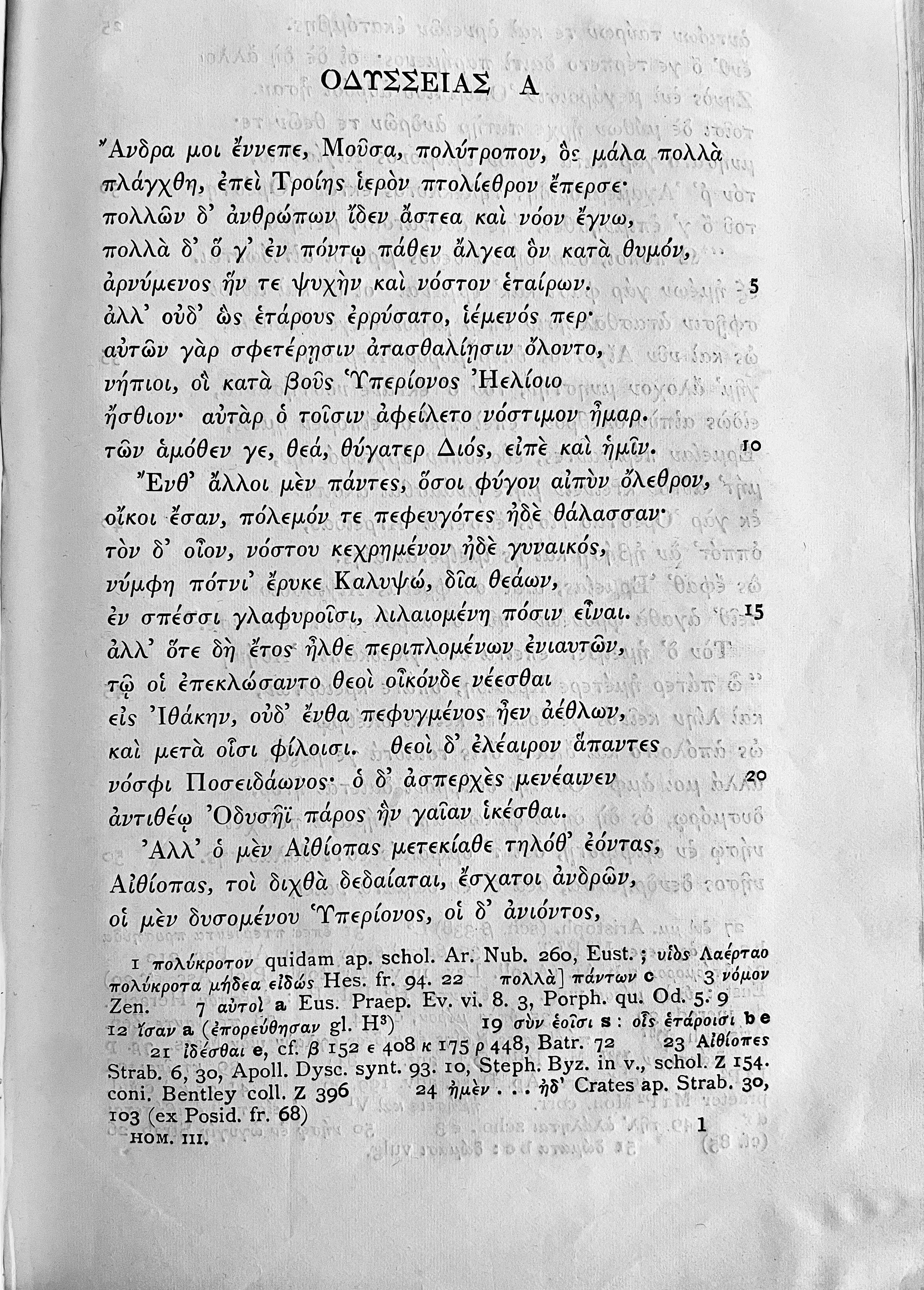
The opening lines of The Odyssey (not a first edition).
“Precedent” is derived from the Latin word, praecedere, meaning to go in front of (prae (in front of) + cedere (to go)).
The majority opinion held that a California law prohibiting the sale or rental of violent video games to minors was unconstitutional.
No posts
Comments
Nothing yet. Say the first thing.
Sign in to join the conversation.