
Cake friends,
If you eat meat, you’ve likely consumed meat glue.
Also known as transglutaminase, this naturally-occurring food additive is a powdered, protein-bonding enzyme that’s used to fuse scraps of meat together. It’s found in processed foods like fish sticks and imitation crab, and also dazzling feats of molecular gastronomy.
In his Steak Zine essay, The Meat Glue Moment, reporter ADAM ROBB looks back to meat glue’s glory days—the fine dining frenzy of the early 2000s, where modernist chefs like Wylie Dufresne and Heston Blumenthal used the sticky ingredient to push the limits of sculptural food—to its status today as a villainized (but still widely used) ingredient. You’ll never look at a chicken nugget the same way again. Read on for the full piece, and let us know where you weigh in on the meat glue debate in the comments.
Essay by Adam Robb
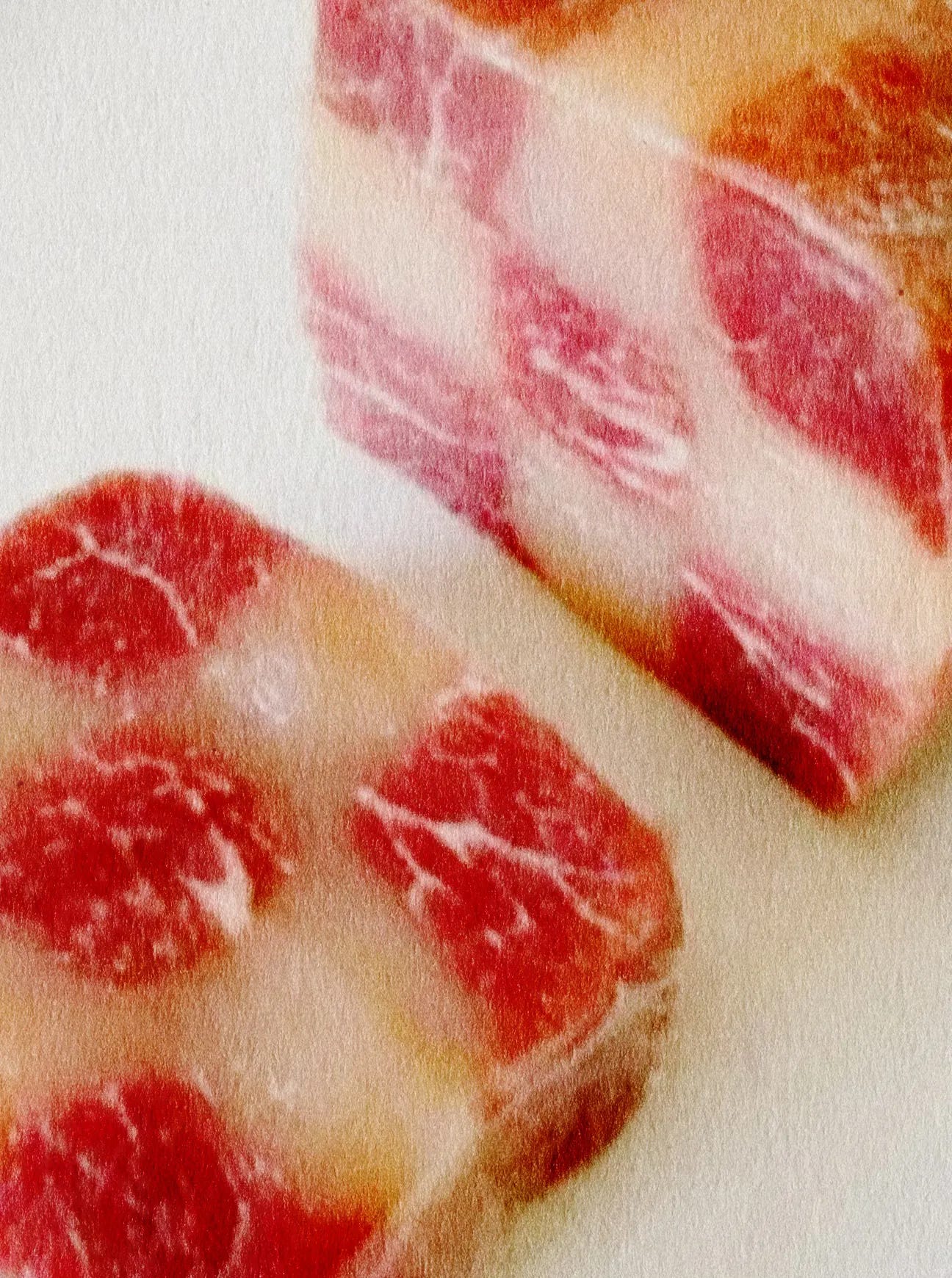
Before I was paid to write about celebrity chefs, modern art, or Jeffrey Epstein; before I learned to satisfy the appetites and curiosities of the patrons who sidled up to the counter of the molecular gastronomy dessert bar where I started and ended my restaurant career; I was a regular poster on eGullet. It was 2005 and the internet message board was blowing up as a finishing school for aspiring food writers and an incubator for outlier chefs. I was the former, eager to experience and chronicle the new modernism coming out of New York, London, and even more so, Chicago. The birthplace of modern food processing and meatpacking had become a nexus of molecular gastronomy, where restaurants like Moto, Alinea, and Tru wowed diners nightly with culinary sleights of hand, like soy paper menus meant to be eaten after ordering.
Suddenly, everyone wanted to know how to source whatever new commercial chemical was now in fashion: methylcellulose, tapioca maltodextrin, sodium alginate. We all learned how to make carbonated fruits with our Thermo Whips, poached steak and eggs in sous vide water baths, and challenged ourselves to try out the latest recipes coming out of Chicago, translated for home cooks in the pages of Gourmet. Chefs who were better known on the boards built their own cult followings, and because they were eager to capture the zeitgeist, wow investors, and cow their competitors, they eventually pushed the limits of culinary decency and began to play with transglutaminase, a fancy word for an ugly truth: meat glue.
This powdered, protein-bonding enzyme has often been reviled as body horror fodder for its use in culinary applications like sausage casings and fish sticks. In the 1980s, meat glue was sourced from the blood and liver of cows and pigs, a process banned in the European Union in 2010 and rarely used elsewhere. Today, the most popular brand of meat glue on the market is created from microbial fermentation and sold under Activa, produced by Ajinomoto of MSG fame. Meat glue is universally popular as a food processing aid (and labeled GRAS—generally recognized as safe—by the FDA here at home). Despite this, conspiracy-minded consumers afraid they’re being cheated with cheap cuts and chemicals have linked meat glue to mass-market meatpackers, food franchises associated with pink slime, and cruise ship kitchens. Officially, mislabeling raw meat would violate FDA rules and could lead to recalls or even prosecution. These claims are denied more often than not.
There are legitimate reasons to use meat glue: Chicken nuggets, strips, and other cuts with no natural definition are often trimmings sealed together with a transglutaminase slurry—repurposing chopped up cuts, that can no longer be legally sold as whole parts, as comfort food staples with universal appeal. But transglutaminase has never captured the popular imagination of home cooks. An ambitious amateur gourmet may gargle liquid nitrogen while whipping up frozen foam, a party trick that wows guests with a puff of white smoke and no damage done, but meat glue requires wearing protective gear. Masks and gloves help avoid physical danger of inhalation, but they only enhance the most traumatic of appetite suppressants: existential dread.
However, fine dining chefs weren’t so cowed. By 2003, The Fat Duck chef Heston Blumenthal, an early advocate of transglutaminase, set off a frenzy among a new wave of modernist chefs who were eager to explore the interplay of processed food additives and haute cuisine. He not only popularized the moniker, but embraced its surrealist potential, challenging himself while confounding diners who made pilgrimages to the English countryside to experience edible taxidermy like the “Ballotine of Mackerel ‘Invertebrate,’” which involved deboning a fish and reforming its flesh and skin into a trompe l’oeil cross-section of itself.
Blumenthal shared his technique with Wylie Dufresne of New York’s wd~50, who responded with spaghetti made almost entirely of shrimp. Both chefs essentially used the same mass market process that produces imitation crab meat from a paste of whitefish flesh and transglutaminase, handmaking supermarket staples with elevated ingredients and selling it to the 1 percent that would never dream of bargain hunting in the frozen food aisle. Likewise with flap steak, which a meat snob might pass up for a strip loin. Dufresne powdered raw slices of the cheaper cut, rolled them into a cylinder and refrigerated them until they invisibly bonded together. He carved into this new and improved roast like butter and lowered costs in the process. These lauded chefs weren’t just confessing to their use—they were outright bragging about it, peacocking while advancing their techniques and aesthetics in the process.
By 2007, I had graduated from eGullet; my own reviews and reporting were regularly picked up from my first blog, The Life Vicarious, and reshared on Eater and Grub Street. My growing interest in molecular gastronomy’s real-world applications led me to work nights at Room4Dessert, a modernist dessert bar in New York. It was helmed by pastry chef Will Goldfarb, the risk-taking chef who once lost his job at the Michelin-starred Cru, in New York’s West Village, after conceiving what local press declared the worst dessert of 2004: a deconstructed “day at the beach in St. Barths” crafted from carbonated pastry cream and frozen brown sugar granite, served in a mist of sea salt. Three years later, his approach to pastry met the moment. I’d arrive early to work to pack and ship orders of his side hustle, WillPowder, boxing up bulk bags of au courant chemical compounds for amateur and professional cooks around the country. One day, I shipped a large purchase order to then White House pastry chef Bill Yosses at 1600 Pennsylvania Avenue. Whether or not he knew it, it’s possible that even President George W. Bush was suddenly getting a taste of the same ingredients that found their way into America’s processed foods.
Aesthetics are essential to the experience of meat glue in fine dining. In 2011, former Microsoft executive turned prolific cookbook author Nathan Myhrvold published his five-volume Modernist Cuisine, with step-by-step instructions for building a red and white chessboard of raw escolar and ahi tuna glazed with the same slurry commercially blended to make chicken nuggets.
In the early 2000s, before Myhrvold published his first cookbook, he contributed to Jeffrey Epstein’s infamous birthday book, thanking the future convicted sex offender for “advising me on my lifestyle.” Myhrvold’s entry concludes with a spread of photos depicting mating animals bonding the old fashioned way.
The same year Myhrvold published Modernist Cuisine, Dave Arnold, then director of culinary technology at the French Culinary Institute, and better known today as the mixology wizard behind Booker and Dax and Bar Contra, wrote a meat glue explainer on his blog Cooking Issues: “Apply a liberal amount of meat glue to the meat and massage it in. Sniff the meat (don’t inhale the powder). If the meat smells like a wet dog or a wet wool sweater, your glue is good.”
Meat glue is as imperceivable as the cells of our bodies, where our own natural transglutaminases keep us bound together. It’s not like kintsugi, the ancient style of Japanese pottery where cracks in porcelain are repaired with gold to create an object more precious than the original; no chef is brazen enough to directly advertise to their customers that they’re sculpting art with cow spackle. Instead, they upsell the labor and ingredients, while making sure diners don’t know how it’s all stuck together. In writing this essay, I reached out to Heston Blumenthal and Wylie Dufresne to share stories of the golden days of meat glue and neither responded. I began to doubt whether I would find a single chef to speak to me candidly about using meat glue today without evoking body horror or canine aromatics, and my time was running out.
As my deadline approached, I boarded the maiden voyage of the Star Princess to better understand the current state of cruise food. The ship boasts more than twenty restaurants including one all-day buffet which has to cater to more than four thousand passengers as it sets sail to the Bahamas and back for the weekend. On my first night, I dined at The Butcher’s Block by Dario Cecchini. The dining room, Tuscany by way of Epcot, emphasized transparency as much as kitsch; prime aged tomahawks traveled from entryway display cases to the open kitchen grills before hitting chopping blocks spread around the dining room.
The next afternoon, I sat down with Rudi Sodamin, the head of culinary arts for Princess Cruises. A wizened eccentric whose thick accent and brassy mop evoked Wolfgang Puck and Phil Spector, he has seldom seen land over the past four decades, wearing his seafaring career as a badge of honor. The logos on his chef’s whites bear the names of every restaurant and ship in the fleet he commands. I asked him straight up, had he ever used meat glue?
“Yes, I used it many years ago, on the Queen Elizabeth 2,” he said, referring to the grand British ocean liner that in its twentieth-century heyday catered to stars like Princess Diana, David Bowie, and Elizabeth Taylor. At twenty-six years old, he was the cruise line’s youngest-ever corporate executive chef, and embraced the same techniques as the modernist gastronome. Now, he makes art out of necessity.
“It’s absolutely useful for not wasting beef. We used it for steaks, for the buffet—but not for fine dining then. Now, you have to be honest, you cannot sell glued steak as a filet steak. But call it ‘an interpretation of filet mignon’ . . . there’s nothing wrong with that.”
Sometimes there’s truth to a conspiracy.
“It’s good you reminded me. We’re going to Alaska for fifty days next summer, so I may have to look into it.”
Adam Robb is an investigative reporter living in New York. He enjoys the Sunday roast at Hawksmoor and hunting bad men.
Join us: We’re hosting a free reading series at Little Island in NYC over Labor Day weekend: 9/4, 9/5, and 9/6. Each day has a completely new lineup of readers and speakers, plus food from a fun pop-up. More info here.
Pitch: mixed feelings, the newsletter and publication that covers internet culture and fandom through the lens of mental health is accepting pitches for its second print issue all about the scary and cute. Pitches are due August 31; find details here.
Read: Jake Stavis in conversation with Madrid-based photographer Felipe Hernández on his series, Servilletas , which documents paper napkins restaurants all across Spain.
Submit: Artist Luke Edward Hall is looking for queer stories by queer contributors for a project The Gargoyle: Queer Myth and Magic. There isn’t a set deadline for submissions, but it’s hoping to go to print this autumn. Get more information here.
Attend: Active Cultures is hosting FOOD: A Convening which brings together artists, cooks, farmers, writers, and organizers who are all working at intersection between food, art, and ecologies on September 25 and 26 in Los Angeles. Get tickets and find more information here.
Want to support Cake Zine’s independent work? Subscribe to this newsletter and order a copy of our latest issue: Steak Zine.
No posts
Comments
Nothing yet. Say the first thing.
Sign in to join the conversation.