
Cake friends,
We hope you had a nice week. We’re still buzzing from our community bake day with One Love Community Fridge, where we packed more than 500 pastry boxes with treats and stocked fridge locations across the city. Thank you to Botani and Pure X-Tract for keeping us refreshed. The fridges are always open to donations of ingredients and prepared food. If you’d like to contribute, you can find your nearest fridge on this community fridge map.
Today we’re offering up a meatier entrée, Six Orders of Foie Gras, for Research, an essay from Steak Zine, by a former plant-based food scientist in the alternative-protein industry who found herself going buck wild for Real Meat under the guise of research. When the author pitched us the piece, she promised to spill — on the edges of her NDA and separation agreement— about the role she played in spending $15 million on things like a whole, intact goose; grass-fed, “barnyardy” chateaubriand; private fish-butchery lessons; and, of course, foie gras. It’s a wonderful, absurd read.
Essay by Author Redacted
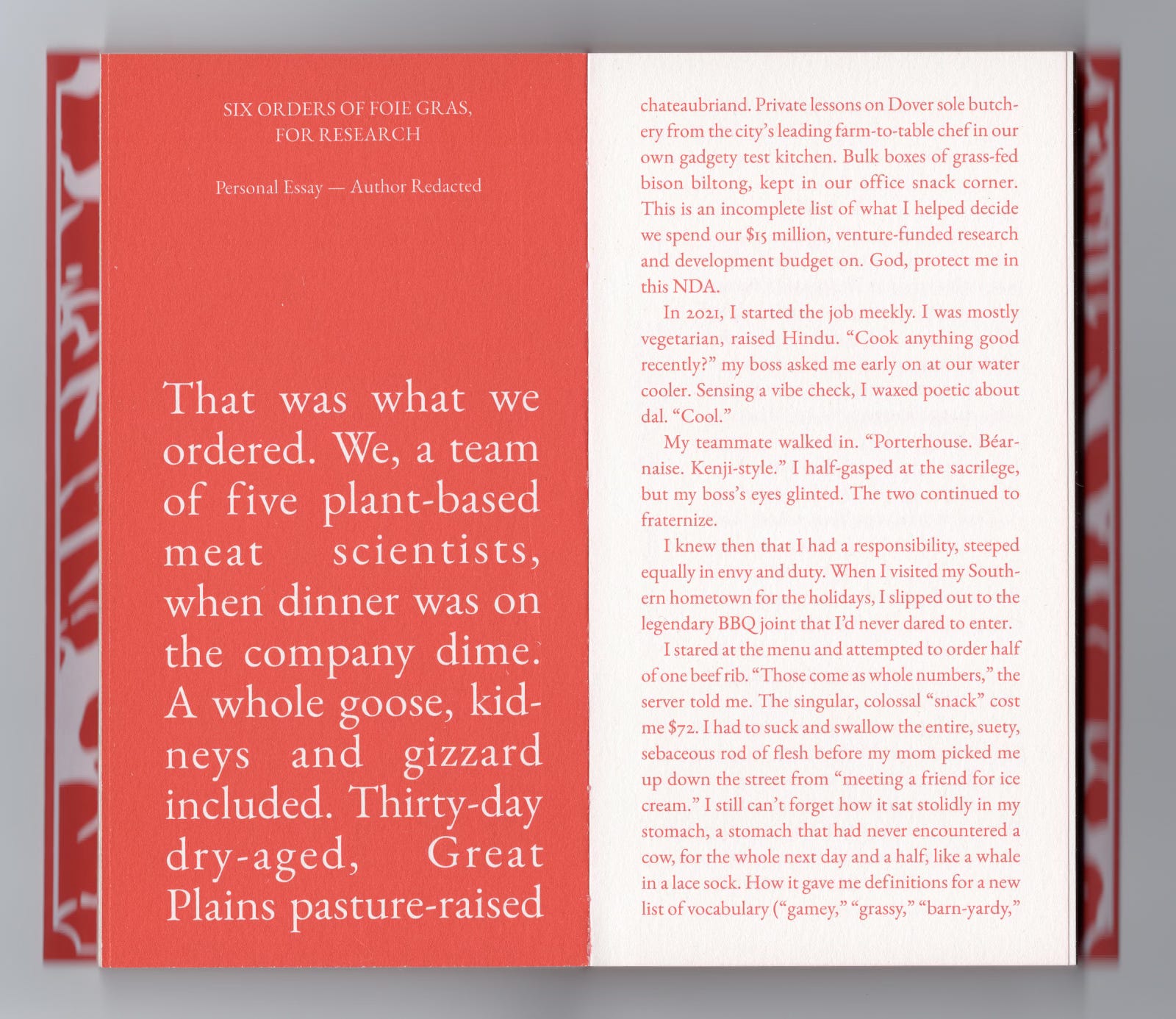
That was what we ordered. We, a team of five plant-based meat scientists, when dinner was on the company dime.
A whole goose, kidneys and gizzard included. Thirty-day dry-aged, Great Plains pasture-raised chateaubriand. Private lessons on Dover sole butchery from the city’s leading farm-to-table chef in our own gadgety test kitchen. Bulk boxes of grass-fed bison biltong, kept in our office snack corner. This is an incomplete list of what I helped decide we spend our $15 million, venture-funded research and development budget on. God, protect me in this NDA.
In 2021, I started the job meekly. I was mostly vegetarian, raised Hindu. “Cook anything good recently?” my boss asked me early on at our water cooler. Sensing a vibe check, I waxed poetic about dal. “Cool.”
My teammate walked in. “Porterhouse. Béarnaise. Kenji-style.” I half-gasped at the sacrilege, but my boss’s eyes glinted. The two continued to fraternize.
I knew then that I had a responsibility, steeped equally in envy and duty. When I visited my Southern hometown for the holidays, I slipped out to the legendary BBQ joint that I’d never dared to enter.
I stared at the menu and attempted to order half of one beef rib. “Those come as whole numbers,” the server told me. The singular, colossal “snack” cost me $72. I had to suck and swallow the entire, suety, sebaceous rod of flesh before my mom picked me up down the street from “meeting a friend for ice cream.” I still can’t forget how it sat stolidly in my stomach, a stomach that had never encountered a cow, for the whole next day and a half, like a whale in a lace sock. How it gave me definitions for a new list of vocabulary (“gamey,” “grassy,” “barn-yardy,” etc.). How I couldn’t scrub away the smell of iron in the shower, and how I still carry and hunt its essence today.
-
Our technology to replicate meat’s texture was patent-pending. We spent Q1 through Q4 concocting samples of plant-based chicken breast and pork belly, but they wouldn’t stop resembling insole foam, both in appearance and texture. Moreover, there was a strange emergence of a mild but consistent IBS-like malady developing among our taste testers. We watched each other as we used spit cups with growing generosity.
Tired of the comparisons to Reebok and in need of almighty direction, our team decided that every sample test was to be flanked with a reference: its animal-derived platonic ideal. The Reebok resemblance only strengthened. Our ability to verbalize the succulence of heritage Kurobuta pork shoulder did, too.
Somewhere along the way, my virginal encounter became routine. I still, to this day, am not sure I like meat. But at a crossroads between caveman and tech bro, I had acquired the taste for cultural capital. Flexing a workday-in-the-life and its perks in front of men became natural. Some days, I wanted nothing more than to sink my jaw into a tender leg of lamb, unwavering in its identity.
It first felt private, furtive. But I soon realized my whole, altruistic team shared the same lure to meat: the very thing that we were supposedly working against. Just as factory farms grew with the help of national subsidies, we were empowered to indulge thanks to the company’s expense account.
Midday trips to the specialty butcher for reference samples became longer. Happy-hour salumerie on the company card became more regionally Italian. Our cushy “professional development budgets” and travel per diems were spent on steakhouses and “bromakase,” typically frequented by a richer corporate echelon. Even PTO abroad was recounted with egotistical reportage of the flesh qualities of kangaroo (minerally, like Chablis), pufferfish (as crisp as a pearl), and snake (exhilaratingly toothsome). In the name of our noble mission, we all silently developed a justifiable, testosteronal compulsion to consume as much Real Meat as we could.
Perhaps all this research led us to realize plant proteins could not do the shapeshifting of gelatin and collagen, which give carcasses chew and game. The more prototypes of vegan meat we fashioned out of goos, gloops, and goops, the more consciously our samples induced gag reflexes, and the more our ingredient list resembled the drain permit of a plastics factory. We nevertheless kept testing, setting moonshot KPIs, entrenched in an intellectual property space race against our competitors.
Our lab was lined with rows of glass dropper bottles of “natural flavors” labeled with unspecific, unpromising titles: “Dark Meat,” “Light Meat,” “Pan Drippings,” “Fried,” “Rotisserie.” The hard pill to swallow was that many companies worked just like ours, ordering the same catalog of “Trending: Plant-Based Meat” aromas, texturizing agents, and legume proteins, and spending distinct, brilliant mindpower and sweat on precisely the same problems. It at least felt valiant—unconstrained by the industrial complex—to pursue inspiration via luscious, force-fattened Hudson goose liver served three ways.
And so, we kept eating. We got better at coming up with rich similes for our samples. It became more and more challenging to argue that our creations were better for our environment, health, and sanity than $4.99 rotisserie chicken. As for cruelty toward animals . . . Were we not animals ourselves, who deserved to be free of suffering?
–
In 2019, Beyond Meat, the first alt-meat company to trade publicly, sold shares as BYND at almost $300 a pop. Instagram was still home to plenty of rainbow acai bowls, Slutty Vegan sandwich porn, and Impossible Foods’ plant-based Whoppers. But in 2025, BYND remains the sole meat alternative traded publicly, now at $1.36 a share.
Somewhere in the cultural whiplash, even the most optimistic among us accepted that most fake meats sucked. They couldn’t live up to their promise. Tech bro culture and Big Food Ingredient monopolies suffocated the once-good intentions of the industry. Meanwhile, raw milk, tallow, and organ meat influencers are thriving.
–
“It’s a tough time,” our CEO said after we failed to fundraise this year. “But let’s keep innovating.”
A week later, I was laid off. Professional development budgets were slashed. My porterhouse-cooking teammate is still there, perennially promoted. The company pivoted to making pet food, with factory-farmed chicken as its first ingredient.
AUTHOR REDACTED is now a barista, freelance food writer, and photographer dependent on rotisserie chicken and oatmeal.
Pitch: Leaves, the biannual zine from Brooklyn tea company Raazi Tea edited by our co-founder Aliza, is looking for submissions for its sixth issue, themed “Spirit.” Think: thoughtful explorations of tea and tea culture that engage with religion, ritual, magic, superstition, the sacred, and self-care. Written pitches are due on June 19th; get more information here.
Eat: Ali, our assistant editor, will be selling pastries at Big Night as part of their café series on Saturday, June 6, from 11 a.m. to 2 p.m. Stop by for something sweet while supplies last.
Survey: Do you read? Stack, the independent magazine club, is conducting a short survey about reading habits and what reading means today. All participants can enter to win a free year-long Stack subscription. Responses are due Sunday; take the survey here.
Read: The latest issue of Tomato Tomato, Hothouse, is out and explores the act of coming together as both lifestyle and lifeline. The issue features essays, fiction, and criticism spanning Serbian salad menus, Singapore school canteens, Puerto Rican restaurant language, Bulgarian ski trips, English pub culture, and the enduring influence of Slow Food founder Carlo Petrini. Find it here.
Submit: Serviette magazine is accepting pitches for its ninth issue, themed “Food is War, Food is Peace.” The magazine seeks reported stories, profiles, essays, Q&As, photo essays, comics, and more that explore the ways food intersects with culture, science, history, and power. Send pitches by June 12; get information here.
No posts
Comments
Nothing yet. Say the first thing.
Sign in to join the conversation.