
Last week, after some clips of an NPR interview with Doug Wilson went viral, a journalist from HuffPost asked me and others who have experienced Christian patriarchy to share our knowledge about Wilson and his influence on our government, particularly his connection with Pete Hegseth.
I’ve written here before about my history with Wilson and how his teachings negatively impacted my life:
Am I thrilled that the stern-looking man who hitched a ride in my family van back in the nineties is spreading his misogynistic theology across mainstream media? Not really. But here he is, so here am I, willing to keep talking about him. Not because I want to keep stewing about it, but because the more the influence of Christian patriarchy spreads, the more women, children, and queer people will be oppressed.
Rev. Cara Meredith, April Ajoy, Tia Levings, Matthew Bowman, and Deirdre Sugiuchi were also interviewed for this piece, which I hope will help others understand the real threat of Christian nationalism. You can read the full article on HuffPost here.
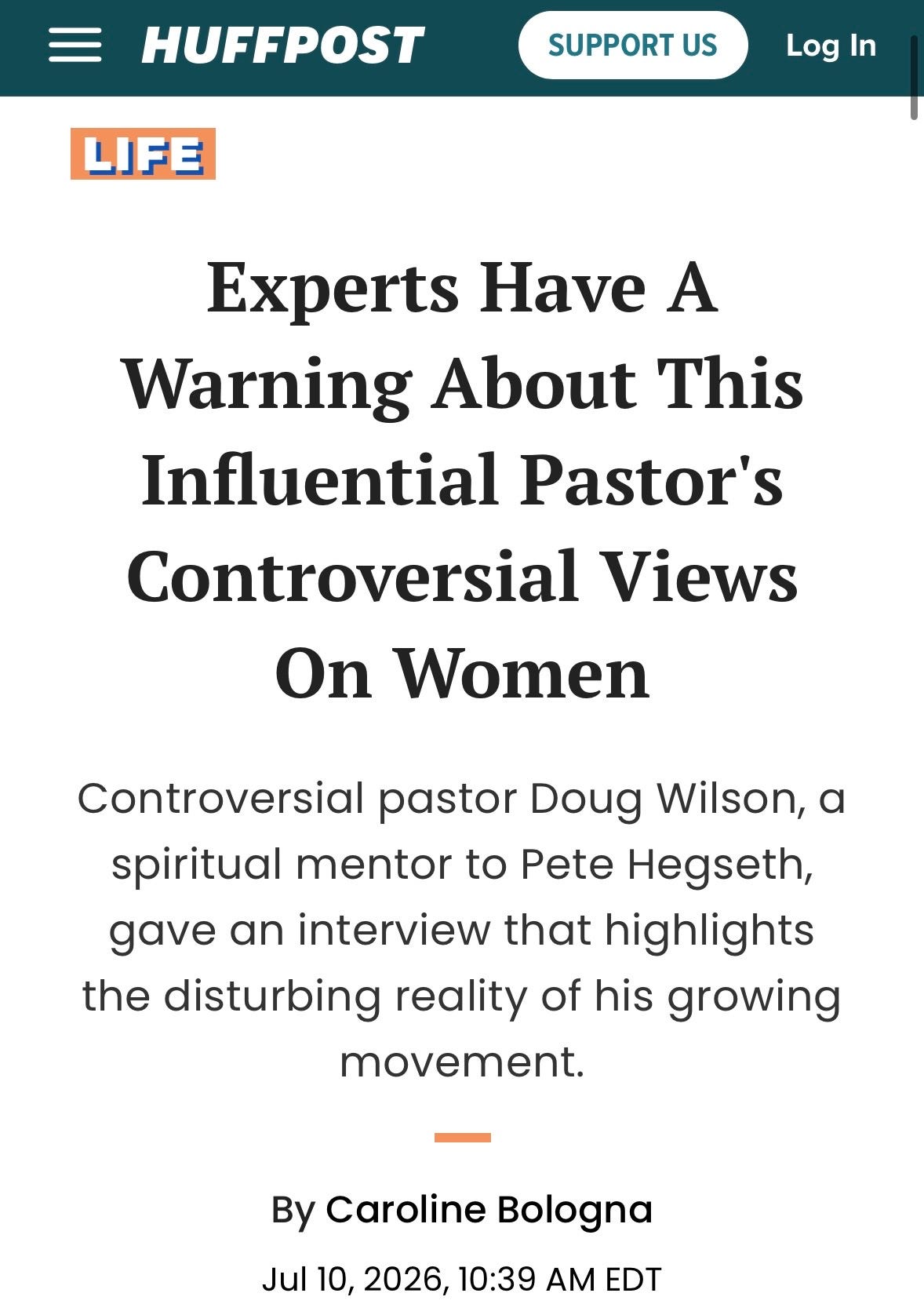
The interview I did with Caroline Bologna was via email, so I thought you all might like to see the full Q&A, kind of like a behind-the-scenes to what it’s like to do this kind of media. I was really happy with the bits Caroline pulled out for the article, and maybe you’d like to read more of what I had to say about Wilson and the push to take away women’s rights.
What do you think of Doug Wilson’s views, especially regarding the 19th amendment, single household voting and the role of women?
I grew up in a family and church greatly influenced by Doug Wilson. He spoke at my church; we subscribed to his magazine; we read his books and listened to his sermons on tape. So I am very familiar with his beliefs from the past three-plus decades. Regarding the 19th Amendment and the right to vote, my church followed the head of household framework. During congregational meetings, when we would vote on electing church leaders, the ballot slips would be passed to the head of each household, typically the father. He could decide whether to fill out each slip or pass them to his family. During political elections, my father would tell my mother who to vote for. Doug Wilson likes to point to head of household voting as if it is a common sense policy. But it effectively removes all power from women, which is exactly the point of Christian patriarchy. Leaders like to say that patriarchy protects women and that it builds healthier families, but in my experience and extensive research, patriarchy only oppresses women and breeds abuse. Removing the right to vote is only one piece to an overarching philosophy of men having power over women.
Is there a biblical basis for Wilson’s position on women, voting and a Christian theocracy, or do you see it as a misreading of scripture? What is the role of unmarried, childfree women in his vision?
It depends on what is meant by “biblical.” Patriarchal leaders such as Doug Wilson like to throw the term “biblical” around as if it has one meaning for all people. The Bible is a complex collection of manuscripts written over centuries by different people, and all English Bibles are translations from the original Greek, Aramaic, and Hebrew. The Bible translation that many Reformed churches, such as those in the CREC, use is the English Standard Version, which some have argued is a translation biased toward patriarchal ideals. One of the translation committee members was Wayne Grudem, a cofounder of the Council on Biblical Manhood and Womanhood. That said, there is no such thing as a Christian theocracy in the New Testament. (There are stories of theocracy in early Israel in the Old Testament, before Christ.) Women in the world of the Old Testament were often treated as property. And women in the time and geography of Jesus had no political power or right to vote. Our current American democracy was unthinkable two thousand years ago, so taking ancient texts and using them to dictate modern society is essentially an impossible task. But patriarchal leaders like Doug Wilson pick and choose the parts of Scripture that fit their vision of a modern patriarchy and call it “biblical.”
The role of an unmarried, childfree woman in the Christian patriarchal world depends on her situation. If she was married and is now widowed, she is technically the head of her household unless she moves back in with her parents. (This could depend on the specific church’s policies.) The church elders (always men) would likely have a lot of influence over her decision making, however. If she has never been married, she lives under the headship of her father until she is married. This was my role as a stay-at-home daughter, which I was until I left at age twenty-five. I was not allowed to have a job outside the home, go to college, or make decisions about my relationships. I was supposed to vote for whoever my father told me to, and I had to submit to him in all things. It’s important to note that in Doug Wilson’s denomination, some unmarried women are allowed to work and attend college, but they are still under the headship of their father. Patriarchy means “rule of the father,” and the CREC and similar denominations take that literally, which is why experiences vary depending on who your father happens to be.
What do you think people should know about this religious movement, which has gained influence at the highest ranks of government? What should Americans understand about the real-world and policy implications of this worldview?
It is important for all of us to understand the risk of having men like Doug Wilson influencing our government. That said, I will never try to cultivate fear about them. They are only human, and they only have the power that they are able to win over or that we hand over. But the risk is real, and the impact of patriarchy in our current administration is already being felt in states where abortion is illegal and where women are being prosecuted for miscarriages. Women are unsafe in a Christian theocracy. Queer and trans people are unsafe. And people who are not white and the “right” kind of Christian are unsafe. Doug Wilson in the NPR interview said he does not believe in “persecution,” but he doesn’t define what that means. What is clear in the interview is that he believes people who do not fit into the white Christian patriarchal box should not have the same protections under a theocratic law. It is my belief that our political environment will become worse in terms of civil rights before it will get better, following the patterns of history.
Anything else you’d like to add on this topic?
When I start to despair about the growth of Christian patriarchy, I look to past civil rights leaders and people who worked toward liberation. They inspire me to keep going. We cannot give up now; we must not obey in advance. Each of us can channel our anger at the injustice toward practical work in our communities, work that helps the marginalized. It is easy to spit rage at the outrageous, outspoken leaders. It is much harder to look closer and see the people oppressed under their leadership and know how to help them.
I want to emphasize this here: Panicking and cultivating more fear around Doug Wilson and his acolytes will not help us. This is why I’m careful with which journalists I talk to. I don’t want to encourage click-bait news headlines, even though some would like to use my story for that. I approach public speaking and interviews with the tools I’ve learned to heal from trauma, always looking to be a grounding voice and point to practical ways to work toward liberation. Oppression is real, and we do well to be informed, but churning unmanageable fear will only keep us under the power of the oppressor. Knowledge is a tool, but only if it guides us to action.
Thanks for reading My Blue Peninsula! This post is public so feel free to share it.
Thank you, as always, for being here, and never forget: Your story matters.
— Cait

The paperback edition of Rift: A Memoir is available for preorder now, wherever you get your books!

Comments
Nothing yet. Say the first thing.
Sign in to join the conversation.