
Batching is a productivity buzzword that means grouping repetitive tasks together and completing them in a single time block. According to Asana.com, batching helps avoid multitasking, promotes deep work and focus, and helps to deter procrastination. I’ve been using batching in my writing practice for about two years.

Thanks for reading Romance Author Adventures by C.A. Fray! Subscribe for free to receive new posts and support my work.
There are a ton of tasks included in being an indie author. Of course, the most important thing is writing the book. But the myriad of other to-do list items is downright overwhelming. Editing, finding beta readers, cover design, procuring the ISBN, building and maintaining a website, networking with other authors, uploading your book and cover to the distributer of your choice, choosing a release date and getting all the work done on time, and don’t forget the advertising, social media promotions, ARC team, newsletters and other media where you build your audience, events, commissioning character art, and more! For a lot of us, this is completed on top of a regular job and family obligations.
After the release of my first book, I was swimming in tasks. I’m also an unmedicated ADHD’er (not by belief but because I tried tons of meds and they didn’t work great for me), so overwhelm was real. The most significant step I took to overcome this was when I started batching my social media. I don’t mind being on camera, and I liked coming up with creative/funny takes online; socials seemed like the lowest-hanging fruit. I went for it: one morning, I did my hair and makeup, scrolled through trending audio, and recorded a bunch of lip-synched reels.
This took me a good few hours. If you’ve filmed content, you know it’s not a walk in the park. To act the right way, to get the right lighting, to lip-sync correctly, or to time your book quote when the beat drops—all while trying not to feel conscious—takes patience and perseverance. Once I had a bunch of clips filmed, writing captions and scheduling them out on the scheduling app I used at the time was another large task. Of course, the first few times I did this, it took the better part of my day. It felt like a waste of time. But over the next two weeks, the freedom I experienced from not trying to think of something to post every day was worth it.
As I got better with my social media batching, I looked for other tasks I could batch. Creative tasks like content creation (including graphic design on Canva) and my newsletter got their own space on my calendar, while author admin tasks like website maintenance, advertisements, financial review/receipt uploads, and event applications and prep got their own blocks. I found the work more rewarding if I completed a lot over the course of a day. The only place I didn’t do this was for my writing/editing. I’m an author who likes to write a little bit each day (or as close to each day as possible), so I found this format allowed me to chunk out a solid few task-heavy days per month, leaving me more time to complete writing on top of my regular job the rest of the time.
Here is a color-coded example of how I batch my time:
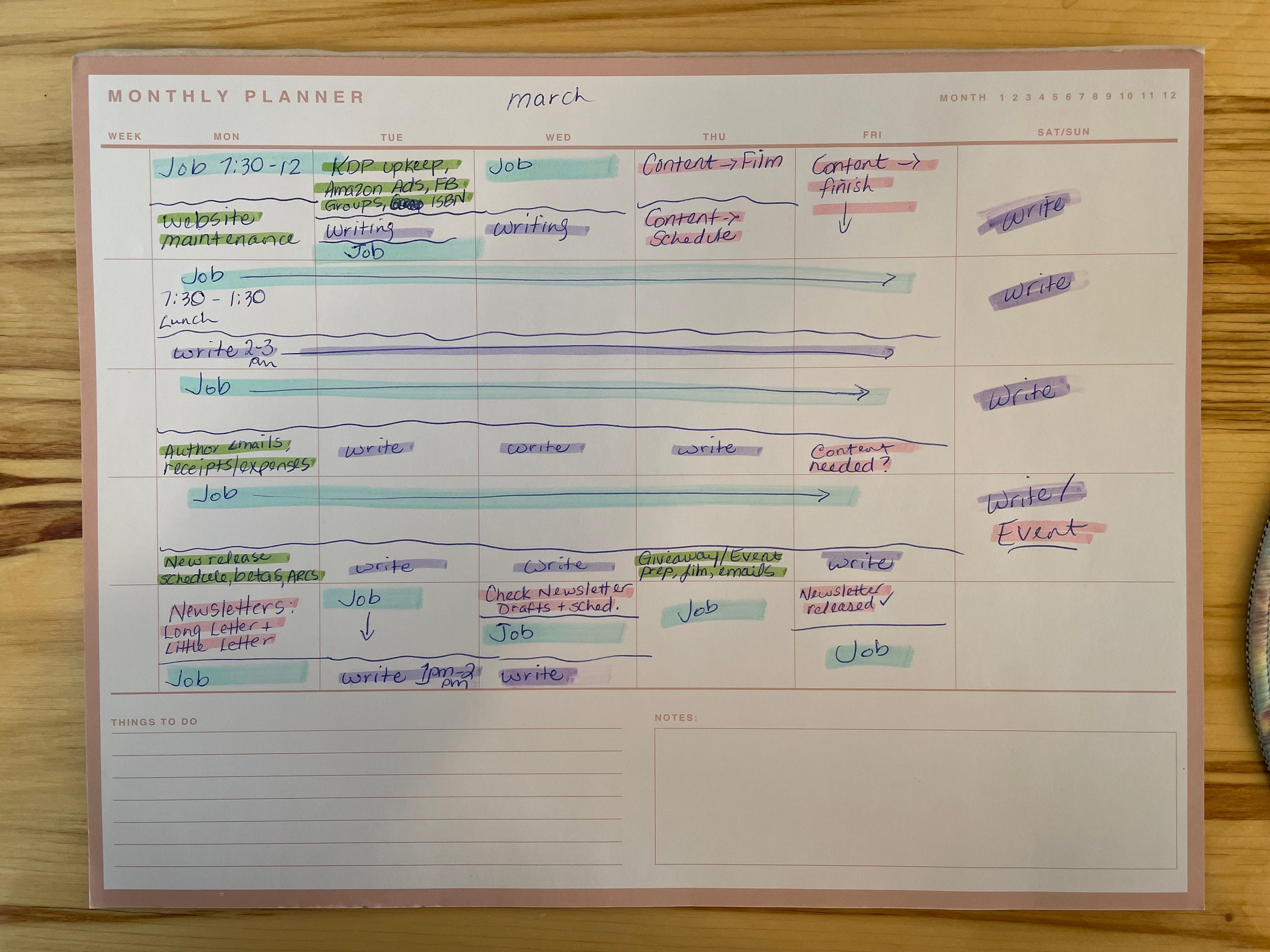
Let it be known: I work from home. I run a utility-type company with my husband, and I have a more flexible schedule than most. My kids are on the bus before 7 a.m., so I get an early start. Most days I am able to fit in some writing. However, when I am on a deadline with a major project or other “regular job” tasks, I cannot write at all. There is a definite seasonal progression to my writing that revolves around the ups and downs of my schedule.
That being said, do you see how the first part of the month is task-heavy? The first week is dedicated to the author admin and content. It allows for writing during the middle weeks, then newsletter prep at the end of the month, which I usually draft, then come back a couple of days later to review and schedule.
Now, does my schedule look like this every month? No. I’ve changed up my priorities this year, lessening my social media content and increasing my Substack content. Still, I can substitute writing Substack posts for social media content days. The time blocks are interchangeable if I have an event scheduled at a different time of the month.
Does this work for me every single month? No. In December, I’m Santa Claus. In June, every field trip of the year is crammed into one month. From July to August, my kiddos are at home, and our family sneaks in some camping. I don’t have the space or time to film as much content, and I forget to schedule ads. I find myself a lot more frantic, which only reinforces my joy when I get back to a manageable schedule.
The important thing for me is that I have the margin to actually write most days, without the burden of knowing I need to work on some admin task. This has helped my procrastination a ton since I tend to put off the less attractive tasks like updating my KDP categories or applying to get my books into libraries. I know that if I “eat the frog” at the beginning of the month, I’ll benefit from the freedom of focusing on writing for the rest of the month. A weight is lifted from my shoulders when I think of what I have yet to do, and I can achieve more of a flow state with each task I’m completing.
Quick Guide on How to Batch Your Tasks
Begin with one task you think you can manage in an hour, whether that be filming content or applying for in-person book events.
Break that task down into parts.
Do as much as you can, multiple times. For example: film several social media videos in a row. Do not add captions, text or music until you have completed filming all you intend to. If you have time, add captions or text. If not, add all of these details in another time batch.
Experiment with time. Allow yourself a few time blocks to complete your task, so you know for next time the total amount of hours the task takes. This can help you determine what part of your task takes the longest.
Schedule out your completed task. If you’ve written a batch of newsletters, use your newsletter distribution software to schedule out each letter over the month.
Schedule the same batch/time block for next week/month.
What happens if I fall behind in my batching? Life is busy and stressful and sometimes things happen. Here’s how to overcome:
Keep your current time blocks (if you have already have them)
Create a list of the most immediate tasks you need completed
Complete the number one task on the list by substituting it for your next available batching time. For example, if you’re going to batch social media on Friday at 1pm but know you need to find a cover designer for your book, let the socials go for the week and research a designer.
Continue down the list until you feel “caught up”—this is subjective since you are usually overcoming a frantic or overwhelming feeling. Some things, like changing KDP categories, designing graphics or even writing can be pushed aside in favor of more immediate tasks, if needed.
Continue with your regular batching schedule.
Thanks for reading Romance Author Adventures by C.A. Fray! Subscribe for free to receive new posts and support my work.
Comments
Nothing yet. Say the first thing.
Sign in to join the conversation.