
I read something recently that many of us have probably wondered about: the structure of the human brain looks remarkably like the structure of the universe. Not metaphorically. Not poetically. Literally.
When researchers compared maps of neuron networks with maps of the cosmic web—the vast filaments of galaxies stretching across space—they found the same basic architecture: networks of nodes, branching filaments, clustered hubs, dynamic flows of information and energy. One system is at least 93 billion light-years in size. One system fits inside your skull.
It’s as if the universe out there and the one in your head were created by the exact same formula. It brings to mind the beginning of John’s Gospel: “In the beginning was the Word… and without him nothing was made that has been made.” Creation has a grammar, a structure, a logic—and John dares to say that structure is Christ Himself.
Now, I’m not a physicist, but I am a pastor with a healthy respect for wonder. And when the most complex systems in creation mirror each other so precisely, I can’t help but ask:
What is God up to?
And even more daring:
What if the universe is thinking us into the shape of God?
Is God seeking to self-actualize through creation?
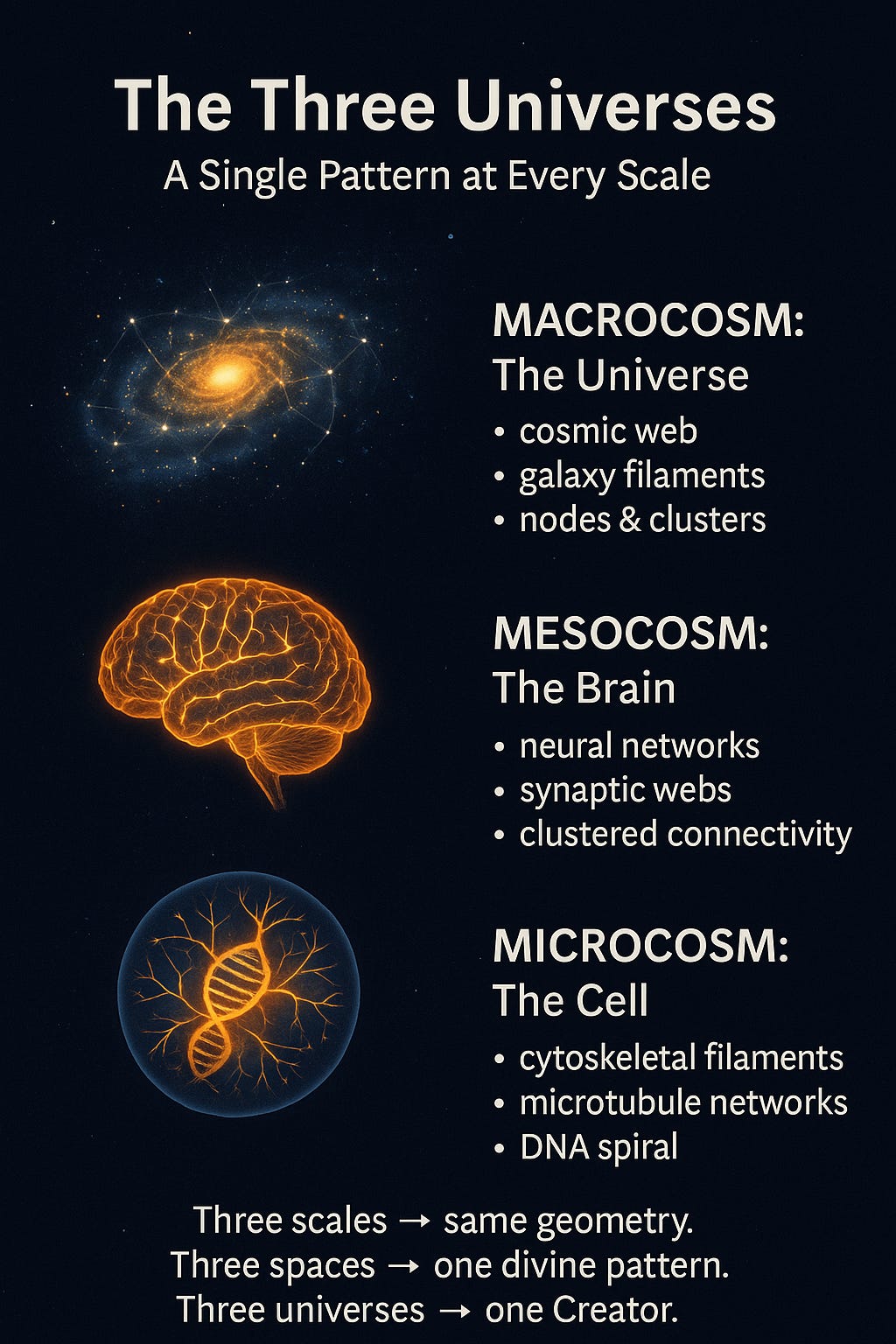
Once you start seeing the parallels between galaxies and neurons in the brain, it becomes impossible not to notice something equally astonishing: yet another microcosm is found inside your cells—so infinitesimally small you can’t see it, not even close. The same pattern found in space and in your head appears yet again inside the microscopic world of the cell.
Under a microscope, the cytoskeleton looks like a tiny cosmos—branching filaments, lattice networks, swirling spirals. Even DNA, the double-helix staircase of life, echoes the same cosmic geometry.
Three universes, one pattern:
MACROCOSM: galaxies, cosmic filaments, glowing nodes
MESOCOSM: the human brain, neural networks, synaptic webs
MICROCOSM: cells and DNA, filaments and spirals of biological life
John writes, “In him was life, and that life was the light of all people.” Life and light—appearing at every scale—seem woven from the same divine thread.
Scientists call this “scale invariance,” nature’s habit of repeating itself at different sizes.
Mystics call it, “As above, so below.”
I call it the signature of God—the same divine brushstroke painted onto galaxies, into brains, and even into our cells.
If the universe is patterned this way at every scale, maybe the image of God isn’t just a spiritual metaphor. Maybe it’s actual structure.
Maybe we bear God’s imprint not only in our souls but in our very architecture.
An acorn doesn’t have free will. Drop it in the ground, add water and sunlight, and it has no choice but to become an oak tree. Humans, however, evolved a frontal cortex—an engine of imagination, choice, creativity, and unfortunately, disobedience. We are capable of saying “yes” to our flourishing—but also “no.”
Evolutionary biologists rightly point out that evolution involves randomness—genetic mutations, environmental pressures, unpredictable extinctions. But here’s what’s striking: despite all that chaos, the overall trajectory moves toward greater complexity, greater consciousness, greater capacity for relationship. The arc bends somewhere.
What if God has been working through evolution the same way God works through spiritual formation—slowly shaping creation through trial and error to produce beings capable of love, wisdom, empathy, and relationship? What if the randomness isn’t evidence against divine purpose but the very method God chose—a universe with freedom built into its DNA?
John 1:14 says, “The Word became flesh and dwelt among us.” What if that moment wasn’t God intervening in creation but revealing its direction?
What if Jesus isn’t just the Savior we needed,
but the prototype of what humanity is meant to become?
In that sense, evolution is not merely random.
It’s going somewhere.
It’s forming someone.
Neuroscience adds another layer of fascination. When we make a decision—anything from choosing lunch to choosing compassion—the unconscious parts of the brain activate before the conscious mind does.
Benjamin Libet’s famous experiments showed that brain activity precedes our conscious awareness of making a choice by several hundred milliseconds. In other words, we’re not actually deciding everything we think we are.
This doesn’t mean we lack agency. Rather, it means our conscious ego is not the true driver of our thoughts and choices. There are deeper strata of consciousness at work—layers of wisdom, instinct, and perhaps something more.
Free will may not be about inventing our decisions from scratch so much as learning to cooperate with the deeper, wiser dimensions of ourselves—to get our ego out of the driver’s seat and trust what lies beneath.
Jesus models this posture Himself:
“The Son can do nothing by himself; he can do only what he sees the Father doing.”
(John 5:19)
Suddenly “deny yourself” sounds less like self-erasure and more like an invitation to let go of ego’s tyranny—to let the deeper self, the God-shaped self, emerge.
Anyone in recovery knows this truth intimately. Our best thinking got us into trouble. Healing began when we stopped trusting the voice of ego—the voice insisting we were in control, that we could manage it ourselves, that we knew better. Recovery teaches us to surrender to something larger, wiser, more trustworthy than our scheming minds.
Addiction, at its core, is what happens when the ego refuses to surrender—when we cling desperately to the illusion of control instead of cooperating with the deeper pattern already written into our architecture.
“Thy will be done” may not be surrendering to an external force at all.
It might simply be returning to our truest nature.
This became more than theory for me one morning years ago. My wife was at work, and I was home with our four kids. Somehow—miraculously—they were all playing peacefully downstairs, giving me the illusion that I might get five minutes of quiet for devotions.
I had just settled onto the sofa with my stack of devotional books when my three-year-old son padded into the room. I sighed. “Buddy, go back downstairs. Daddy’s reading.”
He turned to go, but the dejection on his face and the slump of his little shoulders pierced me. I could almost hear Jesus whispering:
“Don’t send the children away. They are the kingdom.”
So I called him back. He climbed into my lap, warm and wiggly, and I wrapped my arms around him. I didn’t open a book. I just held him while staring at another astonishing Minnesota sunset—this would be my devotion.
And then it hit me—an epiphany deeper than anything in those books:
This is why God made us.
So God could feel this.
If God is spirit—without hands, without skin, without nerves—then God has no way to feel the softness of a child leaning into your chest, the warmth of breath, the joy of simple nearness.
What if God created humans not only to love,
but to experience the wonder of embodied life through us?
John records Jesus saying:
“I am in my Father, and you are in me, and I am in you.”
(John 14:20)
This is not theology in the clouds—it’s intimacy in flesh and blood.
What if the Incarnation wasn’t a divine exception, but the divine intention?
This is where all the cosmic, cellular, neural, and spiritual threads converge.
What if creation is God’s long, patient attempt to bring divine life into physical form?
Not that we become God,
but that God’s character—love, compassion, mercy, relationality—becomes visible in us.
Jesus becomes not only Redeemer but Blueprint.
He shows us what humanity looks like when the ego steps aside and the deeper, God-shaped layer emerges.
And in His final prayer, Jesus says something breathtaking:
“I have given them the glory you gave me,
that they may be one as we are one…
I in them and you in me.”
(John 17:22–23)
This is not metaphor.
This is destiny.
In this view:
Evolution gave us the equipment
Consciousness gave us awareness
Neuroscience reveals the deeper self
Spiritual formation teaches cooperation
Christ shows the final shape
And the universe—the whole miraculous, multi-layered universe—is thinking us into that shape.
Maybe the cosmos looks like the brain because the cosmos is awakening.
Einstein once said the universe is less like a machine and more like a thought.
Maybe God patterned creation after God’s own mind so that creation could one day reveal God’s own self—
“on earth as it is in heaven.”
God is slowly thinking God’s life into us.
Our lifelong task is learning how to say yes—then get out of the way.
“Thy will, not mine, be done.”
And perhaps this:
when we finally surrender our desperate grip on control, when we stop insisting the ego knows best, when we let ourselves fall into the pattern already woven through galaxies and neurons and cells—maybe then we discover we’re not falling at all.
We’re finally becoming what we always were:
The universe gazing back at itself with wonder.
God experiencing God’s own life through our very breath.
John 1:3–4 (NRSV)
“All things came into being through him, and without him not one thing came into being. What has come into being in him was life, and the life was the light of all people.”
Where in your own life do you sense the deeper pattern of God trying to emerge — beneath your ego, beneath your fears, beneath your habits of control?
And what might it look like to cooperate with that pattern instead of resisting it?
Holy One,
Light of the cosmos and Light within our very breath,
Teach us to trust the deeper wisdom you have woven into creation
and into our own bodies.
When our egos grip too tightly, loosen our hands.
When fear clouds our vision, remind us that your life lives within us.
When we forget our belonging, draw us back into the great web
of galaxies, neurons, and souls—all held together in your love.
Make us willing partners in your unfolding creation,
so that our lives may reflect your compassion, your wisdom,
and your ever-deepening light.
Amen.
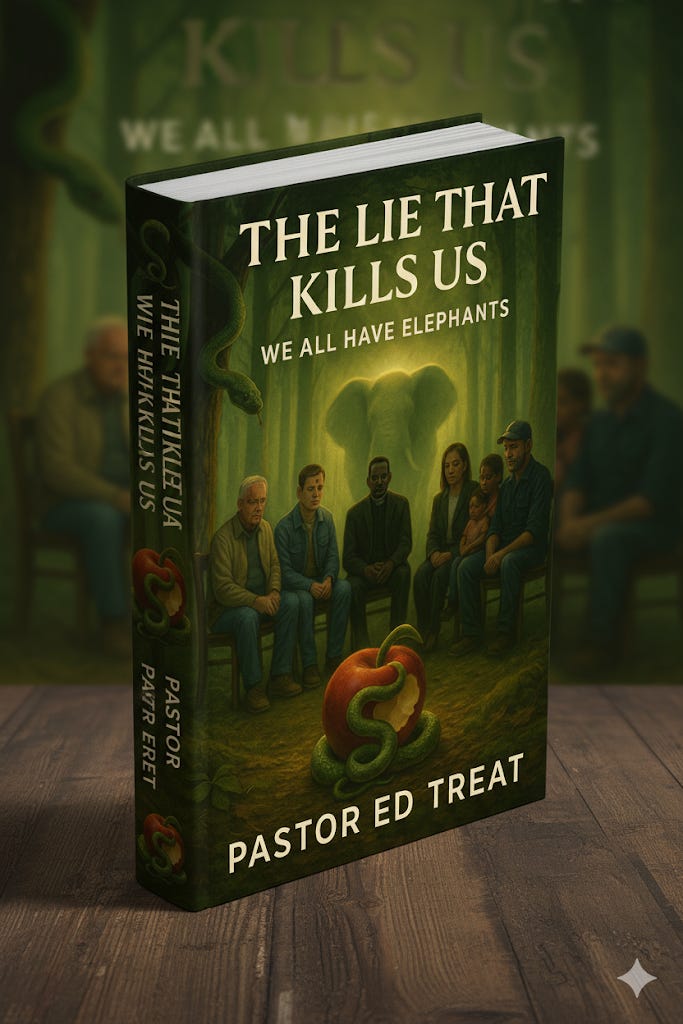
The Elephant Chronicles are reflections based on my upcoming book, The Lie That Kills Us: We All Have Elephants. If you would like to know when the book is available click my email and let me know. I will tell you when it’s out and where to get it. pastored@addictionandfaith.com
No posts
Comments
Nothing yet. Say the first thing.
Sign in to join the conversation.