
The dachshund is a show dog. Long black silky hair: robes of a wealthier time. Groomed robes that no longer matter since things got real.
His caravan is a grey nomad’s dream, surrounded by a knee-high flimsy fence that keeps the dog inside and everyone who might want what he has at bay.
This is Marine Terrace, Rockingham, Western Australia—one of several local itinerant camps.
Some residents are living in tents ringed by disorganised piles of everything they need to live that will not fit inside their tent.
Others sleep in cars, vans and Winnebagos.
I’m supporting a proud Australian veteran, Sarah, who served in the Royal Australian Air Force. Her ageing van, which is her home and transport, now needs urgent repairs to keep her safe and mobile. This fundraiser is just getting started, and sharing helps so much in these early days. Even if you can’t donate, a quick share can help it reach people who may be able to support. Please consider sharing or donating to help Sarah maintain her independence and continue her journey. Thank you for standing with our veterans and showing your support!
https://gofund.me/b0092c6be
A few, especially up here on the wealthier side of Western Australia’s skid row, sit in modern caravans set up as if they were in a proper park. Except there is no power, apart from what their solar panels provide, and there are no public toilets.
“I’m from here. I was born here. But here I am?” he says, like it’s a full stop.He is eighty-plus and in his arms, held like something beloved and a life preserver, the dog barks with the menace this place deserves. He never once tries to quiet it.
He does acknowledge that he is a veteran—another local had already told me—but he will not say how he ended up here.
The only hope he sees for any of them is Pauline Hanson.
“She’s the only one who seems to care,” he says, before refusing to do a recorded interview.
Further along the row, a young woman wears a filigree necklace that decorates the bridge of her nose.
She wants to talk to us, but she can’t do it now, for she has just become a carer for an elderly man living on the same road.
“A lot of people need caring for here,” she says, then hurries off, promising to return.
She’s sharing a family-sized tent with a man in his sixties.
He is looking for work and will not sit for an interview because he does not want the stigma of homelessness to spoil his chances.
He needs the work to support his wife of two years, who is living in the Philippines
.“She gets nothing from their government,” he says. “Nothing at all.”
He is six months out of hospital after a heart episode.
“I was in so much pain, but I didn’t think they’d take me seriously. But when I told the triage nurse I thought I was having a heart attack they raced me straight in. I was there for a week.”Across from him, four tents united by tarpaulins are surrounded by dumped or stolen bicycles.“Meth,” the man says.
“They sleep all day, party all night, which means we have to party too.”
“I can’t help but notice,” I say, “that everyone here is white.”
He nods. “We get a few Indigenous sometimes, and Māori, but yeah—the majority are white.”
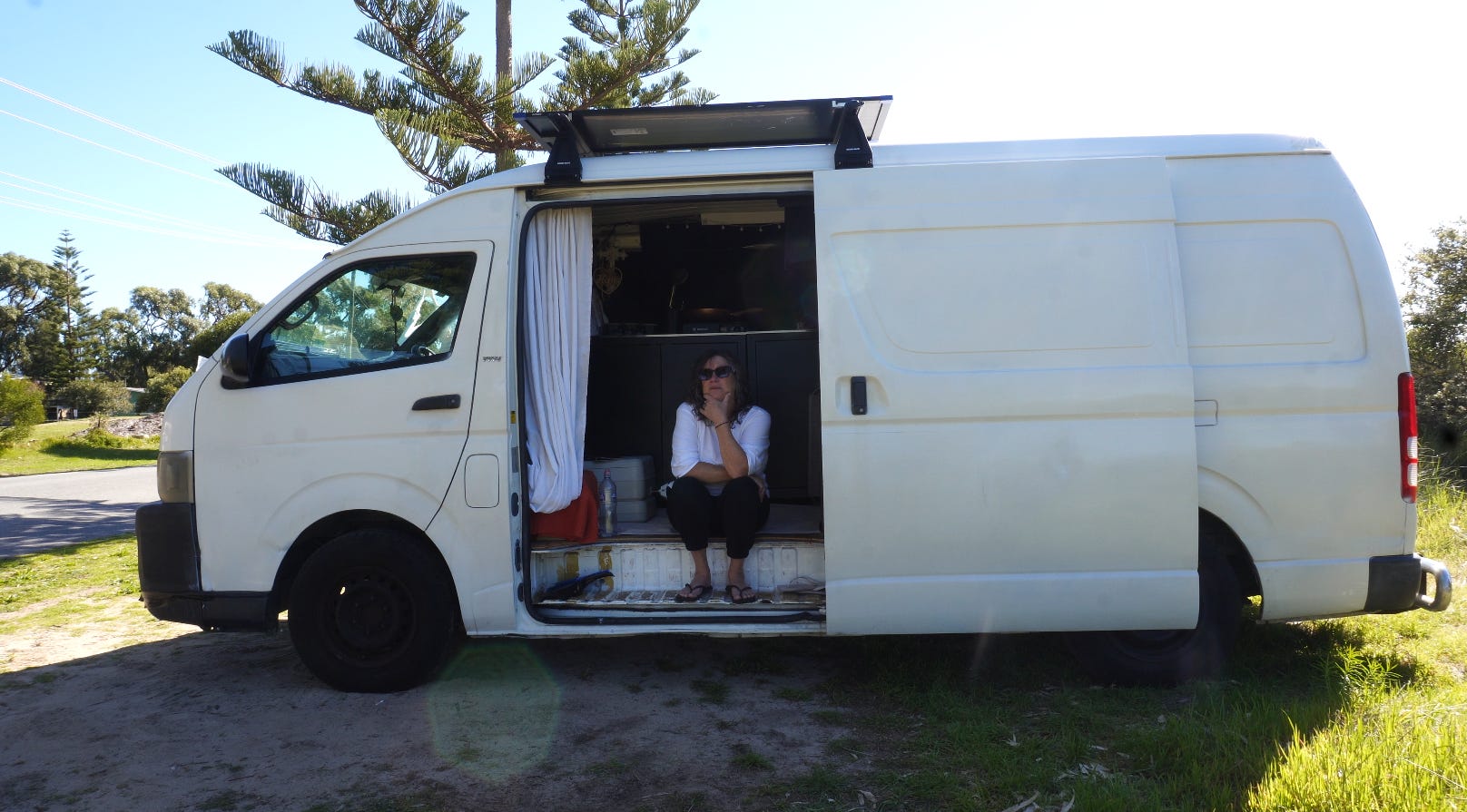
In her mid-fifties and single, Sarah spent seven years in the Air Force and is now tidying her van.
“I’m awake and off-grid,” she says. “I have solar, so I can run a fridge, and a TV, and I also have a toilet that I empty every day.”
“Did you set up the solar?” I ask.
“Yep,” she says, as though it’s nothing.
Above her bed, on the white wall of her van, are affirmations she’s written herself. One states something like, “Life is easier when you have something to be excited about.”
Her main problem, apart from the man who walked the entire camp the other night knocking on windows with a machete, is a failed clutch that she cannot afford.
If the van will not move, the council may tow it and she will be on friends’ couches or back in a tent.
“Do the interview,” I tell her. “You’ll get a clutch.”
“Homelessness,” she told my camera, “eats away at your worth until there is none left. You just feel worthless and no one cares. No one.”
Interview complete, we head back to record the story of the young carer.
Police are here.
Apparently, another local tells us, the girl with the nose necklace was walking past one of the tents when a man burst out, threw a can at her head, then while she was down he beat her unconscious.
Now that man is on the run and she is on her way to hospital.I study the attacker’s tent as we pass it.
It is well established and I wonder, briefly, where you run to when you already reside at the end of the line.
Then I see her. She is outside her own tent, hanging up her washing.
She has a clean SUV parked beside her and she is Filipino or perhaps Mauritian.
I pull over and introduce myself.
I’m an independent journalist who would like to hear her story.
But her English is limited and she does not understand. And since she appears content, I decide not to disturb that and so I leave her in peace.
Later that day I post Sarah’s interview.
Within an hour a mechanic messages: he wants to help if he can.
“There are still good people out here,” he emails.
In the morning I ring Sarah to tell her but she already knows and is overwhelmed.
“The phone hasn’t stopped,” she says. “There have been so many offers of help that I’m overwhelmed.
A couple—both veterans—have already bought the part and are now driving up from down south to deliver it to me personally, and the mechanic said he will install it for free, she says and she sounds like she’s smiling down the phone.
“I was going to call you earlier, but I just can’t stop crying.”
Michael Gray Griffith
Café Locked Out
Comments
Nothing yet. Say the first thing.
Sign in to join the conversation.