
The world will always offer you its rust, cruelty and decay. It will try to convince you that beauty is fragile, rare, a guest that flees when storms arrive. But the ancients knew otherwise. Marcus Aurelius, living among corruption, reminded himself daily: The soul becomes dyed with the color of its thoughts. For the Taíno people, beauty was not just about physical appearance; it was about being in yukiyú, a harmonious state with nature, spirits, and community. Quantum theory tells us that reality exists as a field of possibilities until we bring our attention to it.
In Greek myth, beauty was not a single face but a constellation of powers. Aphrodite embodied desire and sensual splendor; Hera, the regal grace of sovereignty; Artemis, the untamed allure of the wild; Athena, the luminous beauty of wisdom; Persephone, the layered charm of bloom and shadow; Demeter, the earthy radiance of life-giving abundance; Hestia, the quiet glow of the hearth; Leto, the gentle strength of motherhood; and Hebe, the freshness of eternal youth. Together, they reveal that beauty, to the Greeks, was as varied as life itself, a force that could be fierce or tender, radiant or subtle, yet always capable of shaping the human soul.
In Greek thought, beauty (kállos) was never just about appearance , it was bound to truth (alētheia) and goodness (agathos). To the philosophers, beauty was a reflection of cosmic order, a sign that something was in harmony with the greater pattern of the universe.
Plato saw beauty as a ladder for the soul: we begin with love for a beautiful body, then for beautiful minds, then for beautiful laws, until we glimpse Beauty itself, the eternal, unchanging form. For the Greeks, to live beautifully was to live in tune with this higher order.
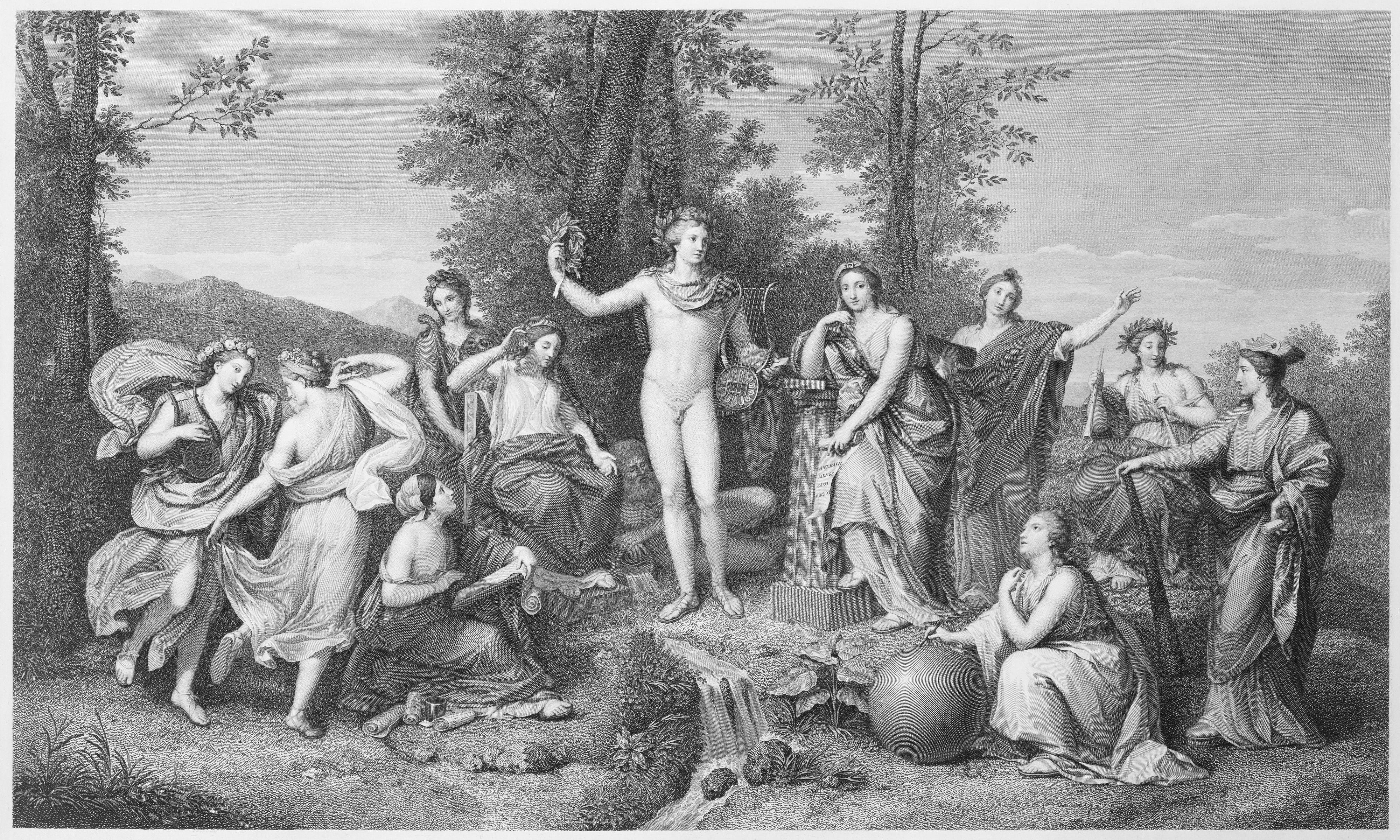
This is where Apollo and his nine Muses come in. Apollo, god of light, harmony, music, and prophecy, was considered the patron of beauty as order, the balance between proportion, clarity, and inspiration. The Muses, his companions, each embodied a realm where beauty could take shape:
1. Calliope – Epic Poetry
Name meaning: “Beautiful-voiced.” Patroness of grand, heroic storytelling, epics that preserved the deeds of gods and mortals. Symbol of lofty vision and moral beauty through words that endure across generations.
2. Clio – History
Name meaning: “To celebrate” or “make famous.” Guardian of memory and the recording of truth. Beauty here is found in remembering, honoring the past so its wisdom shapes the present.
3. Euterpe – Music
Name meaning: “Giver of delight.” Patroness of flutes and lyrical melody. Represents beauty as pure emotional resonance, lifting the heart beyond language.
4. Thalia – Comedy
Name meaning: “To blossom” or “flourish.” Goddess of lighthearted plays, satire, and rural festivities. Beauty in joy and laughter, reminding mortals that even folly can heal the spirit.
5. Melpomene – Tragedy
Name meaning: “To sing” or “chant.” Muse of profound drama, where suffering becomes a mirror for truth. Beauty in catharsis, where tears wash the soul clean.
6. Terpsichore – Dance
Name meaning: “Delight in dance.” Patroness of movement, rhythm, and the physical embodiment of harmony. Beauty in embodied joy, where the body becomes a living poem.
7. Erato – Love Poetry
Name meaning: Linked to eros (passionate love). Goddess of romantic and erotic verse. Beauty in intimacy and desire, the magnetic pull between hearts.
8. Polyhymnia – Sacred Hymns
Name meaning: “Many hymns.” Patroness of spiritual songs, devotion, and deep contemplation. Beauty in reverence, where sound becomes prayer.
9. Urania – Astronomy
Name meaning: “Heavenly” or “of the sky.” Muse of the stars, planets, mathematics and the cosmic order. Beauty in infinite perspective, the awe of seeing oneself within the vast harmony of the universe. For the Greeks, beauty was not passive; it was creative force. The Muses reminded mortals that beauty is something you summon through art, song, movement, and storytelling , not something you simply stumble upon.
In this way, surrounding yourself with beauty, whether through music, poetry, dance, or sacred space, is like inviting the Muses into your life. It is to say: I align myself with light, harmony, and meaning, even if the world outside is discordant.
Even in ugliness, there are unseen patterns, particles trembling with potential. The gaze you choose becomes the shape the world takes.
Curate your life not to erase the world’s ugliness, but to remind yourself, each day, that beauty can still grow here all around you. Choose colors, textures, materials, symbols and words that mirror your inner vision. Objects charged with meaning living around you not as trophies, but as nourishment for the soul, the mind and body.
For the Greeks, beauty was proof of the divine. For us, in a fractured age, beauty is proof that the soul is still awake, and still choosing.
love,
- Caesar
Thanks for reading Caesar’s Substack! This post is public so feel free to share it.
No posts
Comments
Nothing yet. Say the first thing.
Sign in to join the conversation.