
You don’t smoke because you “love smoking.”
You smoke because your brain is trying to solve a feeling: fatigue, stress, boredom, awkwardness, and creative doubt, fast.
Addiction is a learning system issue before it’s a “willpower” issue. And dopamine is one of the main teaching signals.
Dopamine spikes most strongly when something is better than expected (or when a cue predicts a reward). Neuroscientists call this a reward prediction error, the gap between what you predicted and what you got. That signal helps your brain decide: repeat this.
So if a substance reliably changes your state quickly, your brain doesn’t just like it, your brain builds an automatic shortcut:
cue (stress / blank page / after lunch / “I deserve it”)
action (smoke / hit)
state change (relief / stimulation / numbness / “locked in”)
learning stamp: do this again next time
That’s dopamine doing its job, just pointed at the wrong teacher.
Human PET imaging studies show cigarette smoking/nicotine is associated with dopamine release in the ventral striatum (reward/motivation circuitry).
Mechanistically, nicotine activates nicotinic acetylcholine receptors that influence dopamine neuron firing patterns.
Artist translation: nicotine doesn’t “give you creativity.” It gives you a rapid shift in drive, urgency, and salience (“this matters, do it now”), and your brain starts associating that shift with your creative rituals.
Smokers show lower brain monoamine oxidase (MAO-A and MAO-B) activity on PET imaging, meaning the enzymes that help break down monoamines (including dopamine) are reduced in smokers.
There are reviews discussing how MAO inhibition from tobacco smoke may enhance nicotine’s reinforcing/addictive properties.
Artist translation: cigarettes aren’t just “nicotine delivery.” Smoke chemistry can amplify reinforcement, stronger learning stamp, deeper habit grooves.
Nicotine withdrawal is associated with disrupted dopamine signaling and an anhedonia-like state (things feel flat, effort feels heavier).
And nicotine can improve attention/cognition especially in abstinent smokers, which can be partly “return to normal” from withdrawal deficits rather than superpowers.
The trap: you smoke → feel “normal/focused” → assume smoking caused focus → repeat.
But often it’s: you withdraw → feel foggy → smoke → withdrawal lifts → you misattribute it as “creative enhancement.”
Cannabis is trickier because it can feel like it opens perception, lowers self-judgment, and makes boredom tolerable, powerful for artists. But the dopamine story is not “weed = dopamine fountain.”
Human imaging work suggests THC can produce a modest increase in dopamine transmission compared with many other drugs of abuse.
Multiple human imaging papers report that heavy or dependent cannabis use can be associated with reduced dopamine release/reactivity and other dopamine system alterations.
In one study of severe cannabis dependence (without major comorbidity), there was evidence consistent with deficits in striatal dopamine release, and those dopamine measures related to attention/working memory performance.
Artist translation: weed may temporarily smooth discomfort, but over time it can make motivation and sustained drive feel… quieter. Like your “engine” idles lower unless you use. [1]
Acute THC has been shown to impair working memory and increase mind-wandering while reducing accuracy about your own performance (metacognition).
Reviews/meta-analyses also describe cannabis-associated deficits in attention/executive functions, especially with heavier patterns of use.
So why does it feel like focus?
Common hidden mechanisms:
Relief focus: you’re not “more focused,” you’re less bothered (anxiety/irritation drops), so the task feels easier.
Salience narrowing: weed can reduce the volume of competing signals; you lock onto one thing (sometimes great… sometimes a rabbit hole).
Time distortion: you feel productive because you spent time intensely engaged, even if output is lower.
Metacognitive blind spot: you may not notice performance drops in real time.
Withdrawal correction (for daily users): when you don’t use, sleep and mood can get weird; using “fixes” that, temporarily. Withdrawal symptoms often start 24–48 hours after stopping and can peak in the first week.
Here’s the core pattern:
They create a fast state change (up or down).
Your brain tags the cue → action loop with a strong learning signal.
Over time, your baseline feels worse without the substance (withdrawal/anhedonia), and you interpret that as “I need it to create.”
You keep paying in sleep, attention, and emotional steadiness, exactly the stuff art needs.
The goal isn’t “never feel cravings.” The goal is: stop letting cravings write your schedule.
Not “biohacks.” Actual rewiring moves.
Human PET work has shown exercise can alter dopamine signaling (striatal dopamine release measured with raclopride methods).
For artists: 12–20 minutes counts. Walk fast, jog, stairs, push-ups circuits, anything that changes state.
Rule: when your brain asks for a hit, give it motion first.
If you’re quitting weed or nicotine, sleep disruption is common, and sleep loss worsens impulse control and makes reward shortcuts louder. Cannabis withdrawal often features insomnia and weird dreams early on.
Do the boring basics for 10 days: same wake time, dim nights, no doom scroll in bed.
Dopamine spikes on better-than-expected progress.
So design work you can win:
“do some journaling for 5 minutes”
“Cut 45 seconds of a scene.”
“Open the project + label 10 clips.”
“organize one bookshelf”
“label tools or your pantry”
“read for 15 minutes”
“pain for 15 minutes”
You’re teaching your brain: effort → reward again.
Your brain craves the sequence: cue → hand-to-mouth → pause → breath → transition → “permission.”
Swap in a ritual that hits the same beats:
mint toothpick / gum
tea ceremony
90 seconds of boxed breathing (4–4–4–4)
“balcony break” without a substance
journaling
reading
This matters because addiction is also procedural memory, a habit loop. Find new habits!
If cigarettes/weed are within arm’s reach, you’re asking your dopamine system to do Olympic level restraint all day. Don’t.
Remove gear from your space.
Change routes that trigger buying.
Don’t pair “editing”, “writing”, or “working” with the substance cue.
Work in a different location for a week.
This is how you stop your brain from constantly receiving “prediction cues” that light up the loop.
The first stage can feel like: flat + irritated + uninspired. That does not mean you lost your talent. It often means your reward system is recalibrating, especially with nicotine withdrawal effects and cannabis withdrawal sleep/mood swings.
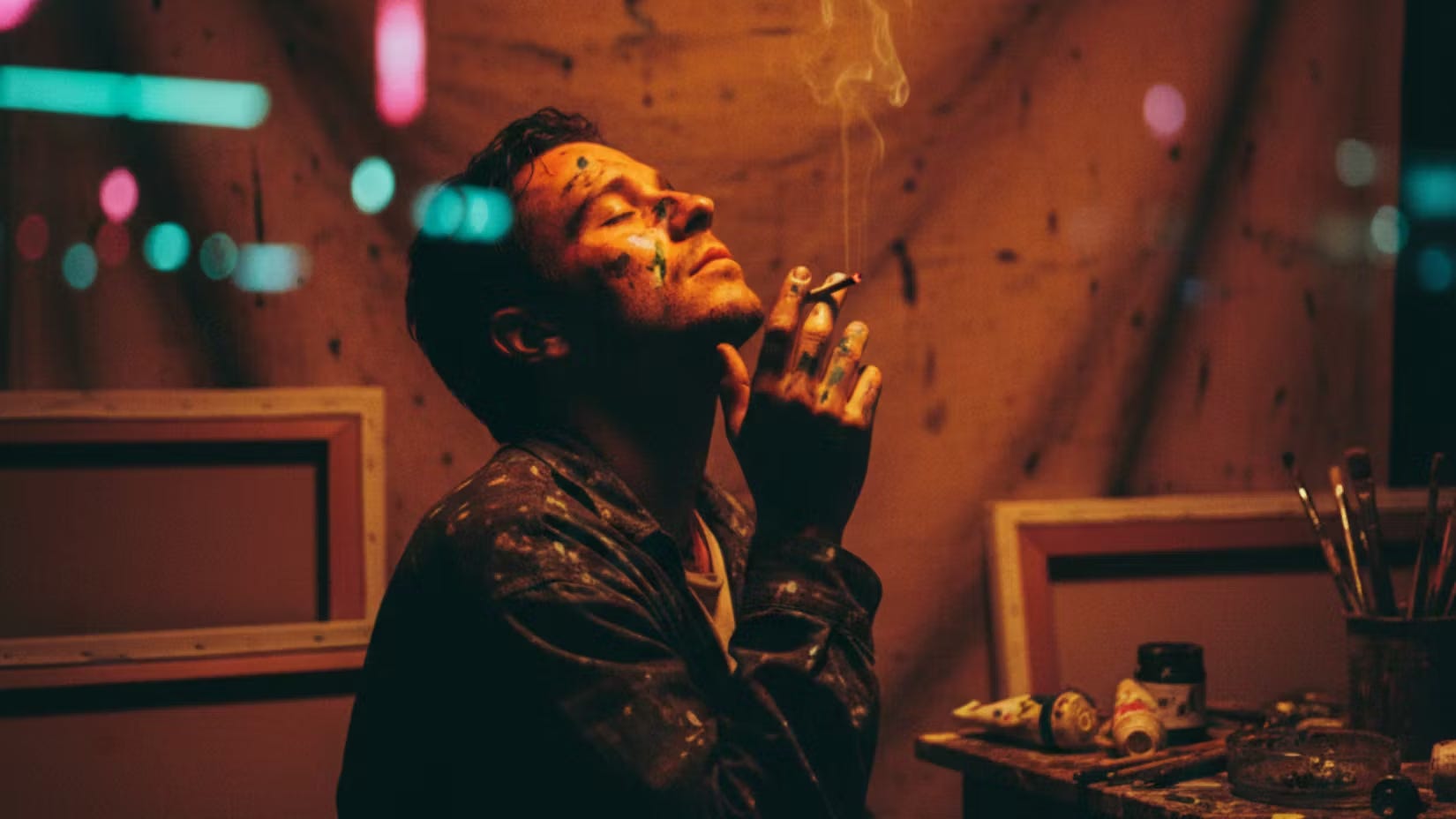
Many legendary painters, from Pablo Picasso to David Hockney’s decades long openness about cannabis use and the way smoke imagery shows up again and again in art history, have been linked to smoking culture, and countless creatives have told stories about weed helping them “open the mind.” But here’s the honest truth: talent doesn’t come from smoke in the lungs or a drag on a cigarette, it comes from the work in your hands and the ideas in your head. The substance might change your mood or your perception in the moment, but the brilliance of Basquiat, Hockney, or anyone else we admire doesn’t depend on a habit. You can breathe clean, build sustainable focus, and still tap into that same radical imagination, because genius is about persistence, curiosity, and practice, not a ritual handed to you by addiction or a fleeting dopamine hit.
Thanks for reading Caesar’s Substack! This post is public so feel free to share it.
No posts
Comments
Nothing yet. Say the first thing.
Sign in to join the conversation.