
There’s a popular belief that repetition makes you stuck. That if you repeat the same actions, the same schedule, the same practice, you’re “not evolving.” The culture rewards novelty, rebrands boredom as failure, and treats consistency like a personality flaw.
I think the opposite is closer to the truth.
Repetition, done consciously, is not a cage. It’s a key. It’s how you build a life where your energy goes to what matters instead of getting burned on constant re-decision. It’s how you make a self sturdy enough to hold change without getting swallowed by it.
The lie about repetition
Most people don’t hate repetition. They hate unconscious repetition. They hate loops they didn’t choose. Patterns inherited from fear, scarcity, people-pleasing, survival mode. They hate routines that feel like they’re happening to them, not for them.
But intentional repetition is different. Chosen repetition creates structure. And structure creates space.
Repetition becomes freedom the moment it stops being “I do this because I’m trapped” and becomes “I do this because I’m building something.”
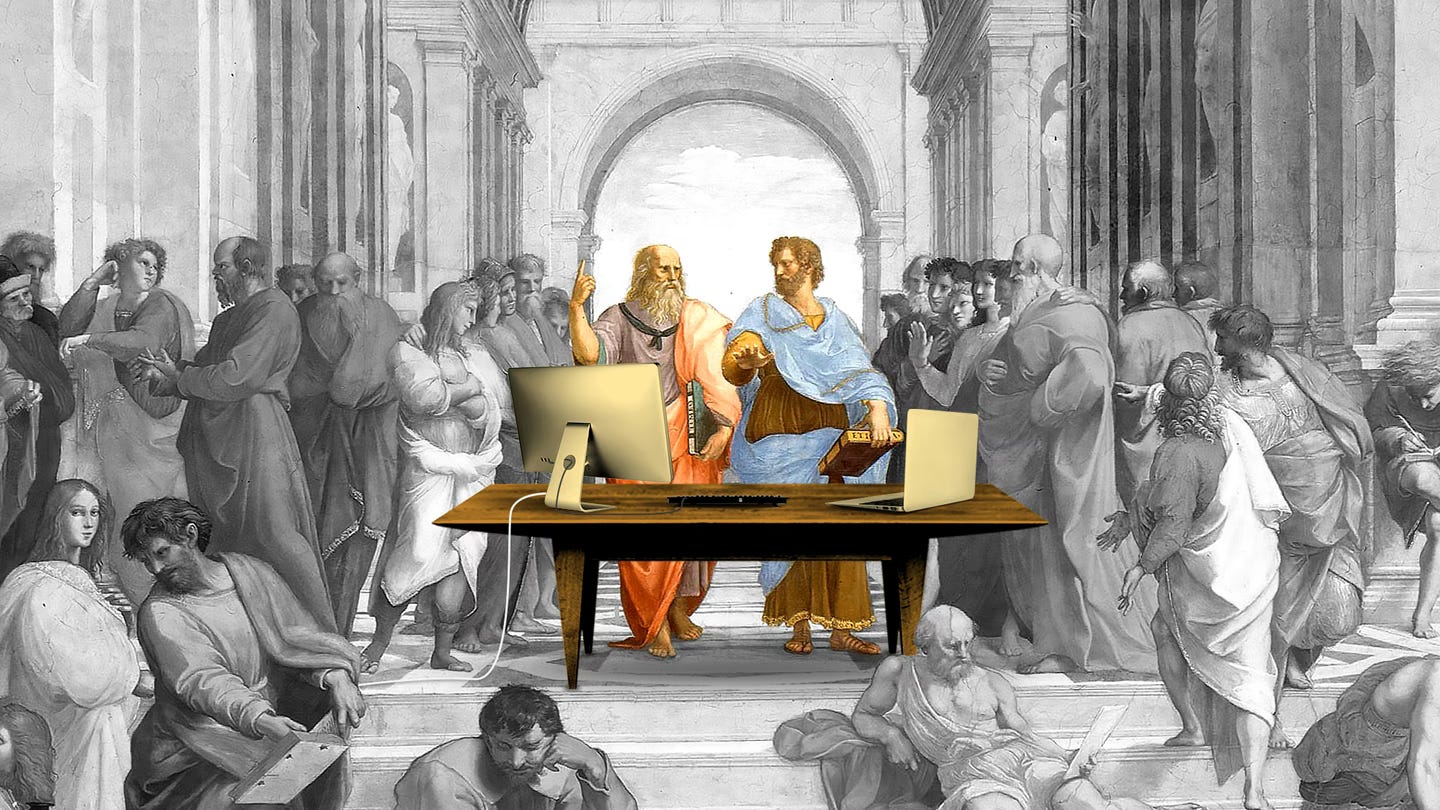
“We are what we repeatedly do. Excellence, then, is not an act, but a habit."
- Aristotle
Aristotle’s ethics is basically a defense of this idea. Virtue isn’t just a belief you hold in your head, it’s a stable disposition you build through practice until it becomes part of you. In other words, you don’t become courageous by having a courageous thought. You become courageous by repeatedly doing courageous actions until your character can hold it.
That’s a radical idea in a world obsessed with identity as aesthetic. Aristotle argues that the self isn’t declared. It’s trained.
Repetition isn’t just a productivity tool. It’s a character tool.
Kierkegaard wrote a whole book called Repetition (1843), and the point isn’t “do the same thing again.” It’s deeper: repetition is how a life moves forward without being reduced to nostalgia. It’s the attempt to recover meaning, not by going backward, but by re-entering life with intention.
Repetition, in this sense, is not copying the past. It’s choosing a form that can carry your next self.
Nietzsche’s “eternal recurrence” is one of the most intense thought experiments ever written. The question is basically: if you had to live this exact life again, every detail, endlessly, could you affirm it? Could you say yes to it?
That’s repetition as a mirror. Repetition exposes where you’re living in alignment and where you’re compromising yourself.
And it suggests something wild: freedom isn’t escaping repetition. Freedom is designing repetitions you’d be proud to repeat.
One of the smartest arguments for repetition comes from Deleuze: repetition isn’t just sameness. It’s where difference shows up. Even if you do “the same” thing again, you do it as a different person, in a different moment, with different weather in your nervous system. Repetition becomes a laboratory where you notice subtle shifts, tiny evolutions you’d miss if you were always chasing newness.
Modern psychology and neuroscience back up what the philosophers were pointing toward. Habits form when repeated actions get linked to context cues, and over time they become more automatic, requiring less deliberate effort.
And habit formation often takes longer than people expect. One well-cited study found an average of about 66 days for a behavior to reach automaticity, with wide variation depending on the person and behavior. This study comes from a 2009 UCL Study by Phillippa Lally and colleagues.
That matters because “freedom” is partially an energy problem. If everything costs you willpower, your life becomes a series of small collapses. Repetition reduces the cost of doing the basics, so you can spend your mind where it counts.
In Greek mythology, Mnemosyne is the Titan goddess of memory ( like I mentioned in my last substack), and the mother of the nine Muses. Meaning: memory gives birth to art.
If memory is the mother of the Muses, repetition is the discipline that keeps memory alive. Repetition is how inspiration stops being a visitor and becomes a resident.
You don’t “find” your muse. You build a home where she can keep showing up.
In mythology, there is no single god of repetition, because repetition itself functions like a deity. Invisible, relentless, shaping who we become.
It protects your creative energy
A structured routine reduces “decision fatigue.” When the basics are automatic, your attention can go to higher-level choices: the edit, the story, the performance, the truth.
It makes ideas compound instead of reset
When you return to the same practice, the same theme, the same questions, your thinking stops restarting from zero. The work develops a spine. Repetition creates depth.
It turns skill into instinct
Whether it’s writing, directing, editing, or performing, repetition is how your taste becomes embodied. You stop intellectualizing and start knowing in real time. (This is habit learning and automaticity in action.)
It stabilizes health by lowering friction
Consistency is often less about motivation and more about environment + cues. Repeating behaviors in the same context strengthens the association and makes the behavior easier to sustain.
It creates a self you can rely on
This one is the deepest. When you keep promises to yourself repeatedly, you become someone you can trust. That trust is freedom. It means you can take bigger risks without losing your ground.
Devotion is like vitamin D3 for the soul, quietly strengthening you through consistent exposure to what nourishes you.
Repetition is not the enemy of transformation. It’s the container that allows transformation to survive.
The world says, “Change your routine so you don’t get bored.”
But boredom isn’t always a warning. Sometimes boredom is the doorway.
It’s the moment the surface stops entertaining you, and the deeper layer starts speaking.
Repetition is where the ego gets quiet enough for the truth to show up.
Not every day needs to be different.
Some days need to be devoted.
- Ceasar
No posts
Comments
Nothing yet. Say the first thing.
Sign in to join the conversation.