
________________________________________________________
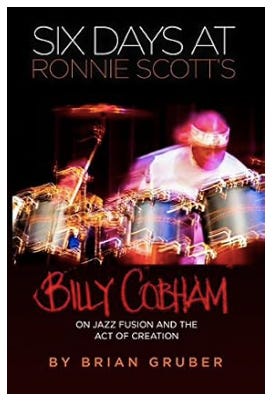
Author Brian K. Gruber’s prior literary offering is a tome that details his sometimes dangerous globetrotting forays to countries that have experienced the effects of American military intervention and how the people fared as a result. Cerebral stuff.
In his latest work he has taken on the task of examining the life work of Jazz and Fusion drummer Billy Cobham, culminating in and juxtaposed against Cobham’s work being performed by a 17-piece orchestra at Ronnie Scott’s London Jazz venue during a six day run that began on June 12th, 2017. Bandleader/gifted trumpeter Guy Barker calls the gig a celebration of Bill’s life and work in music. The book is a massive undertaking that includes distilled transcriptions of interviews with Bill Cobham himself, musicians, crew, club management, fans, super fans and the Jazz police. The musicians interviewed include former Mahavishnu Orchestra bandmate, Jan Hammer, Ron Carter, the aforementioned Guy Barker, Randy Brecker and a host of others.
The book’s preface introduces a snapshot of Gruber family living in Brooklyn in 1970 as the war in Vietnam winds down. This is just about the time Billy Cobham was laying tracks with Miles Davis for the Bitches Brew sessions. Coincidentally, Gruber was taken to his first concert ever in early March of that year. It was at Fillmore East and featured Neil Young and Crazy Horse, the Steve Miller Blues Band and the Miles Davis Quinter, not necessarily in that order.
Despite being raised a generation and culture apart from Bed-Sty raised Panamanian born William Emanuel Cobham, Jr., Gruber manages to pull off a remarkable feat of music journalism. After meeting Cobham in France 2010, Gruber bonds with the drummer and asks him to be on the board of directors of Gruber’s Jazz streaming startup company. As a result, they spent a fair amount of time riding around together. As Cobham regaled Gruber with stories about Jimi Hendrix, Muhammed Ali and a bevy of others, Gruber realized that the oral stories, histories and anecdotes that Cobham effortlessly spouts are certainly worth notating and convinced Cobham of the viability of the project. The interviews with Cobham cover a galaxy of subjects; from the cruel realities of the New York public school system, to the rhythmic complexity of a woman sashaying when walking or the sonic intricacies of live performance. Whew! That’s just a few of many. Gruber has also seen Cobham perform in excess of twenty times, not only at Ronnie Scott’s, but also at the Blue Note in Milano, Italy, Jazz Alley in Seattle, B.B. King’s in New York, The Mint in L.A., the Rio Das Ostras Brazilian Jazz Festival and several more settings both public and private.
Apparent from hanging out with Cobham, according to Gruber, is the solid work ethic of the artist. It is a trait he inherited from his dad, William Cobham, Sr. whose straight gig was a statistician for Bronx General Hospital. By night though, he was a gifted pianist who took requests at the local bar, making more money in six or seven hours than his monthly salary at the hospital. Young Billy started sitting in with his dad when he was all of eight years old. In one segment, Cobham tells the author that despite a relationship with his dad that grew strained and tenuous over time, the resulting ability to make people happy with music, ultimately passed from father to son, is the foundation of how Cobham performs to this day.
So much pride is infused into Billy Cobham the musician, that even at 74 on a gig in which he will play 2 sets, he is hands on at load in, personally schlepping and directing the setup of his drum hardware. He is part Sumo, part ninja, 100/% Panamanian-American.
The author faithfully transcribes exactly what he saw and heard at rehearsals for Cobham’s big band performance run. The musicians patter, what they wore, what they ate, equipment they utilized and so on. Not much is edited out. Not even the throat clearings or false starts. If you really want to be there you are.
From opening night, to a packed house, Managing Directing Simon Cooke speaks to the crowd:
A wonderful week ahead of us. It’s completely sold out. Featuring a great collaboration between Guy Barker up there on trumpet (applause) and this wonderful big band, who are all resplendent before you, and with one of the great jazz drummers, a real figure in history at Ronnie Scott’s, and a massive figure in the history and the ongoing story of jazz, ladies and gentleman please welcome to the stage the Guy Barker Big Band with…MISTER BILLY COBHAM!!!
On day two of the Billy Cobham/Guy Barker Big Band run, the venue dropped a press release.
On June 13, 2017, the Ronnie Scott’s Charitable Foundation invited legendary drummer Billy Cobham to take part in a workshop involving a local primary school, the Soho Parish Primary School. Pete Letanka, a jazz pianist/educator worked closely with the foundation to give children the chance to perform and compose in the style of internationally renowned drummer Billy Cobham. Billy himself worked with the kids and joined them in performance at Ronnie’s.
Four pages are devoted to Cobham’s total devotion to music education for children. He realizes it is the wellspring of his own upbringing and gladly gives of his time and knowledge, passing it forward.
The largest chapter of the book is chapter 3 entitled Miles, Mahavishnu, Montreux. Obviously it covers a lot of ground. Miles work from ’67 forward laying the groundwork for Fusion. Cobham meeting Miles, John McLaughlin and the development of the Mahavishnu Orchestra. Its peak earning period of $50,000 nightly. The awkwardness of leaving the band in the early ‘70s yet returning for recording dates later in the decade. Cobham’s thoughts on playing with McLaughlin again at Montreux in 2010.
In the latter chapters of the book, the author returns to Ronnie Scott’s for additional vignettes on the Cobham/Barker Big Band run at Ronnie Scott’s. Through the use of flashback recollections in various interviews Gruber weaves a fantastic historical record.
There is a chapter entitled, The Art Of The Rhythm Section, which maybe not so coincidentally, is the title of Cobham’s Annual Music Retreat (coming up this year 7/22-28/18 in Mesa, AZ – www.billycobhamretreat.com ) for advanced players seeking to up their performance ante. In Gruber’s book though, the focus is more about how the musicians at the Ronnie Scott’s gig prepare for and interact with each other in such a challenging musical presentation.
Chapter 6 is the setting for the final conversations with Cobham and Barker with all the sentiments and compliments thereof. There is so much information in this book that any serious student of Jazz, Fusion or music history will reap a bountiful harvest.
Conversations with band members, club management, fans, reviewers and crew took place during the six day run as indicated. They were conducted just prior to or shortly after performances.
A nice touch is the Spotify Soundtrack for each chapter of the book that contains some very unexpected musical gems. Hats off to Brian Gruber who accomplished what few could have written with such elaborate authority.
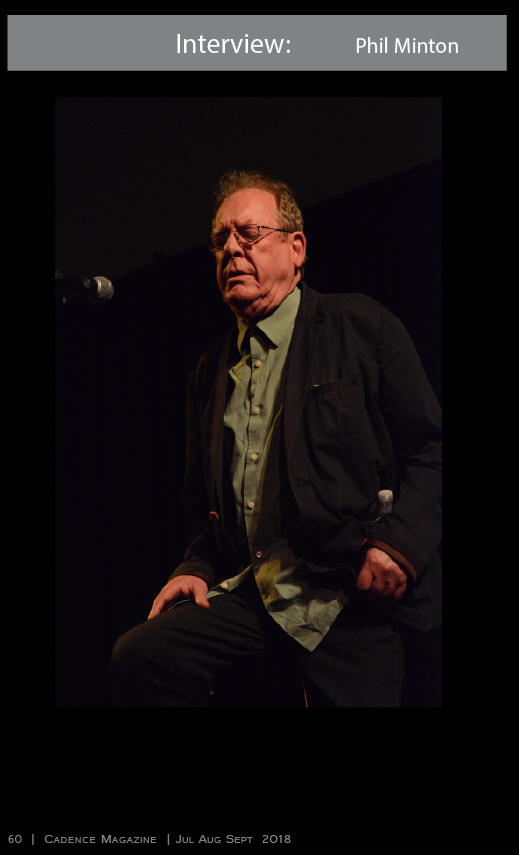
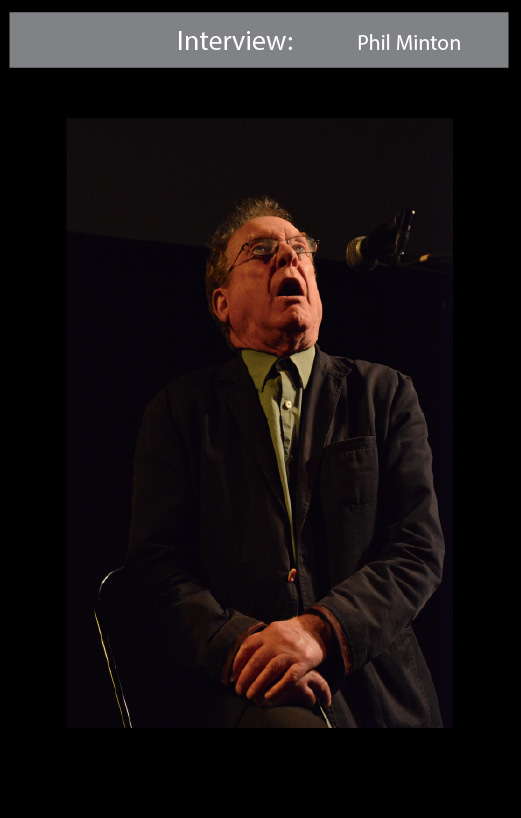
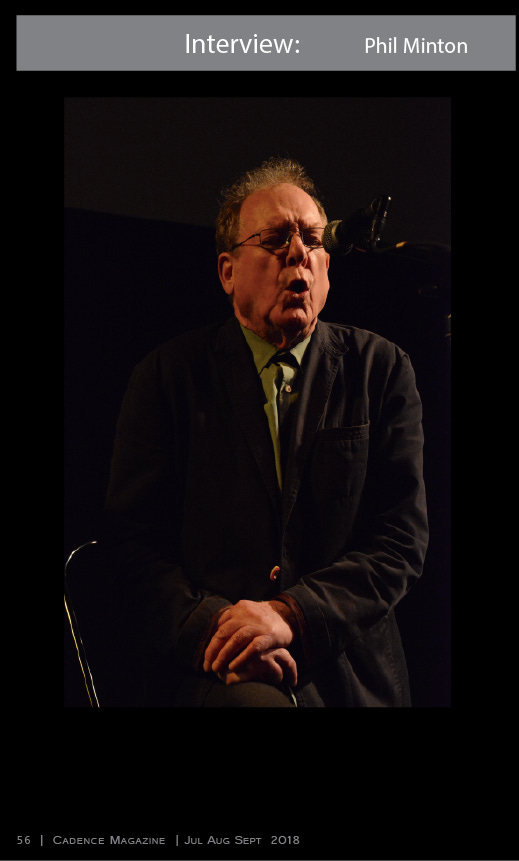
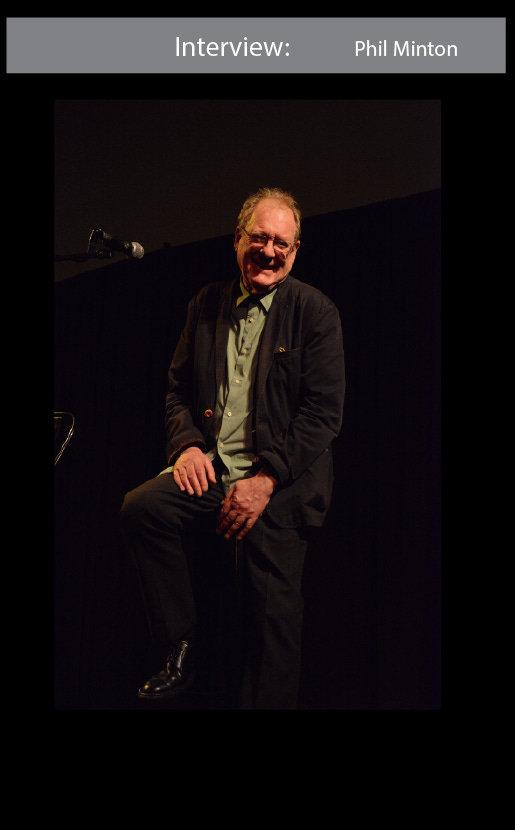
Phil Minton, the wonderful experimental vocalist, was on a rare American tour with Berlin-based fellow extreme vocalist Audrey Chen when Cadence caught up with him at the tour’s starting point in Philadelphia on January 19, 2018 at The Rotunda [presented by Bowerbird]. They’ve performed in duet together off and on since meeting up at the 2006 High Zero Festival in Baltimore. This impromptu interview came about after Minton’s duet with Chen, as he sat resting with a few avid fans. I have included my questions along with the other listeners’ questions.I will list your Philadelphia performance in Cadence as one of the top ten this yr :)
Cadence: How has your investigation of the trumpet advanced your vocalization skills?
Phil Minton: It’s the reverse. I’m relearning the trumpet and trying to forget it is a brass tube with valves that open and shut different lengths of tubing so that you can play different pitches in a certain order. I’m using a lot more half-valving, which is less measured and more like singing.
Cadence: When did you first realize that you could perform and be accepted as an experimental vocalist?
Minton: It was gradual. Since the late ‘50s, I had the idea of playing my voice as an instrument for abstract expression. Jackson Pollock was an inspiration, but playing about with “your voice” was not a respectable thing to do. You were perceived as dishonest – like, “Oh, dear, you sound like a different person!” I suppose I thought playing the trumpet was perceived as respectable. I was in my late twenties before I recorded anything that could be called voice improvising [Phil Minton Quartet with Lars Göran Ulander - Up Umeå, Blue Tower, recorded 1969]. And what I do now is accepted all over the world but only by very small audiences, as is improvised music.
Cadence: How often are you able to find new voice sounds?
Minton: All the time, but I forget most. I did have a little recorder that I carried, but the business of finding it and switching it on wipes the idea.
Cadence: How do you keep from damaging your voice?
Minton: You have to be careful how you force the air out. I think a lot of it’s to do with the fact that I’m using different placings of the voice all the time and it’s not like I’m rubbing one bit in the same place. [Demonstrates his ability to continuously vocalize using different areas of voice]
Cadence: You can get repetitive stress injury from a conversation that you wouldn’t get on the stage.
Minton: Yes, on stage I’m moving around the pitch and voice placings, whereas conversations usually stay in one place and I can hear the blisters forming.
Cadence: It’s really remarkable to hear the range of techniques you have in your bag of tricks.
Minton: [Laughs] Bag of tricks! I like that!
Cadence: Is there ever any kind of a snippet of story going on in your head when you’re improvising?
Minton: Yes, sometimes I’m remembering [what made me angry] and sometimes I’m thinking of very beautiful things as well. Lots of stuff, but I try to be objective and not put too much emotional weight on the sounds. The voice has such a mass of emotional baggage attached. I did say to some young composers just a few weeks ago at a talk I gave at the RCMusic [The Royal Conservatory of Music in London], that I’m interested in counterpoint - an idea that is followed by an opposite, or at the same time if I’m able.
Cadence: How do you practice together with Audrey Chen for your performances?
Minton: We don’t, it’s completely improvised. The only thing we’ll discuss, the only preconceived idea, or whatever, is how long should we play? We’re improvising all the time.
Cadence: When you’re at home, how do you keep your voice in shape? How much do you have to practice?
Minton: I’m doing it every day. I do it when I wake up in the morning [Demonstrates vocal exercises] while I’m going about my day. Usually, when I’m at home and nobody else is in. I do a performance while I’m in the kitchen, yeah, and try stuff out before the family gets in.
Cadence: When I first heard you on things like the Solid Gold Cadillac stuff with the Mike Westbrook band, you were still a relatively conventional musician. When did the change happen?
Minton: I was “playing my voice” on those recordings, check out “Technology” and then “Cadillac” I’ve always been involved in free improvisation, there just wasn’t much of a scene for it in the early days.
Cadence: Was it really seamless or was there a lightbulb moment when you decided to stand on stage and make experimental vocalizations?
Minton: Seeing Jackson Pollock’s paintings and hearing John Coltrane in the ‘50s was when I knew what I wanted to do. But then I didn’t do my first solo improvisation concert until I was 40. I was using a lot of sound and noise, a similar repertoire that I would be using now, as I’ve gotten into less pitches. And I’m hearing music in quite random sounds. I can feel music in light. [Vocalizes a sound of wind rushing from his throat] And I think an aesthetic like that was never used or thought of as music in the West. White noise, almost, you could call it. But as a physicist friend said, “There’s no such thing as white noise,” everything’s got pitches and all sorts of stuff is going on. Like now with electronic music, people are listening to sound and noise, that isn’t in the temperate scale and they are hearing it as music. But as we know, long before Michael Faraday, music was bending and sliding all over the place, except in the concert halls of Christian Europe.
Cadence: Are there sounds that irritate you when you hear them?
Minton: People being angry, I don’t like the sound of anger. The great sound is babies laughing, that’s it for me.
Cadence: How often do you come to perform in America and how well are you known here?
Minton: I have no idea how well known. I don’t come very often, I know that. I played in Philadelphia first in 1981 with Fred Frith, and with David Moss another time in the mid-‘80s, it was a squat sort of loft-type situation above a sex shop in the middle of town. You had to walk up the steps past the shop.
Cadence: It’s good to know you’re moving up in the world.
Minton: [Laughs] I still play places like that all the time. It’s still basically a very small group of people that come out to listen to us.
Cadence: Where do you perform the most?
Minton: In mainland Europe, but I do get all over the world.
Cadence: Are you still doing the Feral Choir projects? [A series of vocal workshops with non-professionals that leads to a performance involving experimental vocalizations]
Minton: Yes.
Cadence: How does that project work? How do people come to it?
Minton: It’s usually an organization that presents it and they advertise for people to participate in the choir. They come for three days of workshops and then a performance. The workshops last for three hours.
Cadence: Are you teaching people how to let go of their inhibitions?
Minton: I don’t teach anything. [Laughs]
Cadence: There’s no teaching, there’s just doing?
Minton: It’s just doing, yeah, yeah. I do a few exercises as warmups first so people don’t fuck their voices up because some people get very excited. [Makes guttural vocalization]
Cadence: The people who participate in the choir, what do they get out of it? What do they tell you?
Minton: They seem to love it. It’s some sort of release to a lot of people, and we know that all together we make interesting and exciting music like “nothing else.”
Cadence: Are there traditional jazz vocalists that you enjoy listening to?
Minton: Yes many - Louis Armstrong, Ella, Sarah Vaughan, Dizzy, loads.
Cadence: What listening music entertains you?
Minton: I listen to hard bop from the ‘50s.
Cadence: What are your non-musical interests?
Minton: Birds.
Cadence: What instrument do you like to duet with the most besides voice?
Minton: I’m happy with most instruments, it’s the person playing that matters.
Cadence: What strikes you as most unusual about American culture?
Minton: I was going to say a lack of historical knowledge about Jazz - the music that has now influenced most of the so-called Christian world’s popular music - but that ignorance is everywhere. So it’s got to be guns and the object Trump.
Cadence: What is your fascination with doughnuts? You have four recordings out featuring doughnuts in the title - A Doughnut in Both Hands [Emanem, 1982] and A Doughnut in One Hand [FMP, 1998], No Doughnuts In Hand [Emanem, 2007] and A Doughnut’s End, [Fataka, 2015].
Minton: That’s best answered by the liner notes from A Doughnut’s
Cadence: Would you share a memorable moment?
Minton: I was standing in my garden in North London a few years ago, it was late springtime. Earlier that day I’d been talking over the telephone with my friend, the composer Mike Westbrook, about the song of the European male robin bird. I’d said to him that I found it hard to hear the melody lines that the robin made because they were so fast and high. Mike, a birder for many years, said, “Think European blackbird speeded up and an octave higher.” I do sometimes have short whistling jams with blackbirds. I never do it for long periods, and I stop defeated after about a half minute because I don’t want to upset the little fellows. Anyhow, on this springtime day, a robin perched on a fence pole about five feet from me and started to sing. I pursed my lips very tight, took a deep breath and produced a note around double high C, up in Cat Anderson territory, and I flicked my tongue to get Bill Dixon-like free Jazz flourishes. The robin almost immediately stopped, took off and flew directly towards me at the level of my genitals, stopping in midair only inches away, and then disappeared into some bushes. I was really shocked and a little shaken and thought to myself, ‘Don’t mess with this man when he’s blowing!’
No posts
Comments
Nothing yet. Say the first thing.
Sign in to join the conversation.