
________________________________________________________
Universal Music Group 2026
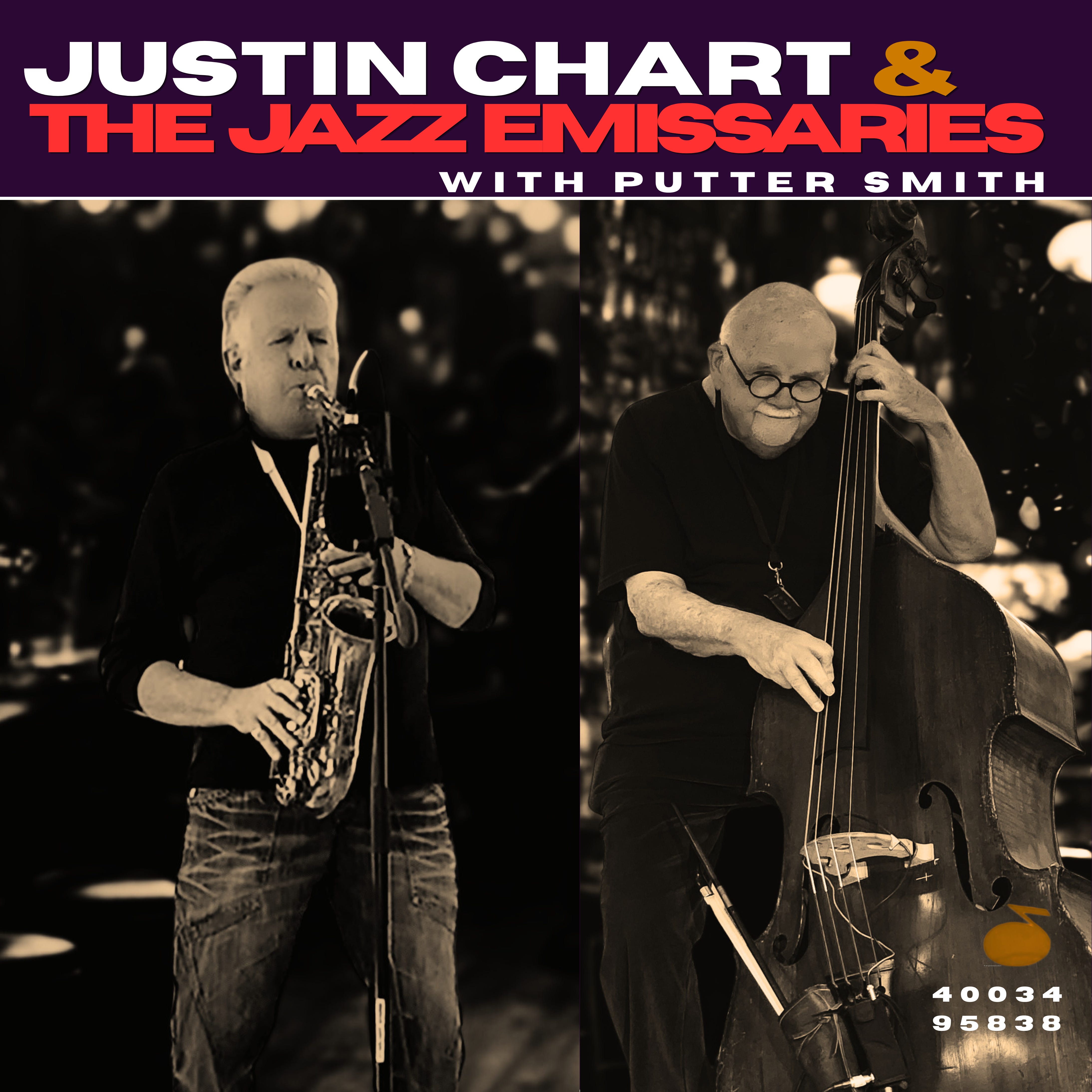
There is a profound, almost conversational intimacy to Justin Chart & The Jazz Emissaries (feat. Putter Smith) that feels increasingly rare in modern recording sessions. Alto saxophonist Justin Chart, a prolific bandleader deeply entrenched in the Los Angeles and west-coast scene, brings a structural clarity to these compositions that acts as the perfect canvas for Putter Smith. Smith, a veteran bassist whose storied career includes time with Thelonious Monk, Art Pepper, Duke Ellington and many more provides a grounding force that is both historically aware and refreshingly understated.
“Cleaning Up The World” is more than just an album opener; it feels like the heartbeat of the record-a swinging invitation to the listener to step into the timeless, night time feel that Chart creates. Smith doesn’t just keep time; he sculpts the space around Chart’s sophisticated and melodic lines, filling the pockets with a resonant, woody warmth that only decades of experience can provide. It is a symbiotic relationship where the avant-leaning tendencies of the ensemble are reigned in by Smith’s bop-honed sensibility, creating a tension that is consistently resolved with grace.
One cannot ignore the thematic weight of this record, which seems to reflect the changing face of the city that birthed both musicians. Pieces like “Leanin’ to the Night” possess a noir-adjacent atmosphere, painting vivid mental images of flickering streetlights and midnight pavement. It is an evocative, cinematic listen that rewards deep immersion, demanding the listener sit with the silences as much as the solos provided by Chart, Smith and keyboardist Theo Saunders and Kendall Kay on drums.
Ultimately, this is a record that bridges the gap between the legends of the past and the creative output of the present. It captures a specific chemistry—a meeting of minds where egos are checked at the door in favor of the collective pulse. For those tracking the evolution of the West Coast jazz sound, this collaboration is not just an essential addition to the catalog; it is a vital document of a masters at work. While Chart provides the melodic framework, it is the inclusion of Putter Smith that gives the album its gravitas, grounding the record in the rich, bebop-drenched legacy of the West Coast scene.
The brilliance of this album lies in the rhythm section’s restraint. Smith’s approach to the double bass remains, as ever, a marvel of melodic support. On the sprawling “Curious Changes,” he navigates complex chordal shifts with a light touch, refusing to overplay while consistently driving the harmonic narrative forward. He understands that in a jazz trio or quartet setting, the most powerful note is often the one you choose not to play, and he leverages this philosophy to great effect here. The tracks are well-paced, moving from the buoyant, rhythmic vitality of “Thrivin’ in Five” to the melancholic, stripped-back beauty of “Noctuary.” Each transition is intentional, creating a cohesive listening experience that flows like a long, well-told story rather than a disjointed collection of sessions.
This is a record for the purist who finds joy in the nuances of a well-placed accent or the subtle interplay between piano and bass. It is an honest, unvarnished look at a group of musicians operating at the height of their mutual understanding. Justin Chart & The Jazz Emissaries is an understated triumph, proving that the most resonant music often comes from the quietest corners of the room.
The album’s strength is its structural diversity. From the shuffling, hard-bop sensibilities of “Kickin’ it with Mr. Kidd” to the introspective, chordal landscapes found in “A Scar Becomes A Suit,” the ensemble displays a remarkable range. The Emissaries navigate these shifts with an intuitive fluidity, Chart-- ever the architect of atmospheric jazz responds to Smith’s bass lines as if they were reading from a shared, unspoken map. It is rare to hear a modern ensemble that sounds this cohesive, this lived-in, and this dedicated to the craft of the ensemble piece. Saunders comping sets the stage for Charts dangerous virtuosity, while Kendall Kay is an unassuming master of complications. As it turns out “Mr. Kidd” is the character Mr. Smith played in the James Bond film “Diamonds are Forever”.
Putter Smith remains an enigma of the instrument; his tone is as dry and punchy as it was forty years ago, yet his phrasing remains contemporary and curious. He treats Chart’s original compositions with the same reverence he might bring to a Standard, elevating the melodies while simultaneously stripping away any unnecessary artifice. This is the hallmark of a true collaborator—the ability to enhance the leader’s vision while leaving a distinct, unmistakable thumbprint on the session.
This album serves as a reminder of what happens when top-tier musicians stop to simply “play.” It is refreshing, sophisticated, and deeply human. Justin Chart & The Jazz Emissaries doesn’t aim to reinvent the wheel, but it does aim to remind us why the wheel turns so beautifully in the first place. It is a mandatory listen for anyone who appreciates the enduring power of the jazz quartet.
Charles Mobley
by Ludwig vanTrikt
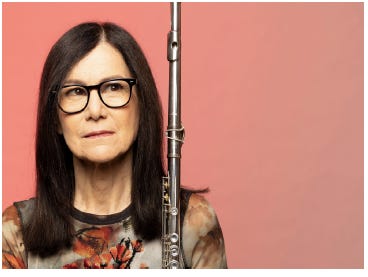
Cadence: I am interviewing you during a time that you have a new Septet+ recording on Sunnyside (“What Times Are These”) and recently came back from a mini tour with another series of concerts coming up. Is your sense that in terms of the jazz performance world things have bounced back post Covid?
J.B.: I would say some things have bounced back and some have not. Some clubs and music venues closed and other’s opened. And, in some ways life as we knew it has “come back,” though differently. While things never stay the same, we have all been affected by Covid in some way or another and I think that has shaped and influenced our lives going forward. From what I have seen, there seems to have been a tremendous number of artistic projects/recordings that were created during that time, which would make sense since most artist were staying home for unusually long periods. In the absence of performing, teaching and touring, many were developing new projects. I guess the “silver lining” would be the resulting amount of creativity and unusual amount of consecutive, concentrated “focus time.”
Cadence: “What Times Are These” is noteworthy on so many levels including your incorporating the Septet+ and guest vocalists along with the use of poetry by women poets. How do you get a massive project like this off the ground financially during a time when jazz cd sales are at best erratic?
J.B.: Certainly, having even just the Septet+ for so many years doing many performances, tours and recordings has been a huge financial commitment for me. Adding four vocalists and a percussionist to “What Times Are These,” made it even more costly. While it has been very challenging, with the increasing success and recognition the band achieved through performances and recordings, over time, we’ve been offered better and better paying gigs and some financial support. That said, my recent recording, “What Times Arte These” was made financially possible by a combination of grants, “crowdfunding,” Sunnyside Records support and having subsidized it with my personal finances. It is, of course, unfortunate (and often means less possibilities to record and develop projects by artists) that the music business is unable (or unwilling) to create more sustainable and equitable formats to help those musicians who are not subsidized by their labels (which is the vast majority), nor compensated for their work from most streaming, broadcasting and sales platforms. I don’t want to blame the independent record labels as I know things are more difficult for them as well. And I also want to mention that there are musicians who are trying very hard to make a difference and change the situation by speaking out to our “lawmakers” and through organizing…
Cadence: Were you able to do any recent touring using guest poets or vocalist with the complete Septet+?
J.B.: We did do several performances before recording the music in preparation for the recording dates, and also did a CD-release performance in NYC to celebrate its release. As you might imagine, in addition to the huge financial expense to present the entire group in concert, the fact that most of the musicians have either their own projects and/or are “in-demand” sidemen makes it very challenging to find dates where everyone is available. With this particular project where much of my composing was with these specific musicians in mind, I am reluctant to use subs when any of them cannot make it. We do though have some performances booked in 2025 that I’m excited about and looking forward to.
Cadence: Please give us a glimpse into the workings of your artistry; how do you compose (using the piano or the flute)? What kind of practice routine do you maintain for the flute?
J.B.: When I compose, especially for this size group, I usually start at the piano to come up with with my initial ideas, melodies and harmonies. I will often sing the melodies in my head, in the shower or when I’m doing other things, to get a sense if they work and/or to try to hear what might need to happen next. In my mind, I am often thinking about the concepts I want to work with and will get an idea and perhaps first try it on the piano. Once I have some ideas, I will put them into my Digital Performer sequencing program so I can hear them in “real time” since I’m not a good enough piano player to be able to execute that. Also DP offers me the possibility to hear many melodic and rhythmic lines at the same time to see if they work, something that would be difficult for me to do at the piano. The sequencing program also allows me to move sections around and try different version of things until I decide what I want and what works best.
For the flute, I practice every day and the number of hours I can spend at it is mostly determined by both my schedule and the availability of the practice room in my building. I generally try to do 2 to 4 hours a day at a minimum. I did a lot more for many, many years however between my schedule, composing and other recent family obligations, it’s been a challenge to find more time, though I do hope to again in the near future.
Cadence: Please elaborate upon the various themes on your new recording especially in light of the forthcoming American presidential election?
J.B.: Well, of course at this point we’ve already had the election and the results are clear. Needless to say it is a challenging time to be living in the US (though I know this will have far-reaching effects worldwide), especially for artists (among other marginalized groups). When I began my work on this recording, choosing poems, clarifying the themes and concept I wanted to focus on and composing the music, it was in 2020 just after Covid shut everything down. I had no idea what the political situation would become here or what things would transpire in other parts of the world. In some ways, one always hopes that by the time their work is finished and is released commercially, that the themes and the music will still be relevant. “For better or worse” as they say, the themes found on my recording are probably even more relevant now than when I began…
The title of the recording was inspired by Adrienne Rich’s 1995 poem “What Kinds of Times Are These” and refers to my experience of what was going on around me both with the outbreak of Covid-19 and what was happening socially and politically.
Soon after everything shut down in March, 2020 and I was confined to my mid-town NYC apartment, I discovered Bill Moyers’s website “A Poet A Day,” and while I’ve never been a huge poetry person, every day Moyers posted a poem that you could read, view a video of the poet reading it, and see Moyers interview the poet about it. This really drew me in.
From that, I got inspired to work on a new project for my large ensemble, deciding to do something I’d never done before - work with poetry as lyrics, composing music for it and writing for vocalists. I chose poems where I found something that “spoke to me” and I could express that feeling musically; I let each poem dictate what I would do, and who I would have sing it and solo on it. I knew the themes I wanted to work with although I didn’t yet know the order of those composition but allowed it to unfold as I went and as things became more clear.
While each composition’s meaning for me is discussed and elaborated in the liner notes that come with the recording and can best be interpreted individually by listening to the music and reading the poem, I offer here some examples:
On “In Those Years” by Adrienne Rich, the beginning passage reads, “people will say, we lost track of the meaning of we, of you. We found ourselves reduced to I.” I highlight this passage and in particular the word “I” by having the vocalist repeat it (with a piano ostinato accompaniment) while having the tempo speed up to give word more urgency and intensity.
Poet-novelist Marge Piercy’s “I Am Wrestling with Despair,” is a dystopian “cri de coeur” about the cruelty of the radical right towards the poor and women. The juxtaposition of the repeated yet displaced guitar/piano intro that continues through the first chorus gives an unsettled feeling.
The opening line of poet Naomi Shihab Nye’s “My Grandmother in the Stars,” (“It is possible that we will not meet again on earth, to think this fills my throat with dust”) was written about her grandmother in Palestine. At that time I’d been sharing in the caretaking of my mother, whose dementia/Alzheimer’s had progressed to a point where I couldn’t even play it for her. However, working with that poem and composing the music for it became a life-line for me, offering me a place to put my feelings about my mother and that experience.
In essence, it is difficult, shocking and depressing to see the direction of our politics and socio-economic climate that has taken shape, accelerating over the past 20 years (though many believe it is a natural outgrowth happing far longer). Music has always been a vehicle of expression for me as was this project.
Cadence: Since founding the Septet in 1999 would it be accurate to say that this lineup has been an artistic and financial success?
J.B.: Oh…success is such a subjective concept. Of course it would be wonderful to make lots of money and be known world-wide (and I would be happy for that), however, my main goals have always been to be able to work at my craft to improve, perform and record as much as possible. Recognition and success, while personally gratifying, usually translates to more visibility, more options and being able to work more…and if that happens, it’s a great thing and is more inline with my goals! Being able to keep the band together (with some personnel changes at different times) this long has been an incomparable opportunity for me as a composer. Knowing the musicians I am composing for in addition to having had this length of time to learn and understand how to orchestrate and arrange for this instrumentation has been a gift. Living in NYC, I have been very lucky to work with so many great musicians who both have the skill and mind-set to play the many unconventional ideas I’ve wanted to explore with this band.
Cadence: How do you balance being a busy artist with living your life in terms of dating or marriage, family responsibilities and the mundane parts of life?
J.B.: I think that is always a big challenge for everyone no matter what field, depending how demanding one’s vocation and aspirations are. For me personally it has always been, and continues to be, a difficult challenge trying to balance family obligations and a satisfying personal life with the demands of being a musician, and often times one area suffers. Sometimes I don’t get enough time to practice or compose, and sometimes I don’t give enough time or attention to friends… Luckily I have been married to another musician who understands the demands of the daily focus and practice I need on my instrument, who I also frequently play and tour with…so that helps. But life presents unplanned and unforeseen interruptions that force you to make choices about your priorities and sometimes I get them right and sometimes I don’t…but unless we can find more hours in the day, whichever choices we make, there is always “a price to pay.” For example, for three years I shared in the care-taking of my mother who lived in Connecticut and suffered from dementia/ Alzheimer’s (mentioned earlier) until she passed this past February. That took a significant amount of time away from every part of my life, but it was the right thing to do and I was glad to be able to be there for her. Now, I have been focused on getting back to a more regular practicing, teaching and performance routine.
Cadence: Do you think that it is necessary in order to release music that it’s helpful to have music with a theme? For instance in 2018 the record “Bridges” connected the musical dots a number of different cultural dots. Pease answer the first part of that question and kindly delve into “Bridges”?
J.B.: I don’t think that it is necessary in order to release music that it’s helpful to have music with a theme. I think that all approaches to creativity are valid and can be used and employed at different times. Personally, for me, I have found that I enjoy working with whatever is inspiring to me at that particular moment in time, that gives me a focus to explore ways to develop ideas and formats for myself (and my band) as both a composer and improviser. For example, because you have asked about “Bridges”…at the time I wrote the music for that recording, I had been doing quite a bit of touring in South Asia (including India, Nepal, Bangladesh, etc.), a lot of listening to the music from those cultures, in addition to doing performances with musicians from those countries, both in NYC and there. I love the music and cultures from that part of the world so became interested in trying to find ways I could take ideas from that music to enhance my own. Of course, I understand and have great respective for their musical traditions, its complexity and the number of years, time and devotion it takes to play and understand that music so I was not trying to write or play in those styles. I was just trying to take some elements to expand my palette and work with them in my own way. Working with Amir ElSaffar, who played in my band during that time, was also influential. We had some discussions about the similarities (and differences) between Maqam, Qawwali and sacred Jewish music that were illuminating and inspired some of the music I wrote and recorded on Bridges as well.
Cadence: Do you foresee to continue recording for Sunnyside Records? Are there any plans to release your music via vinyl?
J.B.: I hope to continue to record for Sunnyside. “What Times Are These” is my fourth recording for Sunnyside and I feel very fortunate to have their support. I have a very good relationship with them and live just a few blocks from their office so enjoy going to visit for a coffee from time to time. The label has a very long history for putting out great music and I am honored to be a part of that legacy.
Sunnyside does not release their music on vinyl, at this point, and I don’t think my earlier recordings have been reissued on vinyl either.
Cadence: Your recently completed a tour of parts of India and would love to get a glimpse into that experience both musically and non-musically? Was this your first time?
J.B.: I actually just returned from a 4 1/2 month tour with the first half being in Europe (Germany, Austria and Spain) and the second half in Kathmandu and Delhi. This was my fourth time performing at the Jazzmandu Jazz Festival in Kathmandu and my third time performing in Delhi. I love Nepal and each time I’ve gone to play at that festival has been special. Also, that festival lasts a little over one week so that amount of time offers the opportunity to get to know a little of the city, the music and some of the musicians and fans. It’s a wonderful, special place and the people are very warm and friendly. It has some similarities to India (though India is quite vast with several different dialects and cultures) however there are also influences from further East including Tibet, China and some of the other surrounding countries, in addition to the many visitors and tourists from Europe and Australia. This time when I went to India, I stayed only in Delhi for one week but was actually happy to have more time there to explore parts of the city and get to know some of the people. The other times I was there I didn’t have any free time since we were performing, rehearsing and giving workshops.
I love that part of the world, the music, the culture, the food, the world view…and so any chance I can get to go, I will gladly take it. It is very different and one really experience a paradox of the juxtaposition of the very old and very new.
Cadence; Going from talking about one of humanity’s most ancient civilizations to AI. What are your views on this burgeoning technology and its potential use and misuse in Jazz?
J.B.: To be honest, I don’t know much about AI and in particular it’s impact on music except what I have heard and read…mostly I’ve heard about it in context of it’s use in music in the film and television industries. Of course, I would be opposed to it’s misuse in any form, however while this might sound naive, I believe there will always be a need and place for live and creative music because musicians need to create, perform and connect with others, and most people need to experience that emotion and connection that can only be had in a live and/or recorded activity. It reminds me of when people talk about whether the CD is obsolete and/or unnecessary…all I can say is that many musicians I know like to compose, perform and/or record thinking and conceiving of their music as a group of pieces that relate, perhaps that has an arch and order to them to communicate a vision, statement or concept they are working with. Many musicians, including myself still find the idea of liner notes, telling a story, a concept and a feeling in addition to having something tactile and finite, to be essential…albeit I know I’m a bit of a dinosaur!
Cadence: I am interviewing you during some extensive touring by you and your band; thus, please address a statement that Esperanza Spalding made about how she noticed that even for someone like herself (a higher profile artist) performance opportunities across the world have dramatically decreased?
J.B.: Actually, the 4 1/2 week tour I just returned from that you are speaking of was not my own tour nor did I do any of the booking for it. I was a sidewoman in pianist/composer Monika Herzig’s group and we were on tour celebrating the release of our fourth CD and 10th year performing together. I do however have a tour coming up in January with my own quartet. To be honest, for me booking the quartet tour recently was much easier than I’m used to because I’ve been booking my large group, The Jamie Baum Septet+, for several years. Booking the Septet+, despite the success of our recent release (with a 5-star review in DownBeat) has become even more difficult because it has now become a 10-piece band (with vocalists and percussion) fitting the needs of the new material. Booking a band of that size (even when it was just a seven-piece band) was always a challenge because it requires a large stage, more backline, and of course more money, not only for artist fees but hotel rooms and flights! Like I said though, I did not book the recent tour I was on with Monika’s band so I can’t speak to the challenges she faced. She did a great job keeping us on the road for so long with many nice performance dates.
Without knowing the specific issues Esperanza Spalding was speaking about (i.e. fee, venue size, travel requirements, etc.) it is difficult to assume the context of the conversation, and so I wouldn’t want to make a comment or dispute her experience. While I have always found it challenging to book performance opportunities, we are finally coming back from the “covid period” where everything was halted! I think it took quite a while for performances to return to the pre-covid level (especially with many of the clubs having closed permanently), so to me it seems like this period is a busy time.
No posts
Comments
Nothing yet. Say the first thing.
Sign in to join the conversation.