
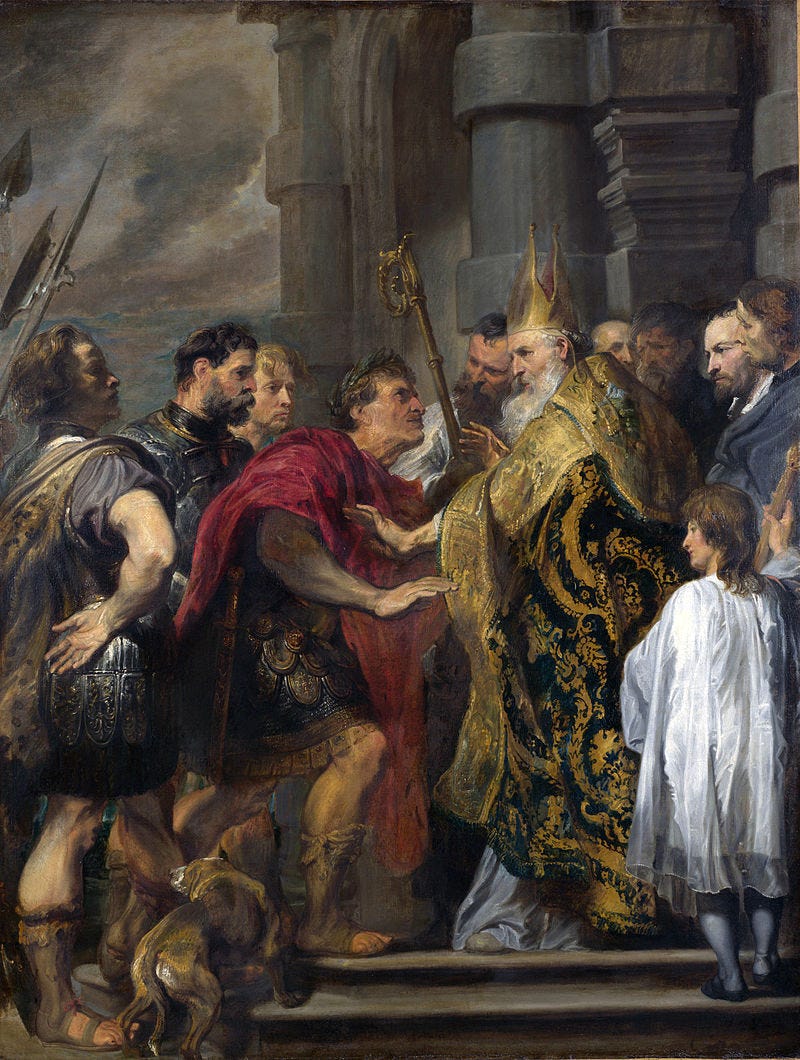
It is well within Byzantine historical parameters to consider the Church and the State as entities that have together and separately defined the Eastern Roman political and social world. Often in the study of Byzantium however, there appears the term “Caesaropapism” in addressing the ideology so to speak, or rather the polity that could characterize the Empire’s status quo. This is of course a rather Western approach to a question that does not merrit such a view and neither does it grant it clear enough view into Byzantine matters. The decentralized nature of the Western European states and systems in the middle ages certainly lends itself to the view that Byzantine centralization could be termed as “Caesaropapism.” Of course this is clearly limited and omits several important details that allow one to understand the system and interplay between Church and State.
Emperor Leo IV writes; “As the polity consists, like man, of parts and members the greatest and most necessary parts are the Emperor and the Patriarch. Wherefore the peace and felicity of subjects in body and soul is the agreement and condord of the kingshipp and priesthood in all things,” quite beautifully quoted by Geanakopoulos (1965) in his attempt to clarify the exact relation between the two. I think the author perfectly combines this quote with the following by John Tzimiskes whom I am thus obliged to quote myself; “I acknowledge two powers in this life: the priesthood and the Empire; the Creator of the world has entrusted to the former the care of souls, to the latter that of bodies. If neither part is damaged, the well being of the world is secure.” Two clear conclusions may be drawn from this passage, the divine appointment of the offices is key in Byzantine perception of statehood and priesthood, and that they run parallel to each other.
As Eusebius of Caesarea writes, the source of all authority is God and that with Christ’s leaving his power on earth was divided in two parts; the spiritual through the Apostles and the civil through the Caesars. The Emperor in this model is the lawgiver and organizer, the protector of Christ’s legacy and in a way His vicar on earth. He is ultimately a mediator between God and man. This places Church and Emperor in an interesting position of conflict and cooperation which the Western analyses of the matter fail to notice the subtlety of.
The Emperor exercises control in three main spheres according to Geanakopoulos, which are Temporal, Spiritual or Eccelesiastical and Dogmatic. Each of these to varying degrees are involved with Imperial Power and Church sovereignty, if I may borrow that word. The Secular, that is the Temporal is under complete Imperial control, the organization of the Church and its administration partially so, and the esoteric form of the Church and the Truth is entirely outside of Imperial power. Intertwined and not separated these three function in harmony maintain for the Emperor a position that isn’t quite that of a kingpriest.
Therein we find interesting political ideas that certainly sound novel to a modern secular reader. The idea of the oikoumene, was that of a society built on creed and culture organized as a state. This under the system described above functions perfectly well in the Imperial context, it prevents the rise of nationalist factions. Imperial power came from God and therefore political authority not only was supreme, it was also justified. This ties in nicely to the debate opened in previous articles, concerning the political primacy in a society. Characterists of such primacy are certainly observed here. The prevalence of Divine and therefore unsurpassable authority from where all other political power is derived, certainly grants political power as described in the Imperial context thereof; the Emperor’s friendship with God, the observation of His laws in Byzantine law making, the beneficiary attitude of the Emperor and much more, all dominated the priority of social and state responsibility. Economy was means to an end, and subjugated as it was to far superior and concrete powers, social attitudes towards those more inclined to its abstract nature were attacked. Intellectuals and free-lancers were somewhat despised as Hunger (1982) shows.
Ostrogorsky provides with an interesting theory of the dyarchy, that is dual rule between the two powers of Church and State, which many are reluctant to adopt. Regardless, politically speaking, the two are important and conjoined in their primacy in Byzantine life and statehood. To return to Spengler’s theories of Economic versus Political primacy, Byzantium provides a fascinating case study. It is a clear example of the ideal Politically motivated society, wherein Divine law and authority fuels statecraft, society, customs, culture and the very nature of power. But it is also an example of a state which was defeated and which failed, despite the rise of economic primacy not being a reason for this Culture’s collapse. Certainly Spengler may not recognize the Byzantine as a distinct Culture or a Culture at all, but its importance in analyzing his work and its later influence in modern political thought is undeniable.
Comments
Nothing yet. Say the first thing.
Sign in to join the conversation.