
When political analysts average dozens of polls into one neat number and present that number to us on the evening news, we feel like we know what’s coming. The polls may differ by a few points here and there, but that average feels like a safe bet, the “most likely” outcome… Yet, every few years, we’re reminded how averages can betray us. The result goes the other way, stumping the pundits who put their faith in the mean. The reality was always in the data, buried among the outliers, just not in the number we chose to focus on.
Climate science has a similar problem.
Thanks for reading ByWater’s Substack! Subscribe for free to receive new posts and support my work.
When researchers use supercomputers to simulate the future of our planet, they don’t produce one prediction, they produce thousands. Each one represents a plausible version of how the world might change depending on energy use, population growth, technological progress, and policy choices. But when those mountains of simulations pile up, scientists face a daunting task: how do you summarize them into something usable? How do you explain to a policymaker or community leader what the “future” looks like, when there are thousands of them?
Traditionally, the answer has been to pick a “middle” scenario, a sort of average of all possible futures. It’s tidy. It’s easy to visualize. But as new research from Gi Joo Kim, a new staff scientist at the ByWater Institute, makes clear, this simplicity can come at a cost. When we average out uncertainty, we risk distorting the very story we’re trying to tell.

Modeling the Future
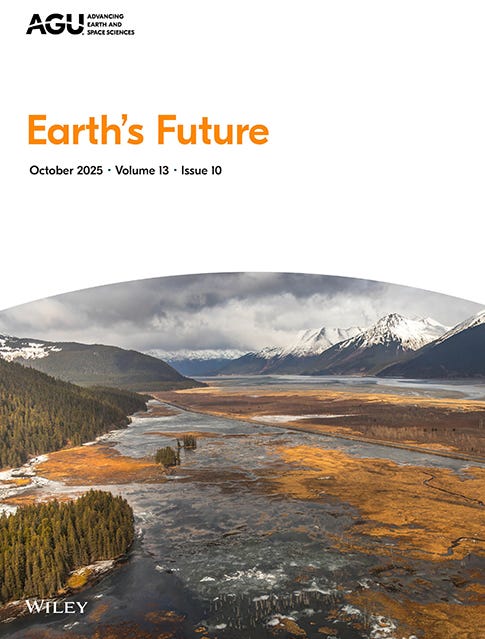
Kim’s recent paper in Earth’s Future, co-authored with researchers from Tufts University, MIT, and the Pacific Northwest National Laboratory, dives into one of the biggest challenges in global change research: how to make sense of vast “ensembles” of future scenarios without losing crucial information.
The team used the Global Change Analysis Model (GCAM), which is a massive computer model that connects the dots between human behavior and the planet’s physical systems. It’s a kind of simulation engine for Earth itself. GCAM links the energy sector with water, land, and food production, then offers projections on how they might evolve through the 21st century.
For this study, the researchers ran the model 5,760 times, creating an expansive dataset of plausible futures. Each one with varied assumptions about factors like population growth, energy preferences, and economic development.
You could think of it like running a video game thousands of times, changing the rules each playthrough: what if renewable energy takes off? What if the global population triples? What if the cost of carbon capture stays expensive? The results tell us how different the world might look by the year 2100 depending on the paths we choose.
The problem, as Kim points out, isn’t running these simulations, it’s summarizing them.
Scientists often condense these scenario ensembles into single statistics, an average, a median, a “best case,” or “worst case.” These summaries, known as ensemble aggregation measures, make the data more digestible and legible, but they can also change the meaning.
Kim’s team compared seven different ways of summarizing their 5,760 scenarios. What they found was illuminating: depending on the method used, the global story about energy, water, and food futures could look quite different.
In some summaries, water scarcity appeared to improve dramatically after the mid-century. In others, it remained stubbornly severe in parts of the world. The same held true for food accessibility and energy productivity.
The “average future,” in other words, wasn’t always the true one, or even a helpful one.
Kim likens it to smoothing over the very bumps that matter most.
If you averaged the paths of every hurricane in a season, you’d get a straight line running calmly across the Gulf of Mexico, even though no storm ever moves that way. The average erases the danger. Similarly, the average of thousands of climate scenarios can hide the extremes that define real risk: the droughts, famines, or energy shocks that could actually shape the future.
Energy Choices Ripple Through Everything
The study wasn’t just a statistics exercise. It revealed how deeply connected our global systems are, and how the future of one sector, especially energy, can ripple through water and food systems in unexpected ways.
Across most of the 5,760 scenarios, energy productivity (or how efficiently societies convert energy into economic output) improves steadily through 2100. That’s good news: the world is likely to do more with less energy.
The picture for water and food is more complicated.
In many simulations, global water scarcity spikes around the 2040s before easing in the second half of the century. This temporary peak, Kim explains, is driven by depletion of major aquifers and the costs of transitioning to more efficient technologies. Some regions, however, particularly parts of the Middle East and South Asia, never see that recovery. Their water crises persist regardless of global averages.
Food systems tell yet another story. On a global scale, food becomes more accessible over time, as economies grow and agricultural technologies advance. However, in certain regions, especially southern and eastern Africa, the model shows food access does not get better than other regions. The reason- competition for land. As countries set aside more acreage for carbon storage or bioenergy production, less land remains for growing food, driving up food prices.
These intertwined dynamics illustrate why Kim’s focus on multiple measures matters. One summary might show global progress. Another might highlight regional collapse. Both are true. But only by viewing them together do we see the full picture.
One of the study’s more surprising findings is that even the so-called “neutral” scenarios scientists often use, the ones meant to represent a “middle of the road” future, can themselves be misleading. In some cases, these baseline scenarios turned out to be overly optimistic, projecting stability where uncertainty reigned. In others, they were too pessimistic, predicting crises that most simulations never produced.
It’s a sobering reminder that even in science, “average” rarely means “accurate.”
Kim’s takeaway is clear: the future can’t be averaged, it’s a kaleidoscope of possibilities. Every assumption, every choice of metric or scenario, filters the story through a particular lens.
Climate Adaptation in a World Without Certainty
For Kim, this isn’t just an academic problem, it’s a philosophical one with direct implications for how we prepare for climate change.
At the ByWater Institute, his work fits squarely into a growing movement toward climate adaptation at the institute, that aims to help communities adjust to an unpredictable world rather than relying on forecasts that may never come true.
That mindset is especially critical in Louisiana, where ByWater researchers grapple with saltwater intrusion, rising seas, and shifting river flows. These challenges resist single-scenario solutions. The Mississippi River alone can flood one year and nearly run dry the next. Planning for the “average” year doesn’t protect communities, it might leave them vulnerable.
Kim’s approach offers a model for how adaptation science can evolve. We can try to think in ensembles, not averages. Instead of planning around one expected outcome, we can test how strategies perform across a range of possibilities. We can use multiple lenses: just as his study used seven aggregation methods, adaptation planners should evaluate solutions using economic, social, and ecological metrics simultaneously. Finally, we can value robustness over precision. The goal is to be resilient no matter what happens.
Kim’s global modeling work can guide the way coastal Louisiana must think locally. The future will not unfold neatly along a median line, but will likely swing between extremes. The challenge for scientists, policymakers, and communities alike is to build systems that can bend without breaking.
ByWater’s climate adaptation mission is founded on that principle. Whether the focus is wetlands restoration, water security, or urban resilience, the goal is to help communities thrive across all of them. Kim’s research is yet another piece of the adaptation puzzle. When we plan for the average, we plan for a world that doesn’t exist. When we plan for uncertainty, we prepare for the one that does.
Thanks for reading ByWater’s Substack! Subscribe for free to receive new posts and support my work.
Comments
Nothing yet. Say the first thing.
Sign in to join the conversation.