
Flat tires, forgotten cones, crater-sized pools of water in the street—potholes and sinkholes plague New Orleans. What may appear as charming dysfunction to the average tourist is mere dysfunction for the average resident. Whether it manifests in the daily discomfort of a bumpy ride or the sudden appearance of a 6 foot deep hole filled with stagnant water on your block, the streets of New Orleans leave something to be desired. As Joseph Cranney noted in The Advocate, “[a] 2016 study gave about two-thirds of the roads in New Orleans a failing grade, or said they don’t meet today’s minimum standards.” The problem has only worsened in the past decade, with the number of potholes fixed annually decreasing by 35% (Cranney). This means roadways vary from perfectly adequate to downright hazardous. The question stands—what is going on with the streets of New Orleans?
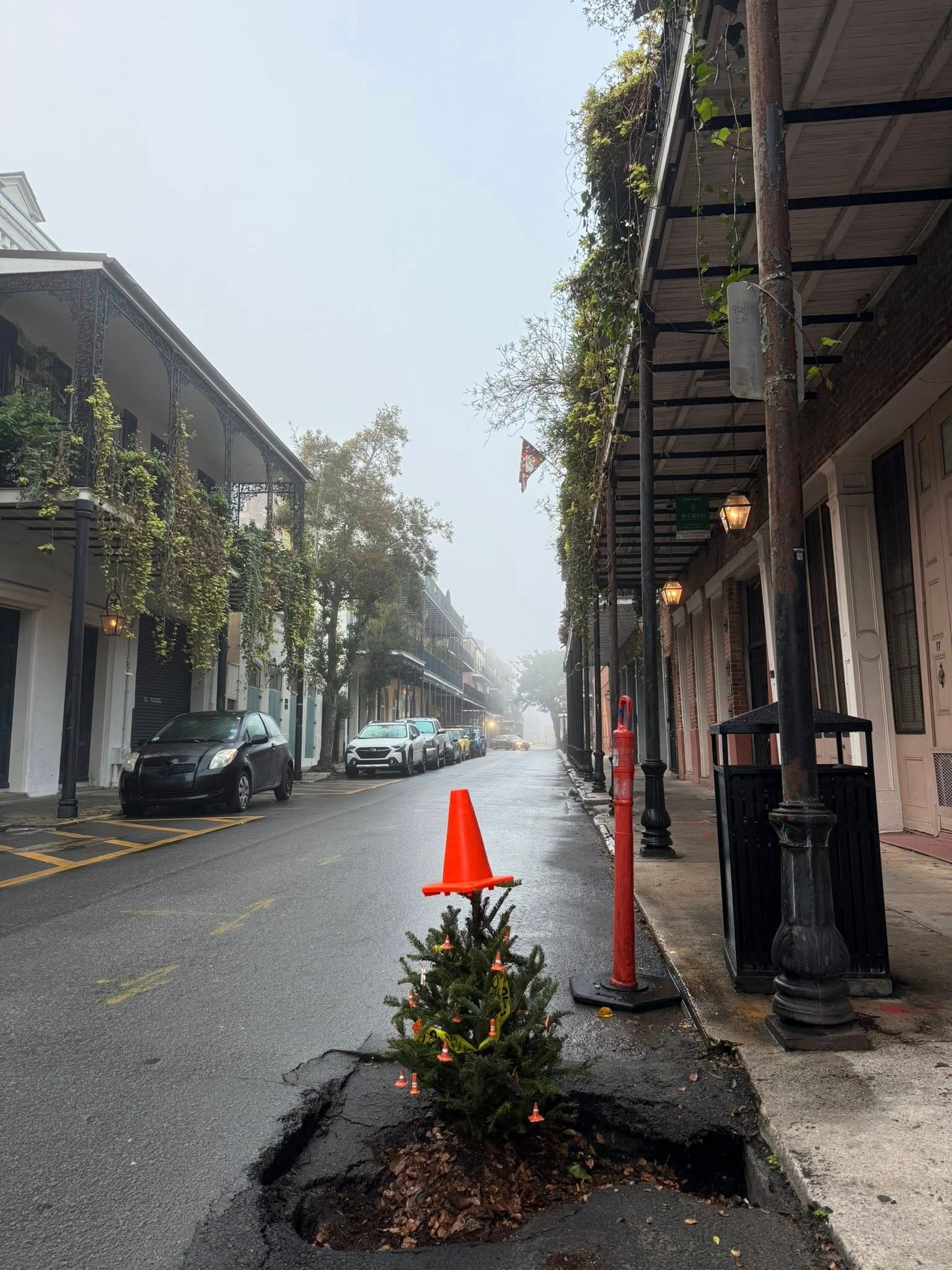
There have historically been three answers to this question. The first answer is subsidence, the second is money, and the third is an understaffed Department of Public Works. Subsidence is the sinking of land, the lowering of surface elevation in relation to sea level. According to the New Orleans Office of Homeland Security and Emergency Preparedness, “[l]and subsidence, the loss of surface elevation due to the removal of subsurface support, ranges from broad, regional lowering of the land surface to localized collapse.” Localized collapse is what causes sinkholes. There is an important distinction to make between potholes, which form on the surface and are caused by surface erosion, and sinkholes, which occur when space opens underground, with the land below no longer able to support the surface road. In one case, the road is eroded, in the other, the land below gives way and the surface sinks. For this reason, sinkholes are unpredictable and more hazardous.
Subsidence has occurred in New Orleans for a few reasons. The first is because the leveeing of the Mississippi River prohibited the cycle of annual fluvial flooding from replenishing the city’s high water table. With the dropping of the water table, the soil of New Orleans compacted and sank. The widespread use of concrete and impermeable materials in combination with a stormwater drainage system that moves water out of the city as quickly as possible interfered with the replenishment of groundwater and exacerbated this sinking.
The draining of the uninhabited backswamp at the turn of the 20th century and the conversion of that land into residential neighborhoods similarly deprived the soil of water. This meant that these newly developed neighborhoods sank as the land compacted, leaving more than half of the metropolitan area below sea level (Campanella). New Orleans is built on a river-dominated delta, which means the soil is only made up of the sediment of the river, organic material, and water. By draining the water out of the ground, space opens in the soil and the organic material oxidizes. Then the organic material shrinks, the land compacts, and the surface level sinks. This sinking happens unevenly—with the city’s land described by Bob Marshall as “a collection of sponges of different sizes and types, each of which is shrinking at different rates”—and has serious repercussions for roadways, causing the sudden structural lapse that results in sinkholes. Subsidence also significantly damages water and sewage lines. When these lines break, the land beneath the street is eroded, creating open cavities that can result in the surface caving.
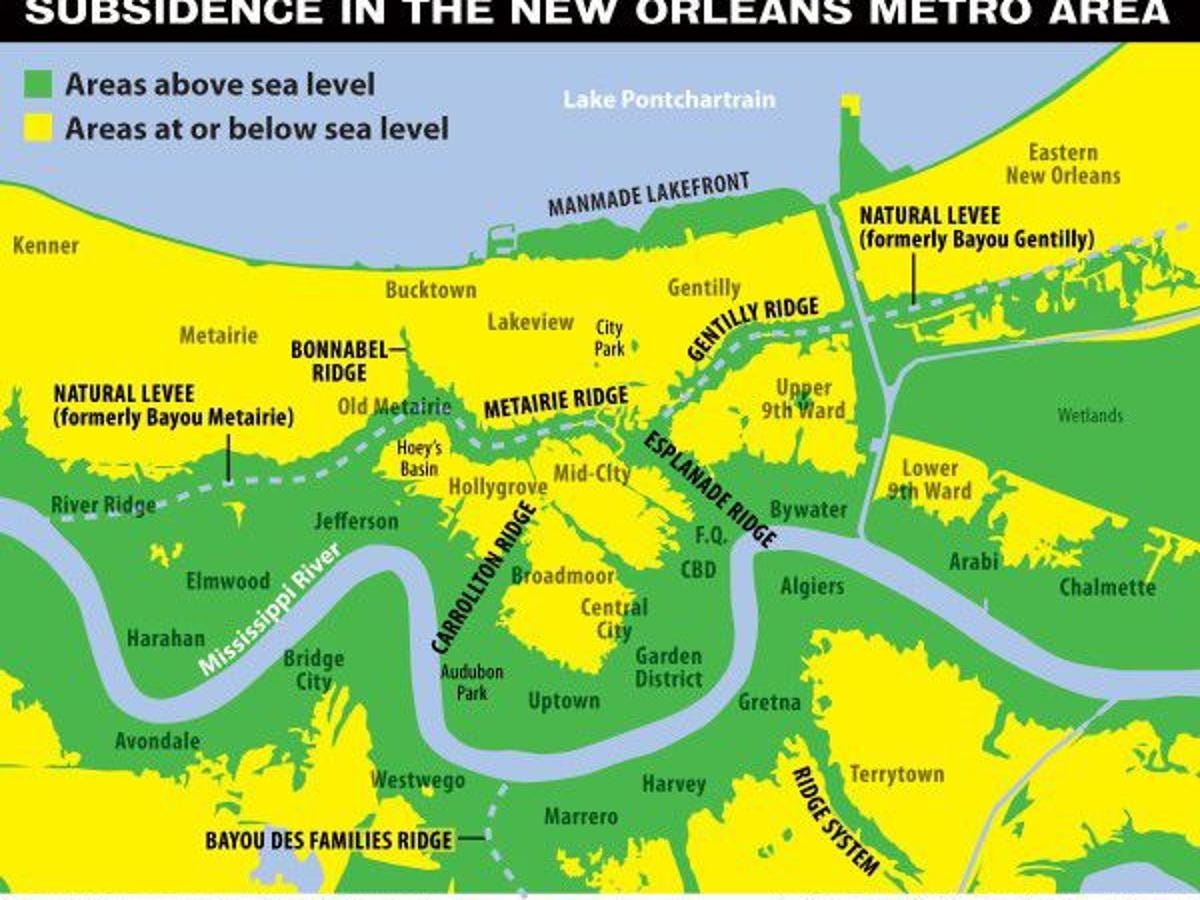
With some neighborhoods like Metairie and New Orleans East sinking between 6 and 12 feet, New Orleans faces considerable subsidence costs (Campanella). A 2015 Times-Picayune article used figures in the Urban Water Plan to gauge the subsidence bill over the next 50 years. This included estimates of $41 million a year to fix home and building damage, $1.5 billion to maintain sinking levees, and $160 million a year to address rainfall flood damage (Marshall). This estimate also noted that a large part of the $24 million spent every year on water and sewage lines is to address damage caused by subsidence. Most notably, the article found that “it costs $7 million a mile to rebuild a street in New Orleans, compared with an average of $1.7 million in other urban areas” (Marshall). This astronomical cost could be attributed to factors such as the replacement of old and deteriorated piping. It could also be the structural reinforcement of piling required in the lowest parts of the city to prevent gas lines from breaking or in the case of Napoleon and Nashville avenues, which are streets constructed on top of drainage culverts (Marshall). Subsidence is what makes the maintenance of New Orleans roads challenging, and it is also what makes it expensive.
Yet, budgetary restrictions cannot fully explain the breadth of the problem. In stark contrast to other comparable southern cities that take an average of a week, New Orleans takes a little under a year to fill a pothole upon a 311 request. Likewise, the city is only able to clear about one in ten catch basins every year, a critical infrastructure for the city’s flood defense. As Cranney explains, “[i]n the New Orleans public works department’s heyday in the 1980s, its maintenance yard had more than 400 workers. Now, it’s fewer than 30.” As of 2024, the Department of Public Works employed just two people to oversee that streetlights and stoplights stay operable and just one pothole crew to maintain the streets (Cranney). These 2024 public works staff numbers are staggering considering that under Cantrell there was $2 billion available from FEMA funding for road repairs (Evans) and that of the $1.5 billion 2024 budget, there was $300 million in federal grants (Cranney). As mayor-elect Helena Moreno explains, “one of the biggest issues that we face is that work that we should actually be doing in-house, we’re outsourcing, and things we should be outsourcing, we’re doing in-house” (WWLTV).
While it is widely understood as easier and more efficient to handle routine public works maintenance in-house, New Orleans hires contractors for basic work such as filling potholes and fixing streetlights. This became standard procedure at the end of the 1990s in an effort to cut costs. As Cranney explains, “when a traffic signal requires emergency repairs, officials are forced to go through the weeks-long process of hiring a contractor. The last three times the city sought bids for those repairs, no one responded.” Likewise, the same problem but in reverse formation, Moreno argues that the mismanaged projects funded through the $2 billion in FEMA relief should have been outsourced by hiring project managers. While subsidence and delta geology are largely to blame for the state of New Orleans roads, routine maintenance is hindered by administrative and bureaucratic inefficiency.
The beautifying projects completed in preparation for the 2025 Super Bowl proved the city government could act swiftly and efficiently. When it comes to public works and basic city functions, Moreno made it clear in her campaign she intends to foster this kind of productivity. In the mayoral debate, she explained, “when we talk about these projects, what also needs to happen is really an urgent level of coordination and collaboration, Super Bowl style.”
In order to properly sustain routine maintenance work and to attend to the growing amount of delayed maintenance, the Department of Public Works requires a larger in-house staff. However, the council only budgets a fraction of the dollars needed to fund those repairs. One of Moreno’s campaign promises was to hire 100 more workers to fill potholes and keep the streets functional. While Moreno’s solution addresses the core bureaucratic issue of an understaffed public works department, it also costs money to employ an additional hundred people. If Moreno wants to deliver on her campaign promises—to start her mayoralty off strong by filling potholes and fixing neglected traffic signals—then the city council will need to prioritize that funding while facing the current $160 million budget gap for 2025 (Poche). While subsidence is not so easily fixed, staffing and budget adjustments have the potential to really change the state of New Orleans streets.
Potholes and sinkholes are dangerous in themselves, but their occurrence is indicative of a larger problem. In order to respond to the threats caused by subsidence, the largest of which is the city’s increased vulnerability to flooding, New Orleans needs to improve its bureaucratic efficiency.
Sources:
Campanella, Richard. “New Orleans Was Once above Sea Level.” New Orleans Times-Picayune InsideOut, 19 Feb. 2015, https://doi.org/10.24926/2471190x.4718.
City of New Orleans. “Subsidence - NOLA Ready.” Nola.gov, 2016, ready.nola.gov/hazard-mitigation/hazards/subsidence/.
Cranney, Joseph. “A City Falling Apart: Why New Orleans Fails to Stay Dry, Functional despite Billions in Funding.” NOLA.com, 27 June 2024, www.nola.com/news/politics/why-new-orleans-is-in-disrepair/article_4eb9e2a6-065e-11ef-80f7-d782e59fc291.html.
Cranney, Joseph. “How Long Does It Take New Orleans to Fix a Pothole? What about a Broken Red Light?” NOLA.com, 1 July 2024, www.nola.com/news/new-orleans-pothole-fixes/article_14eee3be-37be-11ef-a291-5b1593a71bbf.html.
Evans, Beau. “Road Relief: New Orleans to Keep $2 Billion FEMA Settlement.” NOLA.com, 14 July 2018, www.nola.com/news/politics/road-relief-new-orleans-to-keep-2-billion-fema-settlement/article_c74a9d6d-2bcb-561d-930a-9bbb96d2f5bf.html.
Kasakove, Sophie. “State Takeover or Short-Term Cash?: Here Are 5 Things to Know about New Orleans’ Budget Crisis.” NOLA.com, 29 Oct. 2025, www.nola.com/news/politics/new-orleans-budget-crisis-solutions-5-things/article_06f7d4d9-3019-4d0a-92dd-c5eb95dd316a.html.
Marshall, Bob. “Special Report: How New Orleans Is Making a “Serious Problem” Worse with Its Levees, Pumping Stations.” NOLA.com, 5 Mar. 2015, www.nola.com/news/special-report-how-new-orleans-is-making-a-serious-problem-worse-with-its-levees-pumping/article_fa50b23f-eb17-5a89-89b5-39440008dd17.html.
Poche, Kaylee. “Officials Warn Mayor Cantrell’s Budget Would Undermine Street Repairs, Waste Services.” NOLA.com, 16 Oct. 2025, www.nola.com/gambit/news/politics_elections/new-orleans-budget-cuts-potholes-trash/article_e55379b1-5794-417c-a248-19f3ecc66724.html.
WWLTV. “New Orleans Mayoral Debate 2025.” Youtube Shorts, September 2025, www.google.com/search?q=helena+moreno+on+potholes&rlz=1C5CHFA_enUS914US914&oq=helena+moreno+on+potholes&gs_lcrp=EgZjaHJvbWUyCQgAEEUYORigATIHCAEQIRigATIHCAIQIRigATIHCAMQIRiPAtIBCDMwMTNqMGo3qAIAsAIA&sourceid=chrome&ie=UTF-8#fpstate=ive&vld=cid:7c2c9d39.
No posts
Comments
Nothing yet. Say the first thing.
Sign in to join the conversation.