
“At the Table” is a series of interviews and spotlight conversations with people I admire from within and outside of the wedding industry. These conversations focus on topics related to building an intentional, relationship-first business alongside a present, connected, values-driven personal life.
This Substack is reader-supported. If you enjoy my work (or want to support future work), consider becoming a free or paid subscriber.
Introduction:
Shortly after I moved to South Carolina, I was introduced to a small group of women who all operate their wedding businesses at a high level and wanted to grow in business together. We formed a little Mastermind together and met every other week for several years. Latia was part of that group. I’ve had the privilege of listening to her wisdom over coffee on a Tuesday morning, and working alongside her on multiple wedding days. She has boundless energy, a vivacious spirit, and an unapologetic love for her clients and her work. So happy to share her perspective with you!
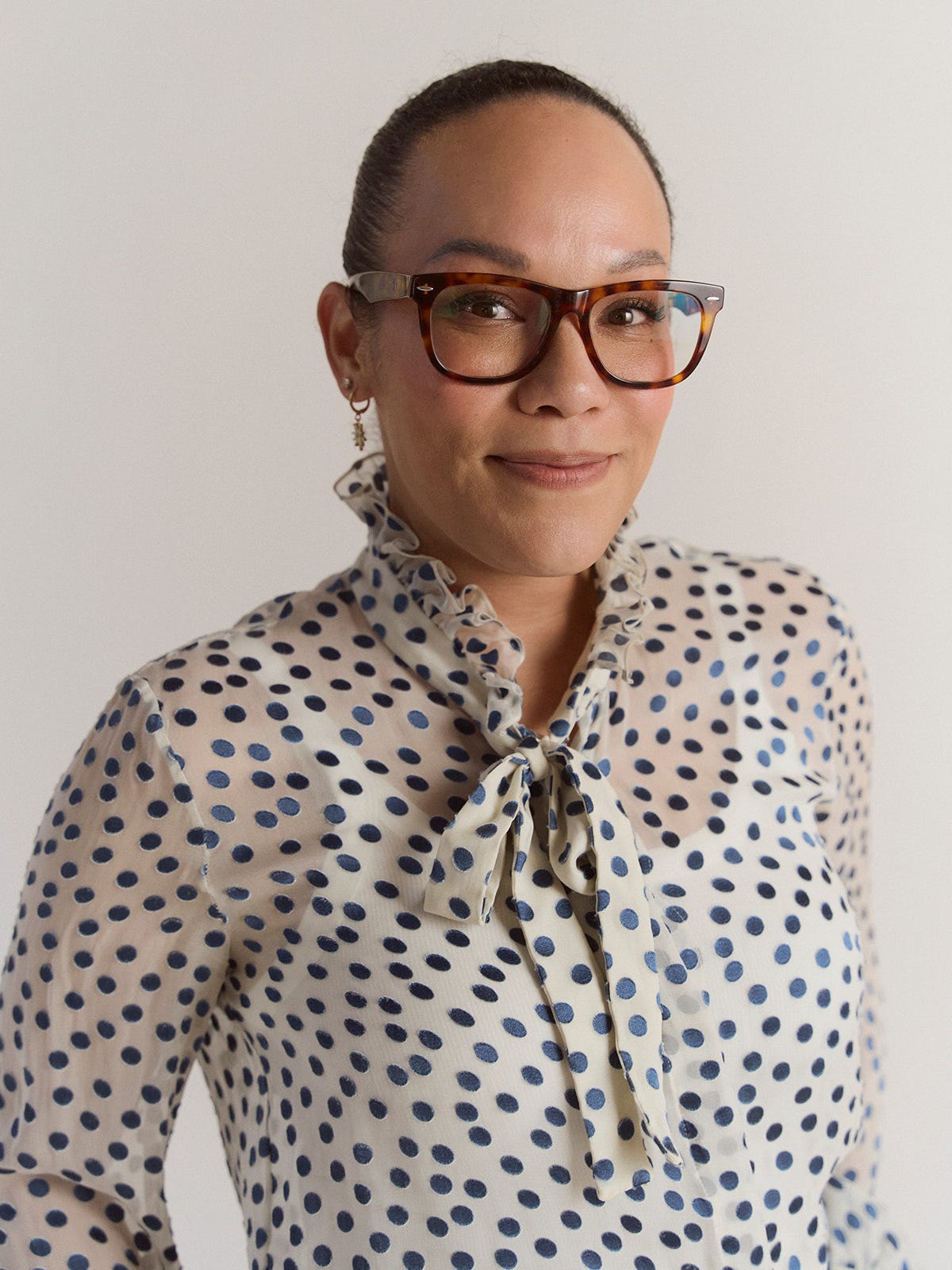
Follow Latia’s work via her commercial website (Latia Curtis), her wedding website (Fine Art Beauty), and IG.
THE INTERVIEW
→ First of all, tell me in your own words what you do for work, and why you do it?
I am a professional hair and makeup artist. I specialize in print and commercial advertising in the fashion realm, but also beautiful, style-driven bridal beauty. I do it because I love being part of telling stories — whether that’s in a commercial advertising forum where you have eight seconds or less to make an impact on the viewer, or in bridal, where I believe in honoring and celebrating the individual and making sure that shows through in their beauty work.
When people ask what I’m most inspired by, I am truly, genuinely inspired by the person in front of me. I like to know what they do for work, what they like to do for fun, where they like to shop, where they like to eat, how they engage with culture and lifestyle. And I find opportunities to infuse that into their look. When someone looks at themselves in the mirror, they don’t say, “Oh, my gosh, my makeup.” They say, “I am beautiful.” Because I believe that beauty is inherent — I find opportunities to celebrate people and their authenticity and their story. Beauty is just my medium.
→ What does a typical day look like for you?
My day varies wildly because, yes, I work with brides, but I also do a lot of print and commercial production work, and I do some art directing for clients as well. What does that mean? I envision what a character looks like aesthetically from head to toe — not just hair and makeup, but also what they’re wearing, all the way down to how they might have their nails done. If I’m working on a food ad where we’ll see a lot of hands, I take into strong consideration what their nails would look like based on who the client is, who we’re in service to, and what story we’re being charged to tell.
But every single day is different. Last week, for example, my days started at 4am outside at the beach, getting someone ready in pitch-black dark with only a generator and my lights. But then on wedding weekends, my days will start at 8 or 9am and I get to give my bride a nice face, head, neck, and shoulder massage to help her get emotionally and mentally centered before we start on beauty. I love when I get to stay with them up until or through the ceremony and just take care of them, be at their service. I call it “Lady in Waiting” service — because I am a lady, and I am in waiting to you.
→ In her book Dare to Lead, Brené Brown says that every person has just two core values that shape everything else that they do or believe. Do you agree with that idea? If you could boil your values down to just two, what would they be? How do those influence how you do your work & live your life?
I spent a lot of time with this question. I tried really hard to boil things down to just two values, but I feel I’m at risk of leaving out important things if I do. I resonate with the way that ambition can be defined as not being in competition with other people. I strongly believe in building community. I’m wired in a certain way to have an internal drive to be better myself, and to help other people be better as well — even if it means stepping outside my lane to make sure everybody gets a piece of this greatness. And I’m always asking how I can learn and gain as much understanding about people, the world, and cultures around me, so that when I’m in different environments, I can still find a way to be of service and make people feel loved and cared for.
→ The British author Alain de Botton has this famous quote: “There is no such thing as work-life balance. Everything worth fighting for unbalances your life.” I tend to agree with this idea, that work-life balance is an unhelpful goal, and we should instead think about aligned values and healthy rhythms in all spheres of life. What do you think about the phrase “work-life balance?” How do keep healthy rhythms & momentum going in both work and personal spheres?
That’s a great question. My work in the production world is not just a career but a lifestyle choice. The wedding industry is, too. We’re not just showing up on a Saturday morning in our hometown — we’re destination-based, so a wedding job can take up half a week. As I’ve moved into higher tiers of the wedding industry, it’s become more all-encompassing of my life and time.
So I have this theory called the Spectrum Theory, and it goes like this: everything lives on a spectrum, and we can find ourselves somewhere along it. Ideally, I want to find the middle. But it’s going to be relative to whatever else I have going on in my life. In my personal life, I might be on one end of the spectrum where I’m not spending much time with friends — but maybe my professional life is going amazingly, I’m getting great clients, going to beautiful places, working with the most wonderful families and vendors. In that scenario, I don’t have capacity to be the perfect friend, but I can ask myself: how do I get closer to the middle? I can’t make it to the birthday party or the girls’ weekend, but I can send flowers and say, “Hey, I hate that I’m missing this. I’m thinking of you this weekend — let’s get drinks when you’re back.”
That’s how we’ve been able to make it work in my household. My husband has a more traditional schedule, and his stability allows me to have this dynamic one. We try to find what balance means for us, knowing it shifts — November and December balance looks very different from May and June. We just have to open ourselves up to the reality of our situation: how do we make the best of it? How do we take advantage of our opportunities? If we only have two days together as a family, does that mean I invest in flying everyone up to my job location? It might mean exactly that.
There’s no such thing as work-life balance. But for me, I just try to keep myself in check and make sure my work doesn’t consume me. The goal is never perfection — that’s not a realistic standard for anyone. And what an ideal situation looks like is going to be different for everybody. So like I say to my kids: keep your eyes on your own paper. I’m focusing on my own Spectrum Theory, because there’s no room for comparison.
→ Some people argue that a focus on people and a focus on profit are competing priorities, but I love talking about the ways that running a relationship-first business aids in building more profitable, sustainable businesses. What do you think about this idea? Are they competing ideas? Why or why not?
People first, always — especially for me. The wedding world is very people-forward. You’re photographing people, I’m doing hair and makeup on people, and there’s no way to take the human element out of it. Without people, there is no profit. So unless you’re manufacturing a tangible product, I can’t see a way to put profit over people.
Profit is important, of course. I love profit because I’m running a business and I have to make money. And in order for me to do my job at the level I want to, I have to be compensated accordingly. Wedding weekends are physically demanding — long days, high stakes, being fully present for every moment — and by Sunday, my body knows it. I have to be compensated for that. Profit is not the end-all, but it matters. What has to be at the core, though, is serving people ethically, honestly, and transparently.
→ What are some ways that running a people-first business has benefited you? How has it benefited others?
My favorite, most delightful surprise of this job was something I wasn’t anticipating at all — the connections I make with these amazing women and their mothers. I grew up without my mom, so I had no frame of reference coming into this industry for what a mom’s role looks like on the wedding day, how to support her daughter, how to allow herself to be supported. And one of the greatest gifts of being a people-first provider is getting to be in that room, and almost every weekend, catching a glimpse of what my future might look like as a mother of my own daughters. Seeing two generations of women feeling beautiful, being loved on, witnessing what a really heartfelt relationship between mother and daughter looks like — it gets me emotional every time.
→ Our culture and our industry is fast—trends come and go in the blink of an eye, and there’s just so much noise, especially on social media. It can be tempting to believe that the only way to stand out is to add to the noise, to follow trends, to make a bigger flash than our competitors. But what if you’re a quiet brand? I have written about the difference between Fireworks and Fireplace brands here. Would you say that your business is more of a fireworks display or a fireplace? How does that influence how you market?
I love this question! I would say fireplace, without hesitation. I take a lot of pride in practicing discretion around my clients and respecting their privacy on their wedding day. I’m not chasing every trend — style-wise, look-wise, or social-media-wise. I’m staying true to what I love and what aesthetic speaks to me, honestly, because I don’t have time to do anything else. And I put that into my marketing, and I think it resonates. The word-of-mouth, by-referral-only practice has connected me with exactly the right people.
I think it would be somewhat shortsighted of me to try to scale really big really quickly, because I am one woman and I work in a very intentional way. Scaling for scale’s sake would attract a different kind of client — one looking for fireworks — and that energy and business style isn’t authentic to who I am or how I work. I find the most joy when I’m fully dialed in with my client.
→ How do you stay authentic when it often feels that “fake it ‘til you make it” energy is rewarded?
I don’t know any other way to be. I think that’s the result of how I grew up — I was often the only person who looked like me in the room. So I had two choices: assimilate, or do my own thing. I chose to do my own thing, and that has always been my way. Because of that, I was able to develop a real mental fortitude.
On the business side of “fake it ‘til you make it,” there’s an important distinction. There are people who have presented themselves as having a certain skill or ability and then, when they get in the room, don’t actually have it — that’s a real problem. But that’s different from imposter syndrome, where you’ve genuinely earned the right to be in that seat, you just haven’t fully accepted it yet. At that point, you don’t have to fake anything. You’ve made it — you just have to quiet the voice inside that says you don’t deserve to be there.
Sometimes bold or attention-grabbing content gets rewarded in views and follows, and it’s worth asking: what is actually being rewarded, and by whom? There’s a lot of content out there that thrives on spectacle, and the question I always come back to is whether it’s attracting the right audience — people who value craft, care, and professionalism. For me, that’s the only metric that matters.
→ What is bringing you joy in your work right now?
Being booked is bringing me a lot of joy. Every time I see “this client signed a contract and paid the retainer,” I am genuinely overjoyed — because it means I can keep doing this work. I just had a conversation with a wonderful client referred by a past client, and the reason they reached out is that they knew I would treat their event with discretion. They knew I wasn’t going to be on social media throughout their weekend presenting it as my own experience. They know I’m there for the job, not the notoriety.
Discretion is the new currency — and honestly, it’s always been part of my ethos. While for me this is my regular Saturday at work, for my client it is the most important Saturday of their life. I can’t treat it as content creation. That distinction matters to me deeply.
→ If we were to meet here a year from now, what do you hope we would be celebrating?
My retirement — because I won the Powerball. But in reality, I hope that we get to work together again soon, and that we simply made it through the year. This business is like a marriage. It’s really, really great, and sometimes it’s really hard. I love it so much I could never imagine walking away from it, no matter how frustrated I get with it, because I know I’m doing what I’m called to do. But it takes it out of me sometimes! So a year from now, we will celebrate still being here.
→ Final question: what is the number one book you recommend to every creative entrepreneur?
What if I told you I don't read business books? I know everyone talks about them, but I use literature as an escape and as inspiration — not for business growth. So I just read for fun.
Thanks for reading! This post is public so feel free to share it.
Comments
Nothing yet. Say the first thing.
Sign in to join the conversation.