
I began writing this essay in 2018, and I read it in its final form to a public audience sometime in the following year. A thought-provoking debate ensued. I’m not a fan of re-sharing old writing (urgh), and if this piece retains a sense of timeliness, well, that says more about our critically sluggish era than it does about the sharpness of my insights. Upon the release of Cowboy Carter, Beyoncé’s latest album, I floated around the idea of re-sharing this essay, so I’ve republished it here, for curious eyes and minds.
A velvet-voiced woman serenades a couple under the flash of cameras and the gaze of millions. The shimmer of her crystal teardrop earrings is matched only by the wetness already collecting in her eyes. The swaying couple are effervescently joyous. With every step, they herald the birth of a revitalised nation, ushering in its latest and most desperately anticipated chapter. This must be true because everyone says so. The man is the Hawaiian-born son of a white American anthropologist mother and a Kenyan economist father who met in a Russian language class at the University of Hawaii. The woman is the Gullah-descended daughter of a Chicago water plant employee father and a secretary mother. Both are held captive by the crooning backdrop of Beyoncé Giselle Carter-Knowles. It’s the evening of January 20th, 2009. On the night of Barack Obama’s inauguration as the 44th President of the United States, the Obamas enjoy their first dance as President and First Lady at the Neighbourhood Inaugural Ball. Beyoncé has been hand-picked to provide a rendition of the Glenn Miller classic At Last, a song most famously covered by a heart-wringing Etta James. In her post-performance interview, Beyoncé is endearingly overwhelmed. She’s tearful and teetering, displaying a rare moment of uncharacteristic abandon. She tells news reporters that singing at this historic moment has been the most important day of her life. “At last he is here”, she sighs. Her smile is watery, but her belief is absolute. “It was all worth it.”
Ten years on, the hazy afterglow of Obama fever has arguably dissipated into the collective fog of contested myth-making. Was it all worth it? For many of us, Beyonce’s statement has acquired a question mark. Our own era presents us with the thorny gift of hind-sight as well as more democratised, and often digital, avenues for black people outside the commentariat and celebrity classes to voice their unfiltered assessments of the Obama Years. Grand narratives have been incessantly destabilised, unclogged from their watertight assurances. Nostalgia-drenched paeans to the Obamas continue to service and unify critics of the Trump administration. These interpretations jockey for dominance against the disillusionment experienced and vocalised by black communities both within and outside the US. To remember things differently is to rain on someone else’s meticulously orchestrated parade.
Much has been said and written about the Obama presidency; a tumultuous eight years where the regime of police violence reached its zenith of hypervisibility and a mass, transnational movement for the right to black life erupted under a black president. Economic disparities between white and black Americans swelled alongside AFRICOM’s military expansion, increased deportations (particularly of Haitian asylum seekers), extrajudicial assassinations, and indiscriminate drone campaigns across the Middle East, South Asia and Africa. For those that cared to look, or cared to even care, the Obama dream sagged under the weight of its nightmarish contradictions. Legacies haunt as much as they inspire. In many ways, we remain anchored to that moment, fossilized in the amber of its promise. Like dancing lovers, we are mesmerized by the reflected image of ourselves. Was it all worth it? How do we measure worthiness? To decipher the worth of a thing is to put it into relation with other things. Worth, like power, is a capricious and slippery web of value judgements given the fleshiness of communal endorsement. In looking away, what do we endorse?
Whose worth is amplified, exaggerated and celebrated at the expense of a larger collective or community? Worth is hoarded by the few and socially reproduced by the rest of us. Its adjudication is the throbbing heart of neoliberal logic. Sell yourself until there is nothing left to sell. Flog liberation on the market. Repackage it accordingly. Haggle over the lives of others. Within global systems that stratify human life, worthiness is rarely earned or deserved. Worthiness is a metric which prioritises individual achievement over collective enfranchisement. When you’ve been conditioned to see yourself as unworthy, it’s understandable to seek comfort in the glorious, billboard-adorning worthiness of others, especially when they look like you. When self-image vies with self-worth, a popstar becomes the perfect stand-in for unrealised dreams.
Black womanhood can be overwrought with this particular kind of one-directional mirroring. It’s a way of looking at the world that is born out of our estrangement from it. Our struggle as black women, to quote the philosopher-critic Sylvia Wynter, concerns the “displacement of the genre of the human, of ‘’Man’’, of which the black population group—men, women and children must function as the negation.” This displacement can enrich our ability to think outside the confines of category, but it’s also a source of profound loneliness. Negation is a terrible prospect to bear. Still, we bear it, with grit, humour, savvy, and skepticism. Vulnerability is imposed upon us before we can choose it. Even then, there are no genteel fainting rooms built for black women with sensitive dispositions. No distressed damsels awaiting rescue. We maneuver, sometimes outwitting the curtailed visions others have for us. At other times, we fall into their traps, our imaginations wilting in sunless rooms. Through it all, we try to nourish our own gardens. Hold on to an inner world blooming beyond the diminished horizons of the one we are forced to creatively negotiate.
For many black women, contemporary intersectional discourse serves as an entry point into the arena of recognition. Recognition, after all, is a lifeblood. Even in superficial doses, it whets the appetite. In an imaginatively impoverished climate, having one’s pain acknowledged remains the surest way to be counted. The political demands of black women are only heard if they are made within the register of disempowered victimhood. If we are loud about being excluded, we may be listened to. Black feminisms are then collapsed into cohesive, totalising projects with a single aim; to function as a corrective for the bumbling missteps of liberal, white, middle class feminism. This is Intersectionality™ as championed by carceral feminists, self-aggrandising politicians, cynical military recruitment campaigns and slick corporations. If there’s a murderous, exploitative institution you wish to revamp, throw a black woman at it. Interrogating the costs of our inclusion into the halls of power is not as easily embraced as the black feminisms concerned with the business—and it is a business—of window-dressing and diversification. Yet, whether others want to listen or not, black women are having conversations about our differences.
Recognition is a profoundly human desire. Black women, like anyone else on this planet, can’t be blamed for seeking it. We too want to be seen. We want to witness our likeness celebrated and revered. To see people like us being unreservedly loved. We delight in the surrogate successes of other black women. That this natural desire is so routinely denied is a cruelty which permeates our psychic health. Worse yet, such desires can be easily perverted and used to appease us in collective rituals of emotional manipulation. (Representational gains conveniently tug on heartstrings and wallets). In surrendering to these anodyne pleasures, we are robbed of the clarity we deserve, the kind of clarity which demystifies the lives we lead and the responsibilities we share.
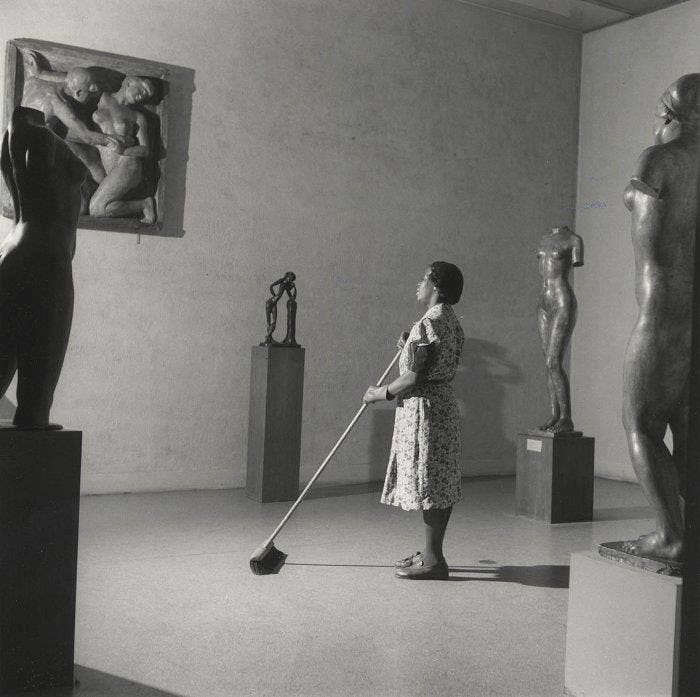
There’s little to celebrate in our exclusion from various genres, categories, ideals, and canons. Yet, if our inclusion relies upon abandoning a life-saving sense of criticality then perhaps it isn’t worth the admission price. Yes, we aren’t protected. But we aren’t infantile in thought either, or at least we shouldn’t strive to be. In her 1992 essay collection Black Looks: Race and Representation, bell hooks defined what she called ‘the oppositional gaze”, a gaze of critical intimacy where black people can “look back, and at one another, naming what we see.” Toni Morrison’s The Bluest Eye is utilised by hooks as an examination of the black woman as spectator. In Morrison’s novel, Miss Pauline Breedlove is a movie-obsessed poor maid who is at her happiest attending the “picture show”, wistfully drowning in images of “white men taking such good care of they women, and they all dressed in big clean houses with bathtubs right in the same room with the toilet.” The trouble with even the best films is that they ultimately end. Miss Pauline is left sitting in the dark. The spell has ended. “But it made coming home hard”, she laments at home, a stinging realisation at the end of another day’s hard toil. As hooks writes, such identification fosters a blissful state of regression. The black female spectator sinks into masochism. Criticality recedes into the rear view. The heart wants what it wants, though the hands remain empty. At the end of it all, hooks reminds us, we can only come home to ourselves. If, in Morrison’s literary landscape, it’s possible to identify with glittering filmic representations of white power, then it’s little wonder why the real thing—the living, breathing vision of powerful black women—can so transfix us.
The Trinidadian-born journalist and activist Claudia Jones spoke to the potential of black women’s oppositionality in her 1949 essay “An End to the Neglect of the Problems of Negro Women!”. The bourgeoisie, she argued, was fearful of the militancy of black women. “The capitalists know, far better than many progressives seem to know, that once women undertake action, the militancy of the whole Negro people, and thus of the anti-imperialist coalition, is greatly enhanced”, she wrote. Jones considered the role of black women in trade unions which largely failed to organise black domestic workers unprotected by union standards and labor legislation. Despite their substantial numbers, black women were rarely given prominent roles within trade unions. Her analysis was explicitly anti-capitalist and anti-imperialist, linking the Scotsboro case to the struggle of Ethiopians against Italian fascism.
Jones led an oppositional life. After migrating with her family to Harlem in 1922, she joined the Young Communist League at eighteen. By the age of 25, she was chairing its national council. Charged with violating the anti-communist Smith Act in 1951, Jones was imprisoned and later deported to London where she became the editor of the West Indian Gazette, founding the first Notting Hill Carnival in 1959. Hounded out of the United States, Britain’s Caribbean population offered her the kind of community she would never find in the parochial Communist Party of Great Britain (whose members had branded her “difficult”). Surveilled throughout her life, her “un-American activities” were recorded by the FBI in a 300-plus page dossier. Long after her premature death, there were efforts to erase her legacy from public memory. Yet, her life remains an example of what it means to theorise from below. She saw herself in the working class black communities which nurtured her, and they saw themselves in her.
Oppositionality offers alternatives. It draws from the deep wells of knowledge we sometimes mistake for burdens. It is, like responsibility, demanding. It’s grown. It’s not easy to sell. Unlike low-hanging platitudes favoured by liberals of all stripes, it doesn’t deny black women agency by sanctifying them. Listen to black women!, our allies cry, even as they deprive us of our differences, contradictions, and varied allegiances. Last November gave us a textbook example of such flattening, with the near-universal mainstream praise for Michelle Obama’s memoir Becoming. By March, Becoming had sold over ten million copies. Michelle Obama embarked on a national, sold-out book tour. Its success, as Keeanga-Yamahtta Taylor’s review detailed, indicates how well it echoed our thoroughly conservative times as well the long-burning potency of the Obama brand. Becoming is riddled with the discredited politics of racial uplift. It views racism as an obstacle, not a pervasive and often fatal reality. We are told that racism can be overcome through education, hard work and a reverential belief in meritocracy. Suspicion and stereotyping, Obama writes, can run both ways. As Taylor contends, Becoming anecdotally equates black people’s distrust of white America with the racial fears white Americans have used to justify everything from lynchings and mob violence to economic redlining. “I’ve been held up as the most powerful woman in the world and taken down as an “angry black woman”, Obama writes, pulling us into her clucking Mother Hen knowingness. “I’ve wanted to ask my detractors which part of that phrase matters to them the most—is it “angry” or “black” or “woman”?” Clearly, she is intimately aware of the tropes plaguing black womanhood. Angry, Black and Woman are categories she is willing to interrogatively put on the table. Power, however, is resolutely kept off it.
While it’s true that right-wing vitriol marred Obama’s entry into public life, the bigotry she has faced doesn’t discount how she chooses to wield the power she still holds. Responding to conservative media’s depictions of her as a militant and unladylike ball-breaker, Obama has worked hard to soften her image. As FLOTUS, she tackled child literacy and obesity. Marriage and motherhood were her focus, as she often reminded the public. Becoming is the natural culmination of this largely successful effort to soften the image of a woman who was once advised to diminish herself so that her husband could win the presidential nomination.
Ascribing to such bootstrap black feminisms lends credibility to the idea that all making it entails is some elbow grease and a dose of aspiration. Or, as Obama puts it: “If you don’t get out there and define yourself, you’ll be quickly and inaccurately defined by others.” In a historical period where upward mobility is no longer guaranteed (if it ever was for most), stagnant wages and mercilessly gutted public services, this is brutish indifference couched in the language of resilience. Most of us are externally defined by our material conditions, and we shouldn’t be blamed for it. What do such feminisms say about black working class women who work the hardest and have the least to show for it? It was these very black women who filled out arenas for a chance to hear Michelle Obama speak, spending their hard-earned money attending her tour dates. When Michelle Obama’s South Side journey finally came to London’s Southbank, black British women did the same. On social media, some voiced their reservations about ticket prices and the general inaccessibility of an event live-streamed on BBC News. Others decried how the event’s unaffordability and the prioritisation of the Southbank Centre’s exclusive members would ensure an audience composed of mostly middle class white women. What remained unspoken was perhaps too painful to consider. Maybe all this pomp and circumstance wasn’t really for us? Had we personally over-identified with a woman who was as much a brand and purveyor of US interests as a fellow sister of the struggle? Do the people we see ourselves in see themselves in us?
bell hooks courted this provocation in “Moving Beyond Pain”, her essay on Beyoncé’s 2016 Lemonade album. “Viewers who like to suggest Lemonade was created solely or primarily for black female audiences are missing the point,” hooks asserted. “Commodities, irrespective of their subject matter, are made, produced, and marketed to entice any and all consumers. Beyoncé’s audience is the world and that world of business and money-making has no color.” There’s a bare-boned truthfulness to this argument, as hooks attempts to parse out critique from the thicket of adulation and fandom fervour. It forces us to stop preening at refracted images, and actually stare reality in its dogged face. Years on, there’s much in that essay I don’t agree with. In her desire for resolution, hooks is heavy-handed, even dogmatic. Lemonade is rife with contradictions, but I think this messiness is what made it so emotionally resonant for its fans. I do, however, agree with hooks’s identification of “a conventional stereotypical framework, where the black woman is always a victim.” This is the primary lens through which even the most vocal supporters of black women operate, one that is embraced by Brand Beyoncé and its insistence on saluting the megastar as both a peerless idol and an eternal underdog who needs our cheerleading against the forces of the white cultural establishment. You can’t be as rich as Croesus and as beleaguered as Miss Celie. Pick a struggle. Are we in communion or standing at command? Postures of victimisation may be stunting, but there are black women who shrewdly adopt them for their own gain. There’s serious money to be made in superficially rehashing Lena Dunham’s latest racial gaffes, desirability politics, dating woes, and hair debates for an audience that will pat you on the back for bravely sharing your pain but will not actively work to undermine the structures which cause it.
As early as 2014, hooks had infamously lambasted Beyoncé, or at least elements of the Beyoncé machine, for its “terrorist” and “anti-feminist” qualities, referring to the global icon’s washed-out TIME cover as part of the mainstream’s visual assaults on feminism and young black girls. Her comments were made during a panel conversation at The New School entitled “Are You Still a Slave? Liberating the black Female Body.” If you watch the recording of the event on YouTube, you can pinpoint the exact moment when the air is sucked out of the room. Audible gasps rise and fall like punctured balloons. There is nervous laughter. Outside the gathering, a wider debate raged on in black feminist circles. Op-eds were hastily typed up. Essays were published. Prominent writers and academics conducted emergency roundtables, such as the 11-person discussion featured in Feministing. (Why you need eleven adults to litigate a pop album remains beyond me). Though hooks’ comments betrayed a suspicion of feminine presentation, harking back to the throwback boogymen of glossy magazines and video games, the reaction they inspired was equally telling. To some, it was inconceivable that a black feminist would, if hyperbolically, critique the constructed image of a black cultural juggernaut. Both women are respected and admired pioneers within their respective fields. Both enjoy varying forms of power and influence. It shouldn’t matter whether one agrees with hooks or not, the knee-jerk urge to avoid divergence of opinion was predictably stifling. To defend one figure was to be beholden to another. A zero-sum game with no winners. It was almost as if, having reduced bell hooks to tote-bag motivationals and reblogged aphorisms, commentators were now unfamiliar with the version of bell hooks standing before them. The complex and often frustrating version that had been there all along, having spent decades critiquing our “deeply anti-intellectual society.”
”People have to be made to understand that they cannot look for salvation anywhere but to themselves.” The strategist and grassroots organiser Ella Baker spoke to what happens when individuals, and our identification with them, eclipse movements. Baker looked towards the community of women who had raised her, from a grandmother who had been whipped for refusing to marry the man chosen for her by her enslaver, to a mother who provided food and shelter to vulnerable neighbours. She described her upbringing as one which stressed that “your relationship to human beings was far more important than your relationship to the amount of money that you made.” From the 1920s to her death in 1986, Baker mobilised working class black people through organisations such as the Young Negroes’ Cooperative League, the National Association for the Advancement of Colored People, the Southern Christian Leadership Conference and the Student Nonviolent Coordinating Committee. She warned young activists of succumbing to the seductive pull of individualism, remaining critical of the “charismatic” leadership model. She was clear-sighted about the dangers of such models. “There is also the danger in our culture that, because a person is called upon to give public statements and is acclaimed by the establishment, such a person gets to the point of believing he is the movement.” Baker was adamant that no one could singularly represent or reflect the hopes and desires of a mass movement. A strong people would not need strong leaders. Baker keenly understood power as an accumulated resource within an organisation. If it was too weighted towards an individual activist or celebrity, the movement would suffer. She understood why the underrepresented looked outwards for affirmation, but did not excuse this impulse.
What should be apparent at our current political juncture is how varied and antagonistic our freedom dreams can be. We tip-toe around these cracks, unwilling to pit black women against each other, unable to reckon with persisting conflicts of interest. We don’t agree upon or even desire the same paths to liberation. Some of us don’t even seek liberation at all. As more and more of us attain greater access to power, our ability to legitimise and bolster the systems which disempower other black women increases. Over-identification can be a source of pleasure, but it can also blunt our necessary criticality. You can’t spend your life trapped in a hall of mirrors.
In her essay “The Idea of Black Culture”, the scholar and critic Hortense Spillers poses her own questions. What happens when the last bastions of critique fall away? “When the imagined moral credibility of black now translates into an enablement of the most repressive practices among the world democracies today?” Resonating daily in our implicated and indivisible lives, these are questions worth contemplating.
For Spillers, the gift of black culture—a gift she worries we are in danger of losing—lies in the “reclamation of the critical edge”, a horizon which has yet to come. This is a culture of dissidence and intellectual friction, invented with our backs up against the wall. That’s what has always been at stake. Spillers is anticipating, not uncritically celebrating, an unrealized black culture. Arguably, we are still waiting for the arrival of a black critical culture which more readily identifies with the disenfranchsied than with monied starlets, charismatic leaders and pandering politicians. We may be able to walk and chew gum at the same time, but it increasingly seems like we aren't very good at it. What kind of conversations could we have if our creative energies were not bound up in defending the already powerful from the exclusions and elisions of the white mainstream? Would we continue to ask the same questions or even seek the same, neat answers? In our cultural debates and coalitions, it’s clear who and what we prioritise. Time and time again, our inclination to foreground the already powerful blunts our ability to rally for our own needs. Over-identification then becomes a substitute for action, a numbing agent that encourages complacency and adolescent fantasy.
Publicly and privately, black women are demanding more in how we envision liberation. We are refusing narratives that flatten us into cheerleaders, accessories and accomplices. We are dictating the terms of our identification with or against power. In demanding more from the politicians and representatives who weaponise our alienation, we assert our own independence, chipping away at the cult of celebrity.
Our pleasures are inflected with responsibility. Can we confront what they reveal? This may mean a recommitment to our own reflections, a groundedness in the reality we share with the people we love and live alongside with. It may require us to look again, anew, at who stands at our shoulders. To refuse to avert our gaze, even from the terror of our longings. We deserve an abundance of alternatives. There, flickering over the horizon, we might just find the power we crave, self-sustaining and shared, diffused among each and every one of us.
Comments
Nothing yet. Say the first thing.
Sign in to join the conversation.