
In 2008, at the age of 11, my dad passed away. I remember my mum crying before I remember anything else. Her body folding in on itself. The kind of crying that makes the air in the room feel thinner.
I’m ashamed to say that my dad passing away got me a lot. It gained me a lot more attention than I was ever used to as a child and soon ‘my dad died’ became a badge of honour for me. People checked in. People remembered anniversaries. People told me I was strong.
Every birthday, every anniversary, every Christmas, I would plaster a photo of him on every social media platform I had with the caption “I miss you,” and soon enough the likes would come flooding in, along with the messages saying they were thinking of me and sending me love.
And I loved it.
I loved it.
Looking back, I sometimes catch myself thinking my grief was performative, and then I feel guilty for even using that word, because it sounds cruel, like I’m accusing my younger self of faking something she didn’t understand.
Maybe performative isn’t quite right. Maybe it was just complex. Maybe it was a child doing the best she could with the only tool she had, which was visibility.
As I have grown older, I have spent some time figuring out who the special man was. The man, who for years, I put on a pedestal so high I couldn’t reach it. My dad was an artist, a hands-on dad, my best friend, I would tell my peers. I said it with such confidence that eventually I believed it myself. Though the only thing that was true out of this all was that he was an artist, an illustrator to be exact.
Through the years, I’ve come to learn more about my dad and, in the process, more about my childhood. I used to say I couldn’t remember much because time had passed, or because grief had blurred everything. It’s not just that there wasn’t much there. It’s that my brain wasn’t storing things in the way you’d hope a childhood brain would.
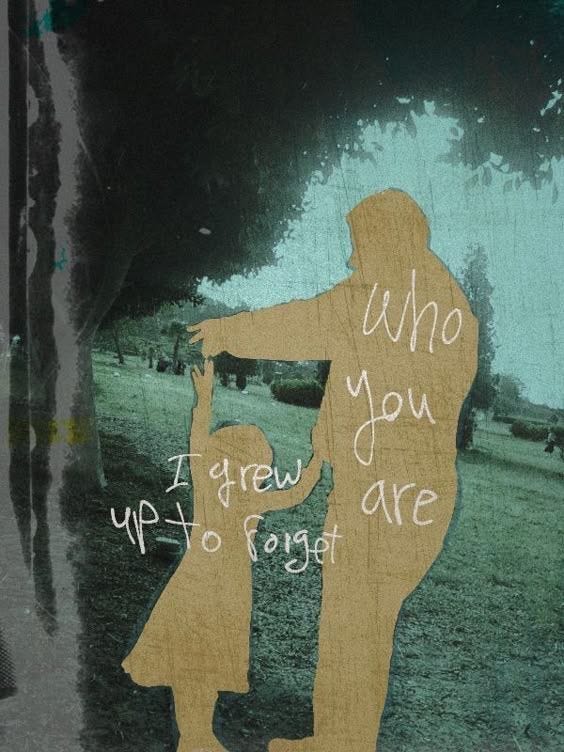
When you grow up feeling emotionally safe, memories tend to stick. They settle into stories. You remember birthday parties and car rides and stupid little details because your nervous system isn’t busy protecting you. You’re allowed to just exist, but when you grow up around unpredictability, when you’re quietly scanning the room without even realising you are, when you’re learning how to manage other people’s moods before you’ve learned how to name your own, your brain doesn’t prioritise memory. It prioritises survival.
So instead of this scrapbook of warm, specific moments, I have gaps. Huge ones. Whole years that feel more like a concept than something I actually lived through.
Which makes grief even stranger, because how are you supposed to miss something you can barely picture?
How do you long for a person who exists more as an idea than a series of memories?
It’s been nearly 18 years now. I don’t post my dad anymore and haven’t done so for the last 5 years. I wish I missed my dad, but I don’t. Not in the way people expect.I don’t wake up aching. I don’t feel a hole at Christmas. I don’t feel like something’s been ripped from me.
Mostly, I feel… neutral.
There is a part of me that feels resentment and anger though. A tight, sharp little feeling that lives somewhere under my ribs. I notice it most when people talk about their late family members with such certainty. With pride, admiration, devastation. When they speak about loss in a way that feels full and heavy and obvious, as if the pain itself is proof of how loved they were.
I wish there was a year where I was suddenly overwhelmed with grief, where it hit me out of nowhere and flattened me in the way grief is supposed to.
There’s something deeply lonely about not grieving “properly.”
It doesn’t get sympathy in the same way. It doesn’t look romantic or tragic. It just sits quietly in your body.
When I say I don’t miss my dad, it isn’t because I feel nothing. It’s because what there is to grieve is harder to name. I don’t grieve memories that ache to revisit. I grieve the absence of them.
I grieve the version of grief that might have made sense to other people and sometimes, that feels lonelier than missing someone ever could.
No posts
Comments
Nothing yet. Say the first thing.
Sign in to join the conversation.