
Welcome to the first Best of Bylines newsletter of the week, bringing you a standout story from one of our 10 UK national and regional publications.
This time, we hand over to Susan Kerrison and a fascinating shorter read about the places we get our news from, first published in Sussex Bylines. Susan has found a new source, with some interesting and valuable voices, offering a revelatory alternative to legacy news media.
In the evening, feet up on the recliner with knitting in hand, I plug into YouTube for the latest on the wars in Ukraine and the Middle East. An international cast of ex-military men, ex-CIA and MI6 analysts, bond traders, ex-ambassadors and academics provide me with what’s lacking in the mainstream media – an in-depth, multi-faceted account of international politics.
Some commentators are in their late seventies with nothing to lose by speaking truth to power and perhaps settling old scores. Others are brave academics on a mission to try and save the world from further destructive wars. They bring practical experience of war and international politics with an in-depth history surrounding previous conflicts and a sophisticated knowledge of weaponry.
Previously, I had not taken much interest in international politics; but clearly something was in the air. Just after the attack on Iran, sardines disappeared from the shelves in my local Waitrose and my neighbours all bought wind up radios! I needed to find out more and a friend recommended Alistair Crooke, a former MI6 agent, on Judge Neopolitano broadcast on YouTube.
One interview led to another and more complex questions appeared. Is this the end of NATO? Should we re-arm to fight the Russians? Will the Israelis scupper the latest peace agreement by continuing to bomb Lebanon and so on. I have learnt new vocabulary – such as security architecture and realism.
A big favourite of mine is Charles Freeman, the former US ambassador to Saudi Arabia and Mandarin translator for the now famous Nixon trip to China. He provides an in-depth overview of the situation in the Middle East. Hard facts about the military operations come from Larry Johnson, a former CIA analyst. Very early on it was clear that contracting out weapons manufacture was negatively impacting the US war effort, as stocks of weapons were being depleted far quicker than they could be replenished.
Some weapons like Tomahawk needed rare earth minerals that can currently can only be obtained from China. Would the Chinese allow the export of such minerals for use in weapons that could be aimed against them? Is the nature of warfare changing so much that aircraft carriers are now redundant when you have to keep them 100 miles offshore as a drone swarm might come after them?
A new entrant to my viewing habits has been Mario Nawfal. Based in the UAE, Nawfal runs a Blockchain consulting company. His honesty about the way his world has been turned upside down has been painful to watch as he expresses shock at the bombing of the Gulf states. Nawfal is interested in the nuts and bolts of business and conducted an hour-long interview with Matt Smith from Kpler, a company which analyses global commodity trading. Smith analysed, in detail, how oil stocks are being depleted to the point where the world economy will crash.
But it has not been all hard, cool analysis; there have been some keenly felt emotional moments. Colonel Lawrence Wilkerson, former chief of staff to Colin Powell was being interviewed by Nima Alkhorshid, an Iranian engineering professor now based in Brazil. In the winter, Alkhorshid was on a family trip to Iran. Wilkerson’s analysis was that a major bombardment of Iran by US was imminent, potentially using nuclear weapons. His concern for Alkhorshid was heartfelt.
One of my favourite hosts is Prof Glenn Diesen, Political Scientist at University of SE Norway. Diesen recently interviewed Trita Parsi of the Quincey Institute for Responsible Statecraft. Both Parsi and Diesen describe themselves as realists. They are concerned to understand the motivations and rationale of the opposing side – Russia and Iran. Those who approach international relations in this way are now pilloried as there is a drive by Western governments to frame all international conflict as a battle between good and evil. Diesen notes that public opinion has been cynically manipulated to ensure that the US or Europe occupy the moral high ground.
For example, WikiLeaks revealed that when European support for war in Afghanistan appeared to be flagging, the CIA advised that as Europe was keen on women’s rights, framing the war as liberating Afghan women and girls would invigorate that support. Another big revelation for me has been Diesen’s interview with George Beebe, former CIA Director for Russia Analysis.
Beebe’s outline of the lead up to the war in Ukraine and how the Russians view the West’s actions as provocative is a revelation. He is not optimistic that war against Russia can be avoided, unless the West begins to understand the Russian point of view. Both Russia and Iran see the West’s actions as a challenge to their very existence and so are likely to fight to the bitter end.
Many commentators are united in arguing that rather than seeing international relations in terms of the West fighting against countries who they view as evil enemies, politicians need to concentrate on developing a new security architecture. That is an overarching framework of institutions, alliances, treaties and defence polices which can be used to maintain regional stability and manage threats.
The comparison between how the debate has been conducted on mainstream media and this alternative way of looking at the world has been a revelation to me.
Unbiased. Independent. Honest. A community that champions everyday citizens and unheard voices. We don’t have oligarch owners, corporate controllers or political paymasters – we have a community of 2,500 volunteer writers and editors, and over 350,000 readers. Help power Britain’s biggest citizen journalism movement. Become a member of our Friends of Bylines Network scheme today.
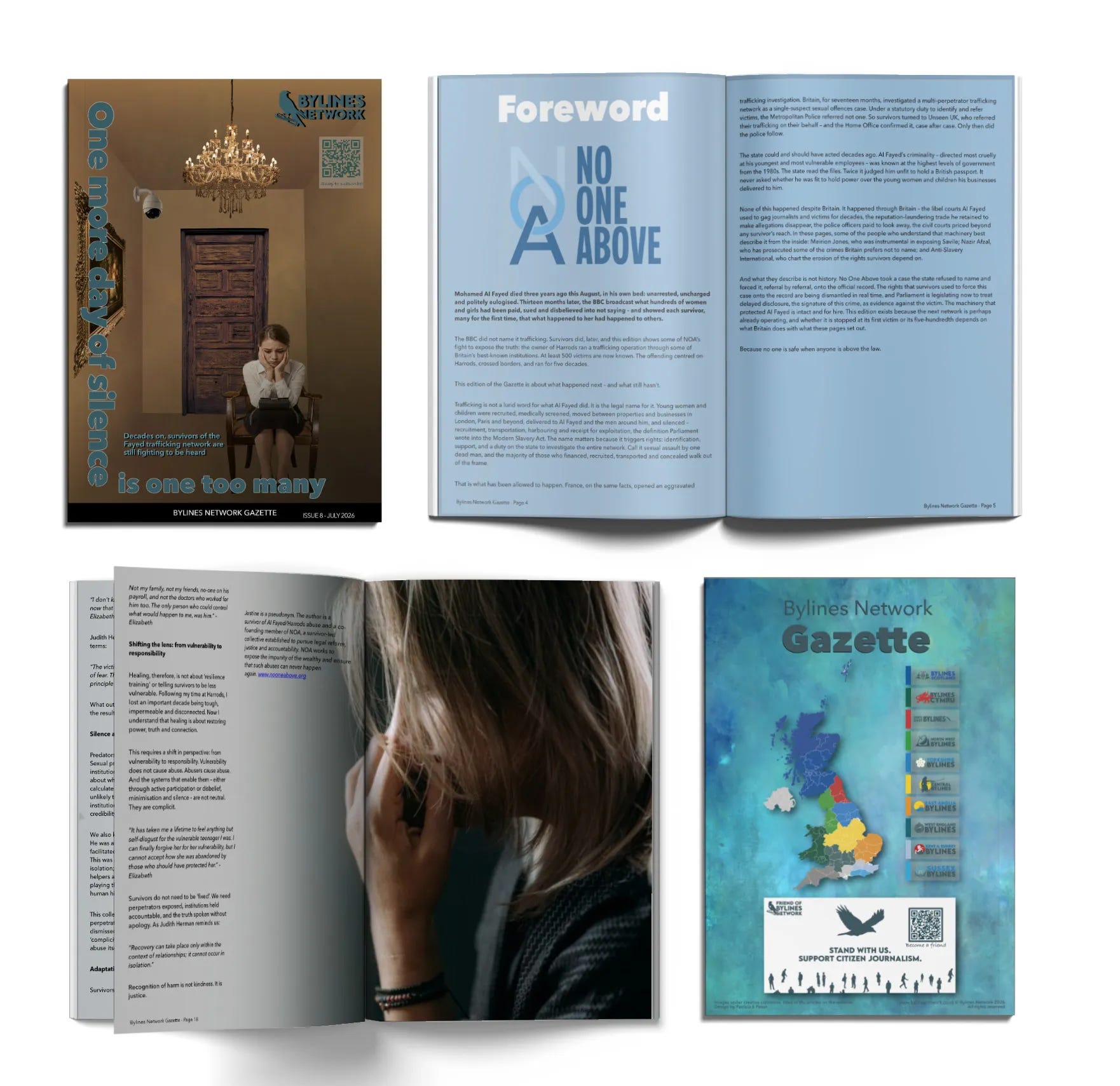
And that’s not all! Every month we release a Bylines Network Gazette, which is delivered directly and free to all our Friends. This month’s Gazette is devoted to survivors of abuse at the hands of Mohammed al Fayed and their quest for justice – which is still routinely denied. This 86 page special features articles from the No One Above organisation, survivor stories in their own words, and exclusives from Nazir Afzal and Meirion Jones. Become a Friend now to get yours.
If you prefer to take out a paid Substack subscription, you can do that too. It’s exactly the same as setting up Friends of Bylines Network registration, just managed through the Substack platform.
Comments
Nothing yet. Say the first thing.
Sign in to join the conversation.