
Welcome to the first Bylines Network newsletter of the week – one of three you’ll receive before next weekend. This is a bumper seven days of powerful citizen journalism!
As always, we will bring you two Best of Bylines newsletters. This is the first, featuring a myth-busting article by Yorkshire Bylines writer Lisa Burton revealing why anti-immigration anger is unjustified. The second will arrive on Friday, with another standout article from one of 10 UK national and regional publications.
In between those, you’ll also receive information about the latest Bylines Network Gazette, released on 23 June to mark the 10th anniversary of the Brexit referendum. Here’s a little taste of what it will feature:


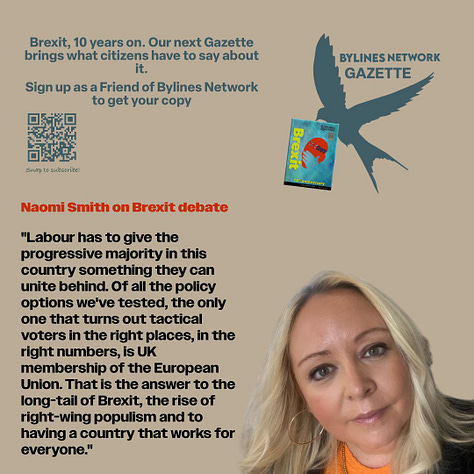
There are interviews with campaigner Gina Miller, Best for Britain chief executive Naomi Smith, National Rejoin March organiser Peter Corr, and Lord Heseltine. As well as an editorial from European Movement UK chair Mike Galsworthy, and perspectives from citizens across the country, sharing what people really feel about Brexit 10 years on.
If you’re a Friend of Bylines Network or a paid subscriber to our Substack, you’ll get an email on Tuesday with a link to download this beautifully designed Gazette or view it in a handy online flip-book. If you’re not already a Friend or a subscriber, you’ll get an email telling you how to sign up – but why wait? You can do it right now by clicking either of these two buttons:
Become a Friend of Bylines Network
Now back to Lisa’s fantastic article
Migration is down 48% from last year and 82% from 2021. Small boat arrivals and the asylum backlog are also down, while 70,000 people were returned or deported. Yet, anti-immigration rhetoric has only intensified. Labour cannot win the immigration battle
Labour delivered what the public wanted: a huge fall in net migration to 171,000 in 2025 from 331,000 in 2024 – the lowest in over a decade. Yet online reactions show that parts of the public and the political class are so radicalised that no reduction will ever suffice.
Nigel Farage can’t say these numbers are good, because he relies on anti-immigration sentiment. It’s been his trump card, since before the Brexit referendum. He says the drop in net migration is primarily driven by a ‘brain drain’ of British citizens leaving the UK in large numbers due to high taxes and being replaced with low-skilled workers.
Not so. Numbers are down because fewer people are coming from outside the EU for work, and fewer family members are arriving with them. Emigration has been steady for years, and, indeed, the Home Office issued a statement correcting such claims.
On the Home Office’s Facebook page, their post on migration reduction drew nearly 5,000 mostly negative comments, many using dehumanising language. Dianne Abbott and David Lammy – two leading Black Labour politicians – are frequent targets. The comments and reactions were similar across all media outlets that reported the story.
In 2023, the Conservatives, through their intentional mishandling of the asylum system and the Illegal Migration Act ‘pause’, created a backlog, which at its peak was around 175,000 people awaiting an initial asylum decision.
The latest official figures show that there are now 48,758 people awaiting an initial decision – a 72% reduction from its peak.
The number of people claiming asylum also fell by 12% in the year ending 31 March.
Between 1 January and 20 May 2026, 7,576 people crossed the English Channel by small boat from France, a reduction of 41% on the same period last year; down from over 47,000 to 39,000 since 2022 under Conservative control.
The number of asylum seekers in hotels peaked at 56,000 under the Conservatives in September 2023, with around 400 hotels in use. This number has since dropped by 63%, a 35% year-on-year fall to just 20,885 people.
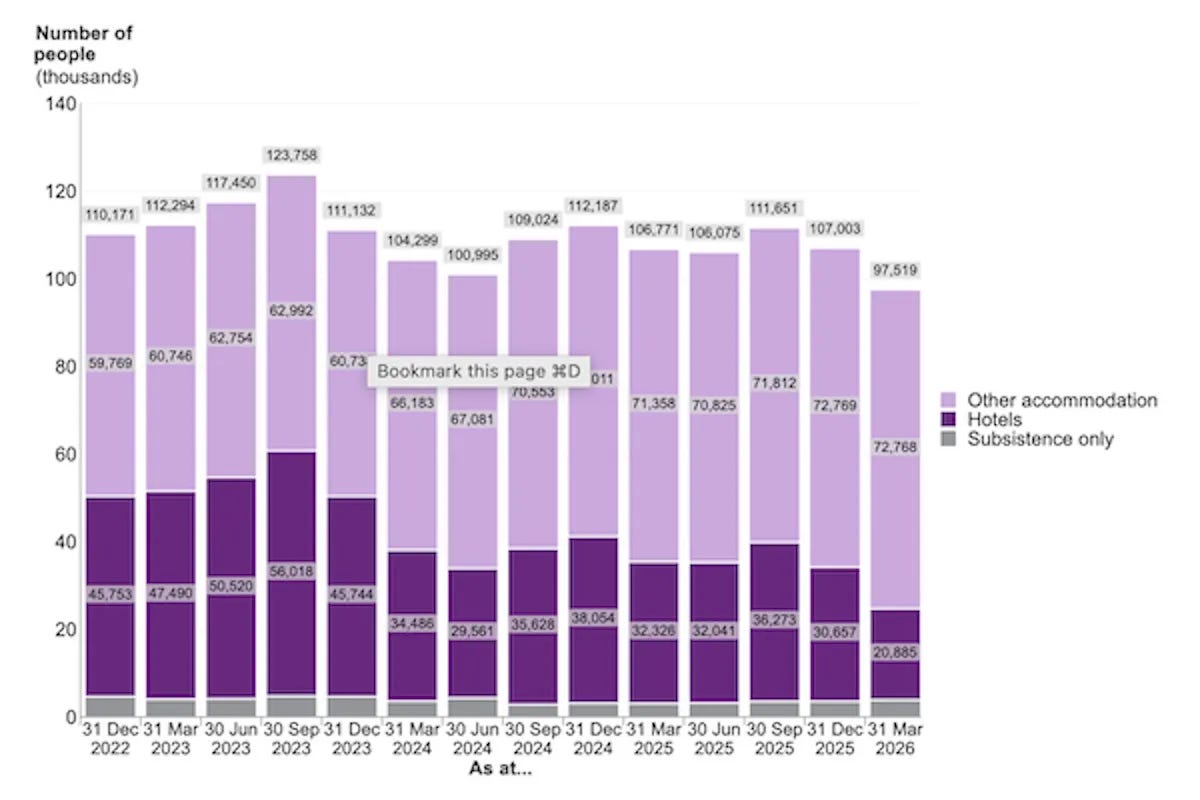
Explanations for this from anti-immigrant voices are that people have just been moved into ‘nice houses’, or that Labour is fiddling the figures, yet Labour has also deported the highest number of people since 2017, with almost 70,000 deportations since coming to office. This includes nearly 10,000 foreign national offenders, a 36% increase over the previous 21 months under the Conservatives.
Far-right parties blame migrants for public struggles, promoting the idea that stopping ‘illegals’ will solve issues. Asylum-related spending was estimated to be £4.9bn last year. When you compare this with the total UK government expenditure of approximately £1.29tn, it amounts to less than 0.4% (ie 40p in every £100) of public spending.
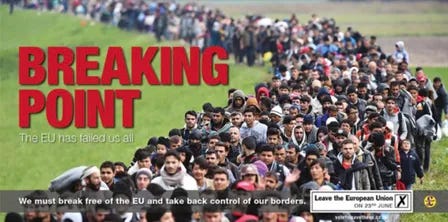
A decade ago, the language used today around migrants, ethnic minorities and ‘non-British’ people would have been seen as shocking, racist and dangerous. Many see Brexit as the catalyst that normalised the language of xenophobia, which then crept into mainstream language and discourse – remember the UKIP ‘breaking point’ poster? Brexit was a huge win for the global far-right and a petri dish to see just how far the British public could be pushed into voting for national harm via the politics of fear and overtly xenophobic and dehumanising imagery and language. It can be seen as the start of the normalisation of lying, and the post-truth society we now live in.
Anti-immigration rhetoric won the Brexit vote, but instead of bringing appeasement, things have only got worse. Brexit was a huge win for right-libertarians, and the far right both domestically and worldwide, and it ushered in a different type of politics. The politics of ‘them and us’, the politics of ‘fear the dark stranger’.
Despite immigration falling, the far-right parties are not about to give up on their ‘us and them’ rhetoric. We are doubtless going to witness a battle over who can be the more extreme, each of them pushing harder to appease the monstrous movements they have helped to create and to ensure the hate and anger don’t dry up.
Elon Musk continues to amplify these movements online through his platform and algorithms. What was once confined to fringe spaces is now being pushed steadily closer to mainstream political discourse.
What was once confined to fringe forums is now increasingly said openly and without shame on mainstream political platforms and across social media.
There is a frequent claim that Britain is a Christian country. However, it remains a multi-faith and increasingly secular society. This language is sometimes used as coded discriminatory rhetoric, especially concerning Muslims, who make up around 6% of the population. The far-right adopts Christian imagery, but not Christian values. Christian nationalism is another form of religious extremism built around exclusion, identity and fear. It is no different to Islamist extremism: it is the other side of the same coin.
Calls are made for remigration: a euphemism for the mass removal of immigrants and ethnic minorities, including people with citizenship and, in some cases, those born in the UK. Directly imported from the European far-right, particularly identitarian and ethnonationalist movements, demands are couched in sanitised language made to sound administrative rather than what it means in practice.
And yet, is remigration even possible? Restore Britain’s website states, ‘If a legally resident foreign national is unable to speak English, lives in social housing, claims benefits, refuses to work, fails to integrate, commits a crime, or actively hates our way of life and wishes to do us harm, they will be deported, and all state benefits will be withdrawn from foreign nationals”.
But slogans collapse under scrutiny. On average, 40% of families receiving Universal Credit are working. And what happens to mixed-nationality families? To someone who worked and paid taxes for decades before falling on hard times? To pensioners who paid into the system all their lives? Will they, too, be deported? Is that the sort of nation they wish us to be proud of?
Because, once you move beyond the soundbites, the reality becomes obvious. The only way to carry out “mass deportations” on the scale now discussed by sections of the British far-right would be through an enormous expansion of state force and power: people taken from homes, families separated, communities targeted, citizenship rights weakened, and entire groups of people permanently treated as suspicious or as conditional members of society. Human rights and other legal protections that would need to be removed would not apply only to the ‘out groups’: everyone would lose them.
Immigration could fall further and net migration could hit zero, but the rhetoric would not end, because this is no longer just about numbers. Once a movement convinces people that their problems are caused by outsiders, minorities, migrants, Muslims, refugees, or ‘non-British people’, it constantly needs new enemies and new escalations to sustain itself. If the boats stop, they move on to legal migrants, then citizenship, then onto ethnicity, culture, religion, language, integration’, or ancestry.
You can already see this happening now. The conversation has shifted from ‘illegal immigration’ to whether certain people can ever truly be British at all.
This is why appeasement fails. Every concession simply legitimises the framework further. Every attempt to outbid the far right on immigration drags the political centre closer to ethnonationalism, while the far right simply moves on to a more extreme position.
If this type of politics continues unchecked, it will lead to a non-inclusive society where citizenship becomes conditional, where all minorities exist on permanent probation, and where being ‘British’ is increasingly defined not by law or shared civic values, but by ethnicity and race.
That is not patriotism. It is white nationalism dressed up in the language of border control, and if you truly believe in British values, you must reject it and call it out for what it is.
As Winston Churchill said of appeasers, in January 1940, “Each one hopes that if he feeds the crocodile enough, the crocodile will eat him last.”
Comments
Nothing yet. Say the first thing.
Sign in to join the conversation.