
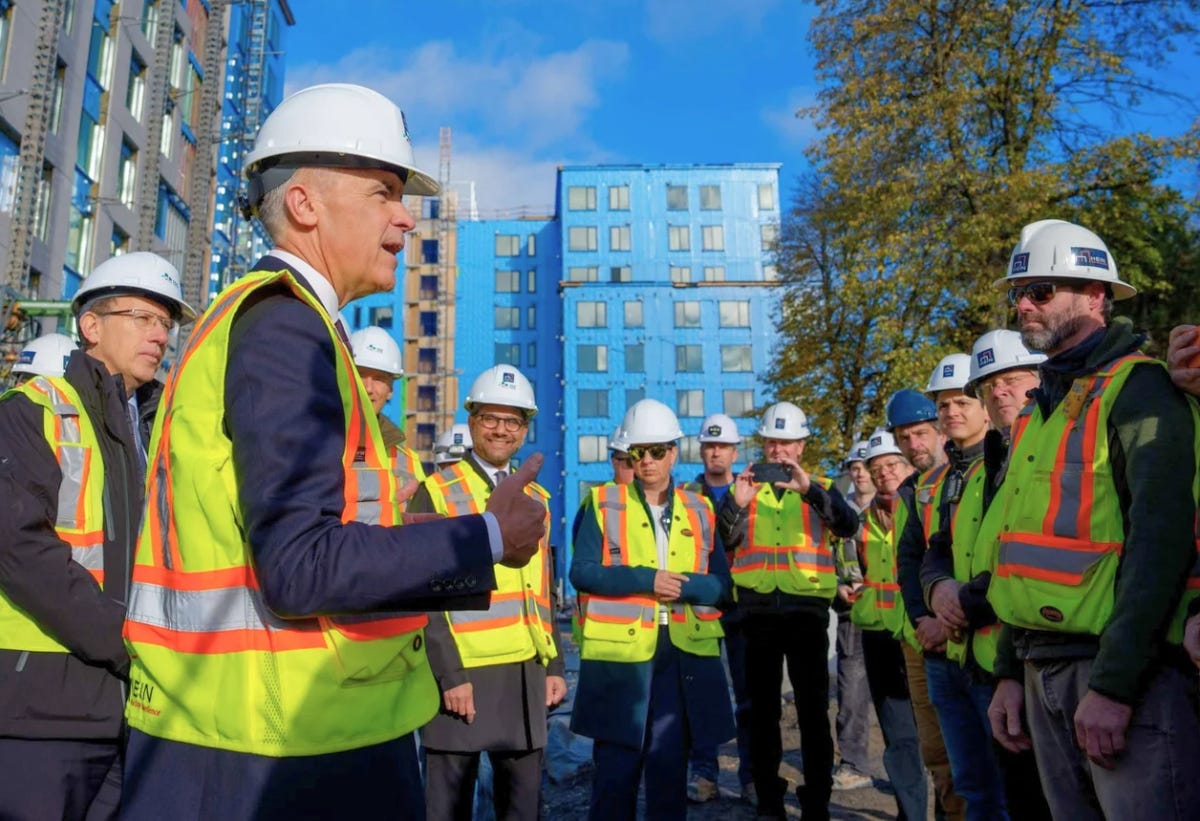
To address Canada’s housing crisis, the Carney government made the promise to build 500,000 new homes per year and it launched a new federal initiative to boost the country’s housing construction. However, Ottawa’s agency in charge of housing reports that housing starts are now decreasing and are projected to decrease for years. Though there has been multiple housing announcements with the prime minister through the past year, the reality is there still remains to be a single house constructed by the new federal agency. With the government’s grossly inadequate response to the challenge, Canadians are experiencing a housing crisis that is worsening.
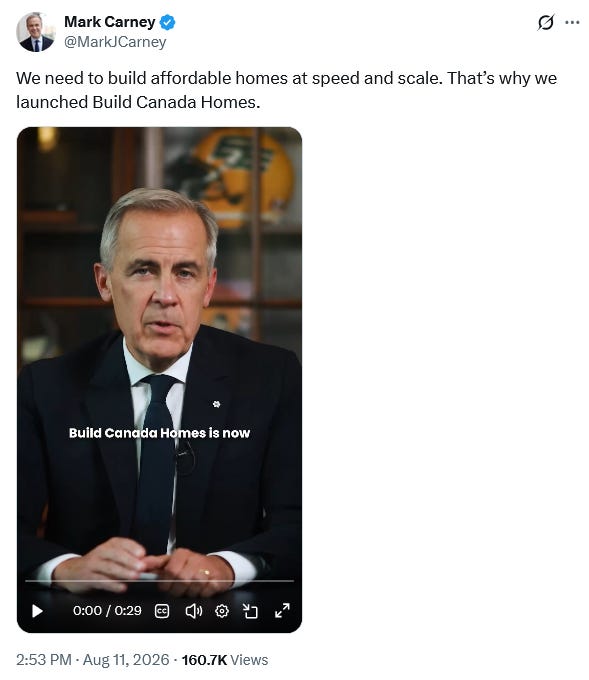
The 2025 Liberal Party election campaign promise was that they would deliver “Canada’s most ambitious housing plan since the Second World War.” The Liberals key talking point that Canadians often hear repeated is “We’re building more homes, faster.” Just this week, PM Mark Carney’s staff posted on X (while he was vacationing in Tuscany) that the federal government is “building affordable homes at scale and speed we haven’t seen in generations.” Yet, the data says otherwise and it exposes these Liberal bromides as hollow political rhetoric.
Canada Mortgage and Housing Corporation (CMHC) has defined Canada’s housing crisis as a significant lack of housing construction, resulting in a shortage of housing and an increasingly unaffordable housing market. CMHC factored that Canada requires 4.8 million homes in the next decade, which is 430,000 to 480,000 starts annually through 2035, in order to restore affordability to the housing market.
The current data reveals home construction is at half the pace required. In fact, it’s worse than that: housing starts are projected to decline from 259,028 in 2025 to 211,900 in 2028. Recently published CMHC data revealed housing starts are dropping and the 2026 projections are now adjusted downward to 238,971.
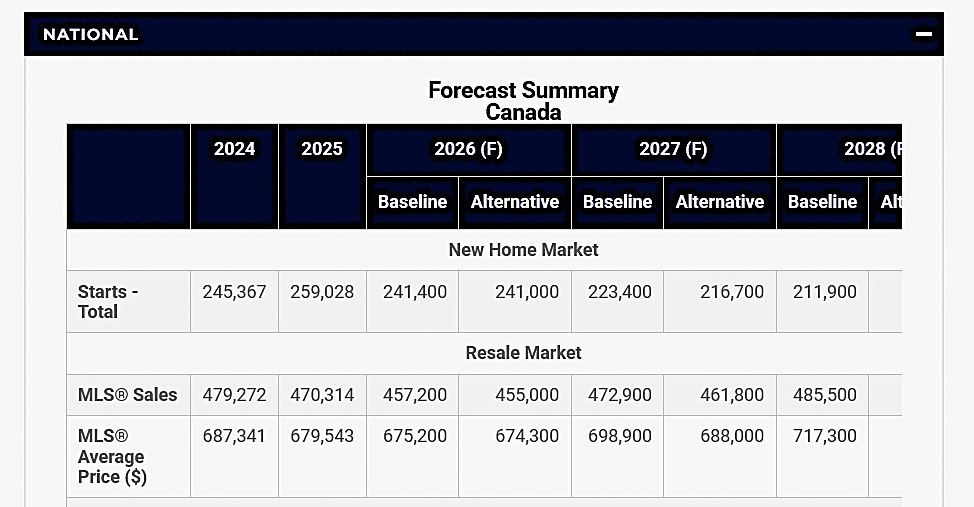
Kevin Hughes, deputy CMHC economist, stated the obvious in a July media statement, “Looking forward, we expect this environment will continue to hold back new housing construction in Canada over the short to medium term and drive 2026 actual housing starts below last year’s levels.” In a CMHC summer update of the housing market, the agency assessed, “Housing activity will remain weak... We expect sales to improve gradually over the forecast period but to remain below levels typically seen in the last decade. We expect continued downward pressure on home prices and construction.”
As disturbing as this weak housing construction data is, there is a more troubling trend that was parsed from the CMHC data by BMO Capital Markets. In a note to their clients, BMO senior economist Robert Kavcic explained, “The most noteworthy story in Canadian homebuilding is the ongoing, and widening, split between construction of homes for ownership, and those for rental.” Canadian builders have shifted from building homes to sell to building homes to rent with the data showing 58.2 per cent of the new construction in the first quarter of 2026 are for the rental market. Kavcic observed Canada is becoming a “nation of rentals” and he stated, “combined housing starts of condominiums and for homeownership have now fallen to the lowest level since the 2009 recession, and the mid-1990s recession before that; while rental starts continue to run near record highs.”
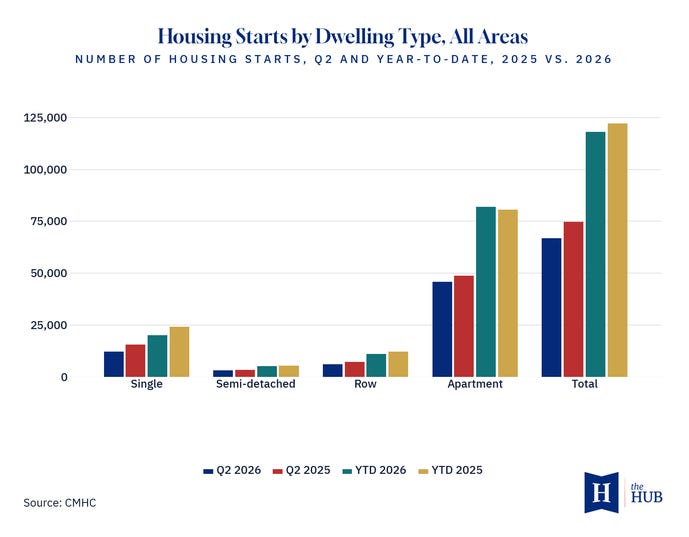
In a data analysis published in Canadian independent news source The Hub, Graeme Gordon quotes mortgage broker and host of the Angry Mortgage podcast Ron Butler, summarizing the data,
“When you see the prime minister in a hard hat and orange vest, walking around some construction, they don’t tell you it’s just rentals. They never tell you that. For all the young people in Canada, you need to know that they’re actually building you into a renter.”
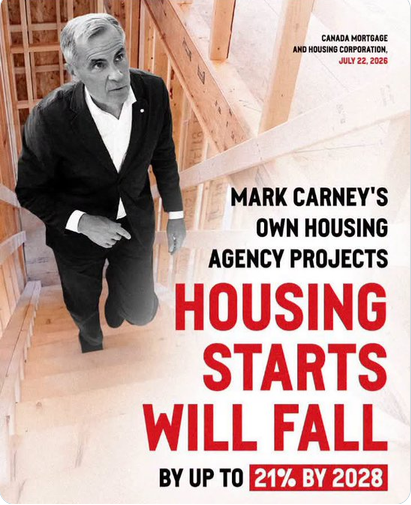
The Carney government’s solution to the country’s housing crisis was to launch a new agency, Build Canada Homes, which PM Carney explained is “charged with supercharging housing construction across Canada.” At a recent housing announcement, the PM described the agency as a “key milestone in the government’s plan to increase housing supply and make housing more affordable for Canadians.” Build Canada Homes was launched in September 2025 with an initial government commitment of $13 billion over five years. It has allocated $7.3 billion of that budget to date in direct construction and in financial support for construction and acquisitions. In almost one full year of operation, it has announced agreements for a total of 17,000 homes, and the PM reported in early August that 1,900 homes are under construction.
Build Canada Homes was to spur construction of 500,000 housing units per year and, this year, it will add 1,900 homes.
Build Canada Homes was to spur construction of 500,000 housing units per year and, this year, it will add 1,900 homes. This pathetic performance is even more inept than the Parliamentary Budget Officer’s (PBO) initial projection that the Carney government’s efforts would only add 2.1 per cent increase in housing completions in five years. Maybe the PBO was being hopefully optimistic in stating Build Canada Homes will spend $7.3 billion to add just 26,000 units to the national supply over five years.
The new federal housing agency was in the news this week with PM Carney making the announcement of its new Chairman of the Board (the board members still must be selected). Eleven months after the launch of Build Canada Homes, Carney finally got around to selecting Evan Siddall, formerly CEO of CMHC, and before that working at BMO Capital Markets, Goldman Sachs, and Irving Oil. This is a very interesting selection for the PM (aside from the Goldman Sachs connection). The government-subsidized legacy media repeated the PM’s printed announcement about the extensive housing experience that the former CMHC head will bring to the table.
Of note, however, there was no legacy media mention that Siddall was responsible for the CMHC initiative to study the implementation of a home equity tax on home owners. In 2019, while he was CEO, Siddall remarked on a podcast that Canadians have “glorified this idea of homeownership” and he commissioned $250,000 to research a new home equity tax. That research concluded that there was great inequity among Canadians due to “windfalls gained by many homeowners while they sleep and watch TV” and it proposed a $5.8 billion annual tax on homes.
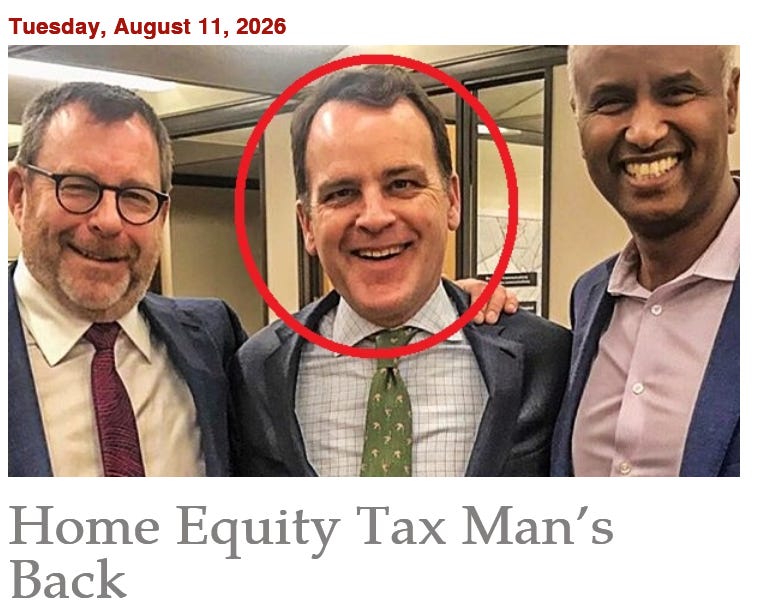
Canadians have independent news source Blacklock’s Reporter to thank for exposing Siddall’s scheme in 2019 and for reminding Canadians of his biases against homeownership in its coverage of the PM’s announcement this week.
It is ironic to think that the man who believes that Canadians overrate owning their own home is now in charge of building homes for them.
In every instance, the Carney government’s initiatives to address the country’s housing crisis have proven to be sorrily lacking.
Aside from the farcical number of housing starts to be managed by Build Canada Homes in the next five years, there are the highly questionable announcements PM Carney recently made relating to condos in Vancouver and rental units in Toronto. In Vancouver, the federal government will spend $1.5 billion to buy 2,200 unsold condos. In Toronto, the federal government is spending $2.7 billion to build 5,600 rental homes.
The Vancouver housing initiative is openly being referred to as “Mark Carney’s B.C. condo bailout” because it involves Liberal-friendly condominium developers who fundraise for the Liberals, one of them actually hosting a $1,750 ticket “Evening with Mark Carney.” There was also the coincidence that 15 days before the condo announcement, Brookfield became co-owner of a Concert Properties development deal, which will benefit from the federal money. Given the apparent conflicts of interest, the government’s condo deal was subject of a parliamentary committee inquiry until it was abruptly closed down by the majority of Liberal MPs on the committee. Little of this is mentioned in legacy media but, again, Canadians can thank independent journalists covering the story to provide facts that would otherwise remain undisclosed. For example, The Bureau News is reporting on Conservative and Bloc Quebec MPs’ request of the federal Lobbying Commissioner to investigate the condo deal: “Did Mark Carney and the Liberal government break the law?”
With the Toronto initiative, it is a question of scale and timing. Carney boasted of a $2.7 billion plan to construct 18 low-income housing projects in the city. The total rental units expected are 5,600 of which 2,000 will be rent-controlled. With Mayor Olivia Chow by his side, the PM told Torontonians that 4,500 homes are planned to be started by the end of the year, and all will be completed by 2031. Carney stated, “For decades, the simple fact is Toronto didn’t build enough housing, and too much of what was built was unaffordable for most Torontonians… the best way to meet the challenge that has been created is to build more supply and to build it faster…” One must wonder what impact 5,600 rental units in the next five years will have in a city of nearly 3.3 million.
One must wonder what impact 5,600 rental units in the next five years will have in a city of nearly 3.3 million.
In response to the PM’s Toronto media event, the Conservative MP responsible for housing, Scott Aitchison stated in a media release,
“The Prime Minister’s latest press conference is just another repackaging of projects already announced or already under construction, and will do nothing to build the millions of homes needed to restore the promise of homeownership for future generations.”
For most of this country’s history, the deal was simple: work hard, save, and you could afford a home. Now, after 11 years of Liberal government, that deal is broken as home prices in Canada have grown 28 per cent faster than incomes since 2015, the worst in the G7, according to the OECD.
“The worst housing affordability in the G7 didn’t happen overnight, and it didn’t happen because Canadians stopped working. It happened because the Liberals spent billions on promises, announcements and photo-ops while delivering fewer homes for Canadians to buy.”
The business advocacy group Coalition of Concerned Manufacturers and Businesses Canada levied its criticism on the Build Canada Homes agency as just another ineffective bureaucracy,
“Because apparently what a carpenter really needs is another deputy minister standing beside the lumber pile. More agencies. More announcements. More billions committed. Fewer homes being started. That isn’t a housing strategy. It’s government measuring its success by how much government it created.”
Last word on the promise of 500,000 housing starts per year goes to MP Aitchison, who observed this week, “This is Prime Minister Carney’s housing crisis: where builders can’t build, buyers can’t buy, and sellers can’t sell. After a year and a half of more Liberal illusions, half-measures and bailouts to those who created the housing crisis, it’s clear continuing the same approach won’t deliver relief for Canadians.”
This article was first published this morning in The Niagara Independent. The By George Journal version above includes additional text and links to source media and resources.
Please share this By George Journal article. Canadians need to be more aware of what is happening in our country.
Comments
Nothing yet. Say the first thing.
Sign in to join the conversation.