
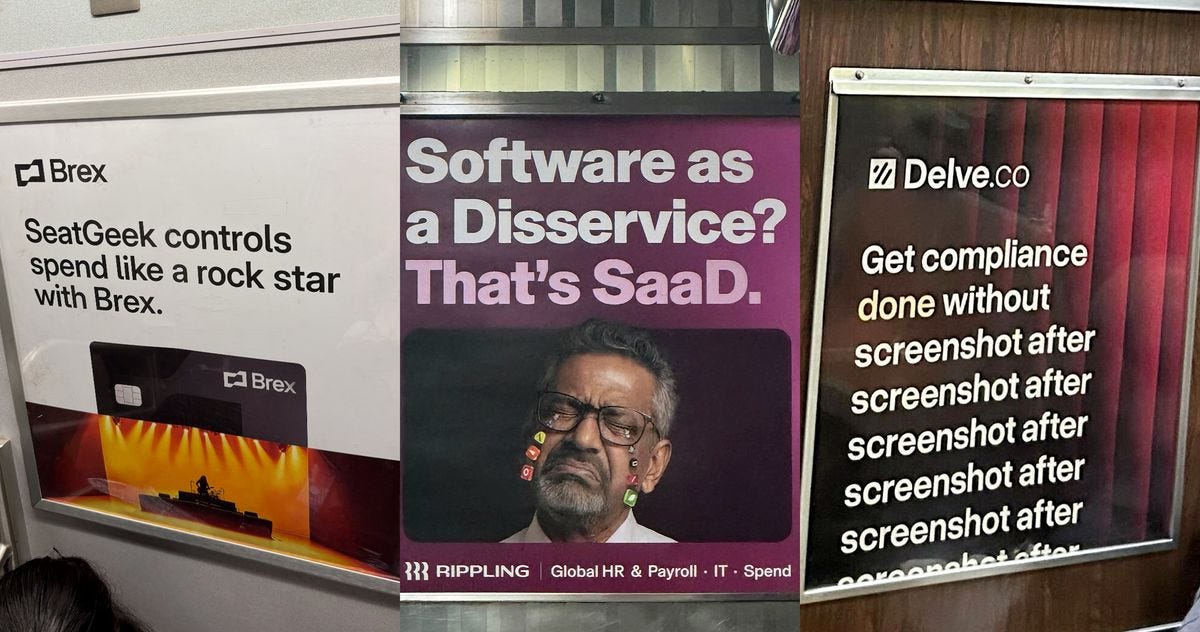
A few weeks ago I was standing on the 2 train at rush hour, close enough to the ad card to read the fine print, and spent four stops trying to work out what the company did. Something about agents. Something about your back office. By the fifth stop I had given up and started reading the card next to it, which was a different company selling something similar in the same colors. So I counted the rest of the car. Eleven ads, eight of them AI.
Tech advertising on New York’s subways and buses rose 50% in the first quarter of 2026, and tech now accounts for roughly 15% of transit advertising in the city, alongside pharma and Broadway. Friend.com spent over a million dollars on 11,000 subway cards, 1,000 platform posters and about 100 urban panels. Riders defaced them thoroughly enough that the brazen graffiti became its own news story, and two comedians started pasting fake AI ads on the walls, which worked mainly because the parodies were hard to distinguish from the originals.
The usual explanation is saturation, and there is something to it. In 1968 Robert Zajonc demonstrated the mere-exposure effect: show people a face, a symbol or a nonsense word often enough and they come to prefer it, for no reason beyond repetition. It is why brands buy the same billboard for a year. The subway shows where that curve bends back, somewhere past the point at which exposure starts producing fatigue.
But volume isn’t the whole of it, because the more interesting feature of these ads is that almost none of them are for sale to the person reading them. They sell back-office automation to mid-market CFOs and agent infrastructure to engineering teams. Most riderers cannot buy the product, would not know what to do with it, and in most cases cannot finish reading the copy before the doors open. Compare that to the rest of the car, where the mattress company, the dermatology clinic and the personal injury lawyer are all addressing someone who might plausibly become a customer that week.
So the ads are doing something else. They signal to recruits and to investors, which is why they run in New York, where the capital sits and the talent commutes. Friend.com paying a million dollars to be vandalized is reasonable on those terms, since the vandalism travels further than the campaign would have on its own. The subway is a place to be seen spending money in front of the two audiences that decide whether a company gets to keep operating.
That is also, I think, the actual source of the contempt for regular people and, especially, for young people. A conventional ad flatters you by treating you as a buyer. These ones address a room they are not talking to, which leaves the rider in the position of an overheard conversation rather than a pitch. Worse, the pitch itself is often about eliminating work of the kind being done by people on that train. A card promising to put your back office on autopilot is describing, to a car full of commuters, a product whose value is that it removes the reason for some of them to make the trip. The rider cannot buy it, cannot opt out of seeing it, and cannot respond to it, which leaves the anger as the only available reply.
The historical pattern is the last piece. In February 2000 the dot-coms bought the Super Bowl, and the Nasdaq peaked six weeks later. In February 2022, FTX, Coinbase, Crypto.com and eToro spent something like fifty million dollars between them on Super Bowl slots; Terra collapsed three months after, then Celsius, then Voyager, then FTX before the year was out. When a sector starts buying awareness from people who are not its customers, the marginal dollar has run out of more productive work. Read that way, the share of transit ads selling something the rider cannot buy is a live gauge of how loose the funding environment is, and loose environments precede tight ones.
Two quick predictions because what is life without some stakes:
First, defacement becomes a line in the media plan. Friend.com’s campaign returned more attention vandalized than intact, and that lesson is cheap to copy. Another example is Artisan, spending two million dollars putting "Stop Hiring Humans" on billboards in San Francisco and New York beside the face of Ava, its (very evil looking) AI sales rep, and the role Ava fills is precisely the one a twenty two year old would have been hired into. Within a year, expect a campaign designed to be marked up, with copy engineered to provoke exactly the response that generates the coverage, and expect the backlash to appear as engagement.
Second, the money comes back as headcount rather than revenue. The rational understanding on a million dollars of subway advertising for a B2B product is that it is a recruiting expense filed under marketing. Most of these companies will exit through acquisition, the price will track engineering team quality rather than ARR, and the ad spend will turn out to have been the cheapest part of the hiring pipeline.
Thank you all for reading and see ya later, folks.
—J&E
Comments
Nothing yet. Say the first thing.
Sign in to join the conversation.