
All of this was pulled from the Byblos live feed - 1,400+ VC firms, 60,000+ newsletters, one place.
See what else came in today at byblos.digital →
Go premium. $10.99/month or $109/year, with a 7-day free trial. You get the full intelligence layer:
Exclusive research from our database of 1,400 investors and 60,000 newsletters
Weekly briefs on where capital is actually moving
Direct 1:1 access to us
Nine VC firms wrote about the same narrow topic this week. How AI agents pay for things.
645 Ventures published two pieces on it. Activant Capital published the third part of a series. Animoca Brands launched a new research letter dedicated to it. The Algorand Foundation posted about it four times in six days. Archetype, Chainlink, Gradient Ventures, Village Global and Jump Capital all wrote about it too.
Our claim, before the evidence: the fight everyone is watching is which payment standard wins, and a startup cannot win that fight. The money is in two layers nobody is defending.
Quick thing before you dive in.
We launch our app on Product Hunt on the 30th of July.
It would mean a lot if you showed up and interacted with it on the day — a comment or an upvote goes a long way for a small team.
What you can do:
→ Follow every VC in your sector in one subscription
→ Filter your feed by fund, sector, theme, and sentiment
→ Open a VC card for any fund to see their investments, focus, and links
→ Build a watchlist around your raise and track what your target investors are writing
Want to make the batch early? How to get started:
🟣 Sign up over here and get a free 7-day trial of all features
🟣 Get added to our Telegram group
🟣 Attend a 1:1 setup call with us
🟣 Receive free exclusive briefs from the 1,400+ VC database and use the app freely
There is no agreed way for an agent to pay for something.
An agent is software that completes a task without asking permission at each step. To finish most tasks it has to buy something. A dataset, an API call, a flight, a bag of coffee.
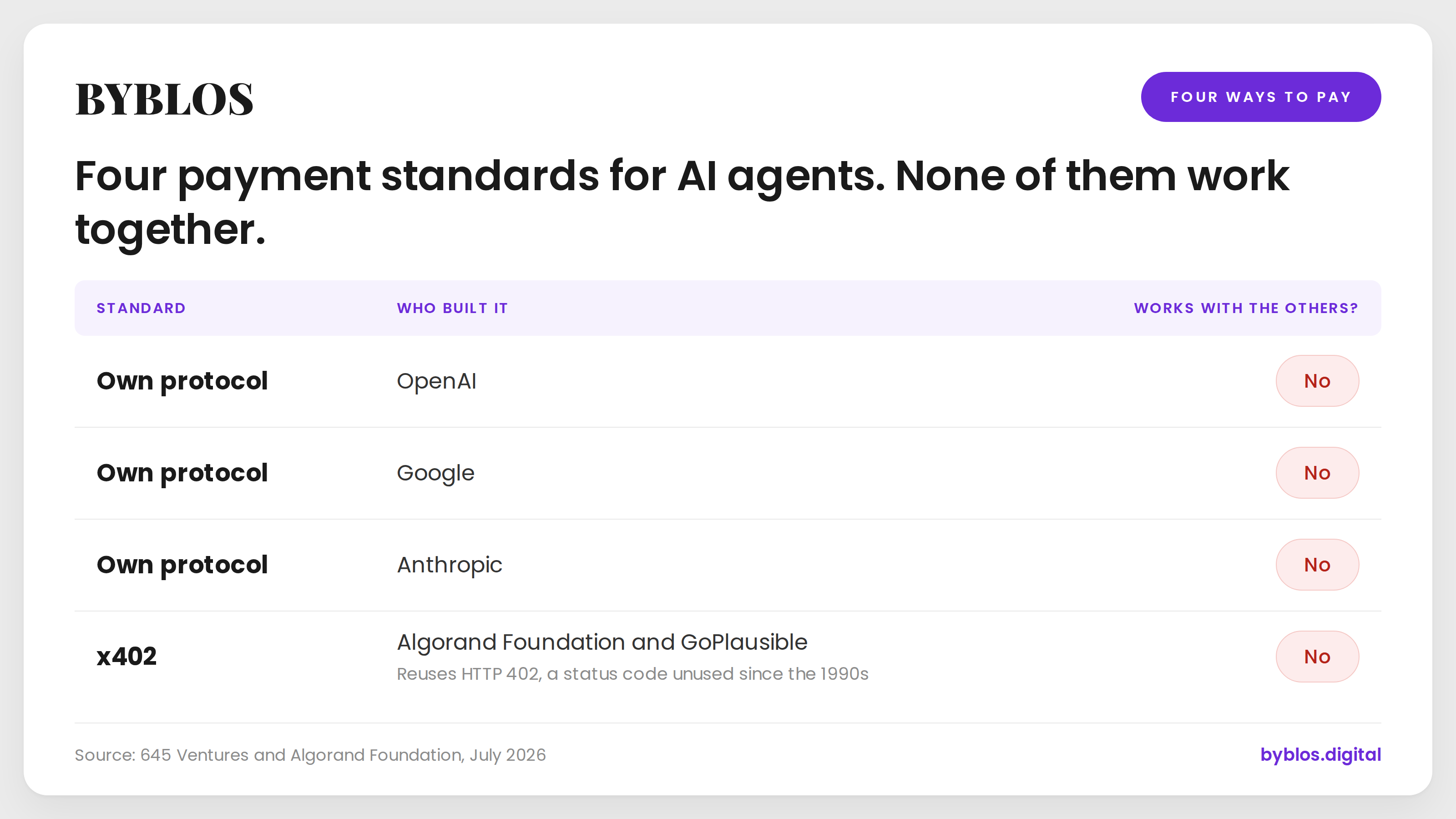
There is no standard way for it to do that. OpenAI, Google and Anthropic have each shipped their own payment protocol, and 645 Ventures reported this week that all three compete directly. A fourth standard called x402 is also live. It works by reusing HTTP 402, a status code meaning "Payment Required" that has existed since the 1990s and was never used for anything.
So a developer building an agent today picks one of four and hopes it wins.
Card networks do not fix this. Algorand made the point plainly. Cards were built for a person standing at a register. They were stretched to cover a browser tab, and that took decades of fraud tooling and extra checkout steps. An agent is not a person at a register. It can decide in milliseconds to call a hundred paid services on behalf of one user.
The evidence, part one.
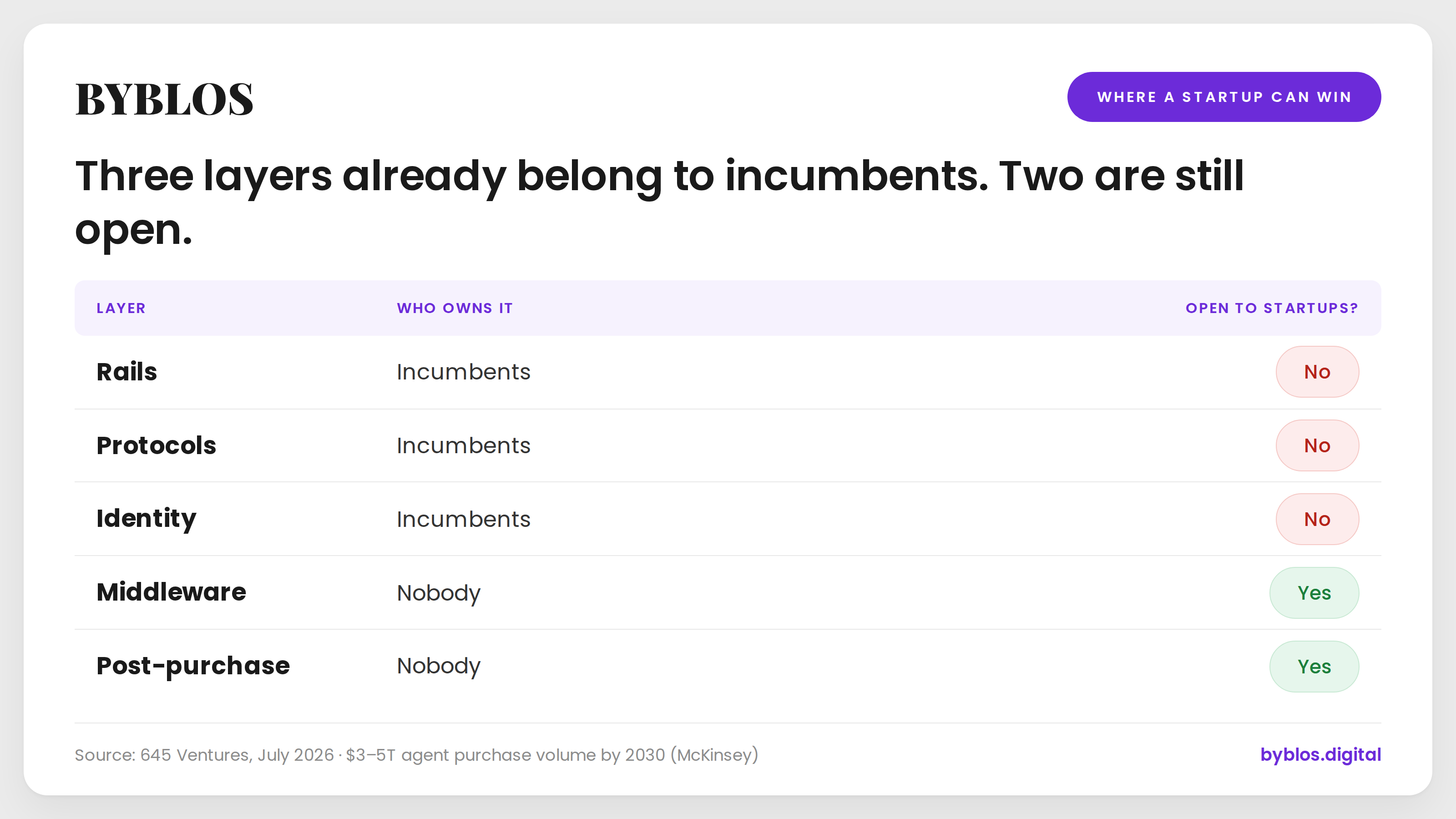
The market is large and the best parts already have owners.
645 Ventures cites McKinsey projecting $3 to $5 trillion in agentic commerce volume by 2030. They also say the category moved from concept into early production over the past eighteen months. So there is real usage today, just small.
Then they say the part that matters for founders. The rails, the protocols and the identity layers belong to incumbents. Those are their words. Two layers are open to a startup: middleware and post-purchase.
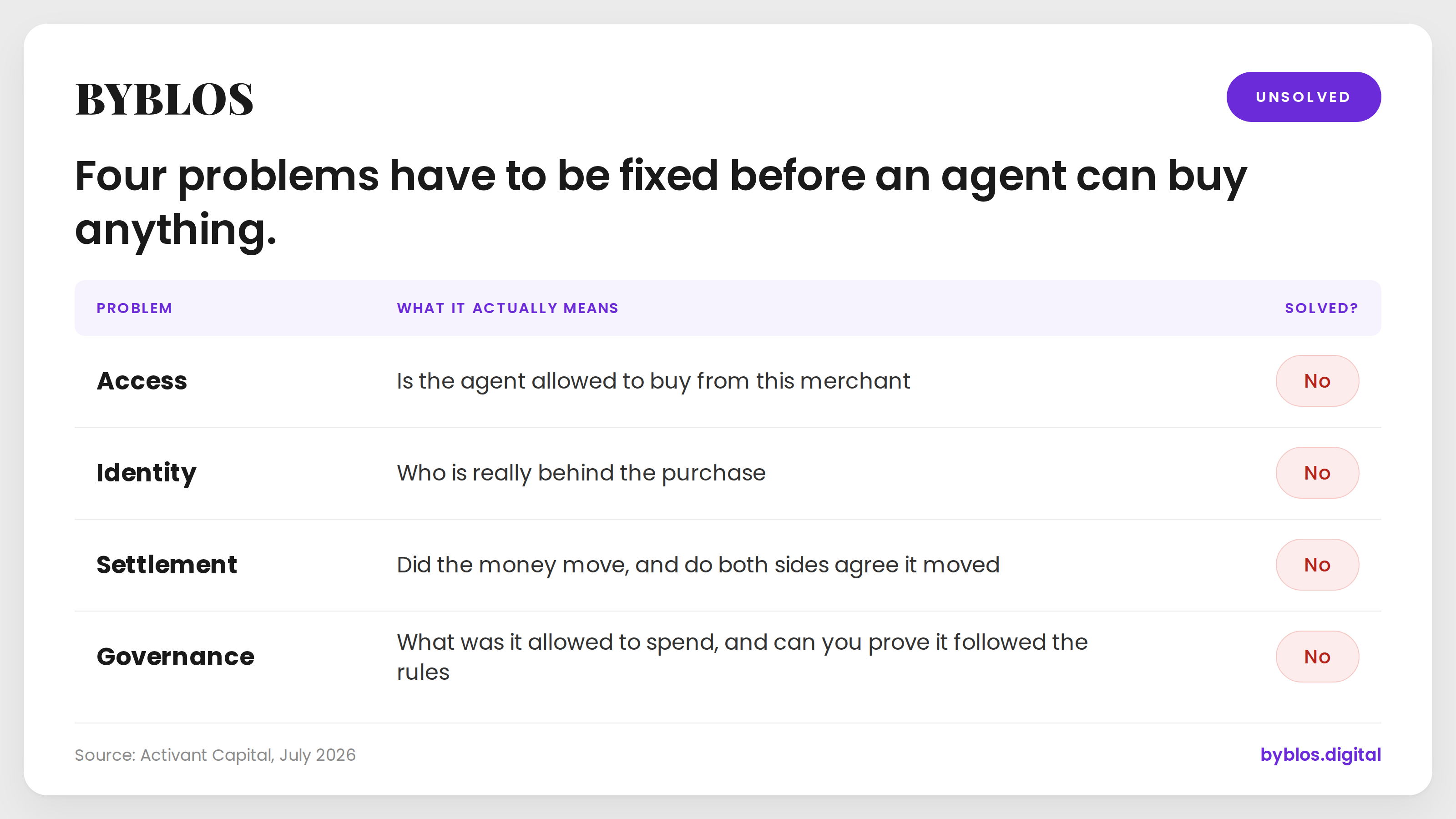
Activant Capital listed the four problems that have to be solved before any of this works. Access, identity, settlement, governance.
In plain terms. Access means the agent is allowed to buy from this merchant. Identity means the merchant knows who is really behind the purchase. Settlement means the money actually moved and both sides agree it moved. Governance means somebody set rules for what the agent can spend, and can prove those rules were followed.
Activant says near-term capital is going into those four problems.
The evidence, part two.
Algorand is paying developers to use a standard.
A payment standard is worth nothing until people use it. Algorand is treating that as the real problem.
The Algorand Foundation put $100,000 and 500,000 ALGO into a public challenge for x402. It is running now. The task is specific: launch a paid API endpoint on Algorand mainnet, get real usage through the GoPlausible x402 facilitator, and climb a public leaderboard. Ten finalists present at Devcon 8 in India.
The entry rule is the part worth noting. A project does not count as entered until at least one real payment has settled on mainnet. Not a demo. A settled payment.
Animoca Brands and The Sandbox are running a smaller version of the same thing, a four-week agentic AI competition in Hong Kong with $10,000 in prizes, starting 28 July.
When the people building a standard start buying usage, usage is what the standard is missing.
Don't build a fifth standard.
OpenAI, Google and Anthropic own their protocols, and they own the models the agents run on. Algorand is spending cash to get x402 adopted. A startup does not outspend that.
The useful position is the opposite one. Merchants will end up accepting several standards at once, because their customers' agents will arrive using different ones. Build the layer that works regardless of which standard wins. That is the middleware layer 645 Ventures named.
The second open layer is everything after the purchase. Four firms described that gap this week without naming it as a company.
Archetype, announcing its investment in Nava, put it clearly. You would not hire a contractor for design work and then hand over your books, your passwords and a company credit card. That is what giving an agent payment access looks like right now.
Aaron Levie, speaking to Village Global, said he cannot hold an agent accountable to anything, and that turning an agent off means nothing to it. He also said agents will hit enterprise systems at 100 times the volume of human users.
Gradient Ventures asked how you back up a company running thousands of agents. They point out that enterprise backup and recovery is a market with $30 billion or more in annual revenue, built over 45 years, for a world where humans made the changes.
Animoca's new research letter says the gap between compute cost and agent revenue will decide which agent companies survive.
Put those together and the missing company is specific. A system that records what an agent bought, proves it was allowed to, and lets a business reverse it.
Three companies to build.
A merchant-side adapter. A merchant accepts an agent paying through any of the four standards without writing four integrations. This handles access and identity, two of Activant's four problems. Sell to merchants, not to agent developers.
Spend controls. A business sets rules for what each agent can buy, how much, and from whom. The system blocks everything else and keeps a record. This is Activant's governance problem, and it is what Levie means when he says he cannot hold an agent accountable.
Reconciliation and reversal. An agent makes 400 purchases in a month. Finance needs to know what each one was for and needs to reverse the wrong ones. This is the post-purchase layer 645 Ventures named and the problem Gradient described.
All three sell to the same customer.
The two objections
The first objection is timing. Agentic commerce revenue today is close to zero. The $3 to $5 trillion figure is a 2030 projection from McKinsey, cited by an investor with money in the category. Your first customers will be companies running agent pilots, not companies running agent operations. Plan for revenue in 2028.
The second objection is that incumbents extend into middleware themselves. OpenAI, Google or Anthropic could ship a merchant adapter. The reason none of them has is that each one wants its own standard to win, so none is motivated to make all four work equally well.
That gives you the thing to watch. If one standard takes clear majority usage, our conclusion stops holding, because a merchant only needs one integration and the adapter has no customer. Watch the Algorand leaderboard and watch whether OpenAI, Google and Anthropic start supporting each other's protocols. Either would be the signal.
Everything in today’s digest came from the Byblos live feed. The full newsletter archive, the VC directory, and tomorrow’s signal are all waiting for you at Byblos.digital - the investor interned, curated.
That’s the data. Now go build something.
Comments
Nothing yet. Say the first thing.
Sign in to join the conversation.