
Hey everyone, welcome back to Throughlines.
There are over a hundred new faces joining us here today, and if you’re one of them, I’m really glad you found your way here ♡
I wish I were writing something light or clever or trend-adjacent today. But Throughlines has always been about the stories that tie us all together, and sometimes the story I can’t stop thinking about just isn’t optional.
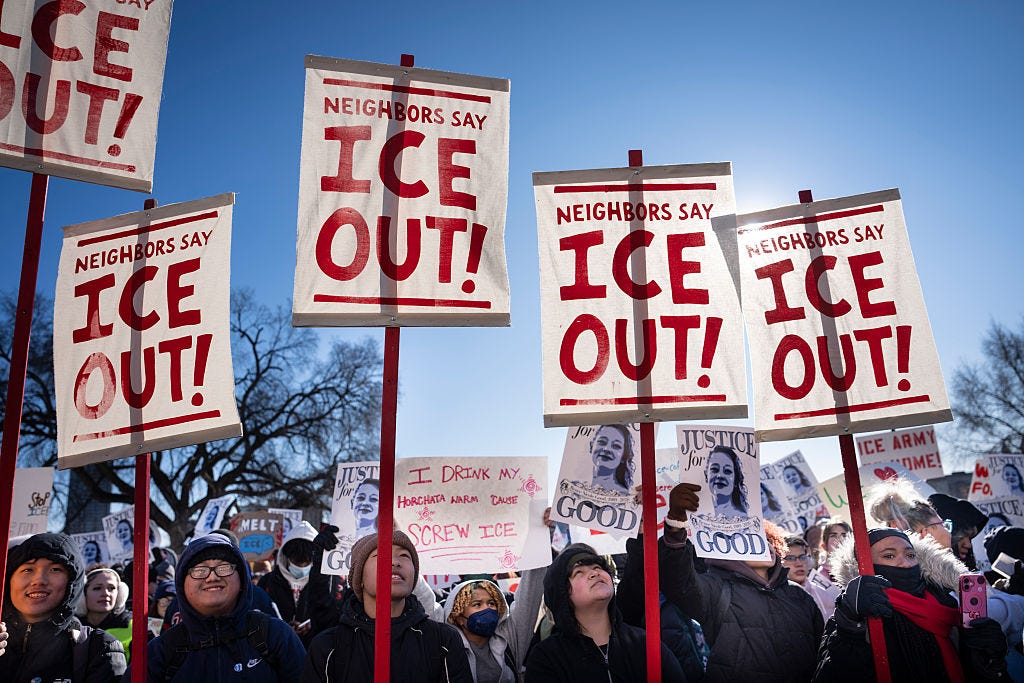
Today, that story is the Immigration and Customs Enforcement (ICE) takeover of Minneapolis and greater Minnesota. My home.
EDIT: Resources to support Minnesotans moved from lower in the piece up here to the top. Please look through these links and consider donating before reading the rest of this essay.
Resources and ways to support Minnesotans
There are tons of folks on the ground in the Twin Cities working hard to help their neighbors. Through my own research and suggestions from my parents, I’ve compiled a list of places to donate and/or take action on behalf of Minnesotans:
Stand With Minnesota has compiled a comprehensive list of mutual aid, rent relief, diaper funds, and more that you can directly donate to.
The Minnesota Immigrant Rights Action Committee (MIRAC) and TC Food Justice are collecting and delivering food for people too afraid to leave their homes. Donate or volunteer with TC Food Justice here. Donate to MIRAC here.
Unidos MN has a thorough “know your rights” resource walking through a number of situations, i.e. if ICE shows up at your home or workplace, if you’re detained by the police, what documents to carry, etc.
Donate money, food, or your volunteer time to Joyce Uptown Food Shelf. (Thank you for this suggestion.)
The Immigrant Law Center is offering legal support to countless people detained by ICE in Minnesota—you can donate here.
Mutual aid / GoFundMe for specific families impacted by ICE activity: for the Ponce family; for Sing and family; for a Minnesota family of nine; for Christian Rivera and family; for Donaldo’s family; for Zurzya Sanchez’s family; for Karla Lopez’s family; for Josefina and Gabriel; for a friend of my friend’s husband who was detained; for a local family separated by ICE; for a family of four unable to work; for Gilberto Avillar’s family; for Jairo Pitalasig’s family; for a family whose young cousin was detained; for a group of seven local affected families; for ChongLy Scott Thao’s family; for Milton, who needs to access his medication for ankylosing spondylitis; and for Nouland, a veteran who had a stroke after being assaulted by ICE.
Support local Minnesota news outlets who have been tirelessly reporting on ICE activity:
MinnPost (my former employer, shout out!)
MSP Magazine (especially this article with tons of resources and other places to donate)

Hopefully you’ve donated to one of the funds above (thank you!). Now, I want to tell you a story about authoritarianism and what it means when we as a country fail to metabolize our own recent history.
A brief list of my Minnesota credentials
I was born in Saint Paul, MN and lived in the western suburbs for 19 years until I moved to Chicago for college and then DC for work.
I grew up less than a mile from where Derek Chauvin lived. Yes, that guy.
I stayed at my parents’ house for a few months during the pandemic, which put me there during the George Floyd protests in 2020.
Earlier in my career, I was one of Minnesota’s two full-time congressional reporters at the time, working as Washington Correspondent for MinnPost, a small but mighty Minnesota news outlet.
As I write this, I’m wearing my grandpa’s old sweatshirt from the Twins’ ‘91 World Series win. If you know, you know.
I say all this because as much as I sometimes “pass” as a DC person, Minnesota has my heart in a way I can’t fully explain.
And Minnesota is hurting right now.
The state is occupied by ICE as you read this. People are being detained, families disrupted, neighborhoods put on edge. Renee Nicole Macklin Good was shot and killed in cold blood. Earlier this week, ICE agents pulled a U.S. citizen from his home into below-zero temps in nothing but a pair of shorts.
And Minnesotans—especially folks in Minneapolis—are fighting back.
From the outside, this may look surprising. Minnesota is flyover country, after all. “Minnesota Nice.” Lakes and lutefisk and loons. A state that’s mostly white. Why would people here care so much about federal agents “doing their jobs?”
I understand where people get that impression. But if there’s one thing I can tell you about Minnesotans, it’s this:
Nobody—and I mean nobody—fucks with our neighbors.
For a more specific example of this sentiment, I’ll quote in their recent piece:
People in Minneapolis have been leading Know Your Rights trainings to packed rooms for months and distributing thousands of whistles. People in Minneapolis are denying ICE access into their businesses and restaurants. People are walking out in droves from their high schools for days of protests. People in Minneapolis are feeding each other and finding ways to pay for each others’ rent, rides, and supplies. After ICE shot another person in North Minneapolis on January 14th, hundreds of responders arrived and pushed ICE out of the community – so quickly that they left their vehicles. The SUVs were smashed open to reveal operation intelligence, phone numbers, and IDs. People have taken it upon themselves to do what even their liberal governments are refusing to do for them due to an allegiance to respectability or the status quo.
We’ve been here before
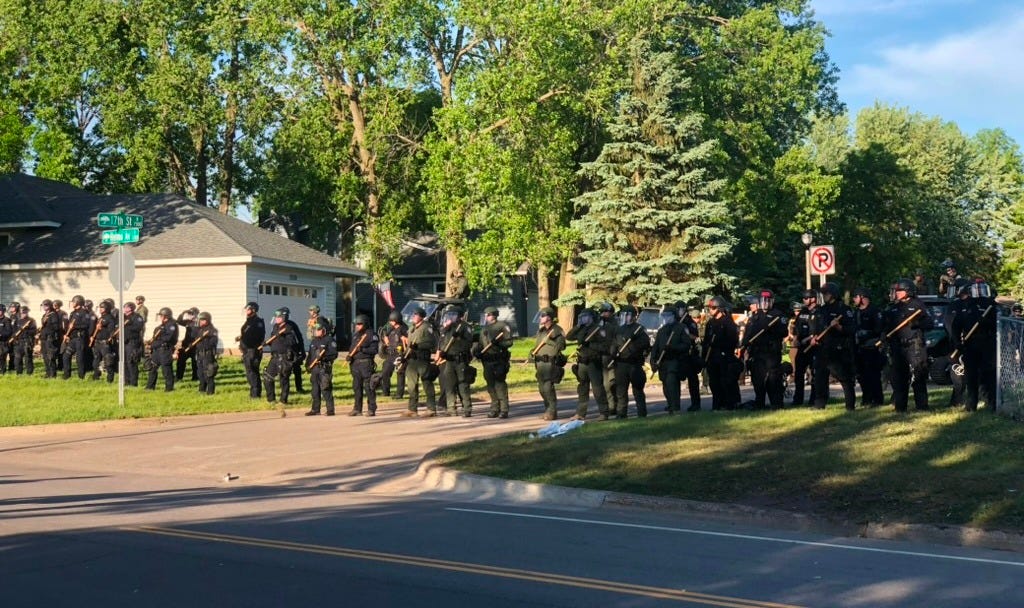
I was in Minneapolis during the George Floyd protests, watching my city erupt in grief and rage. And less than a year later, I was reporting from the U.S. Capitol on January 6, watching another crowd insist on a different version of reality.
Those moments did not feel the same. They were not morally equivalent. But they were connected.
What connects them—and what connects them to what’s happening in Minneapolis now—is not disorder, but power. Specifically: what happens when white supremacy is challenged in one place and reasserts itself in another; when accountability feels imminent and is then deferred; when force becomes the language of last resort.
Our country—or, at the very least, its leaders—never fully metabolized either moment.
Instead, pundits argued about optics. About property. About “both sides.” We rushed toward narrative comfort instead of sitting with what these ruptures were actually showing us.
And when history isn’t metabolized, it comes back altered, escalated, and harder to contain.
Watching ICE move through Minneapolis now doesn’t feel like a new story. It just feels like the next chapter in our ever-expanding section of the next generation’s history lessons on authoritarianism.
Learn from folks on the ground in Minneapolis
As much as I claim Minnesota as my home, I’m not physically there right now. But many folks on Substack are. I’ve highlighted a few below, but please add more in the comments if you’ve come across them.
wrote this touching piece on how ICE has disrupted even the small, human interactions Minnesotans have every day.
provided a snapshot of what it’s like living in Minneapolis right now.
posted a lovely ode to Minnesota.
provides helpful updates for the western suburbs of the Twin Cities.
If you’re in the mood for some lighter content, wrote about some of the things he loves about Minnesota.
If you have any other resources or essays to add, please link them in the comments. Thanks for reading.
And, as always, let’s get through this together.
xoxo Ashley
Comments
Nothing yet. Say the first thing.
Sign in to join the conversation.