
I haven’t been able to stop thinking about this book.
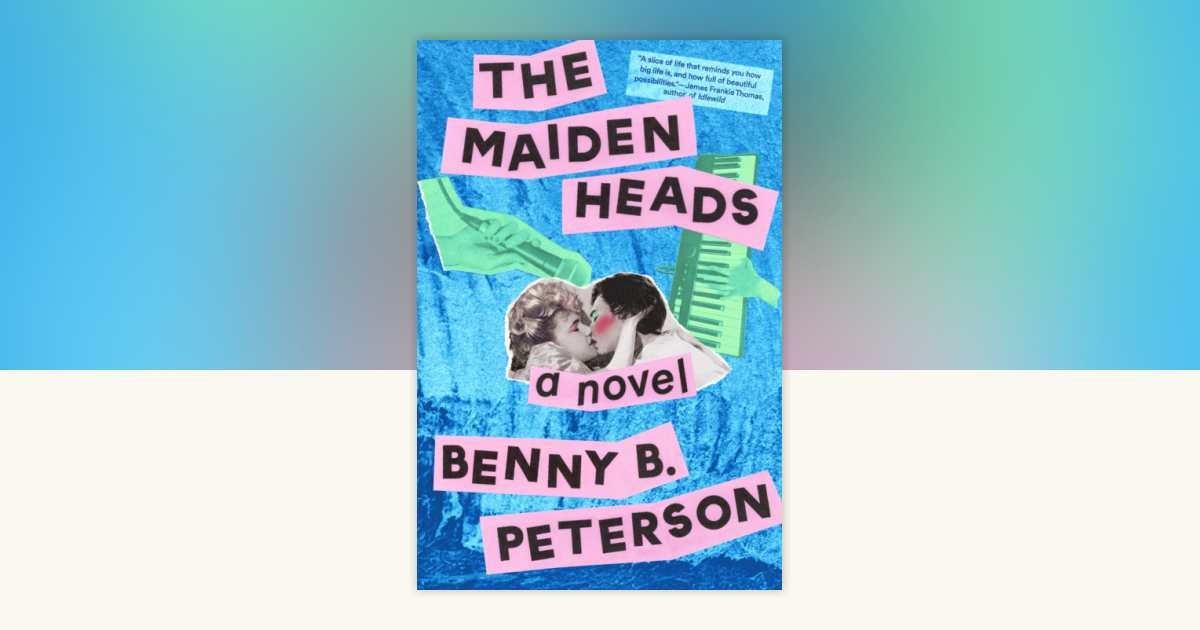
THE MAIDENHEADS is a visceral, deeply emotional story of queer heartbreak, obsession, and the life-altering lengths two people will go to for their fledgling indie rock band. It’s a book about music and mess, yes—but also about gender, the stories we tell ourselves about who we are, and what happens when your identity becomes irrevocably intertwined with someone who doesn’t have your best interests at heart.
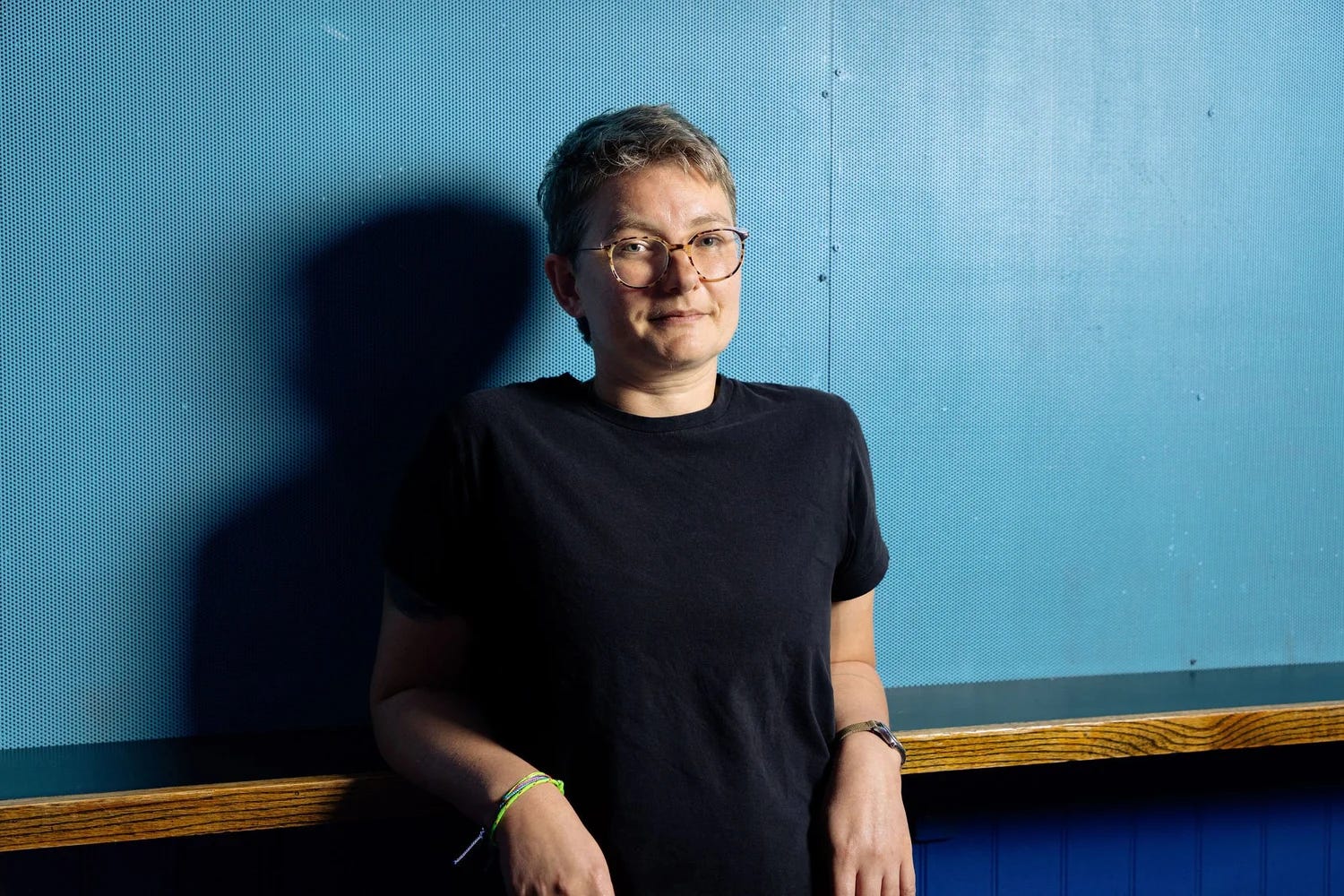
THE MAIDENHEADS, Benny B. Peterson’s debut novel, is out a week from today (preorder it here!). But Benny kindly sent me an early proof, so on an unseasonably warm April afternoon, I sat down with them at a cafe just outside of D.C. to talk about the book.
I’d left the last couple of chapters of the book for that morning because I wanted to go into the interview while still in that mode of living in the story. I’m really glad I made that choice—getting to ask questions of an author immediately after you finish their book is one of the more surreal literary experiences I’ve had.
Our conversation went all over the place, spanning from Benny’s writing process to gender expression in fiction, and of course to the complicated, painfully relatable characters at the book’s center.
HYPER/FIXATED is a reader-supported publication. To receive new posts and support my work, consider becoming a free or paid subscriber.
When a person becomes your hyperfixation
Because this is HYPER/FIXATED, I couldn’t stop circling the question of obsession while I was reading. THE MAIDENHEADS is full of the kinds of fixations that reorder one’s life: the main character, Jamie, obsesses endlessly over her one-that-got-away ex girlfriend Mari. Jamie also fixates on her gender and sexuality, on music, and on her old band, The Maidenheads.
At one point in our conversation, I mentioned to Benny that there’s a sort of love triangle going on in the book: Jamie’s hyperfixation is Mari, but Mari’s hyperfixation is music. Mari knows she can only make her best music with Jamie. They’re in love with each other, sure, but Mari will hurt Jamie if it means she can continue to push her music career forward.
Once you see the book through that lens, you can’t unsee it. For Jamie, Mari is both a first love AND the proof that Jamie is a musician at all. Jamie doesn’t believe in her own voice without Mari there to witness it. When their relationship implodes, she doesn’t just lose the girl, she loses the version of herself who makes music. She stops singing. She builds a life that looks, from the outside, as far from the chaos of indie rock as possible.
Mari, meanwhile, is orbiting something different. She cares deeply about Jamie, but the fixed point in her universe is the music. The band is Mari’s true north, the thing she’s willing to burn everything (and everyone) else for. Everyone who chooses to stay in her life has to understand that and build armor around their softer parts.
That asymmetry is part of what makes their relationship feel so feral and so familiar. Jamie is fixated on a person; Mari is fixated on an art form. Between them sits the band itself, the third presence in their love story. It’s the gravitational field that keeps dragging them back toward each other, long after it would be reasonable for both of them to walk away.
Reading it, I kept thinking about my own history with people I both loved and hated, the ones who rewired my brain so thoroughly that even years later I’m half-worried about what would happen if I ran into them on the street. THE MAIDENHEADS understands that pull. It’s not interested in pathologizing it so much as asking what happens when you finally recognize that your hyperfixation can’t love you back in the way you need—and what else might be possible for you on the other side of that realization.
That’s as far as I’ll go into the book’s plot for fear of spoilers! Since I had the opportunity to chat with Benny about the book and their writing process—and because I know many of my readers are aspiring authors themselves—the rest of this piece will be about Benny’s writing process and author life.
First-person narration can let a character’s gender stay complicated
One of the first things I confessed to Benny during our interview was how much I’d been turning over the book’s treatment of gender—especially the narrator Jamie’s.
All through my read, I was clocking the ways Jamie’s body felt foreign to her, the way she fit and didn’t fit in the roles other people projected onto her. But I realized I’d blown past a basic question.
When I finally asked Benny about Jamie’s pronouns, I admitted that I’d read her as “she” the whole time.
Benny told me they hadn’t been consciously strategizing pronoun-avoidance, but that the book’s close first person did something interesting on its own: it made room for Jamie’s gender to stay unresolved within the confines of the story.
In first person, Benny said, we don’t have the same instant, externalizing clarity we get from a third-person “she” or “he.” The character is “I,” which lets them exist in a more complex space than a single pronoun might allow. Within the timeline of the book, Jamie hasn’t yet encountered language that would help her see other possibilities for herself. The story is set in 2012, when even many queer and trans adults didn’t yet have cultural access to “they/them” as a real option, let alone a teenager outside of major urban queer hubs.
“I do think there's an interesting way that first person can conceal gender, so we don't have a clear sense of someone's gender when we're reading in first person. I did not write that way on purpose, but I did like the fluidity that it created for the character … The binary-ness of the English language makes pronoun choices much more complicated than they would be if there were a true neutral third person pronoun, as there is in other languages.” - Benny B. Peterson
Benny thinks of Jamie as someone whose gender is “complicated in ways she doesn’t have the language to express yet.” They also acknowledged that with Jamie in high school in the early 2000s, she likely would not have been exposed to the type of identity language that is so available to us today.
In other words: the ambiguity we feel as readers is faithful to where Jamie is in her own understanding of gender.
Anyone who has read THE PAIRING by Casey McQuiston may recognize the plot device that first-person narration can be for a character’s “gender reveal,” for lack of a better term.
As a queer woman married to a trans man, I found that this whole conversation (and book) hit very close to home. There is an ongoing negotiation of identity that happens when the world sees you one way—“straight,” “woman,” “normal”—while your interior sense of yourself refuses to sit neatly inside those boxes.
“Coming out” as an author
Benny and I shared a laugh about where our venn diagrams intersect: We are both “former” journalists (can’t take the fight out of the dog, etc.) who have become fiction writers. But while I have been determined to document my fiction journey and “try in public,” Benny took the opposite approach.
“For years I was just continually writing novels for myself,” they told me. This practice of writing in secret may have inspired some of Jamie’s characteristics in the book, too: “I love the idea of writing about someone who doesn’t view themself as an artist anymore, but had in the past … I find the sense of artistic failure or giving up interesting because it’s something I thought about a lot as a writer: Would anyone care?”
After writing in private for so long, Benny eventually had to be more public about it if they wanted their novel to be published. They framed this process as reminiscent of coming out as queer: “I had this private identity [as an author] that I sort of indulged in in secret … but then like all things, when you put it out in the open, it becomes more real sometimes than you’re even ready for it to become … That’s been true with every aspect of my transition, coming out as queer, publishing a book. Suddenly it’s on the outside and people are allowed to react.”
Benny and I agreed that hearing criticism for our journalism felt like nothing compared to any critiques of our fiction writing. It’s just much more personal, like you’re baring your soul for the world to see. If you’re new to the fiction world (or even if you’re a veteran), rest assured that published authors feel this way as well, though it does get easier with time.
HYPER/FIXATED is a reader-supported publication. To receive new posts and support my work, consider becoming a free or paid subscriber.
Art that knows you before you know yourself
Near the end of our conversation, I asked Benny a nosey question: Did writing this book—where a character struggles with and explores their gender identity—help you realize you were trans?
“I feel really strongly that there's something kind of magical about writing fiction and imagining imaginary characters and creating worlds that come out of our subconscious,” Benny said. “And I think it is frequently true—it certainly has been true often for me—that I'm imagining things based on deep desires that I've not fully admitted to yet. That was definitely the case with this book.”
Damn, I replied. Well said. [I’m really eloquent]
Benny went on to clarify that it wasn’t as if they wrote the book, read it back, and were like, ‘Oh, I must be trans.’ But when they look back at their work now, it’s obvious their fictional preoccupations—gender, bodies, the uneasiness of being perceived as a woman when that identity doesn’t feel right—were ahead of their conscious self-understanding.
THE MAIDENHEADS is not autobiographical, but the act of writing it seems to have opened a door. Benny sold the book the same week they started testosterone, a coincidence that feels almost too on-the-nose to be true.
I keep thinking about that convergence: a first novel about a character who doesn’t yet have the language for herself, published into a world where its author is finally living in language and a body that fits them. A story about a musician who stopped making art for ten years and has to find her way back. A writer who spent decades working privately on novels no one saw, then emerged to have a major publisher preempt the book.
As someone in the messy middle of my own debut journey, this is maybe my favorite thing about THE MAIDENHEADS: it’s a book about what happens when you can’t yet fully name who you are, but your obsessions keep dragging you toward the truth anyway.
THE MAIDENHEADS is out now. If you’re a queer person who’s ever stayed too long in a bad situation because the music was good, if you’ve ever felt like your body belongs more to other people’s expectations than to you, or if you’ve ever loved someone who both ruined and saved your life, I have a hunch you’ll be just as HYPER/FIXATED on this book as I am.
Comments
Nothing yet. Say the first thing.
Sign in to join the conversation.